Beware! This is what the vote will do to husbands. Four cards from a strange 1909 anti-suffrage series.
Today, we’re looking at four rare postcards from a twelve-card series published by the Dunston-Weiler Lithograph Company of New York in 1909. The complete set buffoons the women’s suffrage movement through role-reversal cartoons depicting men holding babies and scrubbing on washboards. The popular message was that women would be turned masculine, greedy, uncaring, and unfaithful once given the vote. Our grouping includes card numbers 1, 3, 4, and 10. The most emblematic is Suffragette Madonna, which has been the focus of substantial scholarship.
Each card colorfully illustrates the presumed ill-effects of role reversal in a domestic or civic scene. Men feed infants, wash clothes, or otherwise occupy the era-assigned roles for women. Meanwhile, women take on masculine dress, public authority, and open flirtation.
In the first card, a father poses as a religious icon, complete with laurel leaves and halo, while nursing a baby with a bottle. Another card repeats the theme with a father annoyed by two crying infants. A tiny inset shows his wife commanding a political rally and calling for women to run government. The next card puts a young woman in coveralls under an enormous flopping hat, garments that speak to independence, work, and whimsy unbecoming of a lady. The last card shows a couple mid-embrace, with a headline suggesting sexual favors as an easy vote-getting behavior.
Across all four postcards, the palette includes saturated reds, blues, and golds, with exaggerated Edwardian dress rendered in the exacting art of lithographic printing. Though intentionally brusque, the cards were considered beautiful and humorous for obvious and covert reasons. Captions run along the bottom border in bold sans-serif type, and do as much comic work as the illustrations themselves.
All four cards are chromolithographs published by the Dunston-Weiler Lithograph Company of New York, copyrighted 1909. Three of these cards carry a gold-toned outer border created with the bronzing technique described in Gilded Goods. The fourth uses a plain blue-ruled border with no metallic finish. Each card includes a series number, a title band, and a copyright line naming the publisher.
These cards are unused and uncancelled, double-matted and handsomely framed, with only minor softening of corners. Each card alone is considered rare and small sets in presentation format are uncommon in the marketplace. Several complete sets are held in public and private collections. Catherine Palczewski’s 2005 academic essay in Quarterly Journal of Speech increases demand and value for these items compared to similar postcards of the era.
Subject, scarcity, provenance, and condition are the top variables that govern the market value for vintage postcards, but serious academic attention changes the equation. Once Palczewski examined this set and published an article, they went from cultural detritus to a documented contribution to the historical record. Palczewski identified the visual tropes (a male Madonna and feminized Uncle Sam), connected them to the verbal rhetoric of the anti-suffrage movement, and lent theory and vocabulary for later researchers and collectors to better interpret the materials.
Provenance, in this instance, is not just about who created or owned an object. It is also about who has looked at it seriously and left notes. A card with a known scholarly citation carries a paper trail that an anonymous postcard never gets. It brings it out of obscurity and into a realm of the studied object. From there, new analysis has a footing and further creative work may be inspired, too.
None of this changes the material object, a piece of lithographed cardstock, printed and mailed for a penny in 1909. What scholarship changes is the frame around it and what we can make of it today. Out of the thousands of anti-suffrage postcards produced in that era, these ones are still worth examining more than a century later.
To Read More
Palczewski, Catherine H., “The Male Madonna And The Feminine Uncle Sam: Visual Argument, Icons, and Ideographs in 1909 Anti-Woman Suffrage Postcards” (2005). https://scholarworks.uni.edu/facpub/2905
Catherine H. Palczewski Postcard Archive, at the University of Northern Iowa, includes a dedicated Dunston-Weiler section with most of the twelve cards digitized front and back.
Votes & Petticoats, at the Sheridan Libraries of Johns Hopkins University, features a curated exhibit of anti-suffrage postcard sets.
A Purrrrfect Political Storm, JSTOR Daily’s essay on the cat-and-dog symbolism running through related anti-suffrage postcards.
Today we’re looking at a group of twenty opulent floral postcards from the early 1900s. Botanical illustrations (roses, poppies, carnations, tulips, violets, cornflowers, hydrangeas, and gladiolus) are printed on rich metallic backgrounds.
Though these cards are not a matching set, they are of an era. At the time they were made, a rising middle class was creating new demand for affordable luxury items like fine papers, engraved calling cards, gilt-edged books, and gilded picture frames. Even a small amount of shiny detail on a penny postcard made it special.
Of the great many decorative and floral postcards, these ones do show their age. They were more common than their appearance suggest, and the luster that commanded so much attention a century ago has faded. The corners are softened or torn, and the writing is obscured. The background color itself is mottled, scratched, and often reveals an impression of the stamp or cancellation on the reverse. One card has developed a cloudy bloom across the front, just as verdigris slowly encroaches on the hue and texture of copper.
Meant to appear as gold, the metallic substance used was actually bronze powder, which tarnishes, rubs off, and browns with age. Printers were still experimenting with the best approach to reflective ink. As we’ll see, this wasn’t it.
Print shops called this process bronzing. A lithographer first ran the sheet through the press, using a sticky varnish where the shiny effect was wanted. While the varnish stayed tacky, a worker daubed the sheet with fine metal powder. The powder adhered to the wet varnish and fell away from the dry paper around it. A soft brush removed the excess. In the legendary 1880 trade manual, The Grammar of Lithography, bronzing is described among a series of finishing techniques done after the main color printing was complete. The process required a steady hand and a practiced eye. Too little powder left the image looking thin and patchy, and the loose metal dust was a known respiratory contaminant in the print shop.
Bronzing was a specialty trade but it wasn’t particularly rare. In the Heinrich Steinberg printing supply catalog, bronzing ink was offered to lithographers and letterpress printers as a stock item, sold as one option among many inks and materials a working print shop would order regularly. Bronzing was a routine commercial finish, sold as a fancy extra.
Chemists worked on a better recipe for decades. A 1922 German patent described a new formula for mixing metals into lacquer inks. When metallic elements (most often copper and zinc) are added, they lock into a harder, more water-resistant film that oxidize in the air and leaves a slick surface as the ink dries. However, the oxidation that stabilized the lacquer ink is the same process that tarnished the metallic additives. The finely ground metal flakes keep reacting with the oxygen, even over a century.
This cornflower card shows the die-stamped details that give the petals a sculpted, three-dimensional texture. Embossing is a mechanical process done by pressing the card stock between engraved metal plates. Print shops often combined bronzing and embossing for extra visual weight, further pushing a commercial mechanical process to produce an object appreciated for its artistry.
Victorian and Edwardian greetings commonly carried rhymed text, including references to well-known verses. Robert Herrick’s 1648 poem To the Virgins, to Make Much of Time begins with the line, “Gather ye rosebuds while ye may…” and “In the desert a fountain is springing…” is adapted from Lord Byron’s 1816 poem Stanzas to Augusta with one word changed. In that era, card publishers borrowed freely, rarely credited the poets, and also employed their own writers to produce the florid messages alongside each bouquet.
The Victorian language of flowers, or floriography, assigned a specific sentiment to each bloom. Violets stood for modesty. Roses meant love, more devoted as the color deepened. A sender might choose a card’s flower to express a tender sentiment, though mailing it as a postcard was no secret. Readers of the period were expected to recognize and decode those meanings inside a new middle-class code of conduct. Sending the right card with the right flower and verse reflected the rules of polite society.
Though bent and tarnished, these postcards are no less charming more than a hundred years later. Some of the shimmer is still there, but the smoky ochre slowly replacing it has its own sort of visual value.
To Read More
The Grammar of Lithography — W. D. Richmond’s 1880 trade manual for commercial lithographers, covering the era’s bronzing, gilding, and dusting techniques.
Bronze powder — A materials-science entry from the Museum of Fine Arts, Boston, explaining what bronze powder is and why it discolors over time.
Water-Soluble Oil and Lacquer Paints — A 1922 German patent describing how sulfur, phosphorus, or selenium additives were used to stabilize oil and lacquer paints through oxidation.
The Secret Life of Victorian Cards — The Ephemera Society of America on how greeting cards helped enforce middle-class codes of conduct in the Victorian era.
Imagine all the reasons a man might vanish. Illness, catastrophe, bad deeds. Did our man Navarro step into the volcano itself? The less we know, the more his story unfolds.
In the early 1940s, Frida Kahlo was painting in the blue house in Coyoacán, building a self-image out of indigenous dress, pre-Columbian imagery, and a dramatic interiority of devotion and suffering. A few miles from there, tourists floated around the Xochimilco canals, waiting to have their photos taken aboard the flower boats.
In 1943, on those same canals, Emilio Fernández was filming María Candelaria starring Dolores Del Rio with the cinematographer Gabriel Figueroa. The film would win the Palme d’Or that year and launch the golden age of Mexican cinema with a story that revered the nation’s indigenous origins.
André Breton had come and gone, calling Mexico the most surrealist country in the world. The Louvre bought a work by Kahlo, an unprecedented purchase for the artist and also for its political prowess. The exiled Trotsky was an honored guest, at Diego Rivera’s request. President Lázaro Cárdenas had nationalized the oil industries and redistributed land, putting the state in the middle of an global argument with communism on one side and capitalism on the other. Then Mexico and the United States became WWII allies, and the floes of attention and resources became even more complicated.
Despite the war, Paricutín’s spectacular smoke clouds commanded global coverage. Life sent photographers. Newsreels carried the footage everywhere. Pan American detoured its flights so passengers could see the new volcano from the air.
Navarro passed quietly through it all, camera in hand, one day taking pictures of modernist architecture rising in glass and concrete, and the next documenting the earth itself splitting open in a cornfield.
Navarro pointed his lens at the same indigenous Mexico in the same moment, with the same seriousness. Kahlo’s name and artwork is now symbolic of her culture and synonymous with her city. Navarro vanished entirely, except for one folder in someone else’s archive in Washington, DC.
I exited the Green Line at L’Enfant station, passed quickly through security screening, got a visitor’s badge, and was escorted to the third floor by everyone’s secret best friend, the staff archivist. My bag checked into a locker, and with only my phone, paper, and a pencil, I entered the glass-walled room. Two other researchers had their places set out. My cart of materials was waiting for me near a sunny window with a view onto the leafy street below.
The cart held five Smithsonian manuscript boxes from the William F. Foshag Papers. Careful preparation had led me to order several boxes before and after Box 9. Correspondence was alphabetical, so I asked for the N folders. I also wanted to look through a large sample of images from other photographers, including Bill Foshag and his Mexican collaborators, mostly fellow mineralogists.
To summarize, these guys were into rocks and attribution. Most of the letters contained precise language about the rock samples collected, observed, and lent out by the Smithsonian under Foshag’s direction. Also, who should get credit, and thus funding and the opportunity to travel for further study. Foshag was an administrator by title, but his personal photos and travels in the Southern Hemisphere tell the story of an adventurous life.
Regarding Paricutín, Ambassador George S. Messersmith wrote to the Secretary of State on March 10, 1943, with the story that would later become the official news report and the synopsis we know now. A Tarascan farmer plowing his field saw smoke coming from a furrow, then a wall of molten lava rose a hundred feet high. The Mexican government bought the land and charged spectators twenty-five centavos to fund a new highway, eventually issuing the commemorative stamp that is fortuitously fixed on the back on one of Navarro’s postcards. Quite a clue, and an indelible time marker.
In his memo, the ambassador notes that pictures, movies, and stills are being taken and will be transmitted in due course. Later, pages of Foshag correspondence lament the poor condition of the only moving images, a short film documentary was made of the volcanic eruption but had not survived the reproduction process at home.
In early March, the Office of Naval Intelligence sent an attaché to Uruapan, who drove the rough road out to the volcano and reported back in detail. A camp had sprung up at a distance from the cone, which had to be moved several times in the early weeks. Lava advanced sixteen meters per hour, he calculated. Then, this line that now sounds like an outright lie: no photographer was seen, either in the day or at night.
A Smithsonian paleontologist drove down with two colleagues in June. His field narrative is almost literary, describing lava of “the consistency of stiff molasses,” and “the birth agonies of a new flow.” In closing, he remarked that they had been one of the fortunate few to witness the travail and anguish of one night in Paricutín’s life. The sole, spare, irrefutable fact we know is that Navarro was there, too.
The United States Committee for the Study of Paricutin Volcano tracked every project and every dollar, in order to report in triplicate to their funders at the U.S. Geological Survey, the State Department, and the Geological Society of America. For example, Celedonio Gutiérrez, a local man, was paid sixty pesos a week, later raised to eighty-five, to maintain the camp and keep the record. How did Celedonio miss Navarro?
The committee’s annual reports name every paper published: Krauskopf on eruption mechanics, Barnes and Romberg on gravity determinations, the Foshag-González history of the first two years, and the photographic record being prepared for the National Archives. It is the very same meticulously catalogued photographic record I was thumbing through that day.
Next, I opened a leather-bound album of careful black-and-white prints entitled, Photographs of Paricutin Volcano taken during the first three years of its activity. Selected from the Collection of Ezequiel Ordóñez.
Ordóñez was the dean of Mexican geology. The album was assembled and presented through the official Mexican research-coordination commission. A named, curated, institutional photographic record of Mexican origin to match the Foshag record. The credited gaze of two nations, on two sides of a border, doing the same careful work of attribution.
Finally I opened Folder 7, still fairly crisp tan cardstock with a tab hand-lettered in pencil. Only a surname, a question mark, and the content label: Navarro, ? Photographs of Paricutín, 1943–1944.
Inside, a stack of black-and-white prints in clear archival sleeves. The top print was instantly recognizable as Navarro, though I hadn’t seen it before. A great dark eruption column rising over the cone, a small bare tree silhouetted in the foreground, and the tiny block letters NAVARRO FOT. just legible at the lower right. The stack included twenty photos altogether, only five overlapping with mine.
Navarro seems to have worked exclusively in Kodak Mexicana materials. All of his cards are stamped with the EKC indicia, which was standard professional postcard stock of the day. He was not a hobbyist with a box camera, but more likely a commercial photographer running a business. Most of the scientific images in other folders were printed on regular photo paper, probably by means of institutional production houses. Navarro was printing locally, the same inky contrasts of a real photo, but with the variable frames and exposures found onsite.
We know his territory was wider than the volcano by virtue of the Hotel Virrey de Mendoza in Morelia and the unidentified sanatorium presumed to be in Uruapan. Draw lines between Morelia, Uruapan, and the volcano and you get the tight triangle of a working photographer’s range, anchored east in the state capital and west in the lava.
The most critical contrast between Navarro’s images and the scientific record are the visual content of the images themselves. Bless them, the scientists pointed the camera at the ground, caught the low refractions of an entirely static rock, and labeled it. Navarro captured a nation’s indigenous and religious history being consumed back into the earth.
The Fototeca Nacional del INAH holds regional negatives and studio collections that have never been digitized. The municipal archives in Morelia might have kept studio registrations and business permits from the 1940s. There are other archives to visit like Biblioteca Michoacana, and a few private collections now held at university libraries like Princeton. Occasionally, there are still Navarro cards for sale on eBay. Kodak has extensive business archives that could shed light on the places and people involved in the burgeoning photo film industry far south of Rochester, NY.
The glass-walled sanatorium may belong to the wave of modernist health architecture built under Mexico’s 1942 National Hospital Plan, all the transparency, light, and air needed for the treatment of tuberculosis. Tracing his actual footsteps to that building might place Navarro on a specific hillside or with a known client. Or, it might lead to a pile of rubble.
Some answers are not in any archive. Perhaps they are with a family in Morelia who remember a grandfather with a camera and a tall tale of a fire-breathing dragon emerging from the earth. His picture-proofs held an the old leather bound album that gets passed around at a kitchen table alongside stories that were never written down.
In one of the boxes, I found a small black-and-white photograph of a Purépecha family, four women and three men, seated and standing on a wooden porch in San Juan Parangaricutiro. Pressed above the photograph on an onionskin slip was a handwritten caption from Jenaro González.
A typical Tarascan family, photographed at their home. Aurora Cuaro, lower left. One of the few people in history who have attended the birth of a volcano. A very intelligent woman, one of our best and most reliable sources of information.
A second photograph in the folder showed Aurora alone, standing in front of a wooden building in a white blouse and a long embroidered skirt, smiling straight at the camera. My photo of the photo is terrible, but you can still see her. Clear-eyed. At ease.
Aurora Cuaro lived inside the eruption. It happened in her cornfield, her parish, her sky. Foshag and González knew this and credited her, in writing, by name.
What the archive does not hold is what she knew. The Purépecha had lived in this volcanic landscape for centuries, and they had ways of reading the ground that did not begin in February 1943 and did not end when Paricutín went dormant in 1952. Aurora and her neighbors brought a lived intelligence of their own to the encounter with the era. This is the deeper kind of absence. Undoubtedly, the Cuaro family knew Navarro.
We will probably never know his first name or see his face. I once thought I had a photograph of him, and it turned out to be a man with surveying equipment, not a camera. Was he born in Michoacán or came from somewhere else? Was he twenty-five or fifty in 1943? What did he know of Frida Kahlo, and what did he think about war? After all this time, where is Navarro now?
Dionicio Pulido, the farmer whose cornfield erupted, and whose face will never be forgotten.
With special thanks to the staff of the Smithsonian Institution Archives.
A stash of Petley postcards shows Arizona at its mid-century most.
Bob Petley launched Petley Studios in 1945 with twelve comic postcards. Then, he spent the next four decades photographing the mid-century Southwest from behind a windshield. As I catalogue our Arizona collection, it seems every other card is a Petley production.
Bob Petley was born in 1912 in Akron, Ohio. His father developed products for Goodrich Tire and Rubber, including an early balloon tire. Bob drew posters, threw javelin, and boxed. Arthritis brought him to Arizona in 1943. He took a job in display advertising at the Arizona Republic and left it two years later. In 1945, with wartime travel restrictions lifting, he launched Petley Studios, Inc. from his home.
The first cards sold fast, and Petley had wanderlust. He loaded a station wagon with camera equipment and stopped at hotels, restaurants, motor lodges, civic buildings, desert overlooks, and canyon rims. He met people and made deals along the way. He later traded the wagon for a Lincoln Continental, but the method stayed the same: one man, a camera, every road in Arizona.
Petley Studios and mid-century Arizona grew up together. Bob started shooting in 1945. Over the next four decades, Arizona’s population tripled. New hotels opened in Phoenix and Scottsdale. Civic buildings went up in Tucson. Motor courts lined the highway approaches to every city. Petley photographed all of it. At its peak, the company sold more than 25,000,000 cards annually through roughly 3,500 dealers across Arizona, New Mexico, West Texas, southwestern Colorado, and eastern California. The catalog reached more than 1,100 known designs for Arizona alone.
Petley was the first postcard publisher to use a Kodak Kodachrome negative for production. Those burnt oranges, deep turquoises, and brilliant blues are not retouched. Kodachrome produced them. A Petley scenic held next to a competing card from the same decade is warmer and more saturated.
The small set here is just the beginning of the sorting and sifting ahead. It’s a short stack by Arizona city. Indian Pipe Cactus National Monument visitor center shows a a flat-roofed brick federal building with breeze-block detailing and 1960s cars in the lot. A Tucson pool scene with the saturated horizontals of a resort afternoon. A Slo-Motion golf cart, straight from the promotional playbook of Sunbelt leisure culture. Hotels, restaurants, and scenic views fill the rest.
Petley sold the business in 1984. He died in Scottsdale in 2006 at 93. Several of his original comic cards are now in the permanent collection of the Smithsonian Institution. Individual cards regularly trade for their enduring content and collectible nature, but no single institution holds a comprehensive set. In 1994, the Tucson Post Card Exchange Club arrived at just over 160 designs, but never the definitive collection.
Petley Studios catalog at CardCow.com — More than 2,000 catalogued designs, browsable by subject, city, and era; the most comprehensive online reference.
A Hoenisch Portrait of composer Edvard Grieg at Troldhaugen, July 25, 1907. Six weeks after this photograph was made, Edvard Grieg was gone.
The front of the card is a photogravure portrait in deep black and glowing white, printed full bleed with slightly rounded corners on stiff card stock. A man sits outdoors in a wooden chair, holding the lapel of his dark overcoat, loosely arranged to show a full suit, waistcoat, and bowtie. A white hat sits lightly on a head of wild silver hair. His mustache is full, his gaze lifted and distant. He looks content, a man six weeks from death.
Stylized script in the upper left identifies the subject and moment: Dr. Ed. Grieg / Troldhougen 25.7.07. The photographer’s credit in the lower right reads: E. Hoenisch Phat. 1907. The back carries the publisher’s imprint: Breitkopf & Härtel, 51 Great Marlborough Street London W. A stamp box reads Printed in Germany. The card is unposted and unwritten, with amber flocking on the reverse and damage to the lower left corner.
The photogravure production quality is exceptional, revealing the highlights of Grieg’s white hat and the deep shadows of his coat, detail and dimensionality from century’s old technology. Breitkopf & Härtel were not postcard publishers. They were Grieg’s music publisher, one of the oldest and most prestigious houses in Europe, with Leipzig roots and a London office at the address printed on this card’s back. Their choice of photogravure signals deliberate intent. This is a prestige object, a rare souvenir of a celebrated composer.
Troldhaugen, Troll Hill, sits on a small wooded peninsula jutting into Nordåsvannet, a freshwater lake south of Bergen. Grieg built his pale wooden villa there in 1885, with a panoramic tower and large windows opening onto the water. He called it his best opus so far. By 1891 he had added a small composing hut at the lake’s edge: a piano, a desk, a rocking chair, a view over the water that he described as essential to his work. When he left it for the day he placed a handwritten note on the desk, a humble request.
If anyone should break in here, please leave the musical scores, since they have no value to anyone except Edvard Grieg.
Late July in Bergen is the city’s warmest season, though warm is a relative term. Long northern light persisting until nearly ten at night, the lake surface holding the soft diffuse luminescence of a Bergen summer afternoon.
Nina Grieg, Edvard’s wife and the foremost interpreter of his songs, presided over evenings in the living room around the 1892 Steinway. The house was full that summer. Julius Röntgen was there, the Dutch-German composer who had been Grieg’s closest musical confidant for twenty-four years. Their friendship is exhibited through more than two hundred letters, a deep enough connection that Grieg composed a short piece the previous year titled Sehnsucht nach Julius.
Percy Grainger, twenty-four years old and already an electrifying pianist, had arrived for what would become ten extraordinary days. Grieg had encountered Grainger in London the previous year and noted it in his diary.
I had to become sixty-four years old to hear Norwegian piano music interpreted so understandingly and brilliantly. He breaks new ground for himself, for me, and for Norway.
Ernst Hoenisch was thirty-two years old and already the leading musical photographer in Leipzig. He opened his atelier in 1903, and held the designation Hoffotograf, a court photographer’s appointment conferred by royal warrant. His roster of subjects over the following decades includes masters of musical life: Max Reger, Zoltán Kodály, and a young Kurt Weill.
The publishers Breitkopf & Härtel were also a Leipzig institution. The city’s musical world was compact and interconnected, its photographers, publishers, and performers in continuous orbit around one another. Hoenisch was almost certainly sent through the publisher to document Grieg in his final summer at the home where so much of his music had been written. He arrived into one of the most extraordinary musical gatherings of the era.
From the National Library of Norway Bergen Library Grieg Archives
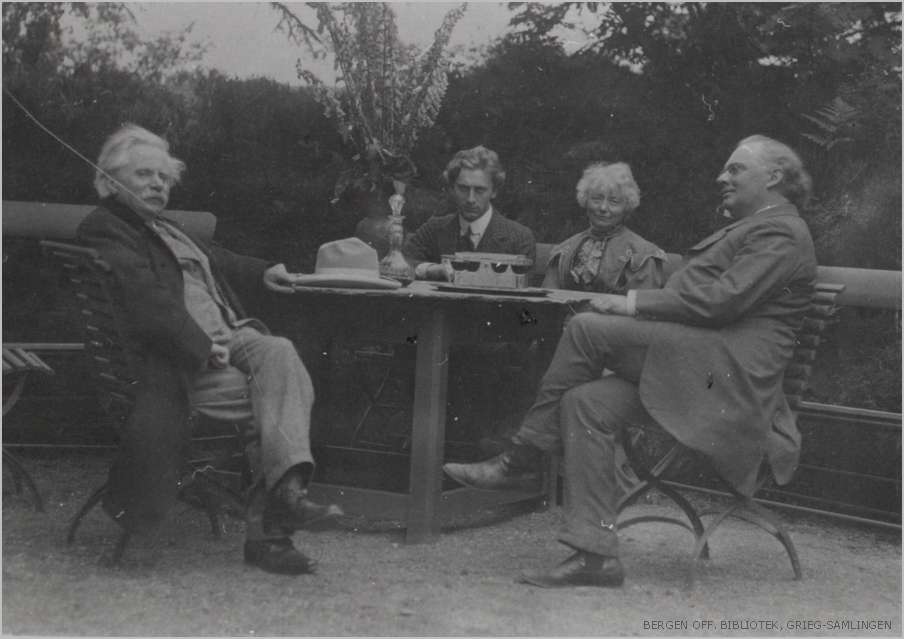
On July 25, that light fell across the garden where Hoenisch set up his camera. Edvard and Nina Grieg, Röntgen, and Grainger gathered at a garden table. An image from the National Library of Norway Bergen Library Grieg Archives captures them together. Grieg is wearing the identical suit, overcoat, and white hat that is visible on our card. Perhaps Hoenisch made the casual group image and then later captured the iconic portrait. A man alone and at rest in the place he loved most, surrounded by the people who understood his music best.
Grieg had been ill for years. A collapsed lung from tuberculosis contracted as a teenager at the Leipzig Conservatory shadowed his entire adult life. By 1907 his condition had deteriorated into combined lung and heart failure, with repeated hospitalizations. When Röntgen said his final farewell at Troldhaugen that summer, he knew they may not meet again.
In September, Grieg prepared to travel to England, where Grainger was to perform his Piano Concerto at the Leeds Festival. He collapsed in Bergen on the way to the ferry, was admitted to hospital, and died the following morning, September 4, 1907. His last words were: Well, if it must be so.
Forty thousand people filled the streets of Bergen for his funeral. His ashes were interred in a grotto in the cliff face above Nordåsvannet, at a spot he had chosen years earlier while fishing with a friend, where the last light of the day touched the rock. Here I want to rest forever, he said.
A fool in full red tunic, tights, and pointed cap riding a half-finished horse. In 1905, Picasso was 23 and in the middle of his Rose Period, when circus performers, acrobats, and jesters were recurring dreams. He saw what the Fool knows, and the rest of us learn along the way.
No one can quite pin down the origin of April Fool’s Day. One theory traces it to the shift from the Julian to the Gregorian calendar in 1582, and New Year’s Day from April 1 to January 1. Those who merrily celebrated the old date were mocked for their foolishness. Other evidence points to the Roman festival of Hilaria at the end of March, when people dressed in disguises and merriment was mandatory. A third argument simply blames the weather. Spring being notoriously unreliable, the fool is the farmer who trusts an early warm day.
Every court kept a fool, the one person licensed to speak the subtext. Under cover of bells and absurdity, they told the king what the courtiers would never. They didn’t matter and slipped away deftly, so they got away with it.
Shakespeare’s fools still deliver their wisdom from the stage. Touchstone sees everyone clearly in As You Like It. Feste in Twelfth Night diagnoses each character’s self-deception with a song. The Fool’s detachment is not ignorance; their folly is not fantasy. It is practical sense and functional freedom. The fool is often the one who tells the full tale as we go.
Let’s not forget all the fun in foolishness. Duckboy Cards gave us these guffaws from Hamilton Montana in the late 20th century.
In the Tarot, the Fool is the zero card, about to step off a cliff with a small satchel. The Fool’s journey is curious, flexible, and nonlinear, akin to the Buddhist beginner’s mind with the great powers of not-knowing.
The disciple Paul wrote that followers were fools for Christ, who knew that worldly measures were the real absurdities. Yurodivye, the holy fool in Russian Orthodox culture, courted ridicule and apparent madness as a form of spiritual freedom.
The Feast of Fools, celebrated across Europe in medieval centuries, inverted the church hierarchy for a day. Junior clergy elected a mock bishop and sacred ritual was gently parodied. The highest were made low for a day. The Church tolerated it for centuries, perhaps because it understood the release it provided.
In each of these traditions, foolishness is not failure. The Fool observes with a keen eye, collects information and assets, plays his cards carefully, and keeps his palm open.
Just such a jester has been riding alongside us this season. In Lucky Us, we find that only a fool pursues luck outright. In Spring Cleaning, earth itself foolishly hopes despite all evidence of winter. In Healing Ward, nurses stringing crepe paper garlands for a room full of wounded men, and show us the beautiful absurdity of insisting on Christmas.
My thanks to you fellow fools who keep reading. Only you know why!
Romans advised that fortune favors the bold. In Sweden, luck never gives, it only lends. In the United States, the harder you work, the luckier you get. The Arabic proverb says, “Throw a lucky man into the sea and he’ll come up with a fish in his mouth.” A Brit might be lucky at cards, unlucky in love. In Japan, the day you decide to act is your lucky day.
Edwardian postcards had a curious set of symbols to call forth fate and fortune. Horseshoes, shamrocks, roses, and playing cards. Small and slightly worn at the edges, these vintage greeting postcards have traveled more than a century carrying a providential wish.
Only one card in the collection actually says Good Luck. The rest offer best wishes, happy hours, and kind thoughts from me to you. As we’ll see, luck is borne of relationships (and circumstances) lifted by the charitable wish for health, wealth, and wisdom.
Some say that luck can be earned, but only a fool pursues it outright. We daydream about what fortunes may be in store, and sometimes ignore the simple sparkles that appear each day. We know, of course, that there are no free lunches. Yet, we are admonished to never look a gift horse in the mouth.
The bold assume they earned their lucky breaks. The humble suspect they’ve borrowed fortune temporarily. The superstitious are not entirely sure we should discuss it. Luck is where fate and intent find common cause, usually in the context of close friendships.
Old English had no luck. It used wyrd instead, which pointed to fate and destiny. Wyrd is the root of our word weird, which may indicate how people felt about fate. It was uncanny, inevitable, and perhaps divine. You didn’t pursue wyrd. You experienced it through awe and fear.
Somewhere around the 15th century, luk and gelucke drifted in from the Dutch and Low German. Luck was looser and more manual. Like weather, luck favored preparation and was possible to influence if you knew the right charms. The horseshoe went up above the door. The rock went in your pocket. If luck is not fate, if it is not fixed in advance, then perhaps you can do something about it. Perhaps it can be courted.
The lucky person is not the one who waits but the one who steps into the room. This is luck as a reward for courage, or at least for motion. Fate deals the cards, and we each have a hand to play.
Fortune favors the bold — fortes fortuna adiuvat ~ Terence, Roman playwright, around 151 BCE
Luck is what happens when preparation meets opportunity, and preparation is something you control. The solo pursuit of fortune is a genuine drive.
The harder I work, the luckier I get. ~ Samuel Goldwyn
But the shamrock gently disagrees. Four-leaf clovers are natural anomalies, not personal achievements. We can’t earn one, only discover it. Even if you can court luck, even if work and boldness can pull it toward you, it is never yours to fully command.
Luck never gives; it only lends. ~ Swedish proverb
Some people simply have it, inexplicably, in ways that have nothing to do with preparation or boldness or a rabbit’s foot.
Throw a lucky man into the sea, and he will come up with a fish in his mouth. ~ Arabic proverb
Some observe that luck is a finite resource and can be unwisely traded away. This may or may not be true, but as a matter of human priority it is clarifying. We each get chances to test our luck.
Lucky at cards, unlucky in love. ~ English proverb
The tension between fate and will, between earned luck and divine luck, is located in a moment of commitment. The lucky day is not the day something falls in your favor. It is the day you decide it might be worth the effort.
The day you decide to do it is your lucky day. ~ Japanese proverb
Whatever the senders intended and however the recipients replied, these cards demonstrate how providential language holds us together in anticipation of something wonderful just ahead. The possibility that things might go our way.
The symbols of luck nested together in relationship, in abundance, in the living world — a horseshoe wreathed in flowers, overflowing with roses, or flanked by shamrocks — is not an accident of Victorian design sensibility. It draws on the ancient wisdom that friends are the true source of life’s lucky breaks. Love does the work and luck gets the credit.
Fröken Susanna Pettersson of Sunnansjö, Sweden couldn’t vote, couldn’t earn, and couldn’t easily leave her small village. But in 1903, she could receive romantic postcards. She kept them. But, did she reply?
Rare Cards ~ Four Antique Swedish Postcards Sent to the Same Young Woman
In rural Dalarna, Sweden around 1903, a young woman named Susanna Pettersson receive four romantic postcards from three suitors in nearby towns. All the postcards arrived through the local mail to an address at Tjärnsvedens, Sunnansjö, in the wooded heart of Swedish folk country.
The honorific Fröken printed before her name on every card tells us she was unmarried. In early twentieth century Sweden, it was a title with genuine social weight that was relinquished upon marriage. For Susanna, the boundaries of daily life were drawn by family, church, and society. The careful correspondence of courtship may have provided a sense of choice.
In these years, postcards were at the absolute peak of a golden age. Dominated by the German printing industry and distributed across Europe and abroad, romance cards were a technically sophisticated and lucrative niche in a rapidly growing economy.
These exquisite cards were chosen deliberately by suitors to convey a range of emotion, laden with symbolic images and verses of serious sentiment. In our case, the hand-scripted messages are overt. To send such a postcard was a cautious and considered act, even a declaration. To receive four such cards suggests a woman who inspired intention.
In the early 1900s, Scandinavia was reckoning with questions of identity and sovereignty that touched daily life and daily culture, woven in with the cultural flowering of Larsson, Lagerlöf, Ibsen, Grieg, and Munch. Sweden itself was unsettled. The union with Norway, in place since 1814, was fracturing toward its peaceful but charged dissolution in 1905.
Borlänge, just down the road from Sunnansjö, was growing fast around iron and steel, drawing young men out of villages like Susanna’s into an industrializing economy. The authors of these cards may themselves have been young men who moved away to seek their futures, writing back to Susanna across a widening distance of place and era.
Card 1 ~ Suitor 1 from Norhyttan
Front: An elegantly dressed couple in a richly appointed interior — man in blue-grey jacket, woman in red and gold dress — seated before an ornate folding screen painted with roses. Tropical palm in background.
Många Hjärtliga helsning av han ere…
Many heartfelt greetings from him who is [yours]…
Back: Addressed to Fröken Sanna Persson, Tjärnsvedens, Sunnansjö. Note the affectionate diminutive Sanna rather than the formal Susanna used on other cards. Swedish 5 öre green stamp, Norhyttan postmark, circa 1902.
Correspondence: Lower right, heavily scripted in a practiced pen-and-ink hand. Left margin written vertically. Lower left coded notation: 1. = 1.9. = 1.19. =
Nog vet du att jag älskar dig, fast du det aldrig hört af mig, min och din blick föråda val den tysta lågan i min själ.
You surely know that I love you, even though you have never heard it from me. Mine and your glance betray the silent flame in my soul.
Production and Collector Notes: Premium chromolithograph with gold embossing, likely printed in Germany or Austria. Numbered series notation, Serie 193. Embossed romance cards of this quality with intact original Swedish correspondence are increasingly scarce. Of interest to collectors of Scandinavian ephemera, Edwardian romance, and social history researchers.
Card 2 ~ Suitor 1 from Norhyttan
Front: An archetypal couple stands on a rocky highland landscape with a misty and dramatic backdrop. A man in rough tunic carries a tall staff next to a woman in flowing white dress with loose hair.
Back: Addressed to Fröken Susanna Pettersson, Tjärnsvedens, Sunnansjö. Swedish 5 öre stamp, Norhyttan postmark.
Correspondence: Densely written in heavy hand-scripted text running in multiple directions across the image.
Elfligt lyckligt är att änga — då ned har bäksfloden bringar men nu skralla den nu torka in text hur dyster då det blefo…
Blissfully happy it is to linger — when down the brook brings / but now how gloomy / when it became…
Production and collector notes: Sepia-toned romantic lithograph published in Stockholm by C. Ns Lj., Sthlm.Series 1339. Domestic Swedish production rather than imported German print, comparatively less common for this period and market. The heroic Nordic couple reflects romantic aesthetic prominent in Scandinavian visual culture of the early 1900s. Dense multi-directional handwriting across the image face is biographically significant. Of interest to collectors of Swedish ephemera, Scandinavian social history, and scholars of private correspondence.
Card 3 ~ Suitor 2 from Borlänge
Front: A young woman in a golden-yellow gown reclines on a chaise surrounded by red azaleas and roses, holding a small red book or letter, gazing pensively to one side. Circular vignette set against a rich gold ground with pink Art Deco lattice decoration and heart motifs in each corner.
Back: Addressed to Fröken Susanna Pettersson, Sunnansjö, Gryftångbodarma. The address variation roughly translates to ‘summer farm buildings’ suggesting that Susanna was not at her main home but was staying at a seasonal outpost. Postmark, Borlänge, 1903. Small printer’s horse mark, bottom left.
Correspondence: Rounder and more casual hand-script. Left margin may be a name or family reference.
Så härligt är ej källans öras invid en blomstertal så härlig är ej dagens ljus son tryckt få din hand.
Not so lovely is the murmur of the spring, beside a flower-tale so lovely — not so bright is the light of day, as when pressed upon your hand.
Production and collector notes: Art Nouveau chromolithograph, Serie “Liebesträume” (Dreams of Love), produced by a quality German publisher and distributed internationally, reflecting Germany’s dominant role in the European postcard market of this era. Art Nouveau romance cards with intact Swedish correspondence and Borlänge postmark are notably scarce. Of interest to collectors of Art Nouveau ephemera, Scandinavian material culture, and historians of industrializing Sweden.
Card 4 ~ Suitor 3 from Stockholm
Front: A couple in a garden setting — woman in white and gold embroidered dress seated on a bench with flowers and parasol. Man in dark suit and straw boater hat leaning toward her attentively. Flowering trees surround them.
Back: Addressed to Fröken Susanna Petterson, Tjärnsvedens, Sunnansjö. Postmark origin reads Sto-, stamp damaged, full date not legible. Almost certainly Stockholm, circa 1903.
Correspondence: Written across the upper image in a compressed angular hand, distinct from both previous writers. Faded pen and ink, with partially legible fragments.
Bätt… polset… och mer… bättre…
Better… better… and more… better…
Production and collector notes: Sepia lithograph with gold highlights published by G. L. Hamburg. Serie 1896, a respected German publisher. Hamburg-published cards with intact Swedish correspondence and Stockholm postmarks from this period are collectible. Of interest to collectors of German-published romance cards and Edwardian Scandinavian ephemera.
Susanna Pettersson lived in a world that offered her limited formal choices. But in a small wooden house in Dalarna at the beginning of the last century, she could make her own quiet judgments. She could choose carefully.
Three suitors, three futures. Did she answer any of them? Whether she eventually became Fru or remained Fröken, we can’t discern from the evidence here. All we know is that she kept those four cards all those years.
The postcards in this rare set were sent from the heart of Dalarna, Sweden — the same province that gave the world the iconic Dala horse, a brightly painted wooden folk toy whittled by loggers and miners during long Scandinavian winters. In 1869, Swedish immigrants from Dalarna carried that tradition across an ocean to the Kansas prairie, founding the town of Lindsborg — known today as Little Sweden USA, where you can Hunt for Wild Dalas!
Valentine’s Day is over. The chocolates parceled out, consumed in a binge, or sweetly regifted. The cards are in a stack. Love trudges on.
Before we go, there is a word worth saying about silences and the quiet costs of delayed connections, and those missed entirely.
In May 2023, the Surgeon General issued an advisory that stopped me mid-scroll. Loneliness had reached epidemic levels in the United States. He was not describing the usual suspects—a widower, a loner, someone at the edge of class or condition. I had to admit, his warning rang a bell in my own heart. I was among a growing contingent of the ordinary, ambient, alarmingly average lonely. As a caregiver, days passed without anyone really seeing me, or me really wanting to be noticed.
The Surgeon General called it a public health crisis. He compared its effects on mortality to smoking fifteen cigarettes a day. Actual harm done.
Indeed, social isolation raises the risk of heart disease, stroke, dementia, and early death. The health research is not soft or sentimental. The body registers being unseen the same way it registers physical pain — same neural pathways, same hormonal alarm signals, same disrupted sleep, same compounding risks. We are living inside a paradox: more connected by technology than any humans in history, and perhaps lonelier than our ancestors.
In the golden age of the postcard — roughly 1900 to 1920 — Americans sent billions of them. A trip to the lake. A hello from the city. A heart, a name, a single line of longing, on full view to the mail carrier and anyone else who handled it along the way. The medium demanded brevity, levity, and a light touch.
That simple approach is worth noticing, because we tend to use the absence of time as our primary excuse for not reaching out. We sense there isn’t room in the average difficult day for a real conversation. So we wait. And the time doesn’t come. And the silence grows.
A postcard is a signal, not a report. It says: I haven’t forgotten. A brief message can make a big point. At times, the whispered delivery bears the full meaning.
The research on what makes people feel less alone points not to the depth of connection in any given moment, but to its consistency. There is comfort in the reliable sense that someone, somewhere, is holding you in mind. A brief, warm gesture, repeated, does more for that feeling than an overwrought or inconsistent one.
Simple gestures are not consolation prizes. They are the architecture of belonging.
Sadly true, is often easier to extend kindness to a stranger than to sustain the loving glow among the people you know best. A stranger on a difficult day can receive warmth without a complicated history. They don’t owe you a response and you likely won’t know how the gift was felt. You haven’t let them down in the small accumulated ways that life’s closeness allows.
The people we love most are the ones we are most likely to let drift or actively ignore. A peculiar paralysis comes with the familiar foibles, caring deeply, and feeling the gap widen.
So here is a gentle nudge, the week after the holiday, when the pressure is off and the expectations are low. Not because it’s February. Because it’s Wednesday, and someone who loves you needs to know. A postcard or a hug, a humble tug on the sleeve or a quiet walk. None of it asks or offers too much. A simple, “We are ok,” can be enough.
Sifting through the stacks this season, in search of levity and brevity.
Oh dear, a trove of kitschy postcard sets has appeared in The Posted Past studio. Careful opening boxes around here. I’ve been sorting and stocking the store this month, getting ready for the holidays.
Most of these vintage finds make thoughtful gifts for nature seekers, travelers, and art lovers. Some make for big belly laughs, too. Quit your job for two minutes and follow me.
Graphic novelist Paul Hornschemeier gives us thirty So-So Heroes, like Amalgamonster and Biggeespeare, in a nicely packaged postcard set. Bound to scare your friends, a little.
This next collection by fine artist and designer Rex Ray feels like a festive fondue party in a retro-future living room. Witty banter, wry smiles, and wood grain. Get your sweater sets.
I am Yours from Seattle-based artist Joe Park comes with a neatly-placed curatorial note from Robin Held and a lovely literary sketch by Jen Graves.
“You have seen these folks before–even if you don’t know where”
The collection does feel like finding a tiny gallery all to yourself, and a weird world of bears and bunnies. Worth the trip!
Stay Tuned by Nathan Fox is a visual romp through the artist’s fantastical funhouse. Eye-frying colors and psyche-stained scenes will make you feel like you woke up on the other side of a paranormal universe.
Anything pre-Y2K is officially vintage now. Not funny, I know. These Golden 50s throwback designs make it even worse. You’ll be thanking your lucky leg-warmers we made it out ok, mostly.