Remember that you will die, but your vacation photos live on.
Looking back takes a measure of imagination. Even if it was you back then, time and distance change the story. The past isn’t exactly what we remember, especially when the memories aren’t even ours.
What happens when the evidence is all that is left?
Today’s time travel includes names, exact dates, even a Greyhound itinerary. In the collection, we’ll see images of two women with young children who may be grandparents now. If you’re familiar with California and its famous redwoods, this might look like a photo album of your own. Travel ephemera include maps, tickets and brochures, the lunch menu from Camp Curry, and a tiny recipe book from Fisherman’s Wharf.
This isn’t a family vacation, at least not ours. The genealogy is discoverable, but that’s not our aim. The arms-length context gives us another way to look back, a wander through the American West by bus in late summer 1955.
If you know these two, send me a note!
These photos were carefully fixed into a well-organized keepsake album documenting the fun-filled vacation, a roundtrip bus ride from Phoenix to San Francisco with a stayover at Camp Curry in Yosemite and a tour of Chinatown nightlife in the city.
Miss Betty, maybe.
Betty and Margaret with the kids.
Cute kids.
Love each other.
Stick together.
Even through this.
Even through this.
Also an adventure.
Yosemite!
Outdoor dining at Camp Curry.
Arriving home, but to the same place?
We’re not sure.
Here’s to old familiar furniture.
A meticulous hand-penciled numbering system helped me put the trip timeline together and the photo locations in order. Zooming in added more connections, including two images by Moulin, the famous photographer of San Francisco and its surrounds.
No doubt this collection came to us because of the postcards, which provides a lovely windows-down cruise up the West Coast with all the scenic stops.
Days of California Dreaming.
Signal Hill, Long Beach
Bixby Park, Long Beach
Redondo, Hermosa, and Manhattan beaches from Palos Verdes Estates view.
Union Station in Los Angeles
Los Angeles International Airport, circa 1955.
Los Angeles freeway interchange, circa 1955.
Merced, CA, looking west on Seventh Street.
Lake Yosemite, near Merced, California.
Arch Rock at Yosemite National Park
Yosemite national Park Entrance Gates and Ranger Station on Highway 140
Yosemite national Park, Half Dome and Sentinel Bridge over Merced River.
Yosemite National Park, panorama view from Wawona Tunnel.
El Capitan, Yosemite National Park.
Yosemite National Park, the Four Falls: Nevada, Yosemite, Vernal, and Bridal Veil.
Yosemite National Park, Upper and Lower Yosemite Falls.
Sequoia in the Mariposa Grove in the south entrance, Yosemite National Park.
Yosemite National Park, Big Trees Lodge.
Yosemite National Park, Wawona Tunnel Tree.
Nevada Fall with rainbow.
Yosemite National Park, Yosemite Lodge.
Yosemite National Park, the beautiful Ahwanee Hotel.
The Firefall that flares from light hitting Glacier Point.
Oakland Bay Bridge opened in 1936.
San Francisco City Hall, modeled after the US Capitol.
Mission Dolores in San Francisco, founded in 1776.
Panorama of San Francisco from Twin Peaks.
Golden Gate Park Conservatory, San Francisco
Portals of the Past, a relic from the great fire of 1906.
Palace of the Legion of Honor in Lincoln Park
Steinhart Aquarium, circa 1955.
Fishing Fleet, photo by Gabriel Moulin,
Alcatraz Island, photo by Gabriel Moulin.
Union Square, San Francisco, circa 1955.
Mission Santa Barbara founded in 1786
Coit Memorial Tower on Telegraph Hill in San Francisco.
Included is a night in Chinatown, as the itinerary promised. These rare, real photo postcards signed front and back may require more research.
For the summer of 1955 (and for many years after, I hope) these mementos stood in for all the laughter, mystery, and adventure that two gals can gather in a lifetime. Though the photos and memories are not our own, the little joys of summer still shine through. After all these years, the collection still reminds us to get on the bus and go.
Three cards were slipped into a box of laundry powder in 1882. Someone kept them. The Victorian collecting impulse worked then, and it still does.
These three Victorian trade cards were issued in 1882 by J.D. Larkin & Co. of Buffalo, New York, and printed by Cosack & Co., one of the most accomplished chromolithography firms in the country at the time. Two cards advertise Boraxine, a borax-based laundry powder; the third promotes Creme Oatmeal Toilet Soap. Premiums slipped into product packages, these trade cards were designed to be collected.
Though selling soap and cleaning powder, none of the three shows domestic labor. Instead, each presents an aspirational female figure representing a Victorian version of beauty, cleanliness, and high design. The cards are notable for the printing mastery, expensive gilding, and their confident use of Aesthetic Movement and Japonisme design conventions.
Both the Larkin Company and Cosack & Co. went on to significant histories. Buffalo’s industrial power in that era were remarkable, and the craft of chromolithography was at its height. The cards survive as evidence of the Gilded Age and still hold their value a century later.
Chromolithography had transformed commercial advertising in the decade following the Philadelphia Centennial Exposition of 1876. The technique required drawing each color separately onto a flat limestone plate, then passing the paper through the press once per color, building the image in successive transparent layers. A finished card of this complexity required a dozen or more passes. The result was a depth and saturation of color that earlier printing processes could not achieve.
Cosack & Co. was among the firms that defined the standard. Founded in Buffalo in 1864 by Hugh Clay and Herman Cosack, the firm described itself as “The Most Complete Lithographic Establishment in the United States” and maintained offices in New York, Chicago, Cincinnati, Philadelphia, Pittsburgh, Hartford, and Boston. Buffalo’s position at the intersection of the Great Lakes and the Erie Canal made it a center for manufacturing and commerce. Printing follows industry, and the company produced trade cards, baseball cards, railroad promotions, Civil War memorial prints, and sporting prints.
None of the three cards depicts domestic work. The women shown are not laundering, scrubbing, or cleaning. Victorian soap manufacturers consistently presented their products through images of the comfort and refinement that cleanliness was understood to produce, rather than images of the labor it required. Cleanliness carried significant moral and social weight in this era. Advertising positioned soap not merely as a cleaning agent but as a indicator of respectable domestic life.
Boraxine was Larkin’s second product, introduced shortly after the company’s founding in 1875. Its advertising copy addressed practical concerns obliquely, but the trade cards operated on a different value system. The cards were premium collectibles in the trade card collection craze that preceded postcards. Their purpose was to be kept, collected, and admired as objects themselves.
The collectible strategy belonged to Elbert Hubbard, Larkin’s brother-in-law and advertising partner from 1878 onward. Hubbard recognized that inserting a chromolithograph into a box of laundry powder gave the customer a reason to purchase routinely. The marketing strategy was driven by the collecting impulse and was itself an object that affirmed the class status of buyers.
In 1885, Hubbard formalized this approach into what he called “The Larkin Idea”. Factory direct sales with valuable premiums bundled into combination boxes at the original price of the soap. The strategy transformed Larkin from a regional manufacturer into one of the largest mail-order businesses in the country, eventually employing 4,000 people with annual sales of $28 million. In 1903, Larkin commissioned Frank Lloyd Wright to design a headquarters building on Seneca Street. It was Wright’s first commercial commission, completed in 1906.
The Victorian trade card era ran from roughly 1876 to the late 1890s, when improvements in magazine color printing reduced the novelty and the format declined. At its peak in the 1880s, trade cards were the most prevalent form of advertising in American commercial life. They were distributed at store counters, tucked into product packages, and carried by traveling salesmen. The collecting culture around them was substantial. Parlor albums were produced specifically to hold them, and publications offered guidance on arrangement and display.
Cosack & Co. continued operating under successive partnerships through the early twentieth century. The Larkin Company closed in the 1940s. Sadly, the Larkin Administration Building was demolished in 1950.
These 1882 cards predate “The Larkin Idea” by three years. The contemporary collecting impulse that Hubbard designed them to provoke also preserved them for more than a century. These three cards survive because they were kept long after the product was gone. They are evidence of a printing firm, a soap company, and a city at a confident moment when quality communication was rightly presumed to outlast its commercial purpose.
To Read More
The Larkin Company — Buffalo Stories Archives offers solid documentation of Larkin’s rise, buffalostories.com
Chromolithography and Trade Cards — The Winterthur Museum holds one of the foremost collections of Victorian trade cards and published research on lithography production, digitalcollections.winterthur.org
The Larkin Administration Building — The Frank Lloyd Wright Foundation maintains records of the 1903 building, demolished in 1950, franklloydwright.org
Borax in the 1880s — The Borax/Death Valley history is well documented at the Borax Museum, Furnace Creek, California, nps.gov/deva
“The Larkin Idea” — The Henry Ford Museum blog tells this story, thehenryford.org
Herman T. Koerner and Cosack & Co. — Western New York History is a good source for more, wnyhistory.org
Trade Cards — A Short History at Cornell University, Waxman Collection, rmc.library.cornell.edu
Robert Jay, The Trade Card in Nineteenth-Century America. University of Missouri Press, 1987.
Jay T. Last, The Colour Explosion: Nineteenth-Century American Lithography. Hillcrest Press, 2005.
A Hoenisch Portrait of composer Edvard Grieg at Troldhaugen, July 25, 1907. Six weeks after this photograph was made, Edvard Grieg was gone.
The front of the card is a photogravure portrait in deep black and glowing white, printed full bleed with slightly rounded corners on stiff card stock. A man sits outdoors in a wooden chair, holding the lapel of his dark overcoat, loosely arranged to show a full suit, waistcoat, and bowtie. A white hat sits lightly on a head of wild silver hair. His mustache is full, his gaze lifted and distant. He looks content, a man six weeks from death.
Stylized script in the upper left identifies the subject and moment: Dr. Ed. Grieg / Troldhougen 25.7.07. The photographer’s credit in the lower right reads: E. Hoenisch Phat. 1907. The back carries the publisher’s imprint: Breitkopf & Härtel, 51 Great Marlborough Street London W. A stamp box reads Printed in Germany. The card is unposted and unwritten, with amber flocking on the reverse and damage to the lower left corner.
The photogravure production quality is exceptional, revealing the highlights of Grieg’s white hat and the deep shadows of his coat, detail and dimensionality from century’s old technology. Breitkopf & Härtel were not postcard publishers. They were Grieg’s music publisher, one of the oldest and most prestigious houses in Europe, with Leipzig roots and a London office at the address printed on this card’s back. Their choice of photogravure signals deliberate intent. This is a prestige object, a rare souvenir of a celebrated composer.
Troldhaugen, Troll Hill, sits on a small wooded peninsula jutting into Nordåsvannet, a freshwater lake south of Bergen. Grieg built his pale wooden villa there in 1885, with a panoramic tower and large windows opening onto the water. He called it his best opus so far. By 1891 he had added a small composing hut at the lake’s edge: a piano, a desk, a rocking chair, a view over the water that he described as essential to his work. When he left it for the day he placed a handwritten note on the desk, a humble request.
If anyone should break in here, please leave the musical scores, since they have no value to anyone except Edvard Grieg.
Late July in Bergen is the city’s warmest season, though warm is a relative term. Long northern light persisting until nearly ten at night, the lake surface holding the soft diffuse luminescence of a Bergen summer afternoon.
Nina Grieg, Edvard’s wife and the foremost interpreter of his songs, presided over evenings in the living room around the 1892 Steinway. The house was full that summer. Julius Röntgen was there, the Dutch-German composer who had been Grieg’s closest musical confidant for twenty-four years. Their friendship is exhibited through more than two hundred letters, a deep enough connection that Grieg composed a short piece the previous year titled Sehnsucht nach Julius.
Percy Grainger, twenty-four years old and already an electrifying pianist, had arrived for what would become ten extraordinary days. Grieg had encountered Grainger in London the previous year and noted it in his diary.
I had to become sixty-four years old to hear Norwegian piano music interpreted so understandingly and brilliantly. He breaks new ground for himself, for me, and for Norway.
Ernst Hoenisch was thirty-two years old and already the leading musical photographer in Leipzig. He opened his atelier in 1903, and held the designation Hoffotograf, a court photographer’s appointment conferred by royal warrant. His roster of subjects over the following decades includes masters of musical life: Max Reger, Zoltán Kodály, and a young Kurt Weill.
The publishers Breitkopf & Härtel were also a Leipzig institution. The city’s musical world was compact and interconnected, its photographers, publishers, and performers in continuous orbit around one another. Hoenisch was almost certainly sent through the publisher to document Grieg in his final summer at the home where so much of his music had been written. He arrived into one of the most extraordinary musical gatherings of the era.
From the National Library of Norway Bergen Library Grieg Archives
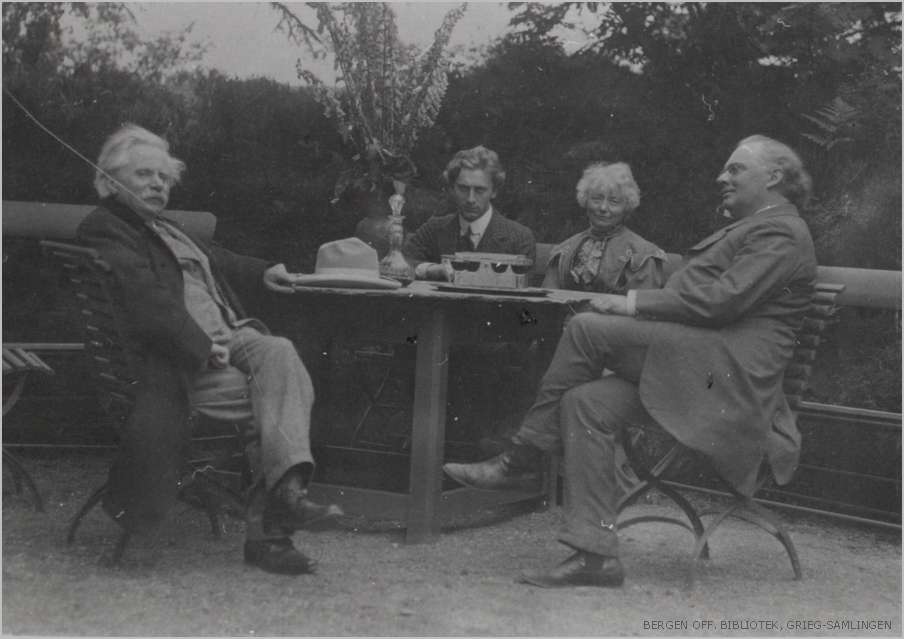
On July 25, that light fell across the garden where Hoenisch set up his camera. Edvard and Nina Grieg, Röntgen, and Grainger gathered at a garden table. An image from the National Library of Norway Bergen Library Grieg Archives captures them together. Grieg is wearing the identical suit, overcoat, and white hat that is visible on our card. Perhaps Hoenisch made the casual group image and then later captured the iconic portrait. A man alone and at rest in the place he loved most, surrounded by the people who understood his music best.
Grieg had been ill for years. A collapsed lung from tuberculosis contracted as a teenager at the Leipzig Conservatory shadowed his entire adult life. By 1907 his condition had deteriorated into combined lung and heart failure, with repeated hospitalizations. When Röntgen said his final farewell at Troldhaugen that summer, he knew they may not meet again.
In September, Grieg prepared to travel to England, where Grainger was to perform his Piano Concerto at the Leeds Festival. He collapsed in Bergen on the way to the ferry, was admitted to hospital, and died the following morning, September 4, 1907. His last words were: Well, if it must be so.
Forty thousand people filled the streets of Bergen for his funeral. His ashes were interred in a grotto in the cliff face above Nordåsvannet, at a spot he had chosen years earlier while fishing with a friend, where the last light of the day touched the rock. Here I want to rest forever, he said.
A fool in full red tunic, tights, and pointed cap riding a half-finished horse. In 1905, Picasso was 23 and in the middle of his Rose Period, when circus performers, acrobats, and jesters were recurring dreams. He saw what the Fool knows, and the rest of us learn along the way.
No one can quite pin down the origin of April Fool’s Day. One theory traces it to the shift from the Julian to the Gregorian calendar in 1582, and New Year’s Day from April 1 to January 1. Those who merrily celebrated the old date were mocked for their foolishness. Other evidence points to the Roman festival of Hilaria at the end of March, when people dressed in disguises and merriment was mandatory. A third argument simply blames the weather. Spring being notoriously unreliable, the fool is the farmer who trusts an early warm day.
Every court kept a fool, the one person licensed to speak the subtext. Under cover of bells and absurdity, they told the king what the courtiers would never. They didn’t matter and slipped away deftly, so they got away with it.
Shakespeare’s fools still deliver their wisdom from the stage. Touchstone sees everyone clearly in As You Like It. Feste in Twelfth Night diagnoses each character’s self-deception with a song. The Fool’s detachment is not ignorance; their folly is not fantasy. It is practical sense and functional freedom. The fool is often the one who tells the full tale as we go.
Let’s not forget all the fun in foolishness. Duckboy Cards gave us these guffaws from Hamilton Montana in the late 20th century.
In the Tarot, the Fool is the zero card, about to step off a cliff with a small satchel. The Fool’s journey is curious, flexible, and nonlinear, akin to the Buddhist beginner’s mind with the great powers of not-knowing.
The disciple Paul wrote that followers were fools for Christ, who knew that worldly measures were the real absurdities. Yurodivye, the holy fool in Russian Orthodox culture, courted ridicule and apparent madness as a form of spiritual freedom.
The Feast of Fools, celebrated across Europe in medieval centuries, inverted the church hierarchy for a day. Junior clergy elected a mock bishop and sacred ritual was gently parodied. The highest were made low for a day. The Church tolerated it for centuries, perhaps because it understood the release it provided.
In each of these traditions, foolishness is not failure. The Fool observes with a keen eye, collects information and assets, plays his cards carefully, and keeps his palm open.
Just such a jester has been riding alongside us this season. In Lucky Us, we find that only a fool pursues luck outright. In Spring Cleaning, earth itself foolishly hopes despite all evidence of winter. In Healing Ward, nurses stringing crepe paper garlands for a room full of wounded men, and show us the beautiful absurdity of insisting on Christmas.
My thanks to you fellow fools who keep reading. Only you know why!
British WWI Hospital Ward RPPCs, a rare paired set, circa 1915–1918
These two real photo postcards document a British auxiliary hospital ward decorated for Christmas, sometime between 1915 and 1918. They are unused and in remarkably good condition. Together they form a matched pair, shot on the same day from opposite ends of the same large convalescence hall.
The architecture, nursing uniforms, iron bed frames, style of celebration, and the back of the cards all point to the same conclusion: a British ward during wartime Christmas, shot by a local photographer working with the same technical materials and conditions as those documented in well-respected the Wellcome Collection in London.
Front of Postcards
The room is large with high ceilings and tall windows running along both sides. Hardwood floors extend the full length of the ward. Iron-framed hospital beds line each wall in neat rows, their white linens crisp and turned. A series of small tables anchor the center aisle, dressed with lace edges and set with tiered decorations, small ornamental figures, and floral arrangements. Crepe paper garlands radiate among the hanging fixtures from the center toward the walls. Nurses in white dresses, bibbed aprons, and distinctive white caps stand at intervals among the beds. Male patients rest in several of the beds or sit up for the photograph.
The first card was shot from one end of the room, looking toward a grand arched window fitted with ornate leaded stained glass and flanking panels in a geometric floral pattern. The second shot looks back the other direction toward an interior archway.
The photographic quality of both cards is high. The tonal range is continuous, with a fine grain and deeply resolved shadows. The nurses in the first image are grouped more loosely near the central table, and a ghostly motion blur in their figures suggests a longer exposure time. The second image is darker and the poses are more formal.
Back of Postcards
The cards share the same markings on the reverse, confirming they came from the same stock and photographer. The back carries the words “Post Card” in a decorative serif typeface, and a clean t-shaped dividing line delineating spaces “For Correspondence” and “Address Only.” No stamp box, printer’s imprint, paper manufacturer mark, or country or origin. That makes this RPPC irrefutably British.
Britain pioneered the divided postcard back in 1902, five years before the United States adopted the format. American RPPCs of the same era almost universally carried manufacturer’s marks such as AZO or VELOX in a printed stamp box, used to identify the photographic paper brand. British cards of this period carried no such mark. The back of these cards places their manufacture firmly in the British tradition.
The absence of any commercial marker further suggests a staff or commercial photographer and local production. These were not mass-produced. They were made in small numbers, likely for official wartime documentation or as personal mementos of a meaningful Christmas.
Two complementary long shots on a memorable day. Paired RPPCs are less common. A matched set intact, from a wartime context more than a century later, is rarer still.
Wartime Convalescence
Britain entered the First World War in August 1914 with 297 trained military nurses. Nowhere near enough for what was coming. Within weeks, the Royal Army Medical Corps and the British Red Cross Society jointly activated the Voluntary Aid Detachment system, mobilizing thousands of civilian volunteers to staff a network of auxiliary hospitals across the country. By 1918, approximately 80,000 VAD members served in uniform. Twelve thousand worked directly in military hospitals. Sixty thousand staffed auxiliary hospitals of various kinds.
The buildings pressed into service ranged from country houses and public schools to civic halls and converted warehouses. The ward in these cards show Gothic Revival arched windows with Arts and Crafts stained glass. The architecture is distinguished with high ceilings and dark wood wainscoting. Perhaps this is a purpose-built civic or private building of Edwardian ambition, converted for wartime use.
The iron bed frames visible in these cards match the tubular iron hospital beds documented in the ward photographs of King George Hospital, the largest military hospital in Britain during the war. Converted from a newly built HM Stationery Office warehouse on Stamford Street, London, the hospital opened in May 1915 and treated some 71,000 men before closing in June 1919. The Wellcome Collection holds its ward photographs. They show the same head and foot rail design, the same lightweight iron construction, the same configuration of beds along the ward walls. This was standard British military hospital specification, and these cards meet it exactly.
Wartime Wardrobe
We can more precisely date these cards by the white caps worn by the nurses. By early 1915, untrained VAD nursing staff had begun adopting the triangular floating veil worn by trained military nurses. Professional nurses were already unhappy about working alongside civilian volunteers. By November 1915, the Joint War Committee introduced a standardized cap for VAD nurses, making distinctions of training and rank visible at a glance.
The caps in these cards match that post-1915 VAD style. They are not the earlier flat cap prior to 1915, nor the fully structured veil of the trained QAIMNS sister. The confidence of the nurses’ poses and the scale of the ward celebration suggest an established wartime routine rather than the improvised urgency of the war’s first Christmas. This may narrow the date to 1916, 1917, or 1918.
Wellcome’s Wartime Collection
The Wellcome Collection’s photographic holdings of The King George Hospital archives open a window onto wartime convalescence. From the start, its philosophy held that recovery from war’s trauma demanded more than medicine.
Each bed had an electric light and a pink and white quilt. Common rooms on each floor were set up for socializing, smoking, reading, and writing letters. A miniature Harrods-like gift shop kept the wards stocked with comforts to necessities. It ordered up to 60,000 cigarettes each week so every patient could have six or seven smokes a day.
Most remarkably, a Royal Academician designed a rooftop garden that eventually held 24 revolving shelters positioned so patients could take in the air and watch the River Thames in all weathers. Queen Alexandra visited in May 1915, and that September she sent the hospital a tripod telescope so patients could study the rooftop view across London. On Christmas Day 1916, King George V and Queen Mary toured every ward in person, and presented each patient with a copy of the Queen’s Gift Book.
The decorated ward in these postcards belongs to that same time period, patriotic conviction, and palliative approach. The lace tablecloth, tiered cake stands, crepe paper garlands, and nurses standing at attention in their best uniforms were elements of organized care for men who had survived the Western Front, deserved a memorable Christmas, and needed more than the doctor’s orders.
Romans advised that fortune favors the bold. In Sweden, luck never gives, it only lends. In the United States, the harder you work, the luckier you get. The Arabic proverb says, “Throw a lucky man into the sea and he’ll come up with a fish in his mouth.” A Brit might be lucky at cards, unlucky in love. In Japan, the day you decide to act is your lucky day.
Edwardian postcards had a curious set of symbols to call forth fate and fortune. Horseshoes, shamrocks, roses, and playing cards. Small and slightly worn at the edges, these vintage greeting postcards have traveled more than a century carrying a providential wish.
Only one card in the collection actually says Good Luck. The rest offer best wishes, happy hours, and kind thoughts from me to you. As we’ll see, luck is borne of relationships (and circumstances) lifted by the charitable wish for health, wealth, and wisdom.
Some say that luck can be earned, but only a fool pursues it outright. We daydream about what fortunes may be in store, and sometimes ignore the simple sparkles that appear each day. We know, of course, that there are no free lunches. Yet, we are admonished to never look a gift horse in the mouth.
The bold assume they earned their lucky breaks. The humble suspect they’ve borrowed fortune temporarily. The superstitious are not entirely sure we should discuss it. Luck is where fate and intent find common cause, usually in the context of close friendships.
Old English had no luck. It used wyrd instead, which pointed to fate and destiny. Wyrd is the root of our word weird, which may indicate how people felt about fate. It was uncanny, inevitable, and perhaps divine. You didn’t pursue wyrd. You experienced it through awe and fear.
Somewhere around the 15th century, luk and gelucke drifted in from the Dutch and Low German. Luck was looser and more manual. Like weather, luck favored preparation and was possible to influence if you knew the right charms. The horseshoe went up above the door. The rock went in your pocket. If luck is not fate, if it is not fixed in advance, then perhaps you can do something about it. Perhaps it can be courted.
The lucky person is not the one who waits but the one who steps into the room. This is luck as a reward for courage, or at least for motion. Fate deals the cards, and we each have a hand to play.
Fortune favors the bold — fortes fortuna adiuvat ~ Terence, Roman playwright, around 151 BCE
Luck is what happens when preparation meets opportunity, and preparation is something you control. The solo pursuit of fortune is a genuine drive.
The harder I work, the luckier I get. ~ Samuel Goldwyn
But the shamrock gently disagrees. Four-leaf clovers are natural anomalies, not personal achievements. We can’t earn one, only discover it. Even if you can court luck, even if work and boldness can pull it toward you, it is never yours to fully command.
Luck never gives; it only lends. ~ Swedish proverb
Some people simply have it, inexplicably, in ways that have nothing to do with preparation or boldness or a rabbit’s foot.
Throw a lucky man into the sea, and he will come up with a fish in his mouth. ~ Arabic proverb
Some observe that luck is a finite resource and can be unwisely traded away. This may or may not be true, but as a matter of human priority it is clarifying. We each get chances to test our luck.
Lucky at cards, unlucky in love. ~ English proverb
The tension between fate and will, between earned luck and divine luck, is located in a moment of commitment. The lucky day is not the day something falls in your favor. It is the day you decide it might be worth the effort.
The day you decide to do it is your lucky day. ~ Japanese proverb
Whatever the senders intended and however the recipients replied, these cards demonstrate how providential language holds us together in anticipation of something wonderful just ahead. The possibility that things might go our way.
The symbols of luck nested together in relationship, in abundance, in the living world — a horseshoe wreathed in flowers, overflowing with roses, or flanked by shamrocks — is not an accident of Victorian design sensibility. It draws on the ancient wisdom that friends are the true source of life’s lucky breaks. Love does the work and luck gets the credit.
A picture is worth a thousand words, which can be tough news for a writer. I like words and images together, and art cards are a peaceful place to be while sorting through the longer storylines happening around here.
To start an art card, I pull together a collection of cards and ephemera related to a theme or style I want to explore. Gather tools, supplies, and a drink at my art board. Set my phone aside, and pick up an exacto knife. Then, I sit down, quiet down, and begin to make meaning out of the materials in front of me. I’m nowhere near my computer or journal, but making an art card now and then is part and parcel with my writing process.
The Posted Past Art Card Gallery is inspired by so many wonderful postcard projects over the years. Worth mentioning are PostSecret, which invites anyone to share an anonymous secret on a postcard, and PostCrossing, which makes it easy to send and receive postcards around the world.
For our part, we collaborate with collage artists to make something small and special for everyone to enjoy. The artist requests a theme or two based on interests like, trees, farms, or portraits. We send an art card bundle and they create collage postcards with these materials. The postcard collages come back through the mail, celebrating the wear and tear of the postal service journey.
The Art Card Gallery is a place to see art card collages created by artists around the world.
If you’re already a subscriber, bless you for hanging on as you do. You get a little note in your inbox each Wednesday. Most times it flits away like a red cardinal, down into the cold, thatched hinterland of your inbox scroll. I know.
Introducing the Wednesday Weekly Reader, a new place to catch up with a previous story series bundled in a way that is easier to read. If you love our national parks, wonder about where the past gets lost, or know a few lonely snowbirds, a story series may meet your fancy.
Over the past few weeks, a rare photo postcard album has revealed places, property, and people, along with our own ideas about what we see. We’ve gone from unmarked wilderness, to building structures and social life, to faces and a few names.
We look back at them, and they return the gaze. Their stories blend with our own memories and imagination. They begin to feel like someone’s ancestors, though the particulars remain elusive.
Rochester in Rearview
In 1877, photography required glass plates, wet chemicals, heavy equipment, and specialized knowledge. George Eastman, a frustrated bank clerk from a poor family in Rochester, taught himself the process in his mother’s kitchen.
A decade later, Eastman had invented a simple camera pre-loaded with film for 100 exposures. By 1903, the Eastman Kodak Company released the 3A Folding Pocket Camera with 3¼ × 5½ inch film—exactly postcard size and pre-printed on the reverse. Local photographers and home enthusiasts could contact-print the negative directly onto postcard paper. No enlarger needed, and simplified processing equipment and chemicals.
Rochester became an ecosystem. Bausch & Lomb made the lenses. Kodak manufactured the cameras, bought the film company, and controlled the processing. Customers shipped the entire camera unit back to the factory, and received prints and a pre-loaded camera in return. “You press the button, we do the rest.” Factory workers were the first to witness an era of American life, as images of farms, houses, banks, theatre, and towns and their inhabitants poured in.
A quiet man, Eastman watched this unfold from the center, as his invention changed history and rippled through culture. By 1920, millions of Americans owned cameras. Eastman left a simple note when he ended his own life at 77 and in degenerative pain, “To my friends: My work is done. Why wait? GE”.
What We See
The studio portraits above show painted backdrops—ornamental arches, garden trellises. The lighting is controlled. Poses held steady. Technical quality consistent. These were made by professionals charging by the sitting.
The outdoor snapshots show real places—porches, orchards, dirt roads. Natural lighting, sometimes harsh. Composition varies from confident to awkward. These came from camera owners of varying skill. The irregularities in frame and exposure suggest they were developed at home, too.
What We Don’t See
Despite the pre-printed paper and earnest intent, real photo postcards were rarely sent as such. A few have difficult script, cryptic addresses, faded cancellations, and worn stamps.
“Hello Fanni. Miss Fanni Moore, Panhuska, Okla.”
The remaining relics haven’t been labeled, addressed, or mailed. Most backs are blank, and they were often collected in photo albums. The manufacturing marks may have been quite incidental.
What’s missing from nearly all: names. Very few clues to subjects, locations, dates. The people who made these photographs knew who everyone was. They didn’t need labels. Or, perhaps they were accompanied by letters and mailed in envelopes for privacy and protection.
A century later, the faces remain potent but anonymous. We guess at relationships from physical similarity, from who stands near whom. Sometimes we’re right. Sometimes, we can’t believe our eyes.
Spaces in Between
The 3A Folding Pocket Kodak cost $20-30, equivalent to $600-900 today. An expensive hobby, but accessible to prosperous farmers, small business owners, middle-class families. Film cost about 50 cents per roll.
The investment meant something, whether it was the equipment or the studio session. People photographed what mattered—children, homes, gatherings. The images document their priorities, and their time passing.
Real People, Real Limits
These are real people who lived, worked, loved, died. Someone cared enough to preserve their images. They matter still, in part, because they mattered to someone before.
But our analysis stops here. We can describe what we see—the composition, the technical choices, the historical context. We can note patterns across the collection. We can explain how the technology worked and who had access.
The work of naming and placing, in particular, belongs to families searching their own histories, connecting faces to stories passed down, matching photographs to genealogical records. Those searches have their own purposes, their own meanings.
We are collectors examining patterns, not descendants reclaiming ancestors. Though, it is tempting.
One enigmatic postcard album is my companion for the next three weeks. Pages of rare black & white photos tell of people, places, and property, but with scant details of who they are, where they are, or what is happening. The past is present in these images, but not at all reliable.
It may seem too obvious to point out, but postcards move around over time. Cherished memories first organized in a new, handsome album sit in the front room for a decade or more before migrating to a study drawer, a garage, or a dusty attic.
If the album is later unearthed or given away, a collector might save it as an artifact of a bygone time. Or, they could pull it apart (mercilessly) to be sorted again into categories by geography or historical era.
After one collector is gone, the sifting and sorting can be nonsensical and misleading. Storylines get separated, and suddenly history relies on little more than a few questionable clues.
Landscapes get lost first, along with the creatures that inhabit them. The wolf, the moose, the fawn, and the prairie dogs in the snow were known only briefly to the soul who got the shot. To us, they are familiar ghosts.
And, what about the trees, the lakes, the frozen road, and the sandstone tunnel? I know they were likely loved in their day. Still there? Maybe. The tunnel could elicit some belabored guesswork. But, why?
I’ll be walking in the trees quite a bit in the next three weeks, taking pictures that I will share liberally on social media and won’t label properly. I doubt it would bother you. After a century or so, we can live with anonymous scenery and abstract wildlife. A picture can lose its place.
But, there is a certain creative tension ahead when it comes to people and property. The desire for a real story gets stronger, to find the ‘where’ there. Who are they, and what can they say about us now? Despite the lack of evidence, we can’t help searching. Stay tuned.
Old Rufus Dale had seen a thing or two, and Irene had her suspicions.
An early 20th century real photo postcard (RPPC) showing a poignant intergenerational portrait.
Front of the card: The photograph captures an elderly man with a distinctive long white beard, dressed in a dark suit, seated on a dilapidated wooden loveseat or couch in front of a clapboard house. Beside him sits a young child in a white dress, perched on the arm of the furniture. Behind them a decorative lace curtain hangs outside the open window. The setting appears to be rural America.
Back details: The reverse shows the handwritten inscription in pencil, Uncle Rufus Dale, age 84 and Irene age 4. We can assume a family relationship, likely between grand-uncle and grand-niece.
Condition and Appeal: The real photo postcard is in excellent condition front and back, unposted with helpful writing, and an AZO indicia dating the item between 1904 and 1918. The subject matter and production method suggest this is a unique image and object, with no known duplicate.
RPPCs are quite collectible, especially those with interesting and clear photographic subjects. The rural American family setting, the age gap between subjects, and the excellent condition make this item more desirable, appealing to collectors of early photography, genealogy researchers, postcard collectors, and those interested in American family and social history from the early 1900s.
[Note: Summer focus is on detailed captions. Essays return in September!]