A path appears underfoot every year around this time, with a slight softening of the ground and a change in the light. The road is old, but the way is new again.
Spring equinox arrives in just a few days, another moment when day and night stand in perfect balance. Nowruz, one of the world’s oldest celebrations, falls on the equinox itself, marking the moment the earth turns toward renewal. Observed for at least three thousand years across Persia, Central Asia, the Caucasus, and the diaspora communities that carry it around the world, Nowruz means new day and it begins precisely at the moment of the spring equinox.
Preparations are meticulous. The house is cleaned from top to bottom in a practice called khane-tekani, shaking out the house, to release the accumulated weight of winter. A ceremonial table is set with sprouted wheat for rebirth, vinegar for patience, garlic for health, and a goldfish in a bowl for life against all odds.
In Chinese Lunar New Year, it is the year of the horse. All the teachings of Ramadan have been quietly observed this month. Christians are entering the heart of Lent, when liturgical colors shift from penitential purple to radiant rose, and the invitation is to rejoice. World traditions share this central wisdom. To walk forward, one must first prepare.
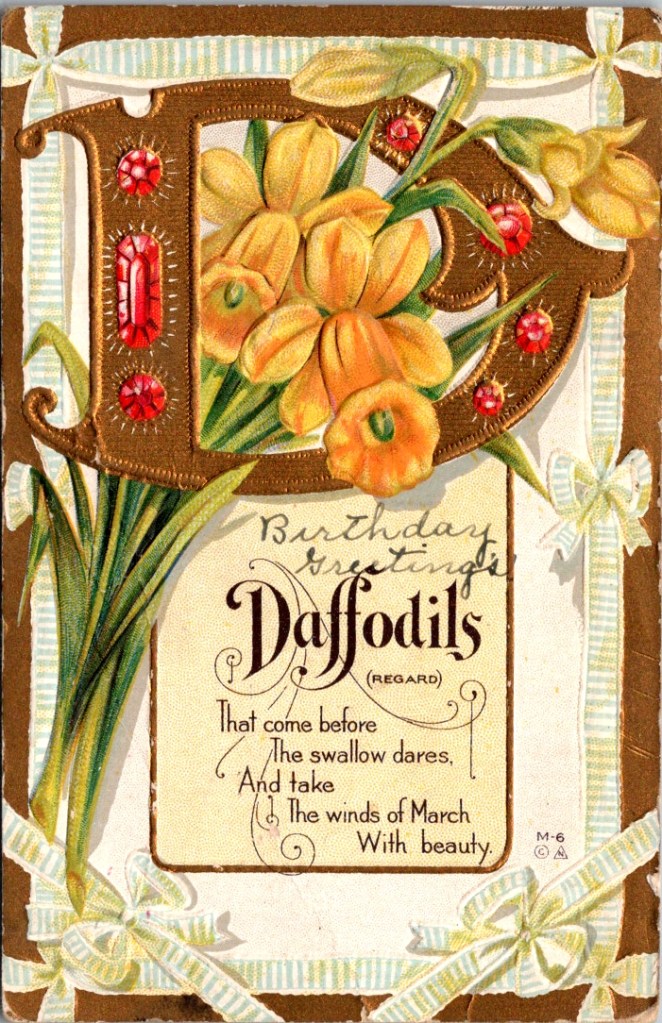
This morning my path runs along Sligo Creek near Washington DC, where the trail follows the water through an old urban forest. The snowdrops are done. Small and white and brave, they came and went in February. Crocuses are finishing now, purple and yellow scattered through the leaf litter. Daffodils line the path in both directions to proclaim the news of spring. Soon the cherry blossoms will arrive, carrying the Japanese mono no aware, bittersweet awareness as beautiful things pass.
For the next few weeks I’ll be traveling. Away from my desk and the collection. Being in motion feels at pace with the season. By early April I’ll be back in Arizona, where spring doesn’t linger the way it does in the East. The desert has its own brief, vivid version of the season. Sharp early light and cool mornings, palo verdes going yellow and the brittlebush blazing.
For me, it’s a time to toss off the heavy winter blankets, move furniture, dust out the corners, and feel all the motivations of the season. The Posted Past is making some new moves, too.
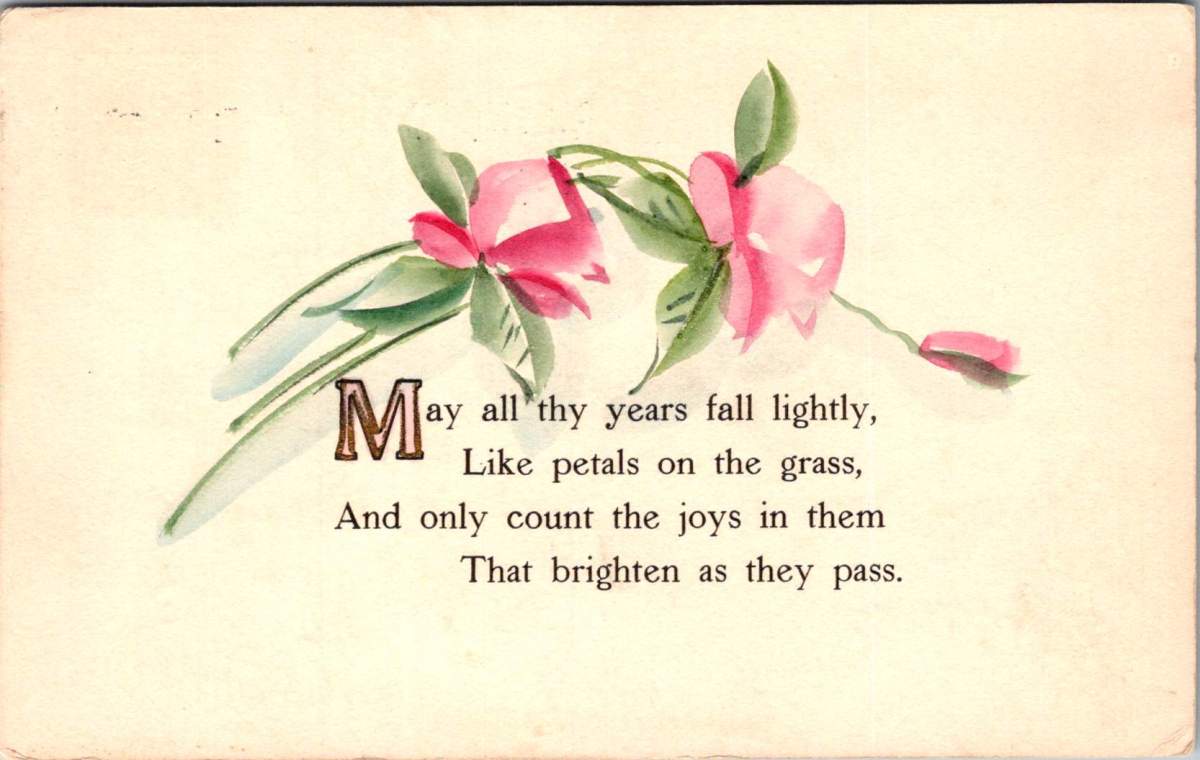
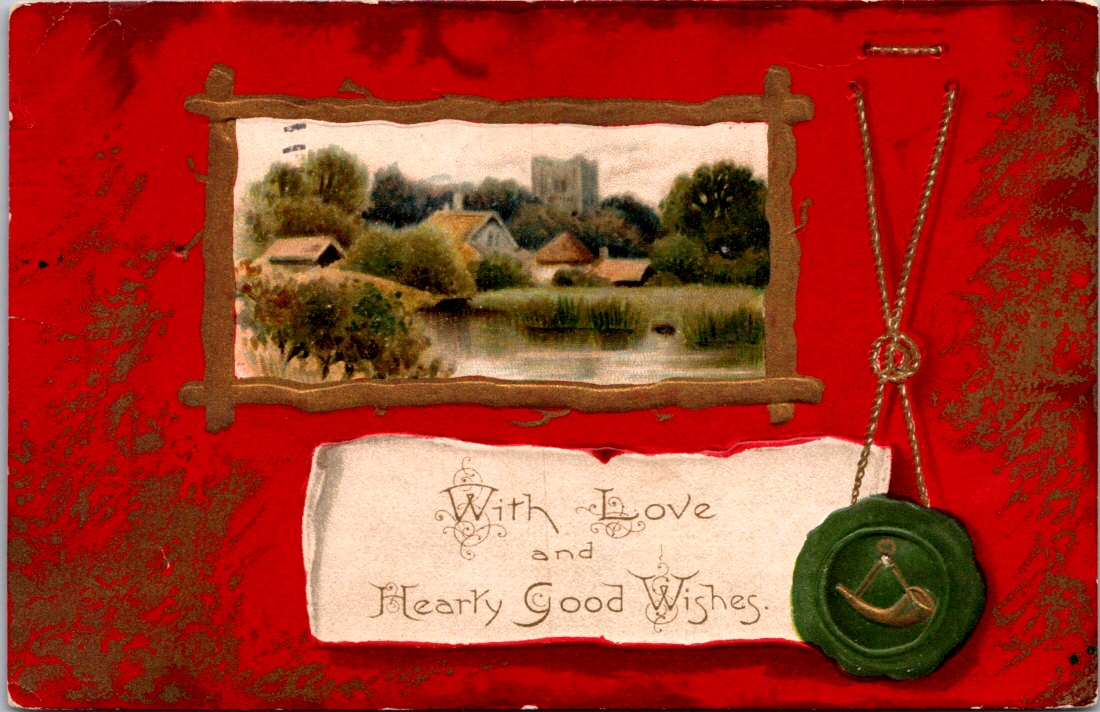
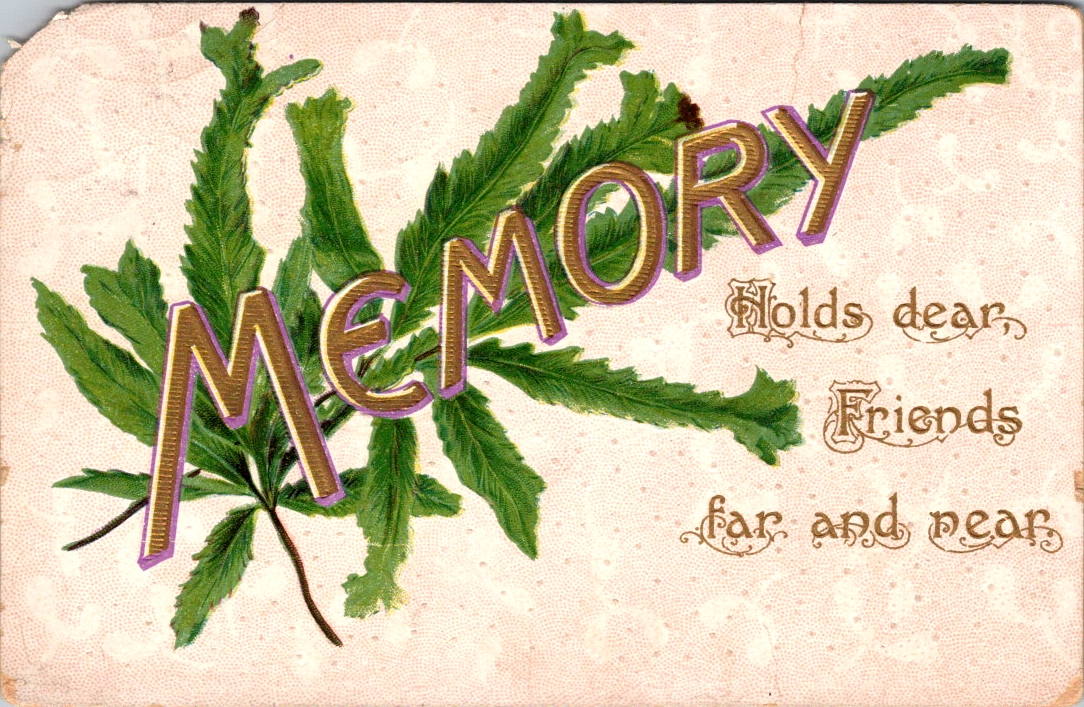
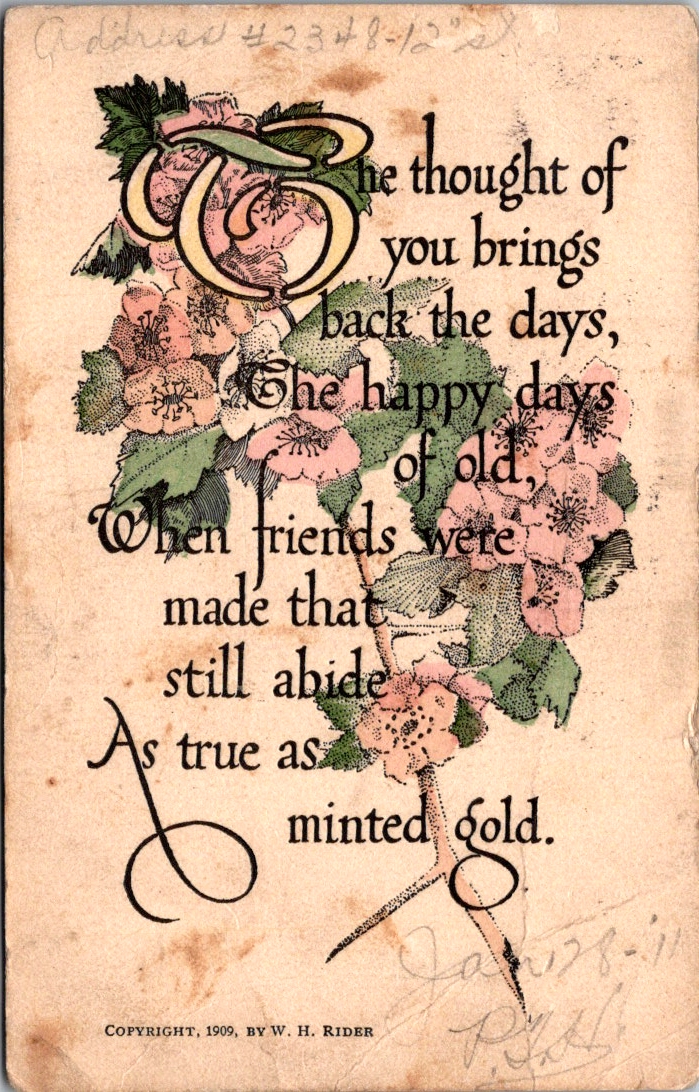
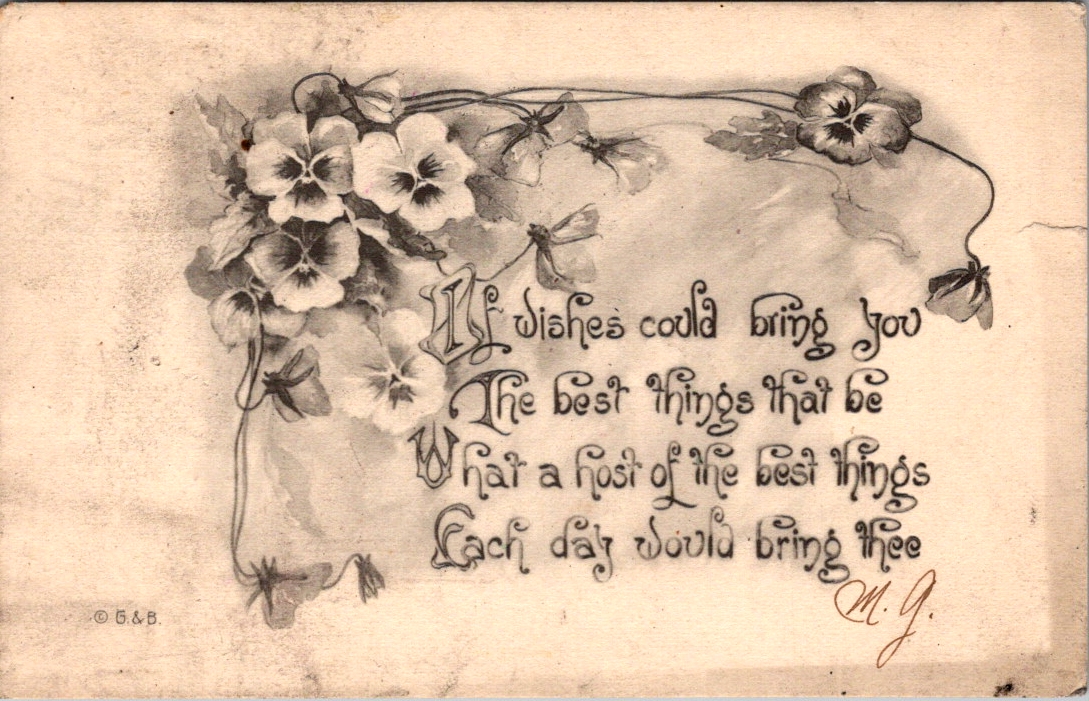
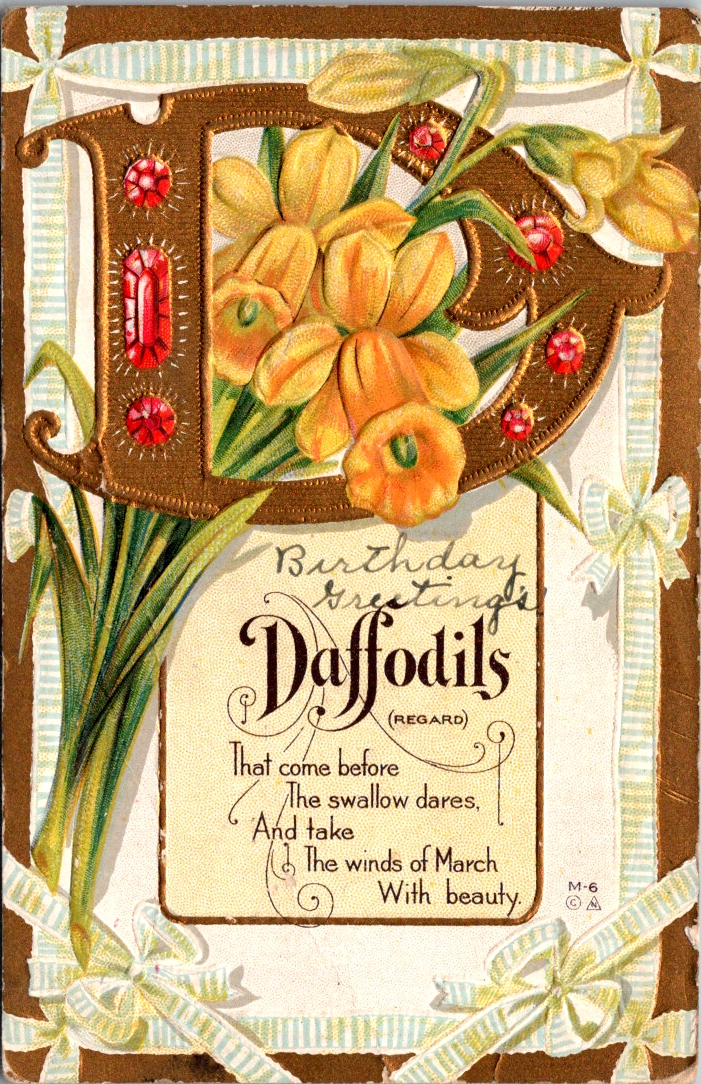
Spring greeting cards are full of flowers and fancy, and the messages give us gentle permission to start again. If you are grass-side up, count yourself among the living and the hopeful. Believe that what comes next might be better.
Take a walk this week, if you can. Clear an old task you’ve been putting off. Set the table. Notice what’s arising in your life. Greet the new day.
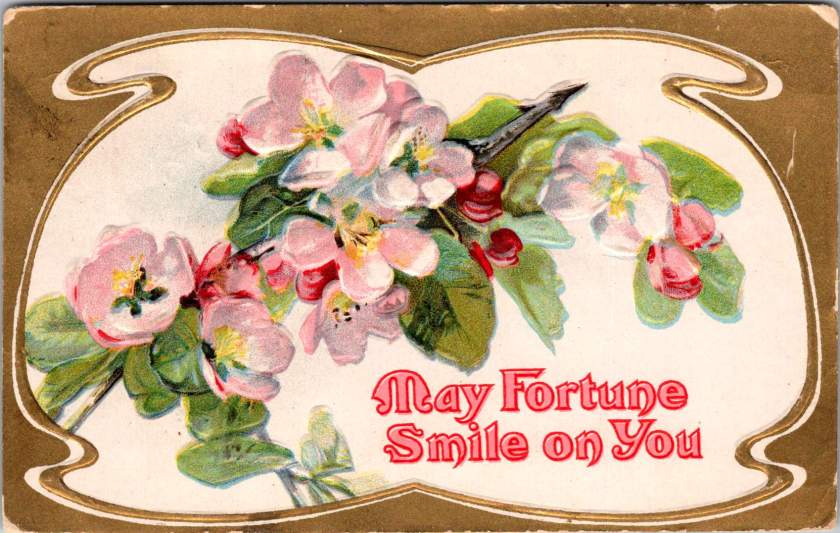
Romans advised that fortune favors the bold. In Sweden, luck never gives, it only lends. In the United States, the harder you work, the luckier you get. The Arabic proverb says, “Throw a lucky man into the sea and he’ll come up with a fish in his mouth.” A Brit might be lucky at cards, unlucky in love. In Japan, the day you decide to act is your lucky day.
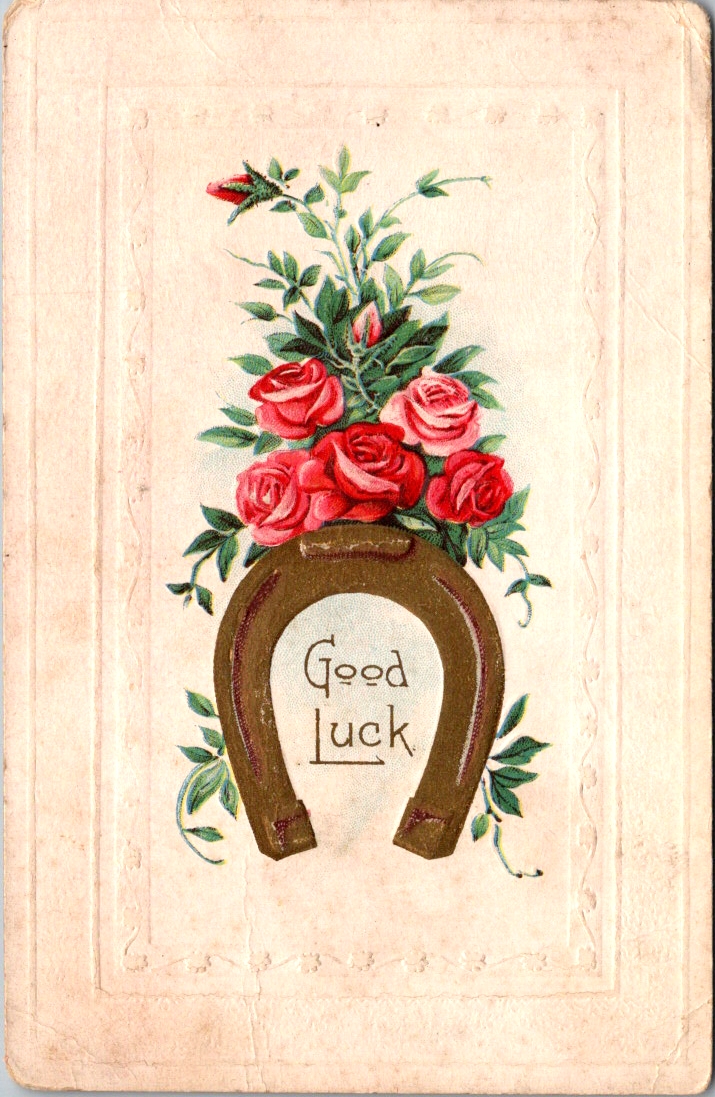
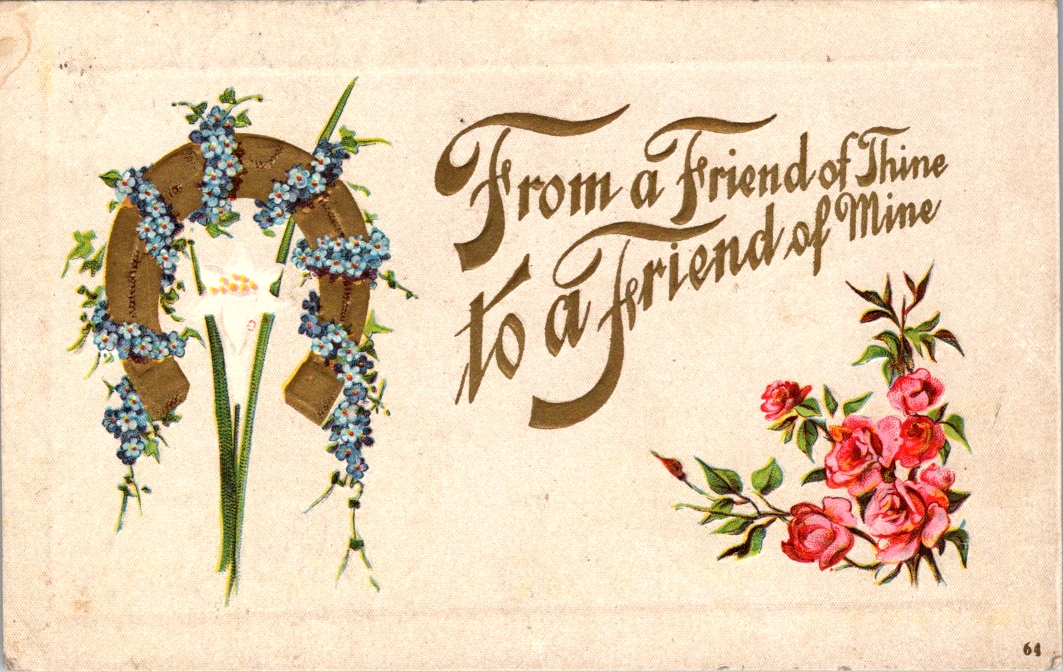
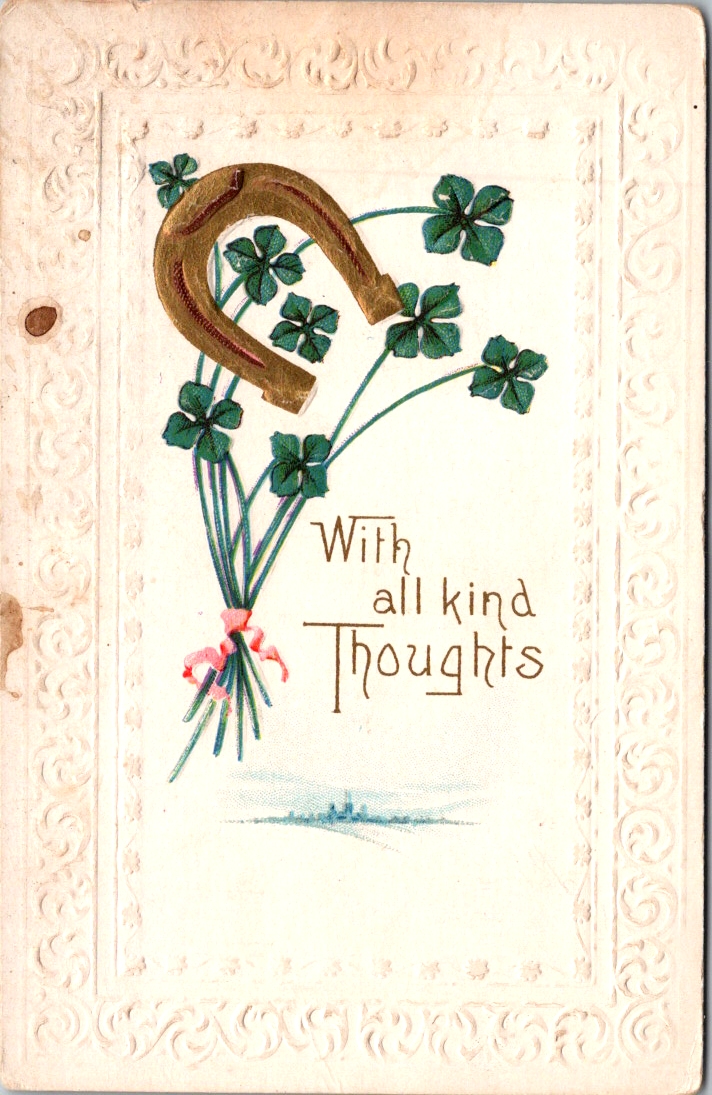
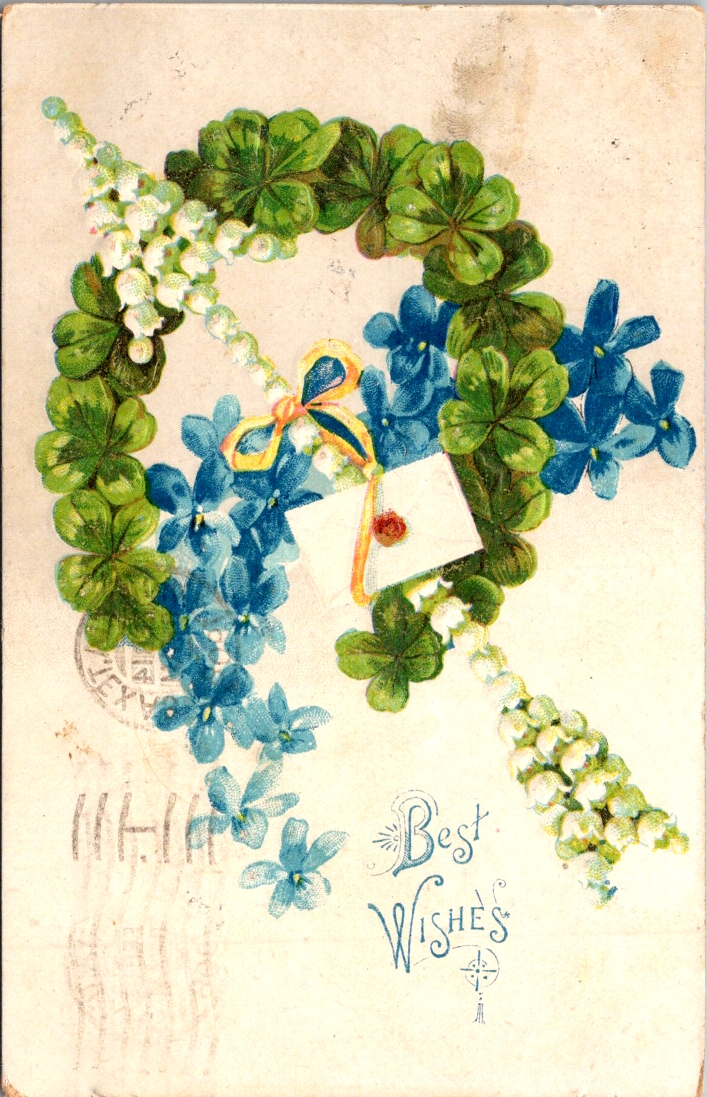
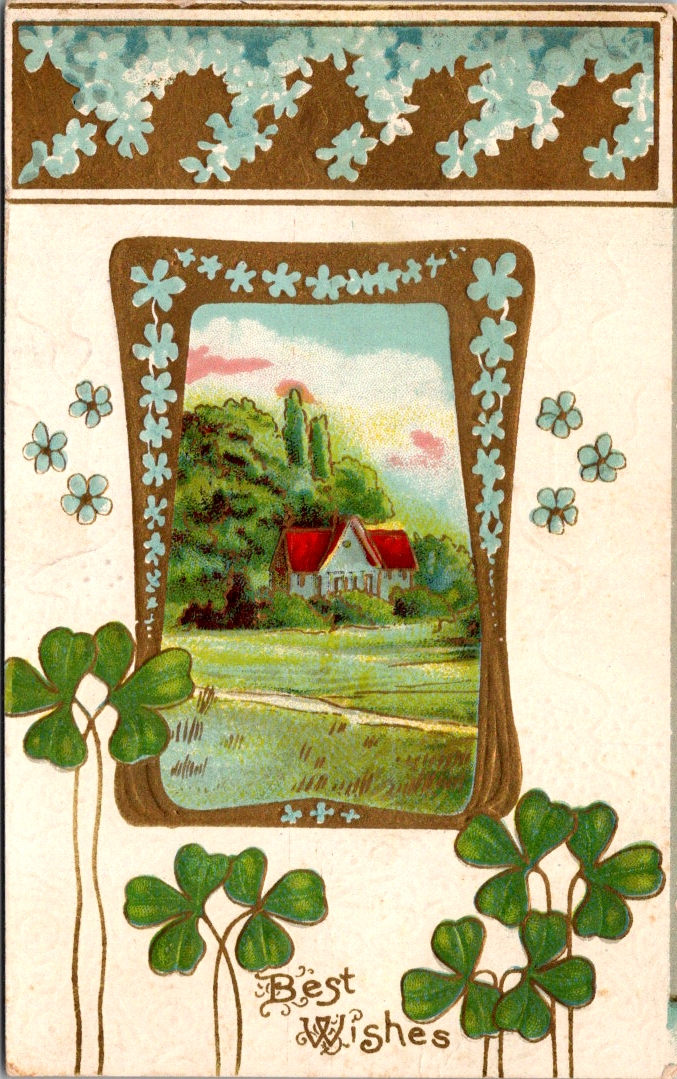
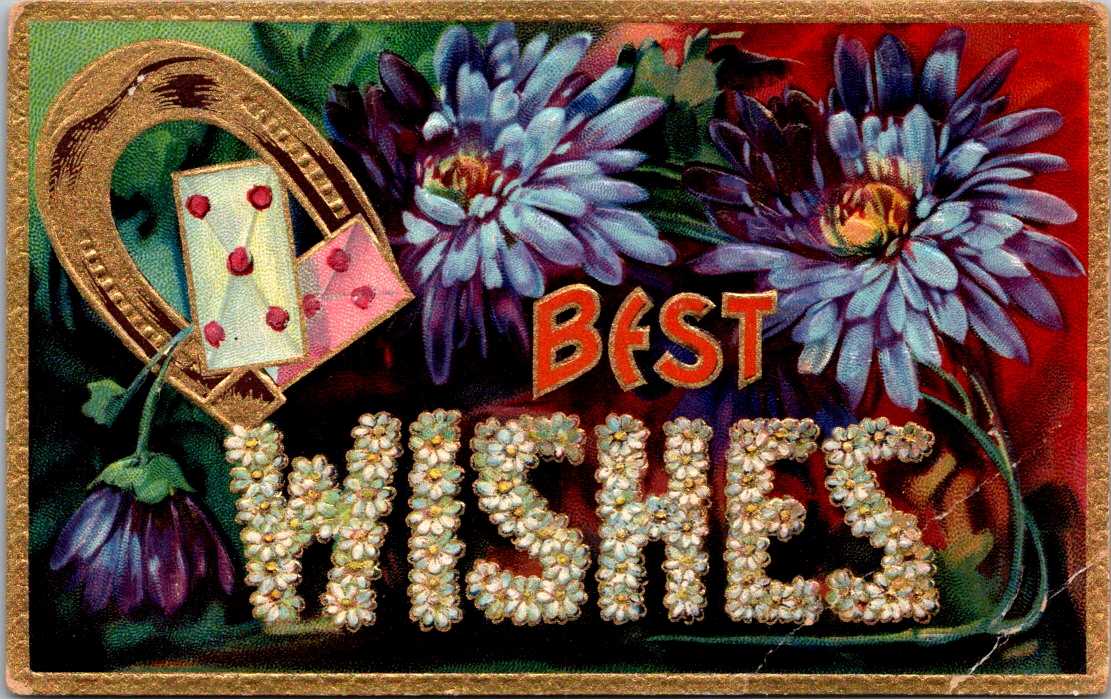
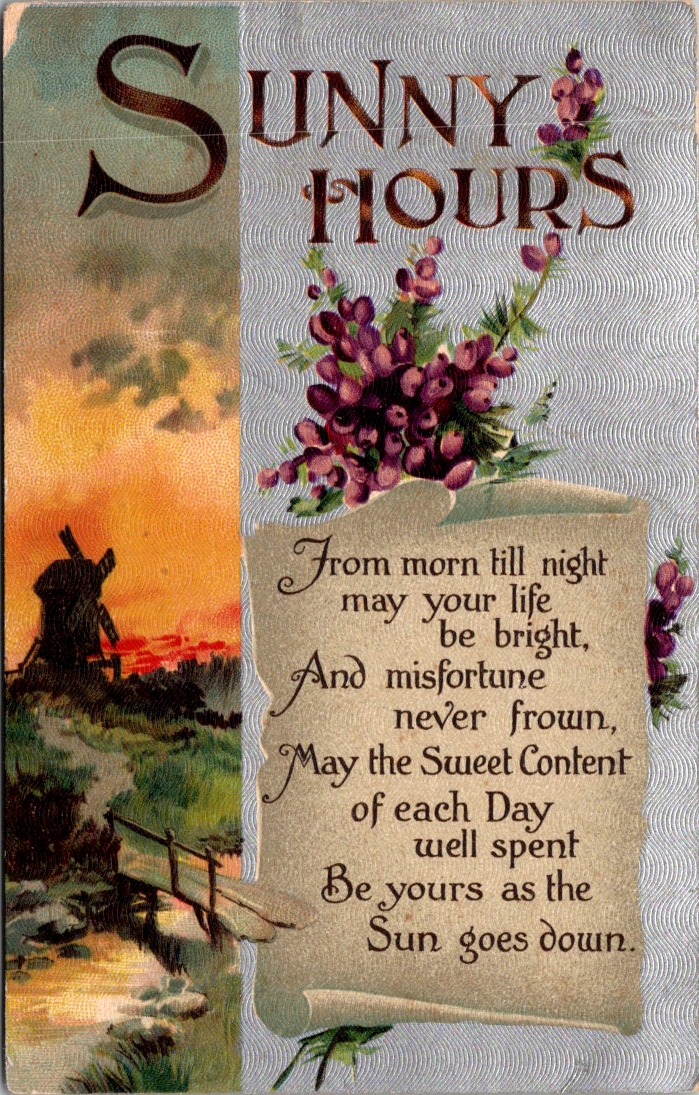
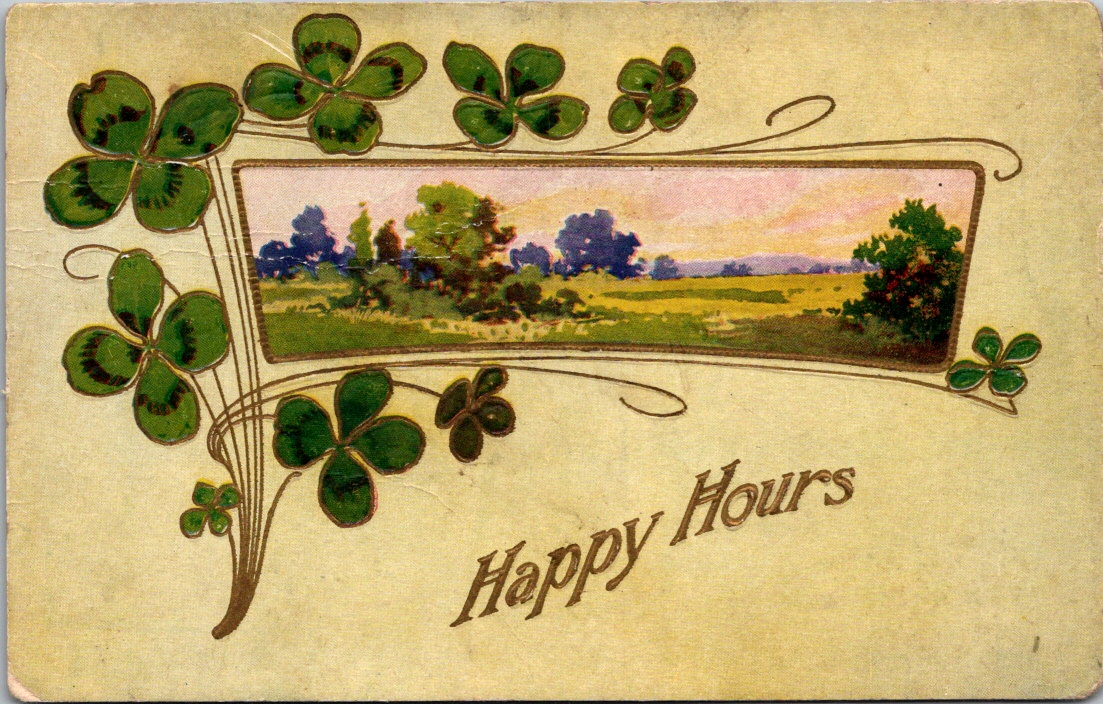
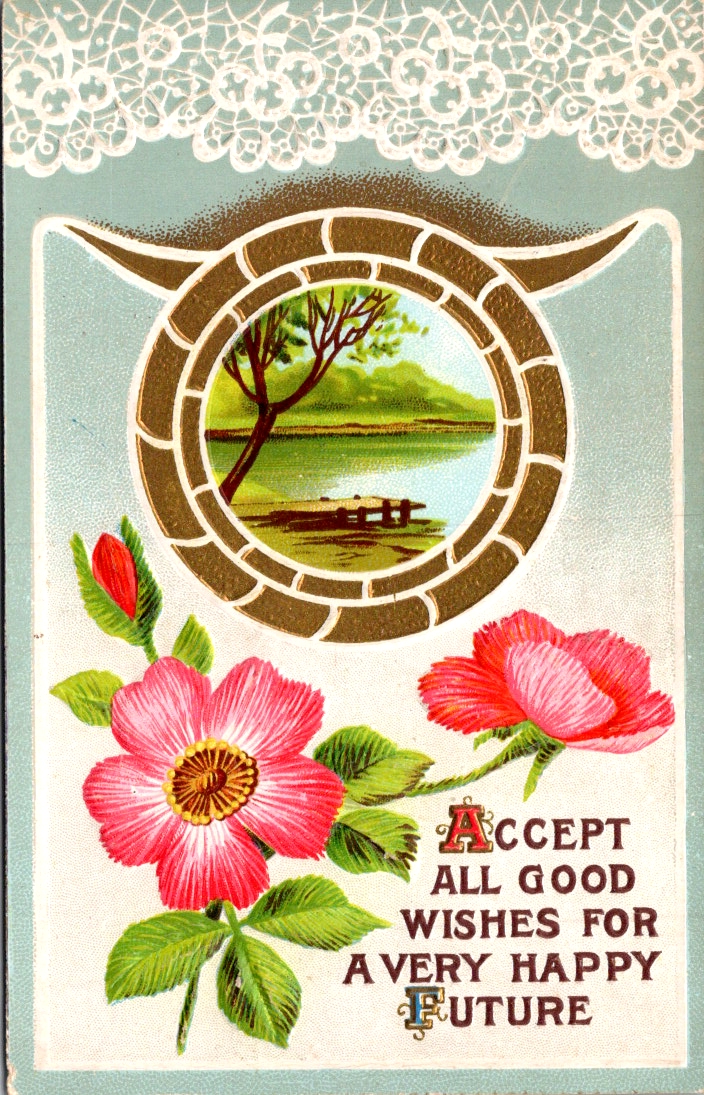
Edwardian postcards had a curious set of symbols to call forth fate and fortune. Horseshoes, shamrocks, roses, and playing cards. Small and slightly worn at the edges, these vintage greeting postcards have traveled more than a century carrying a providential wish.
Only one card in the collection actually says Good Luck. The rest offer best wishes, happy hours, and kind thoughts from me to you. As we’ll see, luck is borne of relationships (and circumstances) lifted by the charitable wish for health, wealth, and wisdom.
Some say that luck can be earned, but only a fool pursues it outright. We daydream about what fortunes may be in store, and sometimes ignore the simple sparkles that appear each day. We know, of course, that there are no free lunches. Yet, we are admonished to never look a gift horse in the mouth.
The bold assume they earned their lucky breaks. The humble suspect they’ve borrowed fortune temporarily. The superstitious are not entirely sure we should discuss it. Luck is where fate and intent find common cause, usually in the context of close friendships.
Old English had no luck. It used wyrd instead, which pointed to fate and destiny. Wyrd is the root of our word weird, which may indicate how people felt about fate. It was uncanny, inevitable, and perhaps divine. You didn’t pursue wyrd. You experienced it through awe and fear.
Somewhere around the 15th century, luk and gelucke drifted in from the Dutch and Low German. Luck was looser and more manual. Like weather, luck favored preparation and was possible to influence if you knew the right charms. The horseshoe went up above the door. The rock went in your pocket. If luck is not fate, if it is not fixed in advance, then perhaps you can do something about it. Perhaps it can be courted.
The lucky person is not the one who waits but the one who steps into the room. This is luck as a reward for courage, or at least for motion. Fate deals the cards, and we each have a hand to play.
Fortune favors the bold — fortes fortuna adiuvat ~ Terence, Roman playwright, around 151 BCE
Luck is what happens when preparation meets opportunity, and preparation is something you control. The solo pursuit of fortune is a genuine drive.
The harder I work, the luckier I get. ~ Samuel Goldwyn
But the shamrock gently disagrees. Four-leaf clovers are natural anomalies, not personal achievements. We can’t earn one, only discover it. Even if you can court luck, even if work and boldness can pull it toward you, it is never yours to fully command.
Luck never gives; it only lends. ~ Swedish proverb
Some people simply have it, inexplicably, in ways that have nothing to do with preparation or boldness or a rabbit’s foot.
Throw a lucky man into the sea, and he will come up with a fish in his mouth. ~ Arabic proverb
Some observe that luck is a finite resource and can be unwisely traded away. This may or may not be true, but as a matter of human priority it is clarifying. We each get chances to test our luck.
Lucky at cards, unlucky in love. ~ English proverb
The tension between fate and will, between earned luck and divine luck, is located in a moment of commitment. The lucky day is not the day something falls in your favor. It is the day you decide it might be worth the effort.
The day you decide to do it is your lucky day. ~ Japanese proverb
Whatever the senders intended and however the recipients replied, these cards demonstrate how providential language holds us together in anticipation of something wonderful just ahead. The possibility that things might go our way.
The symbols of luck nested together in relationship, in abundance, in the living world — a horseshoe wreathed in flowers, overflowing with roses, or flanked by shamrocks — is not an accident of Victorian design sensibility. It draws on the ancient wisdom that friends are the true source of life’s lucky breaks. Love does the work and luck gets the credit.
In Shakespeare’s As You Like It, Jacques delivers his monologue in Act II, Scene VII, observing human life with world-weary detachment. He sketches out seven distinct chapters of a human life, from mewling infancy to toothless old age, with equal parts affection and irony. One of the most quoted passages in all of Shakespeare, by the 1880s it was deeply embedded in popular culture — the kind of verse that some households knew by heart.
“All the world’s a stage, and all the men and women merely players.”
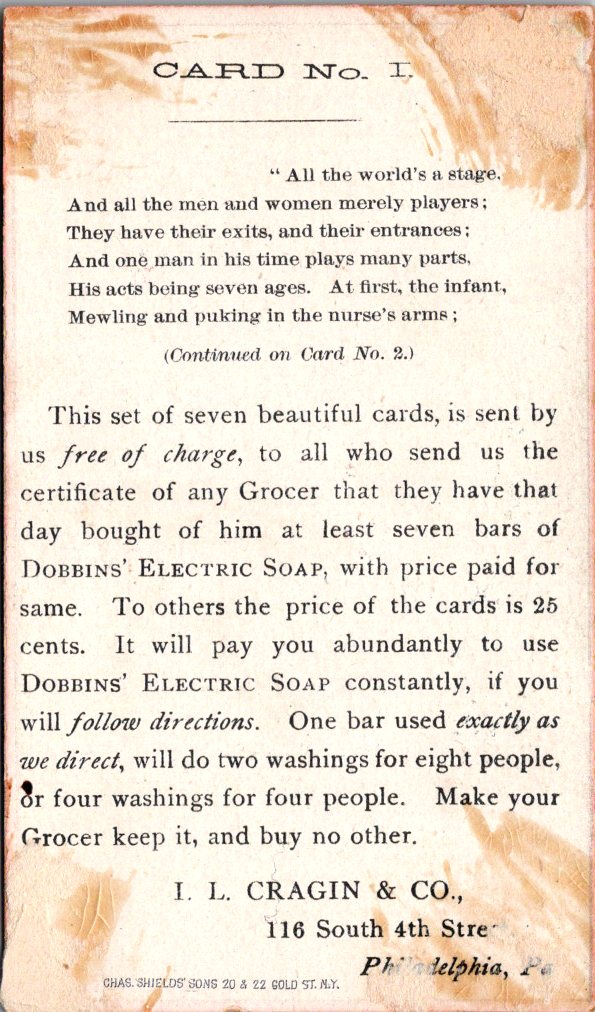
Dobbins’ Electric Soap was manufactured by I. L. Cragin & Co. of Philadelphia and had been on the market since the mid-1860s. By the early 1880s, the company was advertising heavily through trade cards, chromolithographic collectibles that matched the indulgences of the Gilded Age. Cragin’s innovation was to produce not a single card but a series of seven that required the collector to buy a bar of soap each time. Get the certificate from your grocer, and the full set arrived by mail free of charge.
Philly, 1880s. Shakespeare meets laundry.
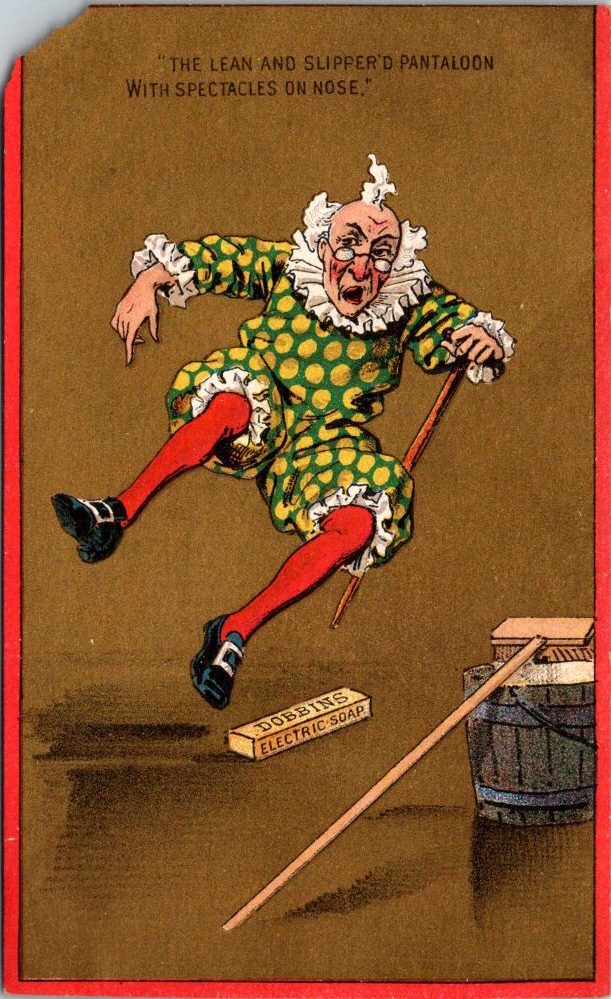
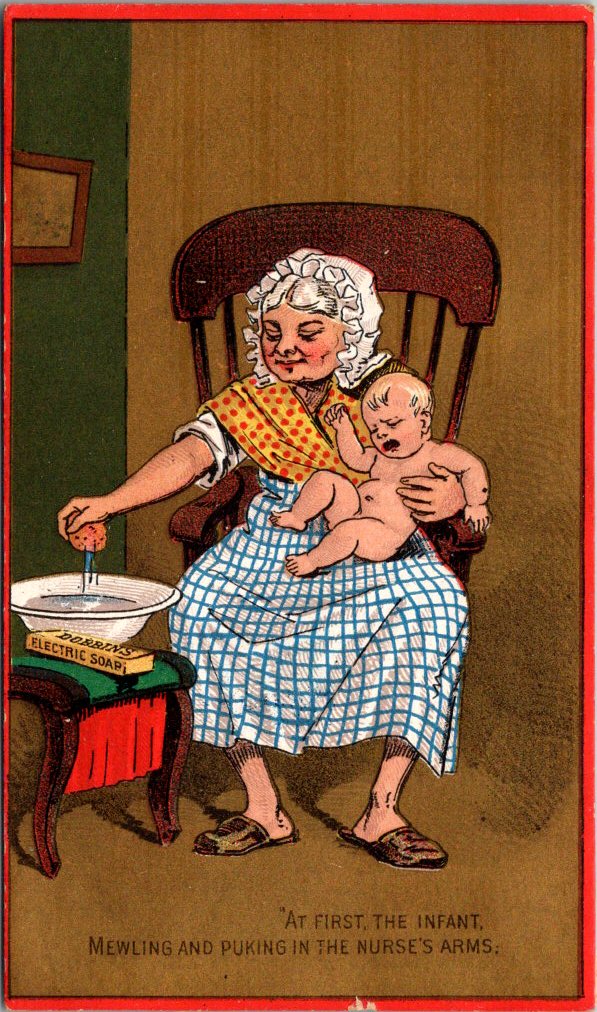
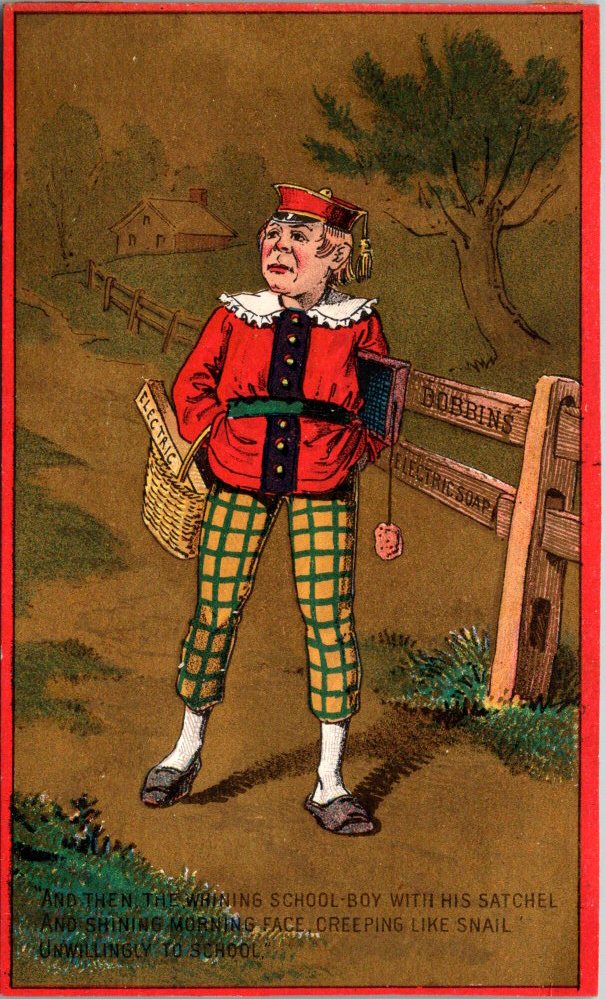
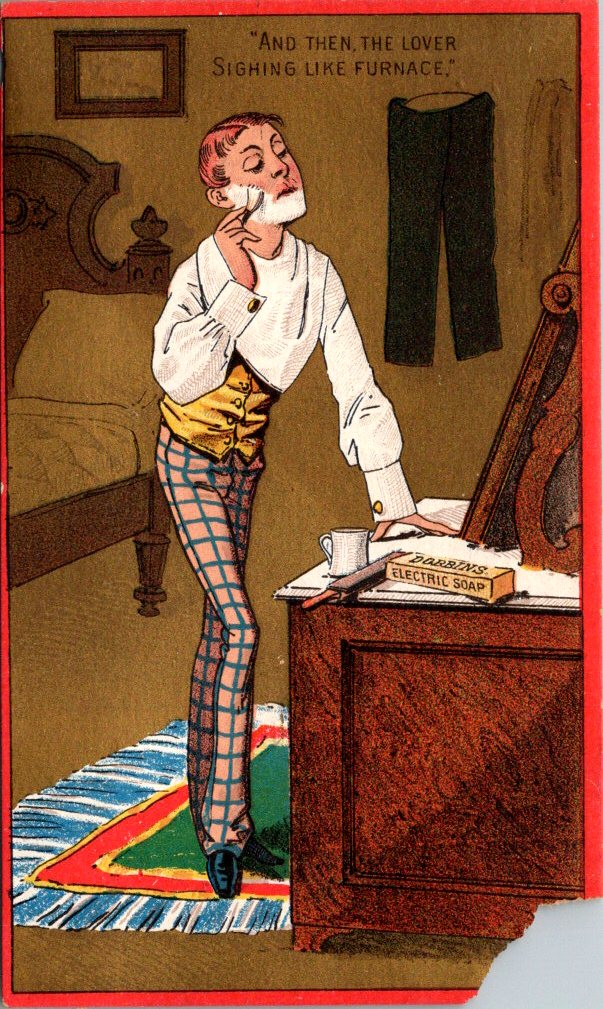
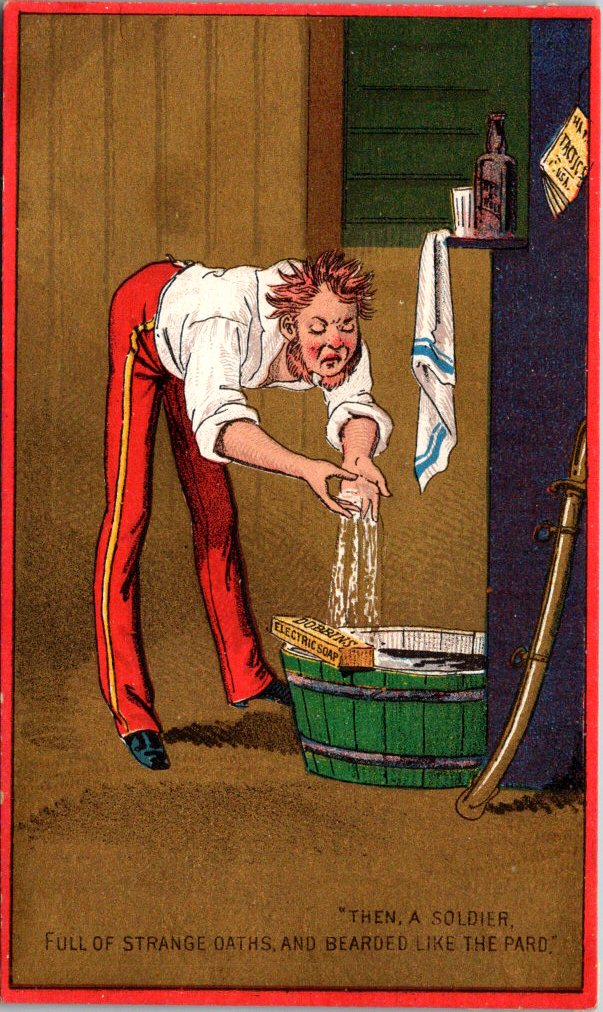
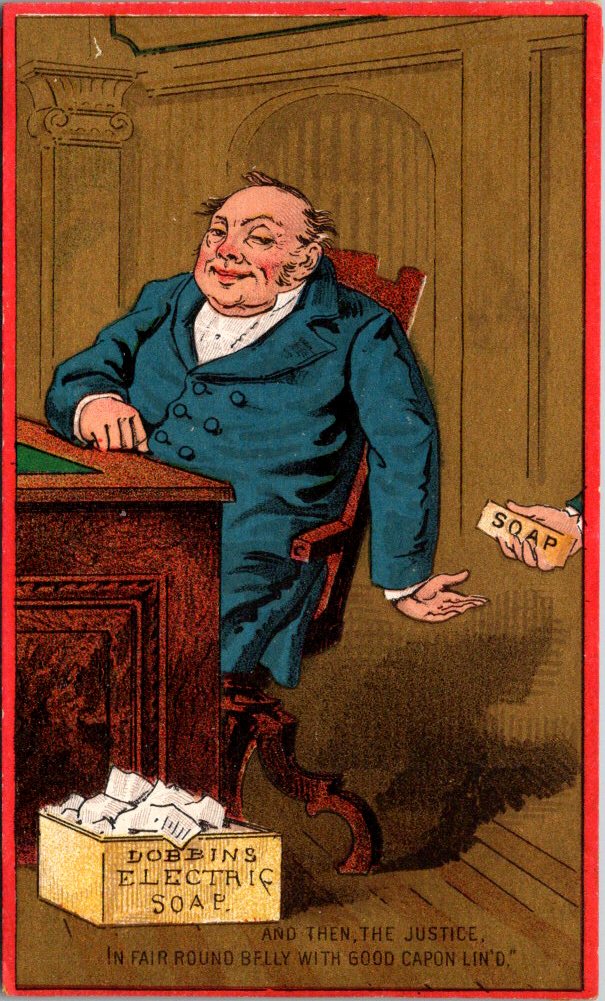
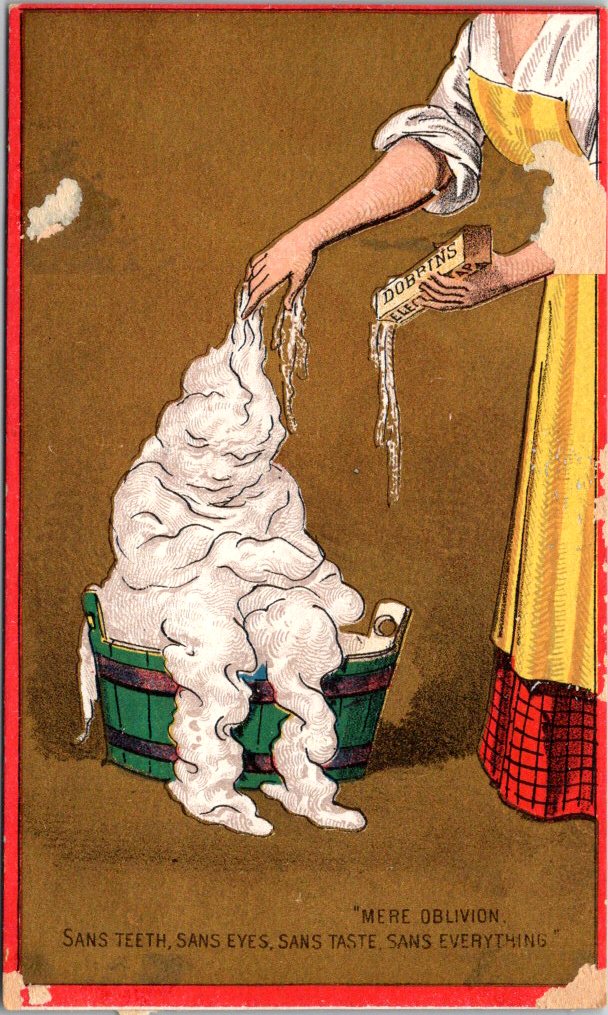
Front: Each card is a vivid chromolithograph on a warm gold ground with a bold red border, a consistent visual identity that makes the cards a set. The figures are drawn in a coarse comic style, expressive and exaggerated, with each character placed in a domestic or outdoor scene with a bar of Dobbins soap nearby.
First, a round-faced nurse in a white mobcap seated in a rocking chair, holding a squirming naked infant over a washbasin. Card Two shows a sulky schoolboy in a red jacket and yellow-green plaid knickerbockers, satchel over one shoulder. The lover on Card Three is a lanky figure in a gold waistcoat and plaid trousers, leaning against a bureau in a disheveled bedroom.
The soldier on Card Four is wild-haired and red-faced, bent over a green barrel-tub in his uniform trousers and braces, and a sword against the wall behind him. Card Five presents a rotund man in a blue coat, leaning back in his chair with the serene self-satisfaction of someone accustomed to receiving gifts. Card Six is an elderly Harlequin figure in a polka-dotted costume with red stockings, tumbling in mid-air. The final card is a woman in a yellow apron leaning over a green wooden tub, and a billowing human figure made entirely of suds.
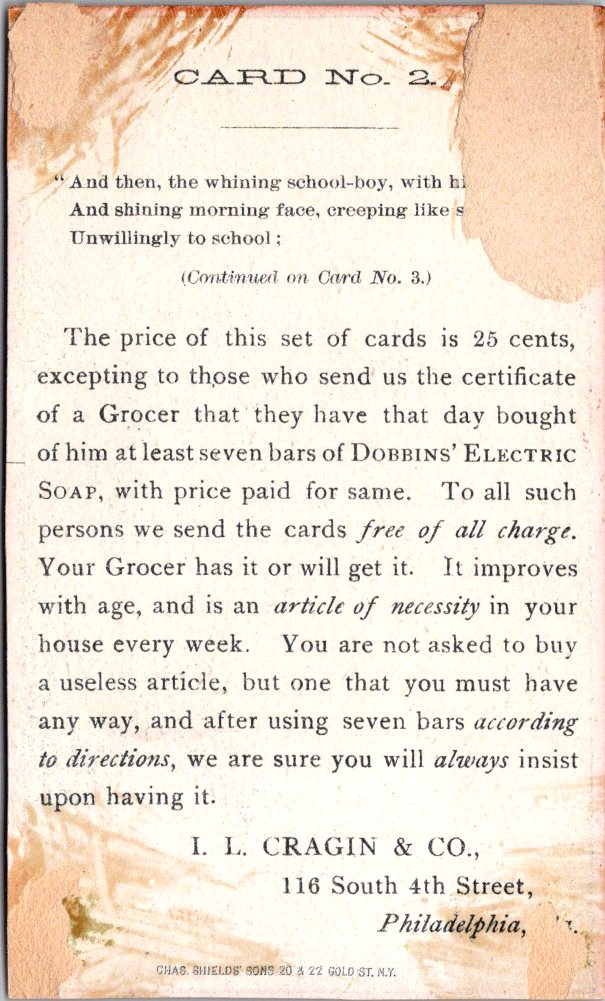
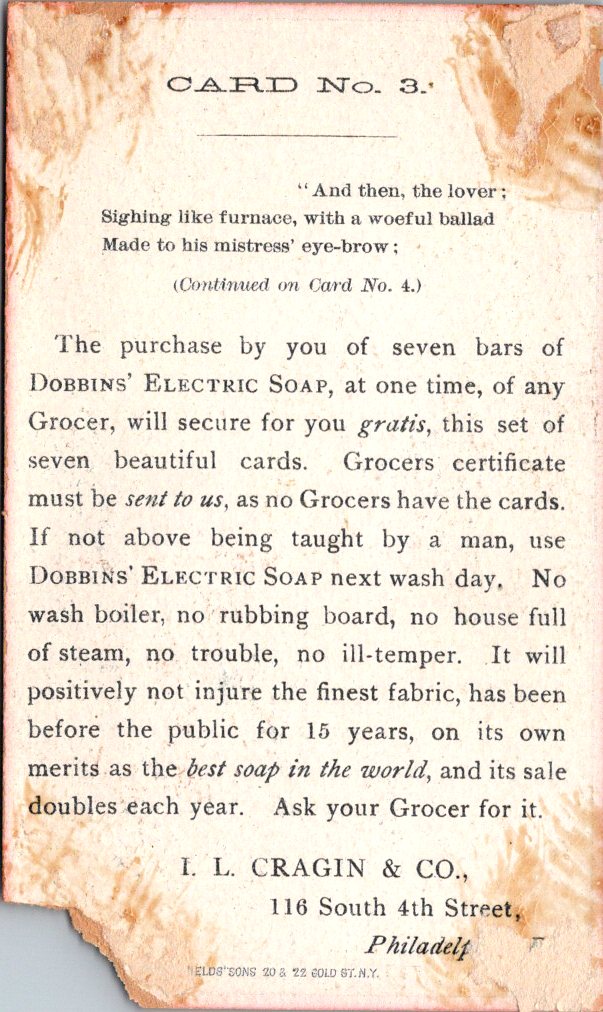
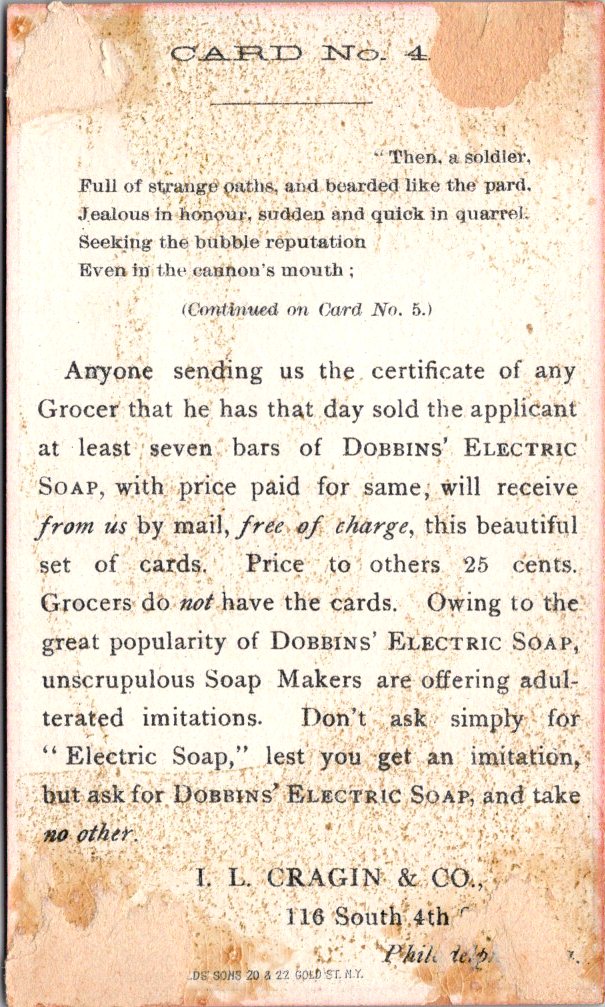
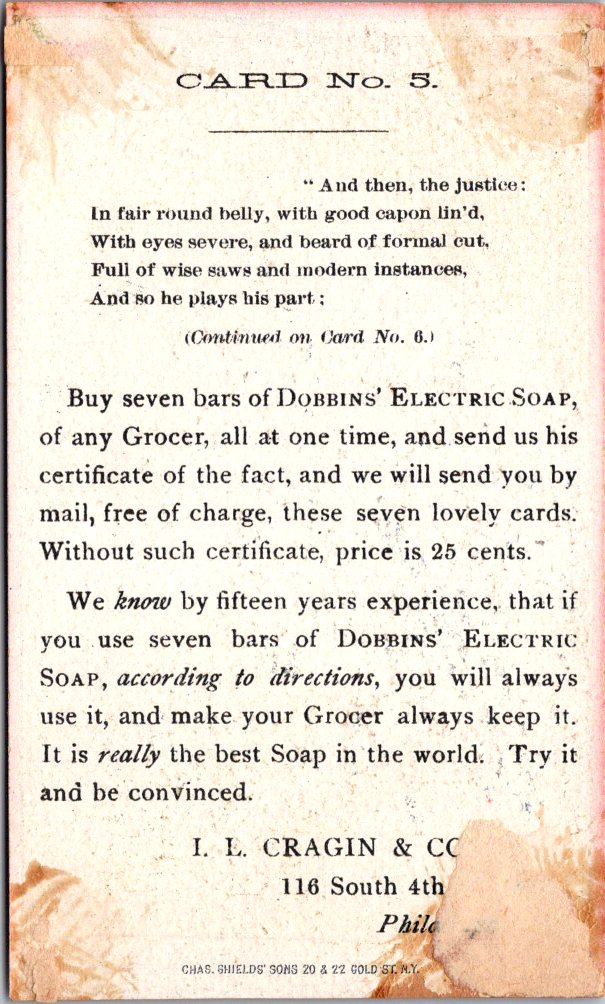
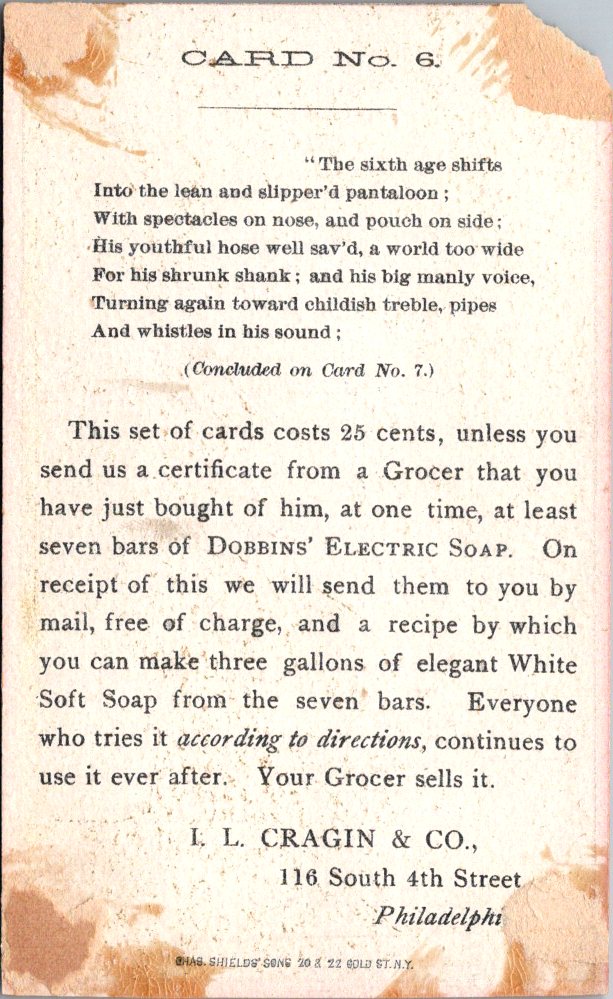
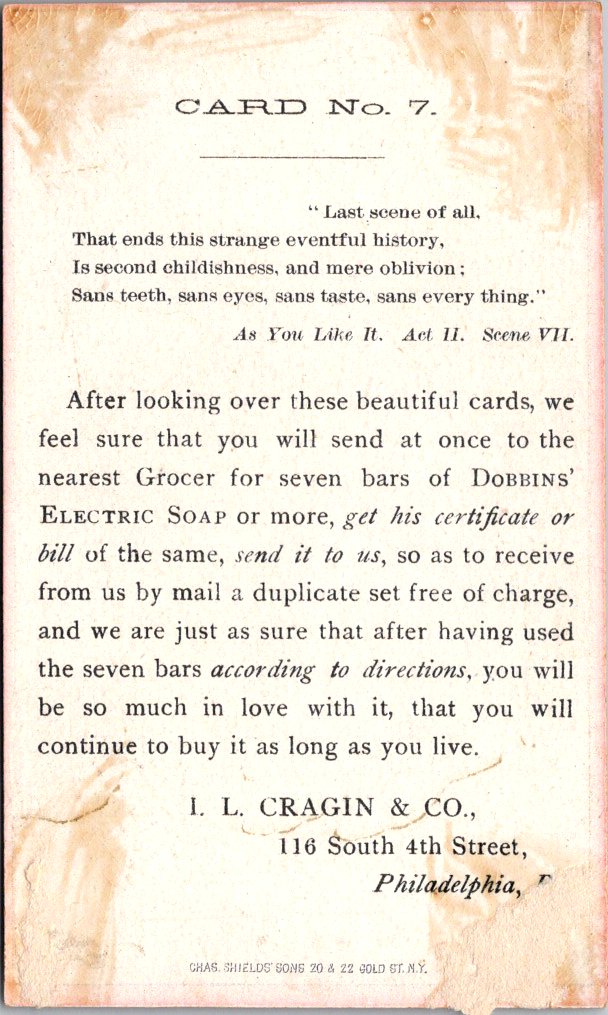
Reverse: Black text on cream stock with the full Shakespeare speech across all seven cards, each picking up the verse where the last left off. The final card identifies the source: As You Like It, Act II, Scene VII.
Below the verse, each card runs a version of the same offer in slightly varied language: collect a grocer’s certificate for each bar purchased and mail seven of them to 116 South 4th Street, Philadelphia. Without the certificate, the price for the set is 25 cents.
Each card presents a few product features: no wash boiler, no rubbing board, no house full of steam. Card Four warns against unscrupulous imitations and instructs buyers to ask for Dobbins’ Electric Soap by name. The printer’s imprint for Chas. Shields’ Sons, 20 & 22 Gold Street, New York appears at the foot of each reverse.
Production: These high-quality commercial chromolithographs likely date to the early 1880s, after the business had been in operation for more than a decade. The color registration is precise throughout, the figure work confident and expressive, and the gold-and-red palette gives the set a unified identity that still reads as a coherent series. The illustration style and rich production values mirror the opulent aspirations of the era.
Collectibility: Complete sets of themed trade card series are uncommon; most were distributed individually and rarely survived intact. The Shakespeare framework, the quality of the printing, and the conceptual ambition of the campaign make this set particularly distinctive. It appeals to trade card collectors, Victorian advertising historians, Shakespeare enthusiasts, and ephemera collectors with a taste for the literary and the delightfully absurd.
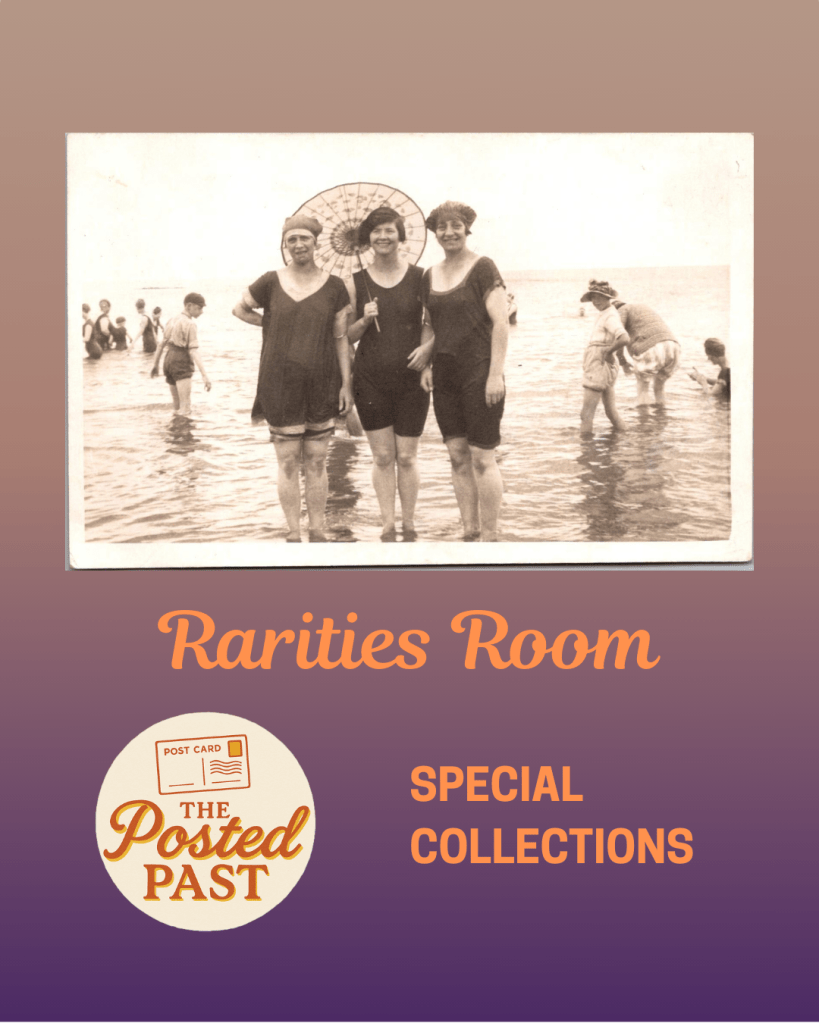
new Rarities Room
Our new space for the old stuff that no one ever threw away – yay!
Fröken Susanna Pettersson of Sunnansjö, Sweden couldn’t vote, couldn’t earn, and couldn’t easily leave her small village. But in 1903, she could receive romantic postcards. She kept them. But, did she reply?
Rare Cards ~ Four Antique Swedish Postcards Sent to the Same Young Woman
In rural Dalarna, Sweden around 1903, a young woman named Susanna Pettersson receive four romantic postcards from three suitors in nearby towns. All the postcards arrived through the local mail to an address at Tjärnsvedens, Sunnansjö, in the wooded heart of Swedish folk country.
The honorific Fröken printed before her name on every card tells us she was unmarried. In early twentieth century Sweden, it was a title with genuine social weight that was relinquished upon marriage. For Susanna, the boundaries of daily life were drawn by family, church, and society. The careful correspondence of courtship may have provided a sense of choice.
In these years, postcards were at the absolute peak of a golden age. Dominated by the German printing industry and distributed across Europe and abroad, romance cards were a technically sophisticated and lucrative niche in a rapidly growing economy.
These exquisite cards were chosen deliberately by suitors to convey a range of emotion, laden with symbolic images and verses of serious sentiment. In our case, the hand-scripted messages are overt. To send such a postcard was a cautious and considered act, even a declaration. To receive four such cards suggests a woman who inspired intention.
In the early 1900s, Scandinavia was reckoning with questions of identity and sovereignty that touched daily life and daily culture, woven in with the cultural flowering of Larsson, Lagerlöf, Ibsen, Grieg, and Munch. Sweden itself was unsettled. The union with Norway, in place since 1814, was fracturing toward its peaceful but charged dissolution in 1905.
Borlänge, just down the road from Sunnansjö, was growing fast around iron and steel, drawing young men out of villages like Susanna’s into an industrializing economy. The authors of these cards may themselves have been young men who moved away to seek their futures, writing back to Susanna across a widening distance of place and era.
Card 1 ~ Suitor 1 from Norhyttan
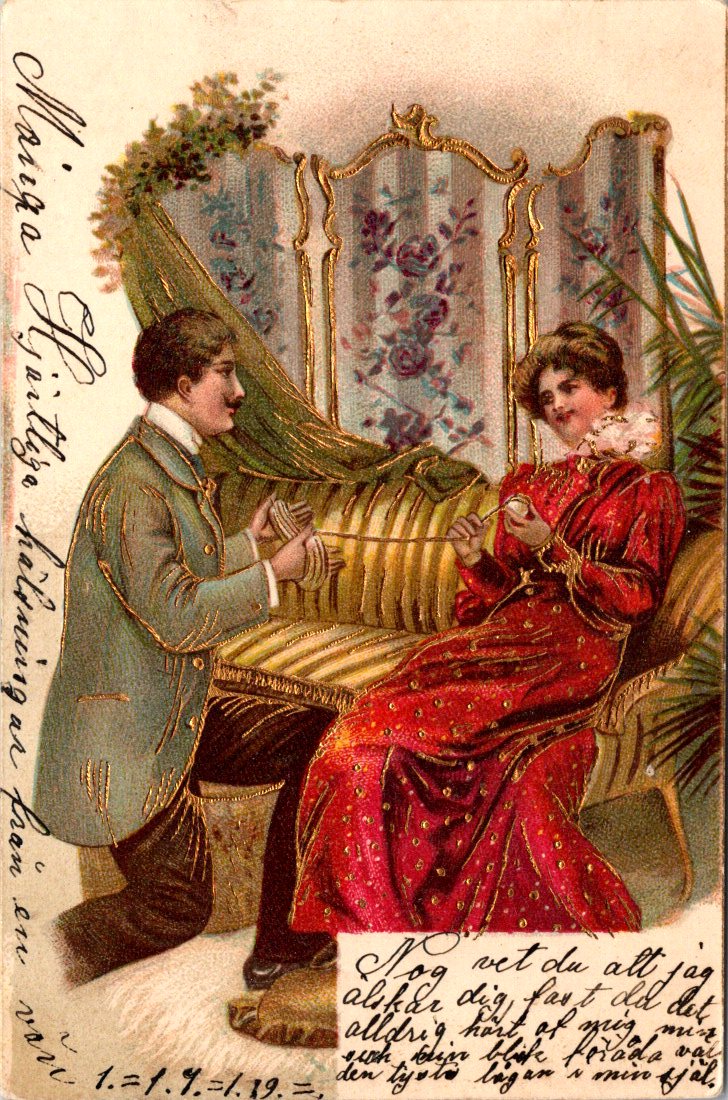
Front: An elegantly dressed couple in a richly appointed interior — man in blue-grey jacket, woman in red and gold dress — seated before an ornate folding screen painted with roses. Tropical palm in background.
Många Hjärtliga helsning av han ere…
Many heartfelt greetings from him who is [yours]…
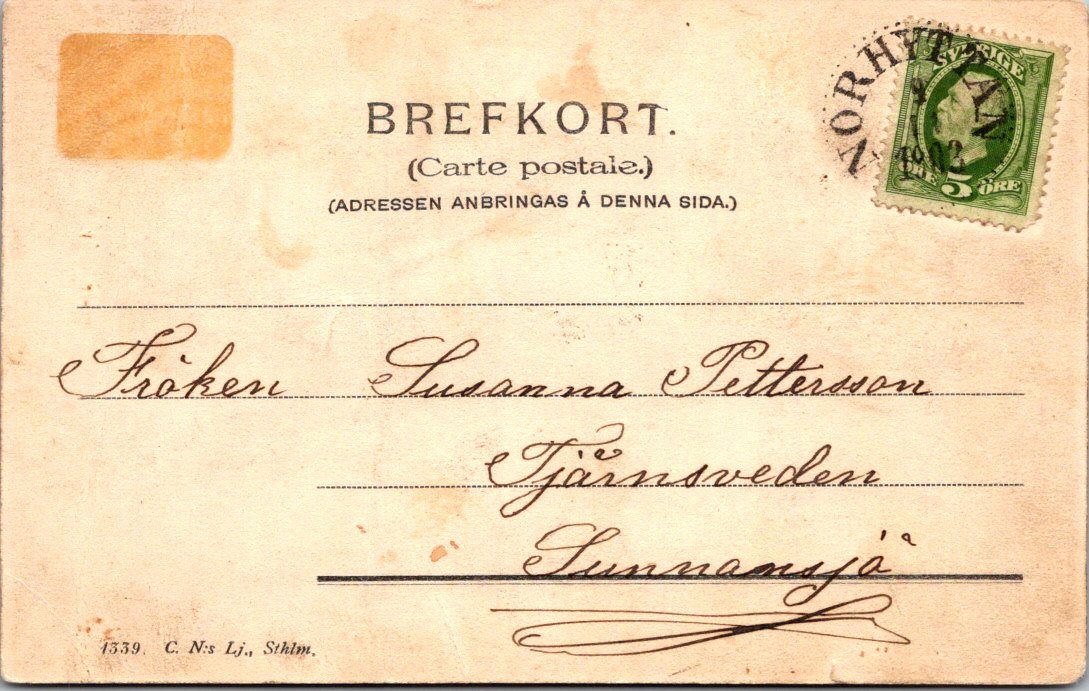
Back: Addressed to Fröken Sanna Persson, Tjärnsvedens, Sunnansjö. Note the affectionate diminutive Sanna rather than the formal Susanna used on other cards. Swedish 5 öre green stamp, Norhyttan postmark, circa 1902.
Correspondence: Lower right, heavily scripted in a practiced pen-and-ink hand. Left margin written vertically. Lower left coded notation: 1. = 1.9. = 1.19. =
Nog vet du att jag älskar dig, fast du det aldrig hört af mig, min och din blick föråda val den tysta lågan i min själ.
You surely know that I love you, even though you have never heard it from me. Mine and your glance betray the silent flame in my soul.
Production and Collector Notes: Premium chromolithograph with gold embossing, likely printed in Germany or Austria. Numbered series notation, Serie 193. Embossed romance cards of this quality with intact original Swedish correspondence are increasingly scarce. Of interest to collectors of Scandinavian ephemera, Edwardian romance, and social history researchers.
Card 2 ~ Suitor 1 from Norhyttan
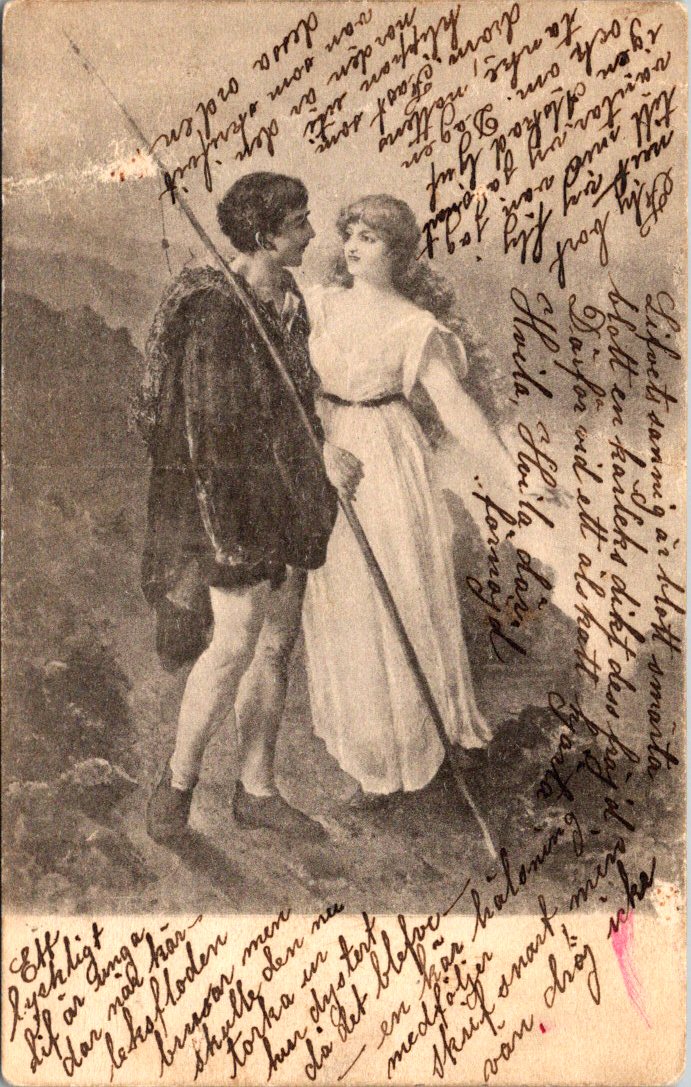
Front: An archetypal couple stands on a rocky highland landscape with a misty and dramatic backdrop. A man in rough tunic carries a tall staff next to a woman in flowing white dress with loose hair.
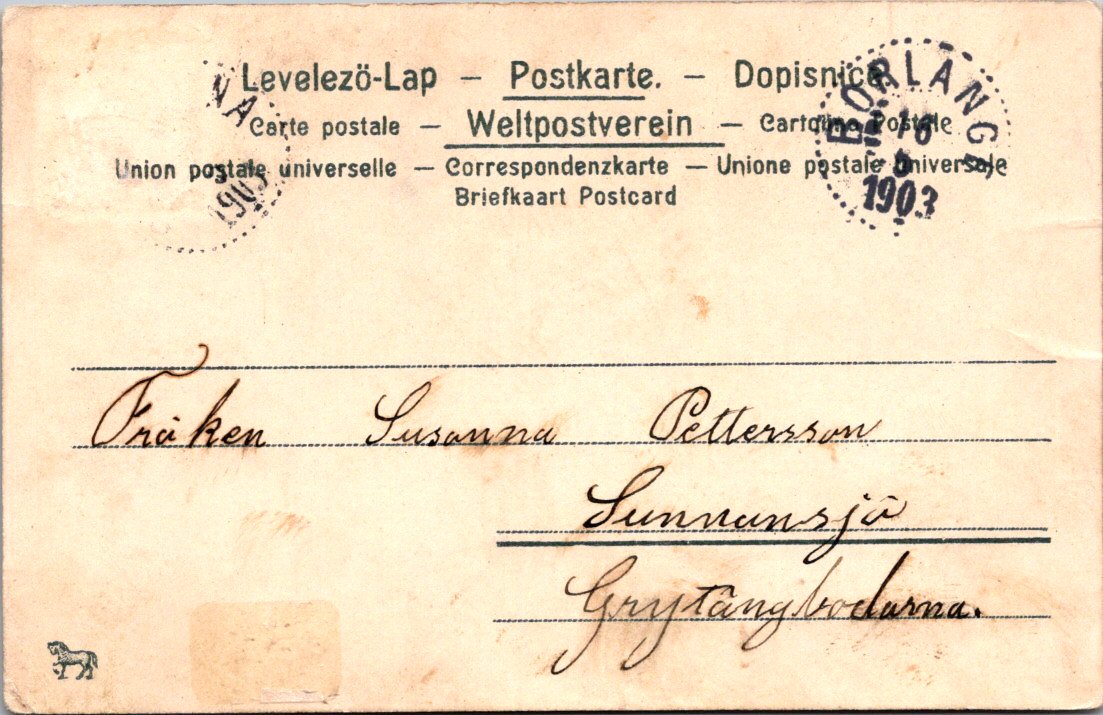
Back: Addressed to Fröken Susanna Pettersson, Tjärnsvedens, Sunnansjö. Swedish 5 öre stamp, Norhyttan postmark.
Correspondence: Densely written in heavy hand-scripted text running in multiple directions across the image.
Elfligt lyckligt är att änga — då ned har bäksfloden bringar men nu skralla den nu torka in text hur dyster då det blefo…
Blissfully happy it is to linger — when down the brook brings / but now how gloomy / when it became…
Production and collector notes: Sepia-toned romantic lithograph published in Stockholm by C. Ns Lj., Sthlm.Series 1339. Domestic Swedish production rather than imported German print, comparatively less common for this period and market. The heroic Nordic couple reflects romantic aesthetic prominent in Scandinavian visual culture of the early 1900s. Dense multi-directional handwriting across the image face is biographically significant. Of interest to collectors of Swedish ephemera, Scandinavian social history, and scholars of private correspondence.
Card 3 ~ Suitor 2 from Borlänge
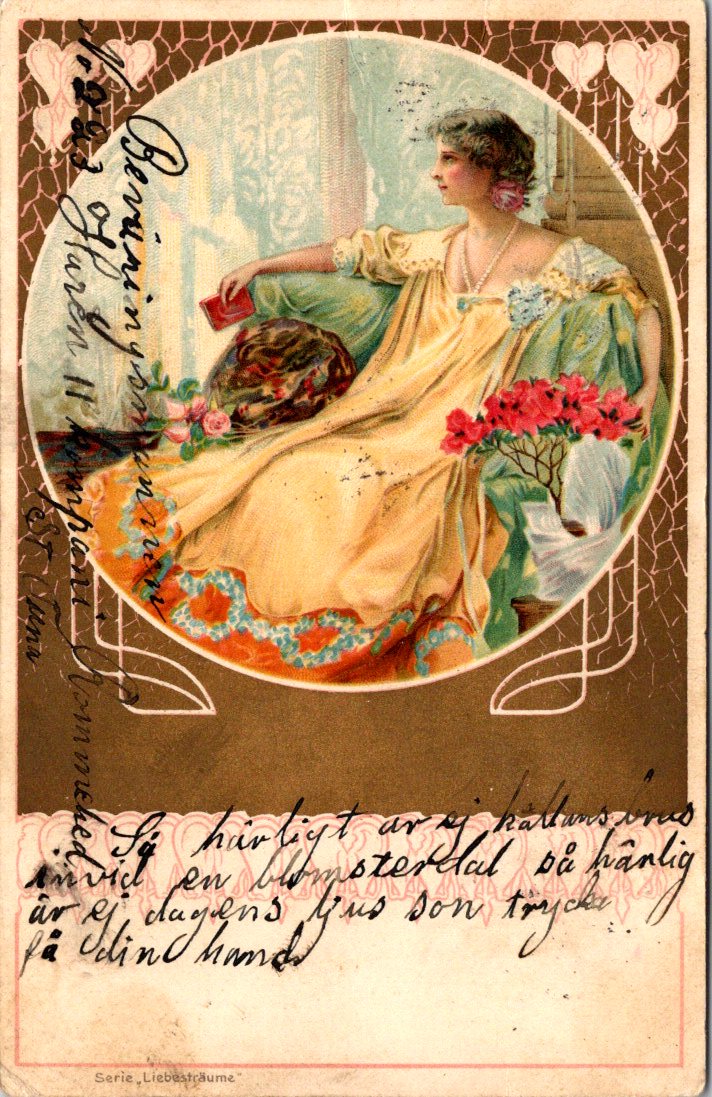
Front: A young woman in a golden-yellow gown reclines on a chaise surrounded by red azaleas and roses, holding a small red book or letter, gazing pensively to one side. Circular vignette set against a rich gold ground with pink Art Deco lattice decoration and heart motifs in each corner.
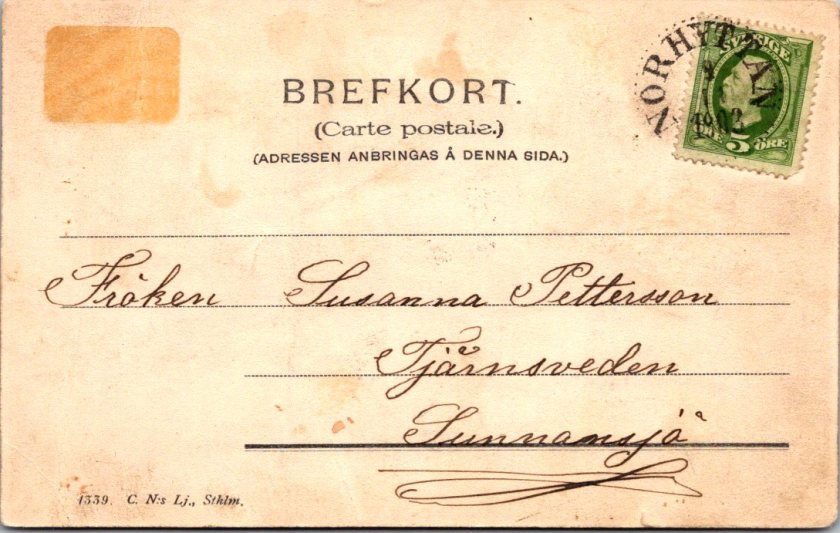
Back: Addressed to Fröken Susanna Pettersson, Sunnansjö, Gryftångbodarma. The address variation roughly translates to ‘summer farm buildings’ suggesting that Susanna was not at her main home but was staying at a seasonal outpost. Postmark, Borlänge, 1903. Small printer’s horse mark, bottom left.
Correspondence: Rounder and more casual hand-script. Left margin may be a name or family reference.
Så härligt är ej källans öras invid en blomstertal så härlig är ej dagens ljus son tryckt få din hand.
Not so lovely is the murmur of the spring, beside a flower-tale so lovely — not so bright is the light of day, as when pressed upon your hand.
Production and collector notes: Art Nouveau chromolithograph, Serie “Liebesträume” (Dreams of Love), produced by a quality German publisher and distributed internationally, reflecting Germany’s dominant role in the European postcard market of this era. Art Nouveau romance cards with intact Swedish correspondence and Borlänge postmark are notably scarce. Of interest to collectors of Art Nouveau ephemera, Scandinavian material culture, and historians of industrializing Sweden.
Card 4 ~ Suitor 3 from Stockholm
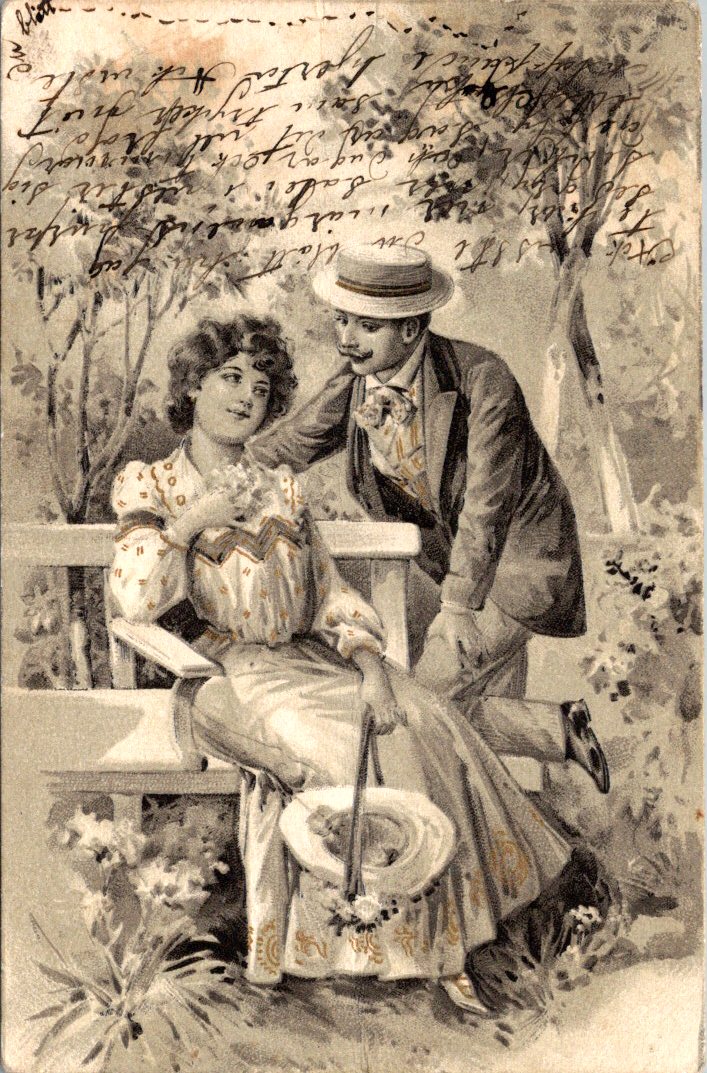
Front: A couple in a garden setting — woman in white and gold embroidered dress seated on a bench with flowers and parasol. Man in dark suit and straw boater hat leaning toward her attentively. Flowering trees surround them.
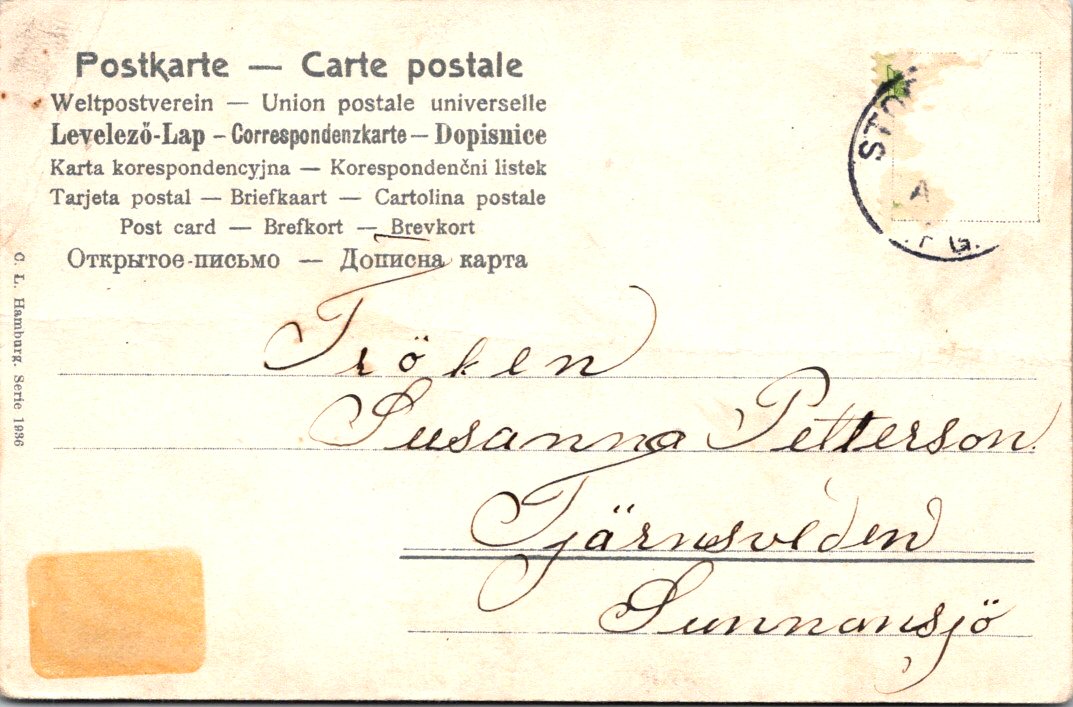
Back: Addressed to Fröken Susanna Petterson, Tjärnsvedens, Sunnansjö. Postmark origin reads Sto-, stamp damaged, full date not legible. Almost certainly Stockholm, circa 1903.
Correspondence: Written across the upper image in a compressed angular hand, distinct from both previous writers. Faded pen and ink, with partially legible fragments.
Bätt… polset… och mer… bättre…
Better… better… and more… better…
Production and collector notes: Sepia lithograph with gold highlights published by G. L. Hamburg. Serie 1896, a respected German publisher. Hamburg-published cards with intact Swedish correspondence and Stockholm postmarks from this period are collectible. Of interest to collectors of German-published romance cards and Edwardian Scandinavian ephemera.
Susanna Pettersson lived in a world that offered her limited formal choices. But in a small wooden house in Dalarna at the beginning of the last century, she could make her own quiet judgments. She could choose carefully.
Three suitors, three futures. Did she answer any of them? Whether she eventually became Fru or remained Fröken, we can’t discern from the evidence here. All we know is that she kept those four cards all those years.
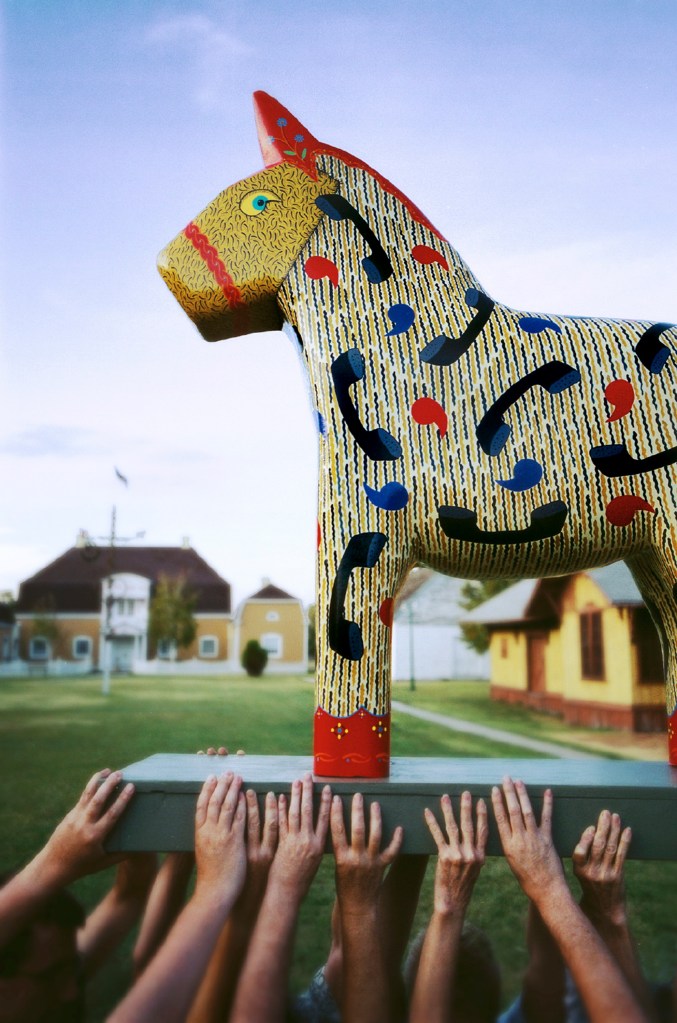
The postcards in this rare set were sent from the heart of Dalarna, Sweden — the same province that gave the world the iconic Dala horse, a brightly painted wooden folk toy whittled by loggers and miners during long Scandinavian winters. In 1869, Swedish immigrants from Dalarna carried that tradition across an ocean to the Kansas prairie, founding the town of Lindsborg — known today as Little Sweden USA, where you can Hunt for Wild Dalas!
Valentine’s Day is over. The chocolates parceled out, consumed in a binge, or sweetly regifted. The cards are in a stack. Love trudges on.
Before we go, there is a word worth saying about silences and the quiet costs of delayed connections, and those missed entirely.
In May 2023, the Surgeon General issued an advisory that stopped me mid-scroll. Loneliness had reached epidemic levels in the United States. He was not describing the usual suspects—a widower, a loner, someone at the edge of class or condition. I had to admit, his warning rang a bell in my own heart. I was among a growing contingent of the ordinary, ambient, alarmingly average lonely. As a caregiver, days passed without anyone really seeing me, or me really wanting to be noticed.
The Surgeon General called it a public health crisis. He compared its effects on mortality to smoking fifteen cigarettes a day. Actual harm done.
Indeed, social isolation raises the risk of heart disease, stroke, dementia, and early death. The health research is not soft or sentimental. The body registers being unseen the same way it registers physical pain — same neural pathways, same hormonal alarm signals, same disrupted sleep, same compounding risks. We are living inside a paradox: more connected by technology than any humans in history, and perhaps lonelier than our ancestors.
In the golden age of the postcard — roughly 1900 to 1920 — Americans sent billions of them. A trip to the lake. A hello from the city. A heart, a name, a single line of longing, on full view to the mail carrier and anyone else who handled it along the way. The medium demanded brevity, levity, and a light touch.
That simple approach is worth noticing, because we tend to use the absence of time as our primary excuse for not reaching out. We sense there isn’t room in the average difficult day for a real conversation. So we wait. And the time doesn’t come. And the silence grows.
A postcard is a signal, not a report. It says: I haven’t forgotten. A brief message can make a big point. At times, the whispered delivery bears the full meaning.
The research on what makes people feel less alone points not to the depth of connection in any given moment, but to its consistency. There is comfort in the reliable sense that someone, somewhere, is holding you in mind. A brief, warm gesture, repeated, does more for that feeling than an overwrought or inconsistent one.
Simple gestures are not consolation prizes. They are the architecture of belonging.
Sadly true, is often easier to extend kindness to a stranger than to sustain the loving glow among the people you know best. A stranger on a difficult day can receive warmth without a complicated history. They don’t owe you a response and you likely won’t know how the gift was felt. You haven’t let them down in the small accumulated ways that life’s closeness allows.
The people we love most are the ones we are most likely to let drift or actively ignore. A peculiar paralysis comes with the familiar foibles, caring deeply, and feeling the gap widen.
So here is a gentle nudge, the week after the holiday, when the pressure is off and the expectations are low. Not because it’s February. Because it’s Wednesday, and someone who loves you needs to know. A postcard or a hug, a humble tug on the sleeve or a quiet walk. None of it asks or offers too much. A simple, “We are ok,” can be enough.
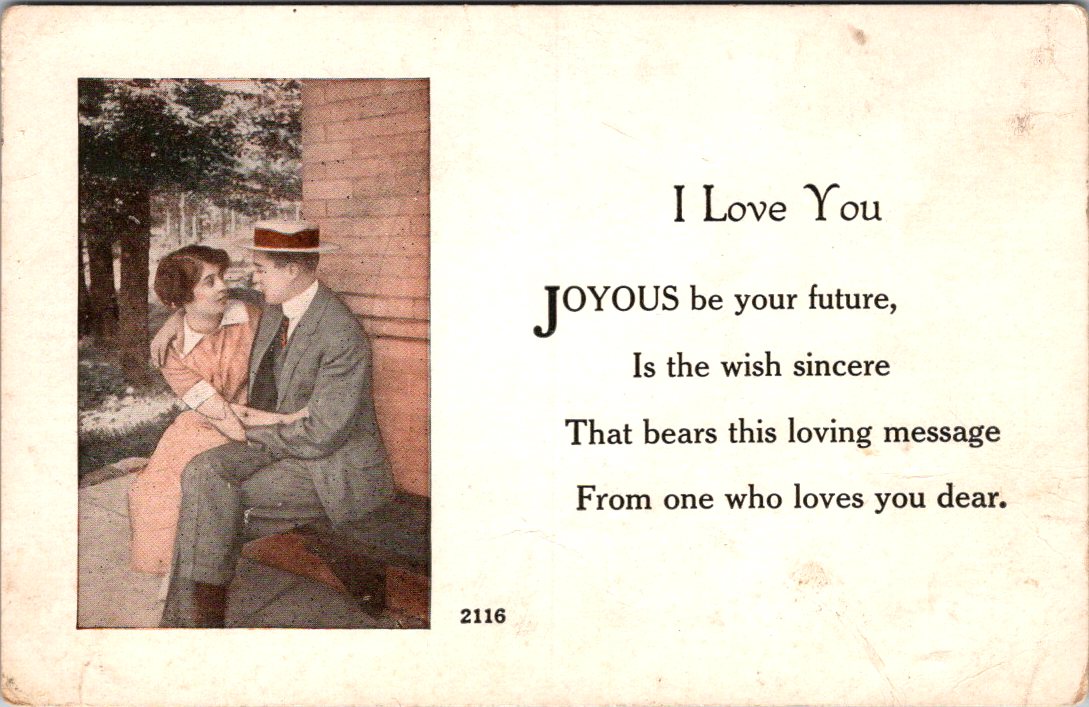
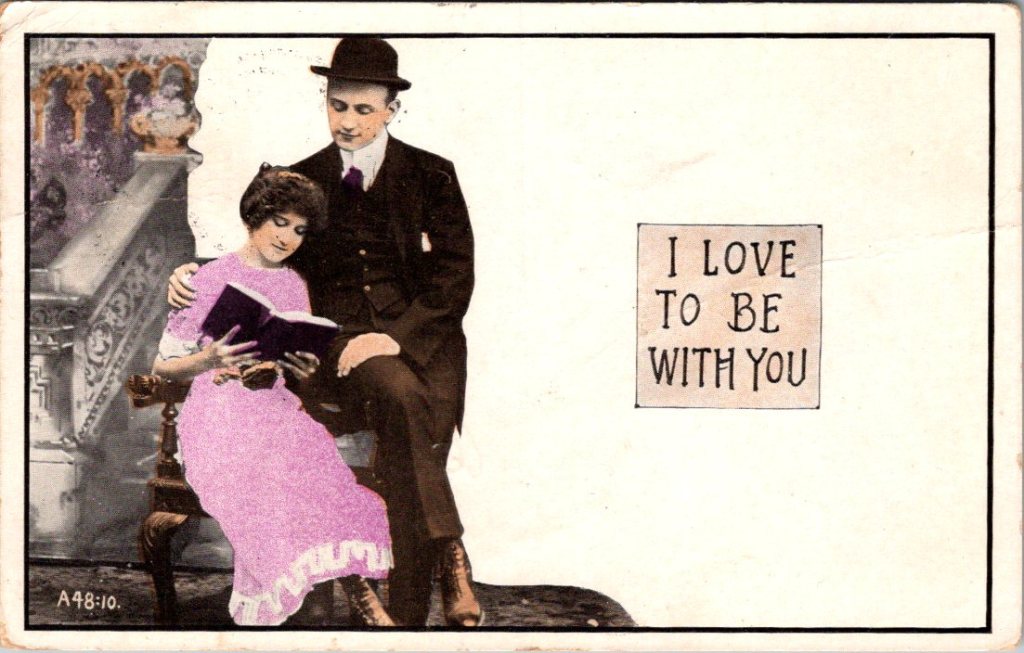
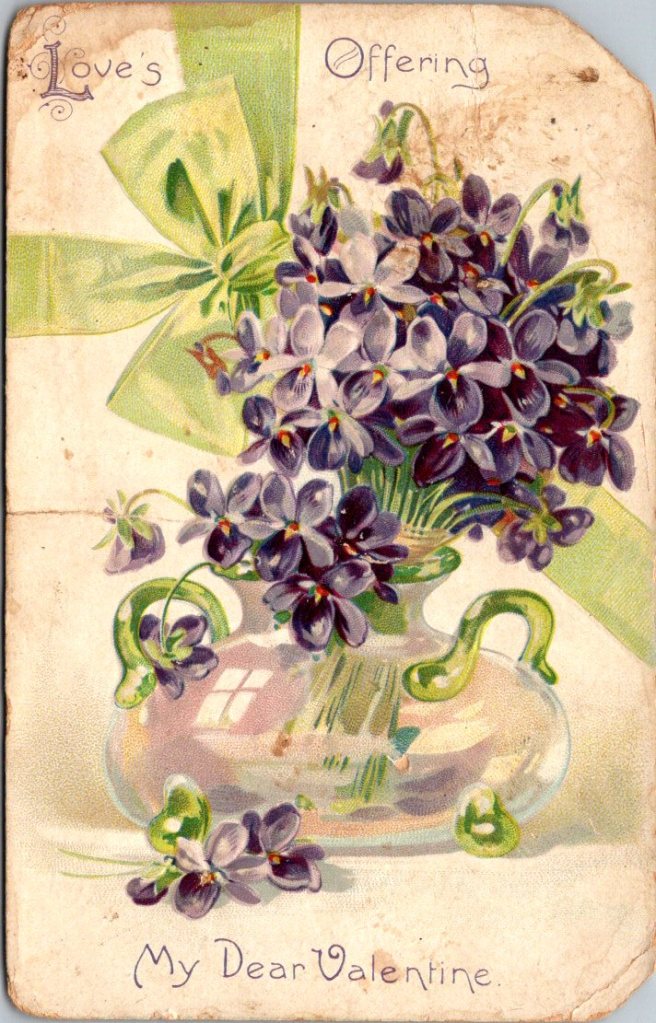
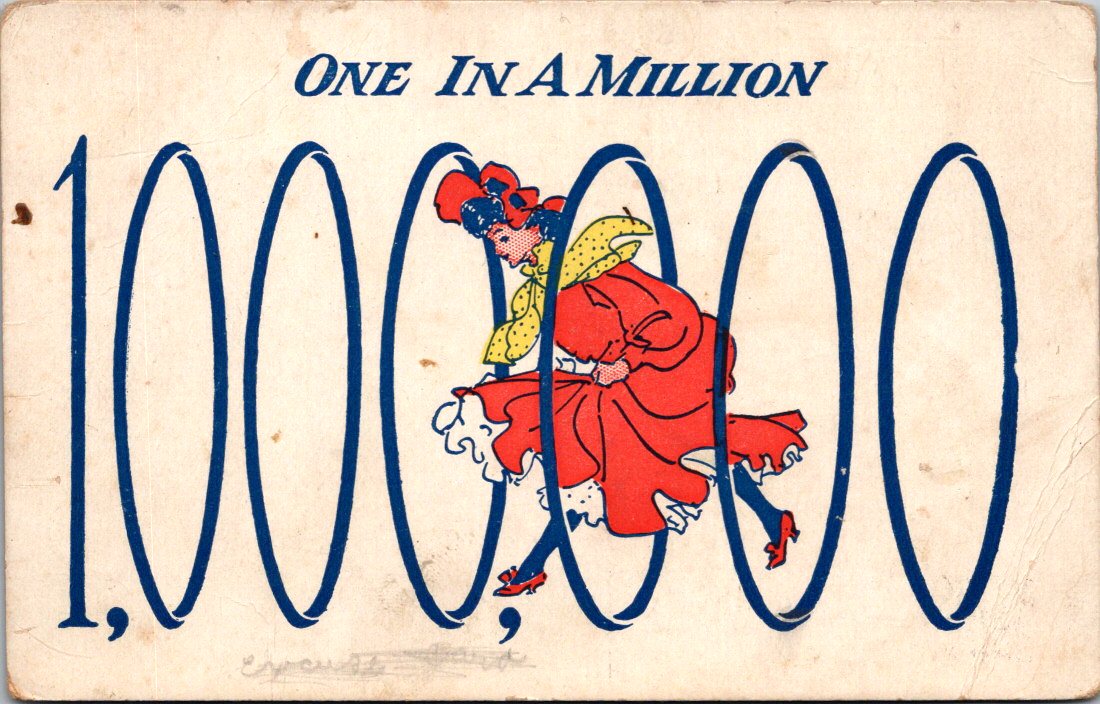
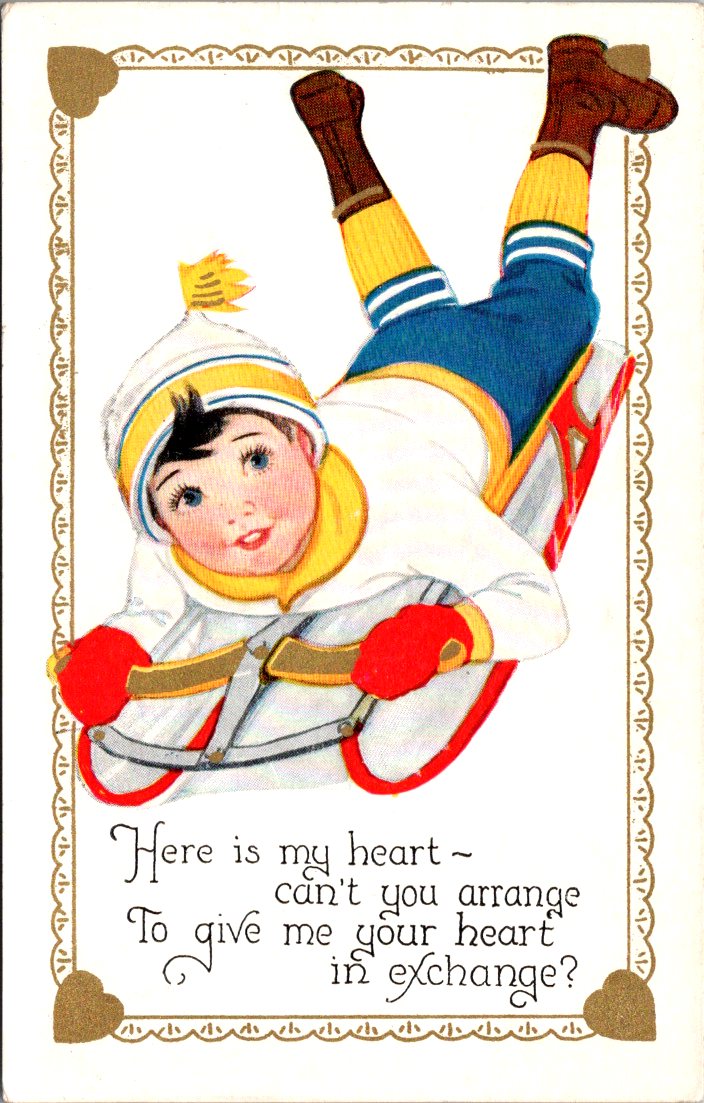
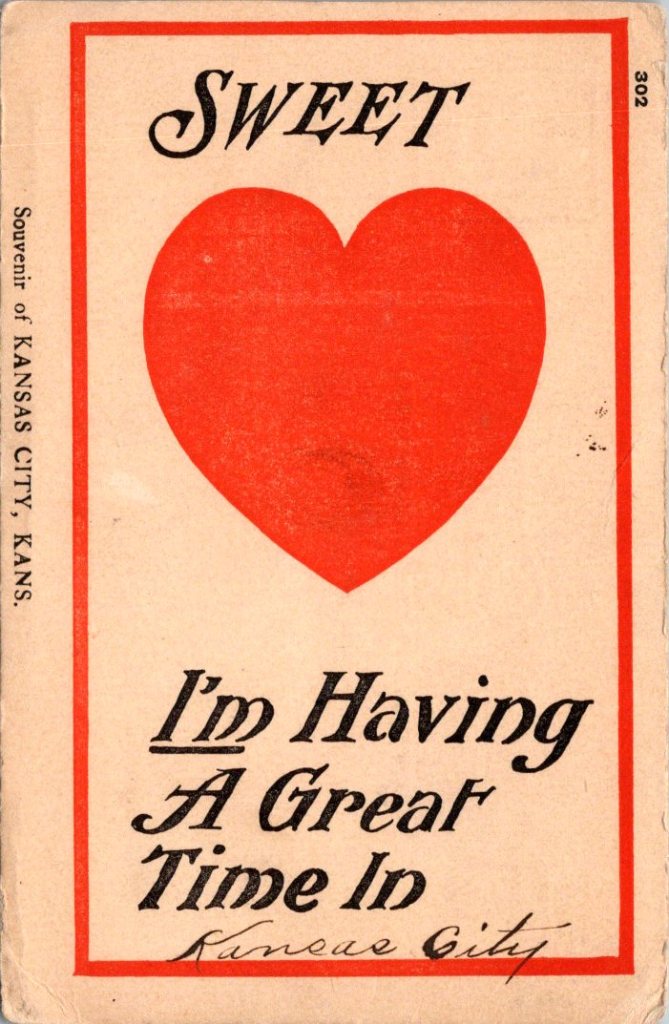
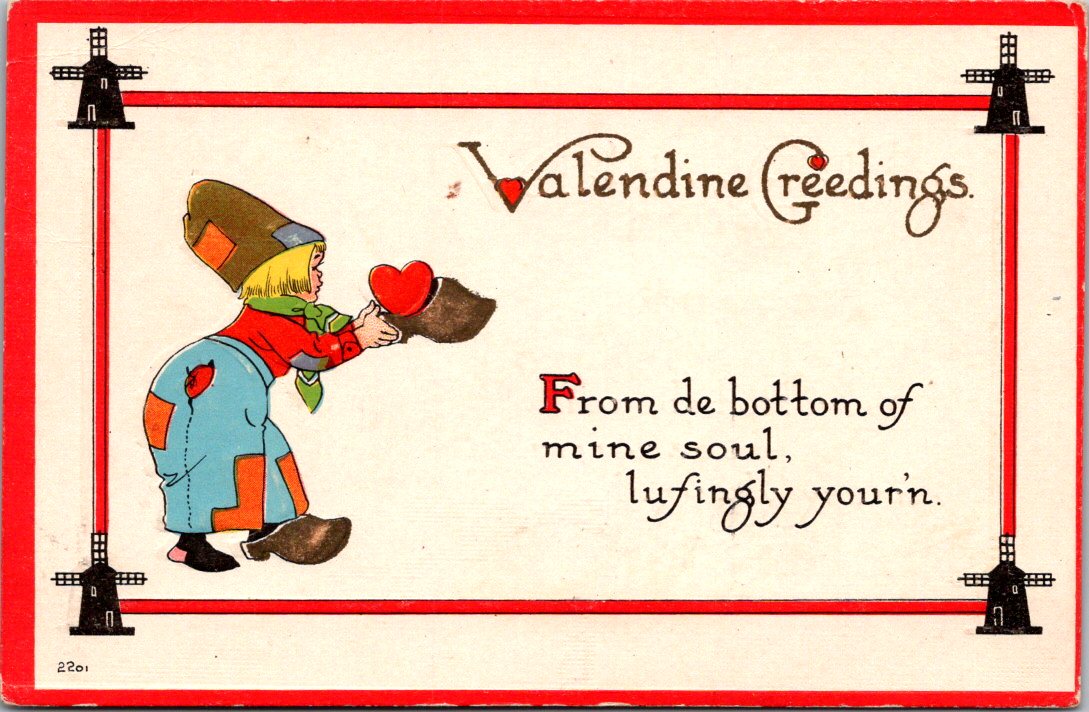
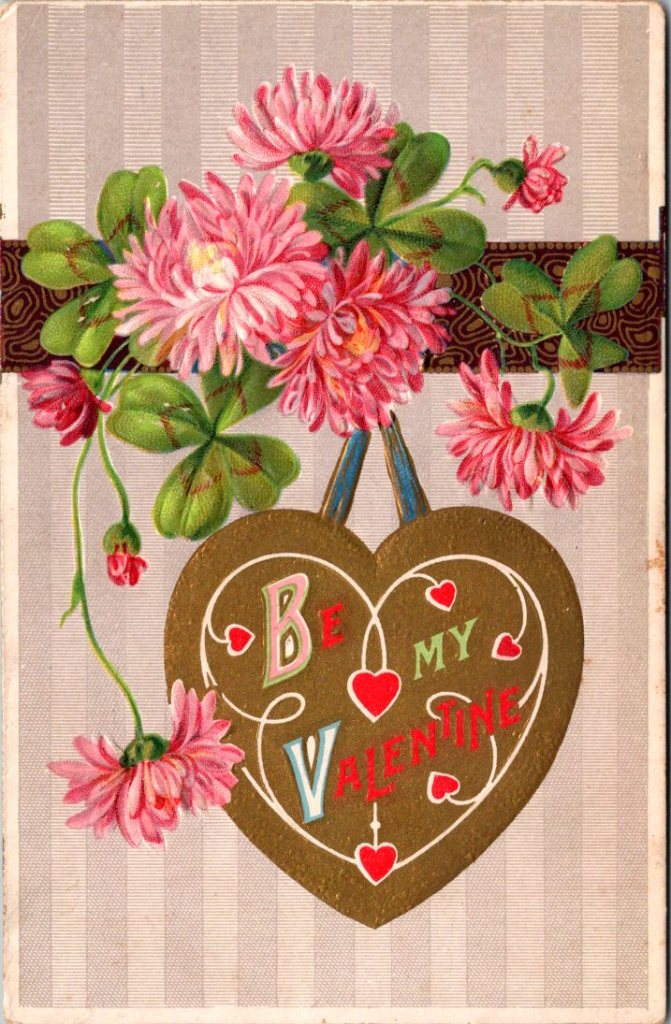
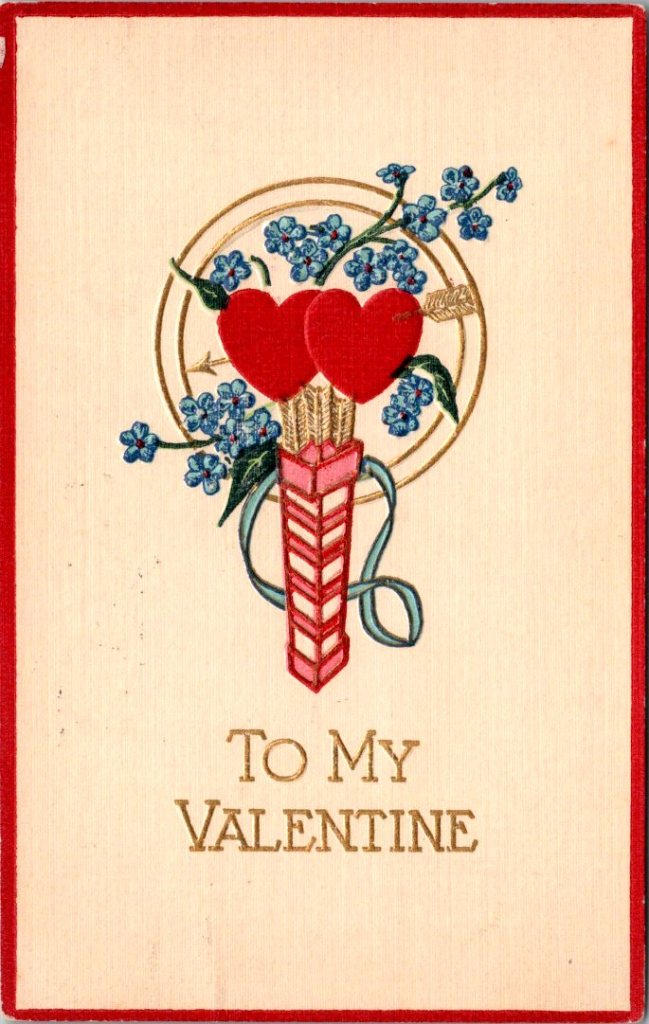
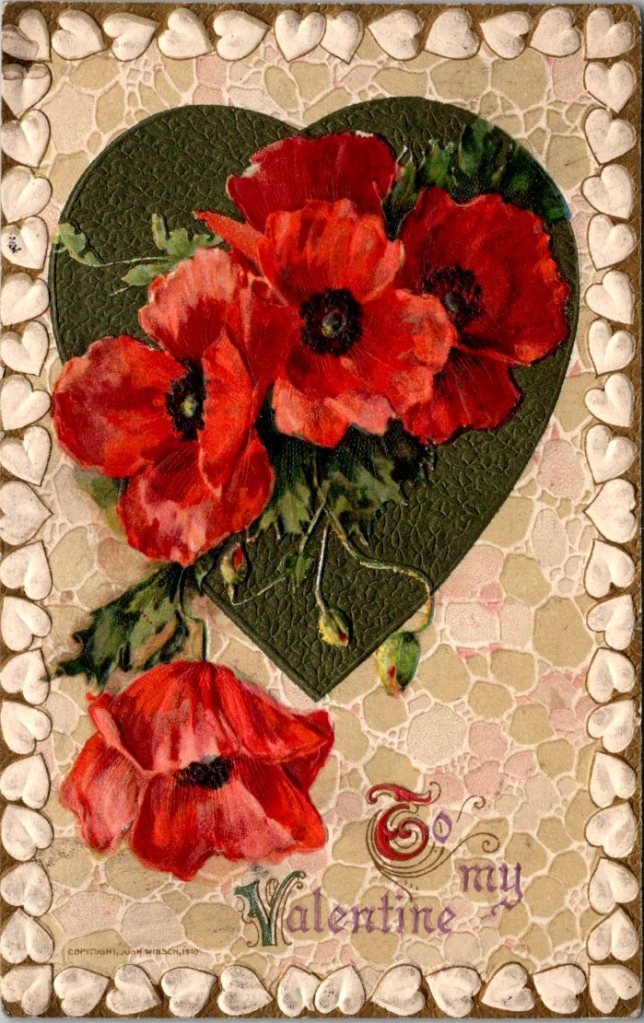
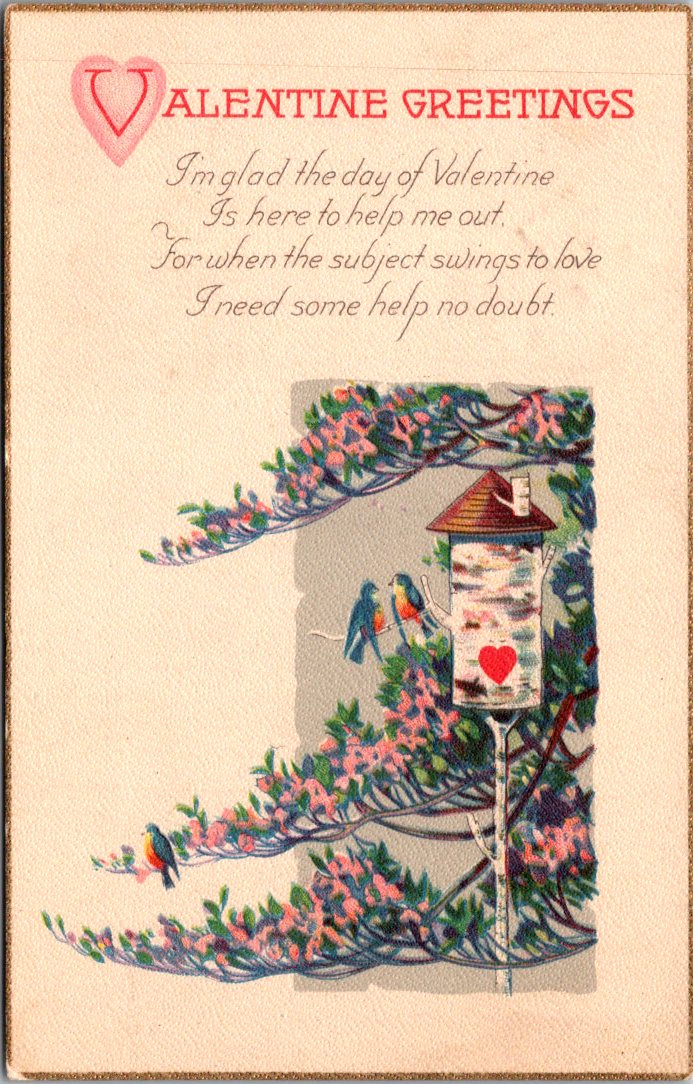
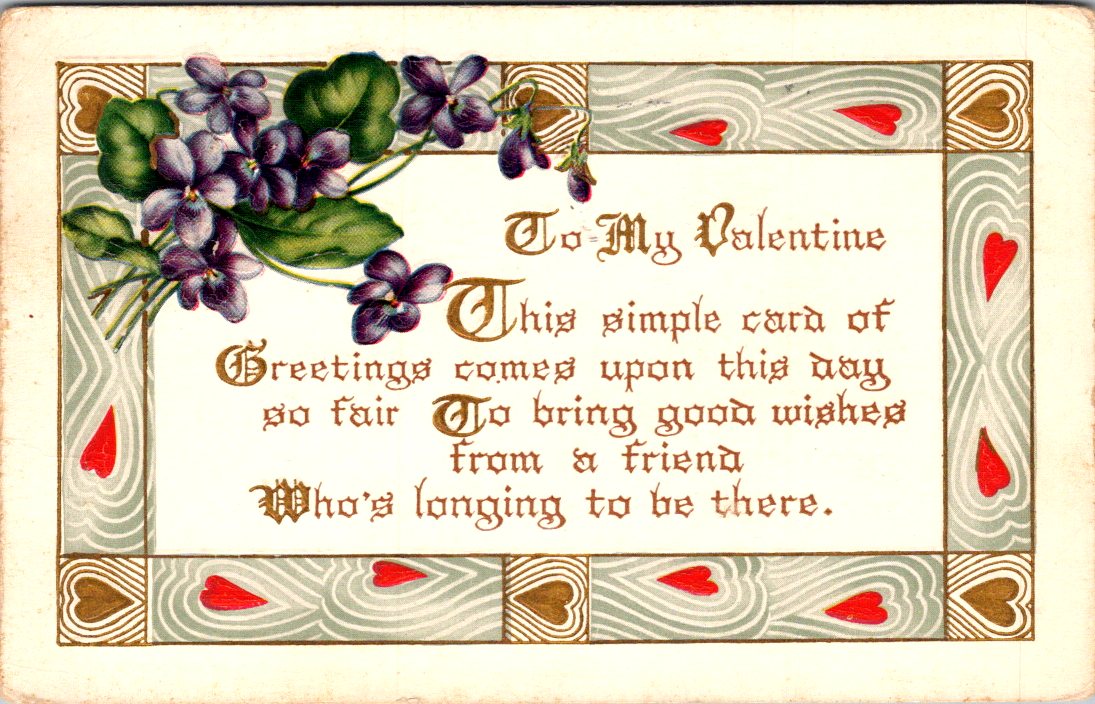
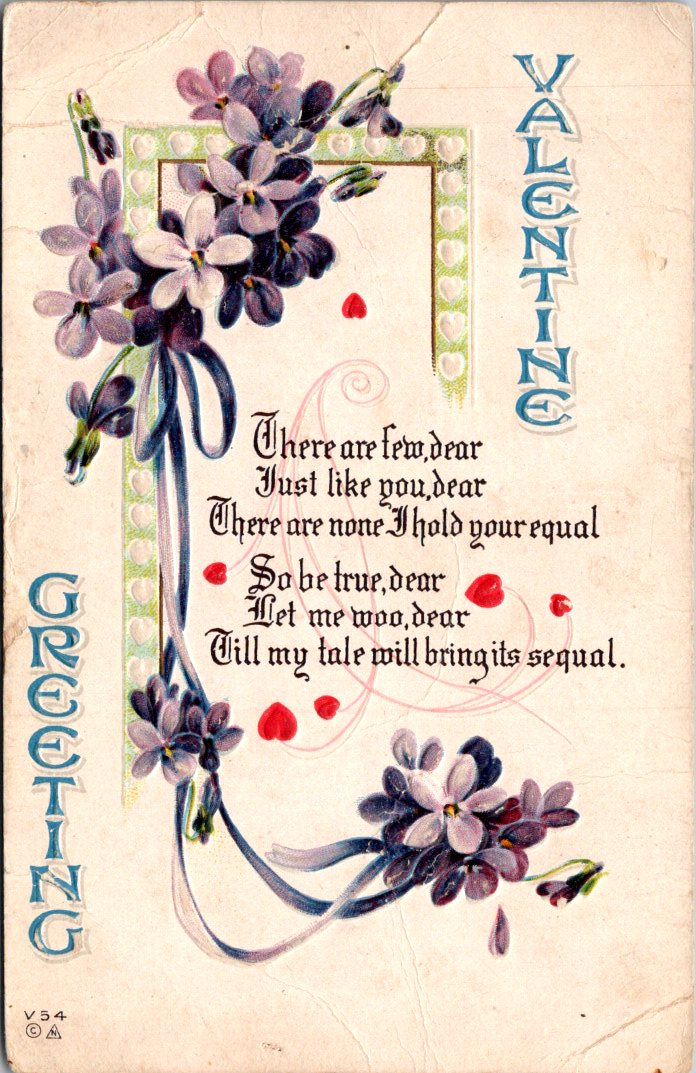
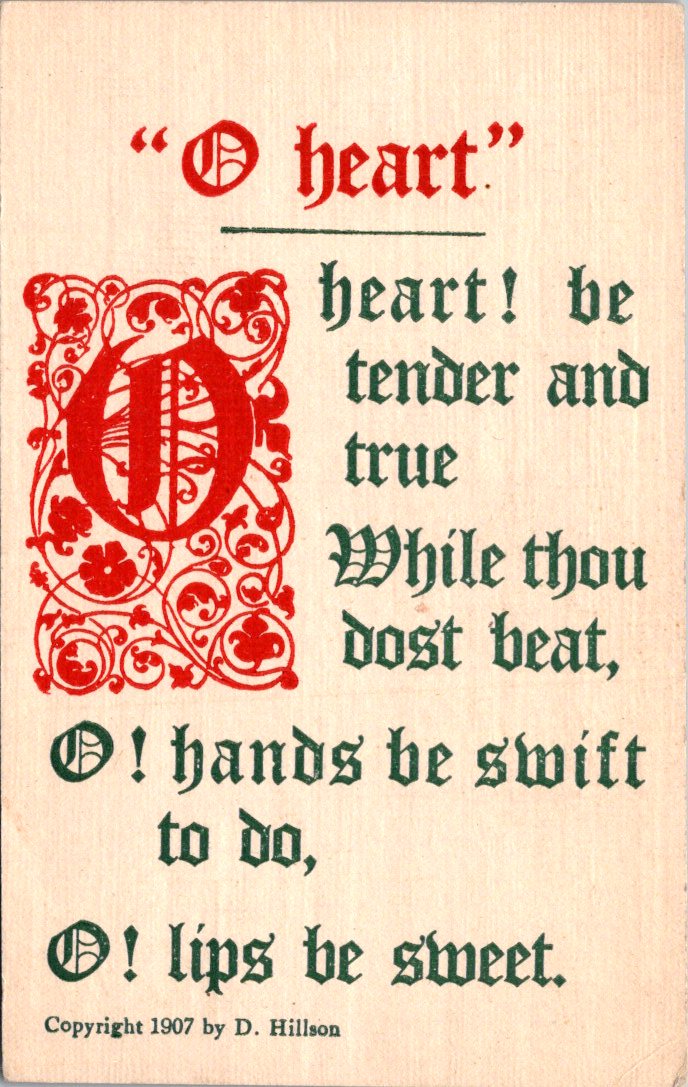
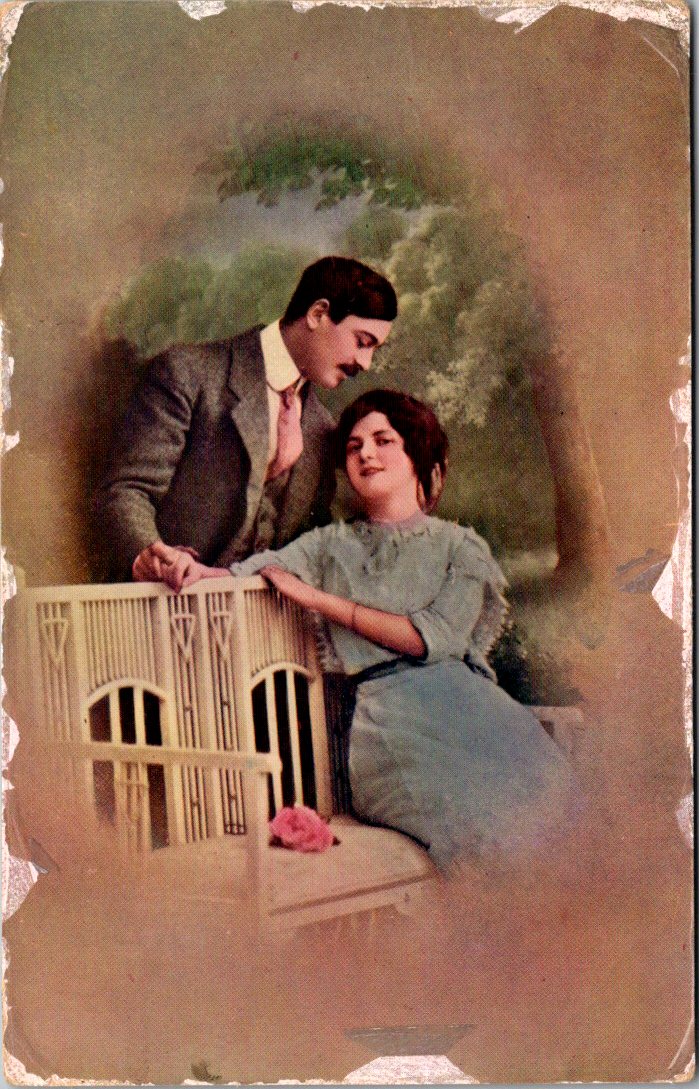
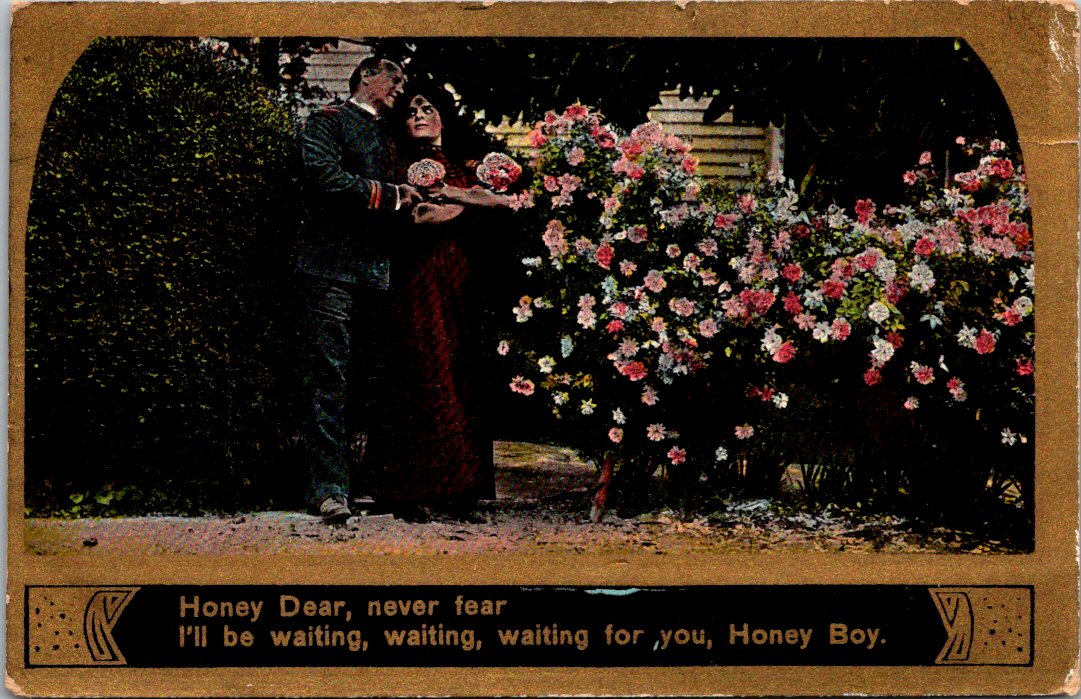
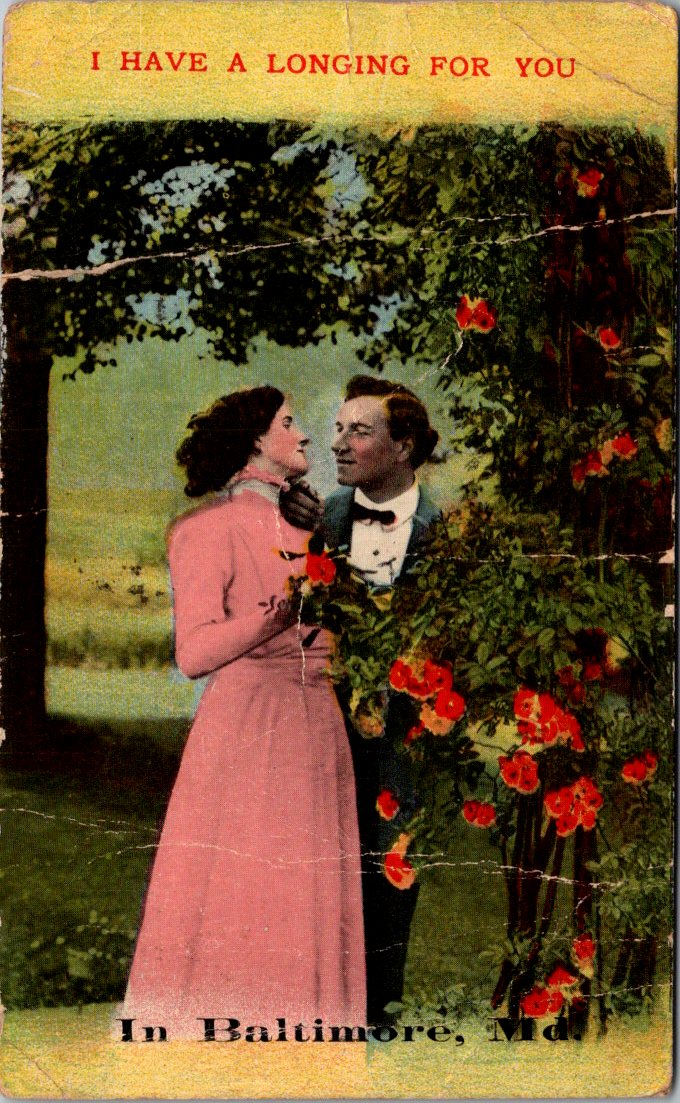
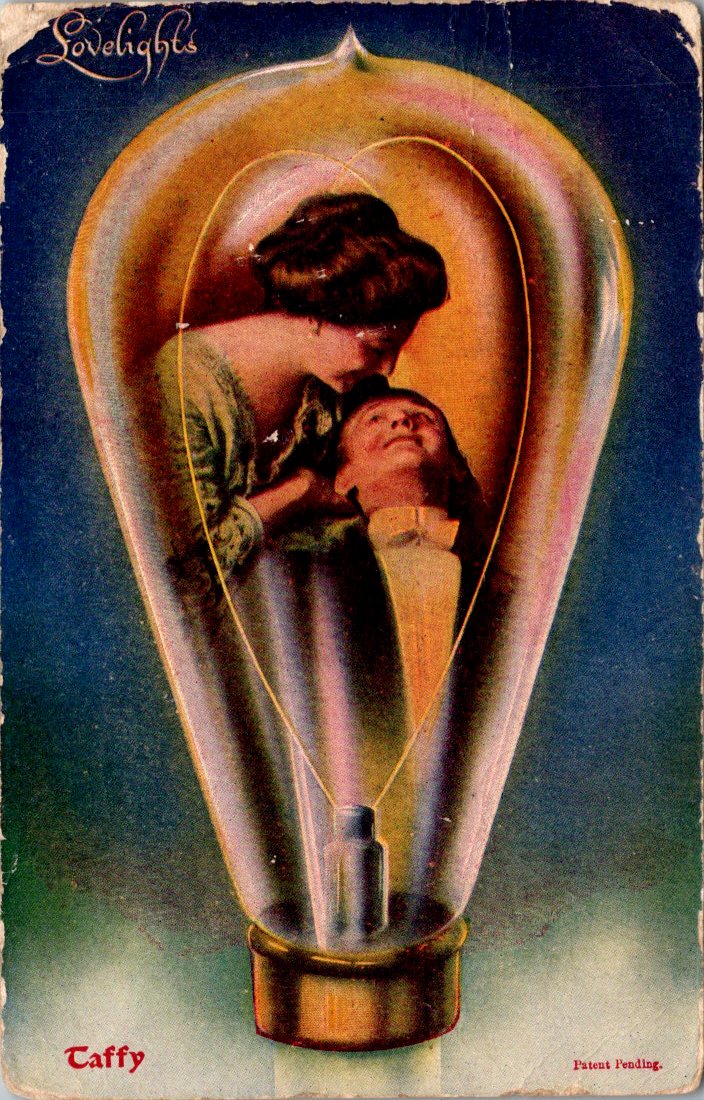
I don’t dare reveal the flipsides of the love-laced cards you’re about to see. What Ida, Minnie, or Gertrude sent or received isn’t for you or me.
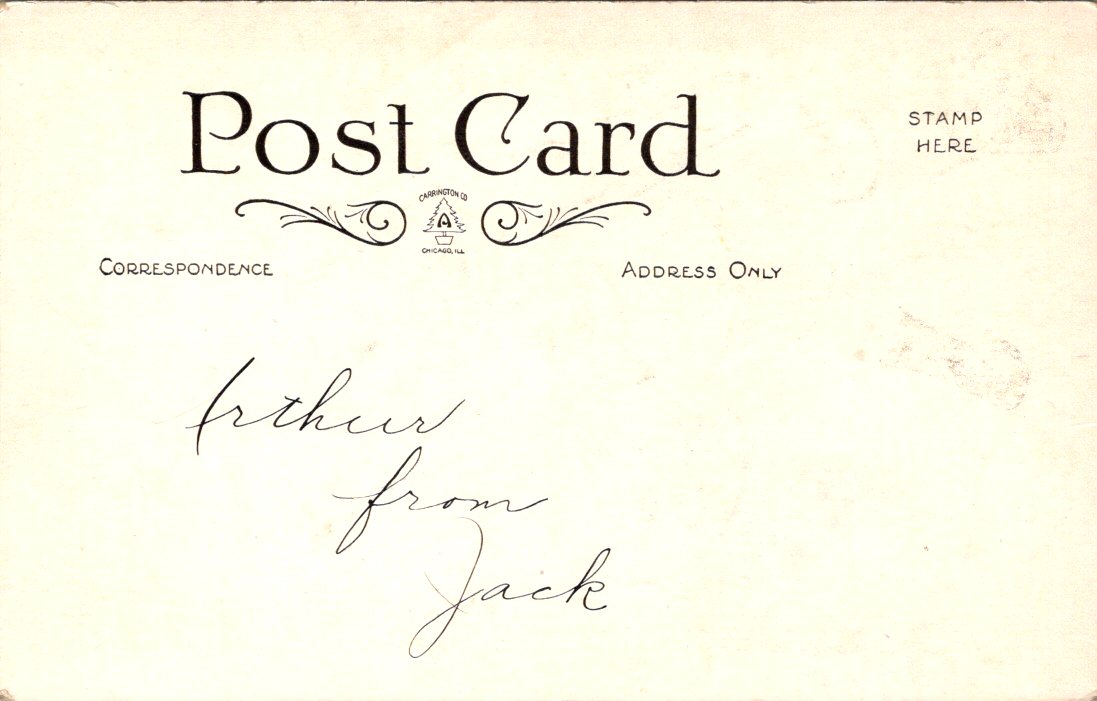
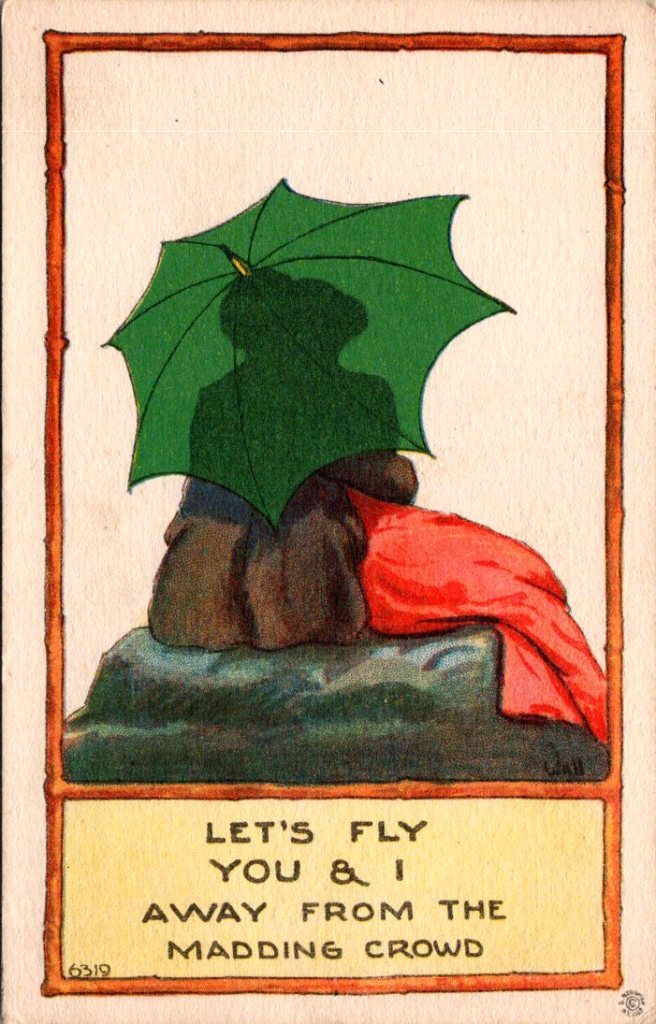
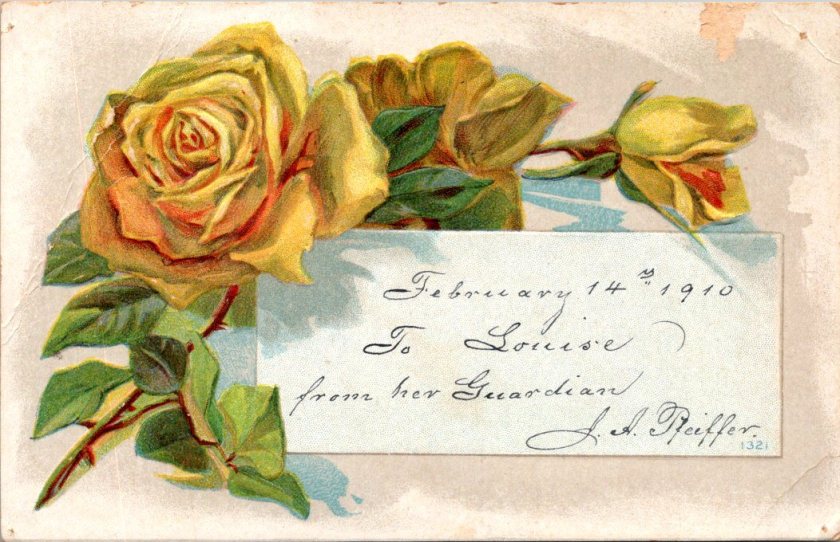
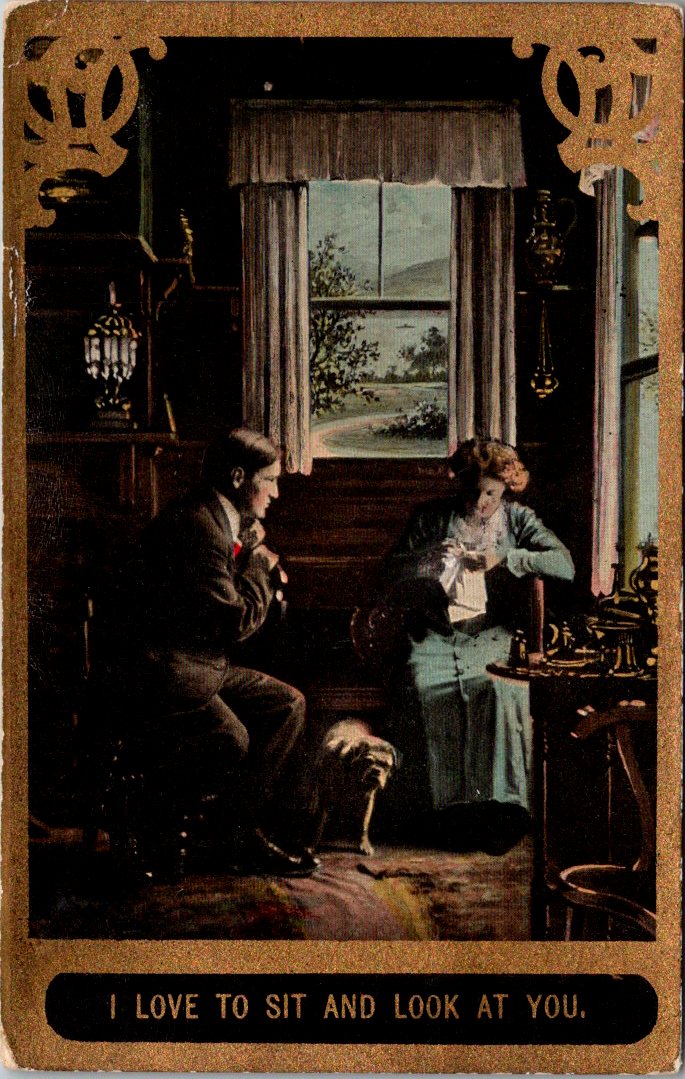
Hand-delivered to Arthur from Jack, this first example is our single exception. With a humble request and an elegant script, we can only hope the romance of a lifetime began, heated up, or settled in. Maybe it was placed on the pillow that morning, sometime before 1907 when postcards still featured undivided backs.
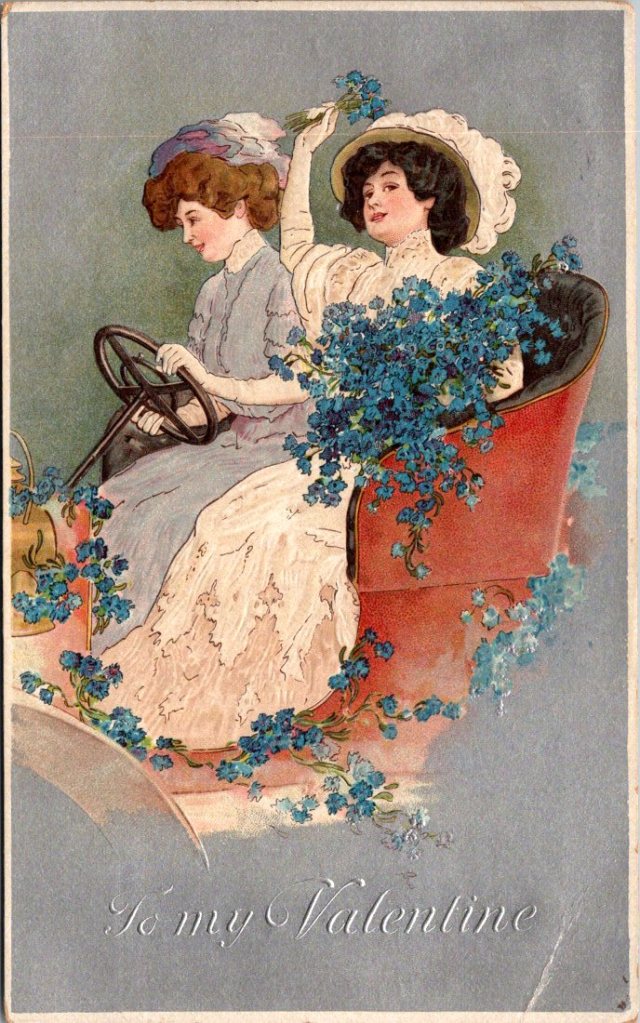
My own love is famously far afield. In the early days, our photograph appeared in a magazine alongside a short interview on the workings of our long-distance affair. We were an ocean away in those days, and on the adventure of a lifetime together. It could be a car drive now, albeit a very long one. Always tempting!
Obviously.
Yes, let’s do!
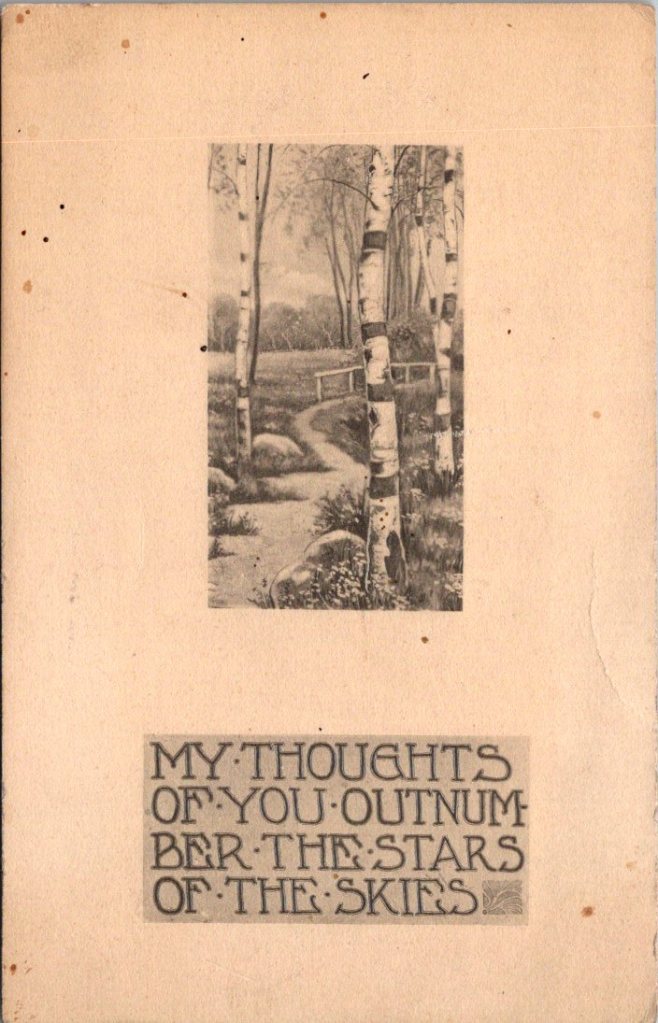
Finding here anywhere we meet.
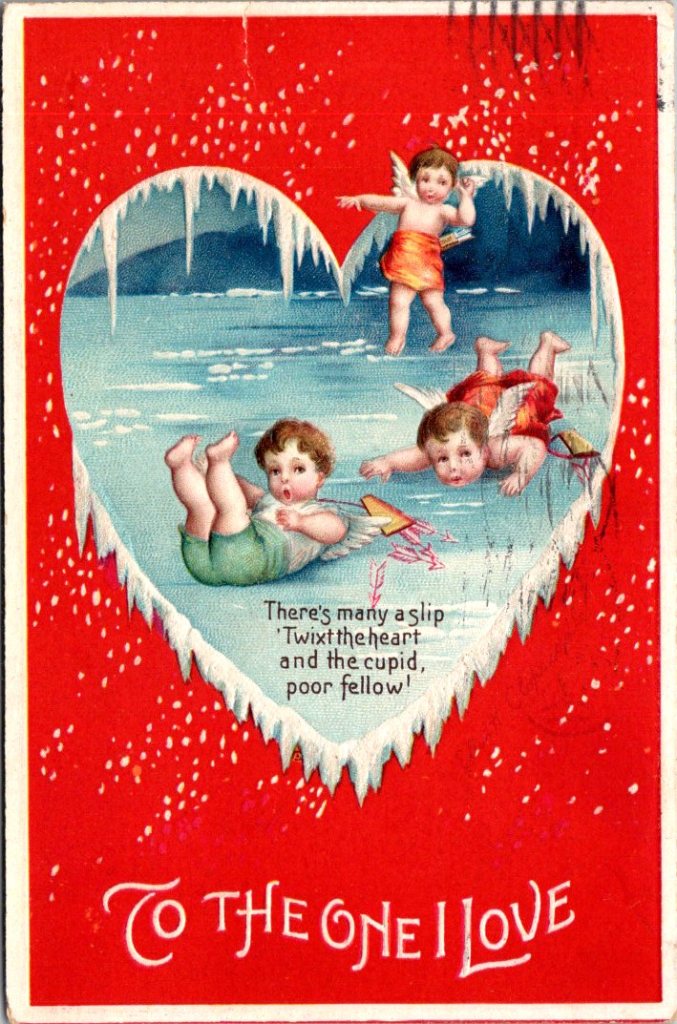
Snowcrete!
Little Blue Carriage for Two
Future Flights
Love, Your Guardi-Anne.
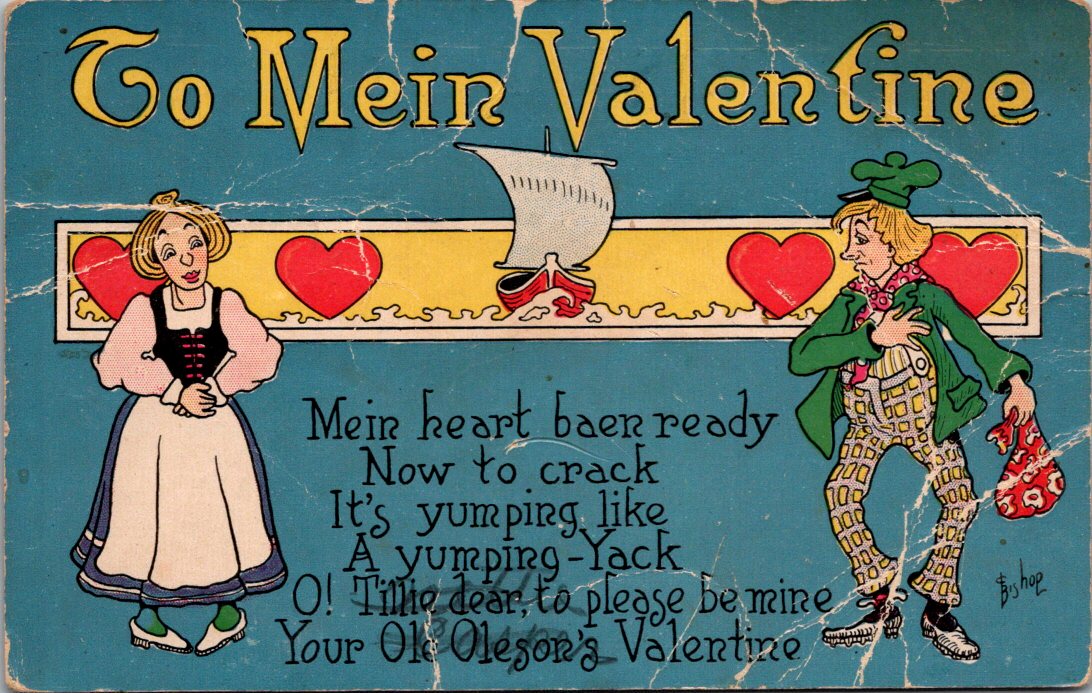
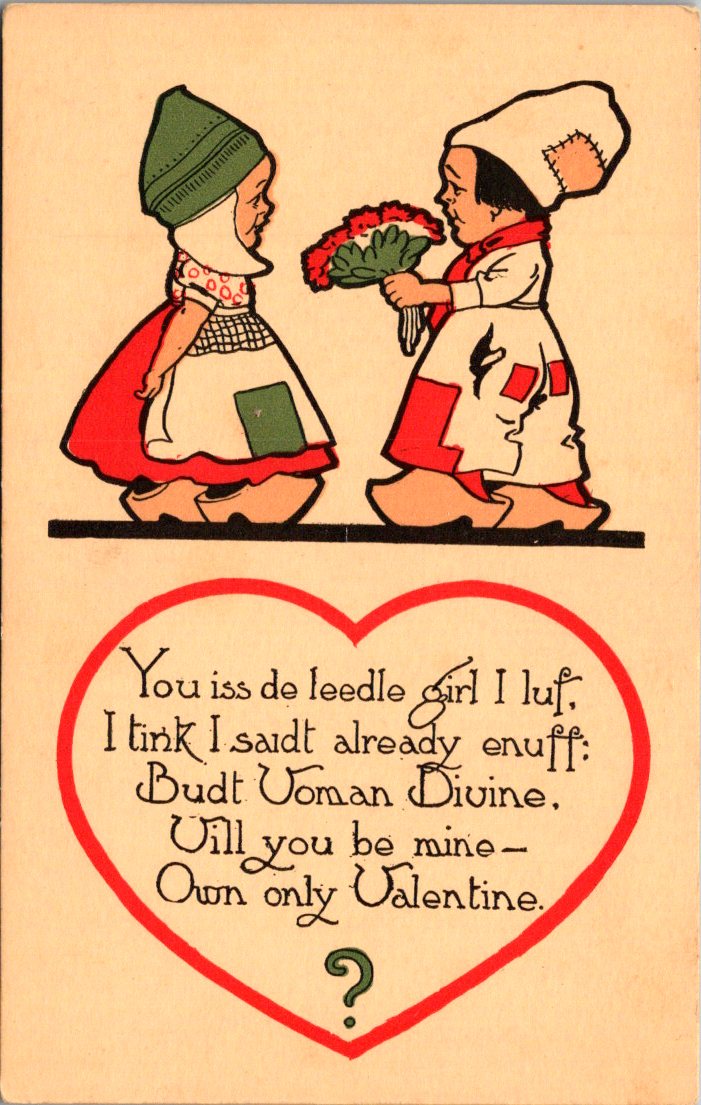
Languages are a passion and a profession for my lady linguist. So a few more out of pure fun and fascination. Luf yah!
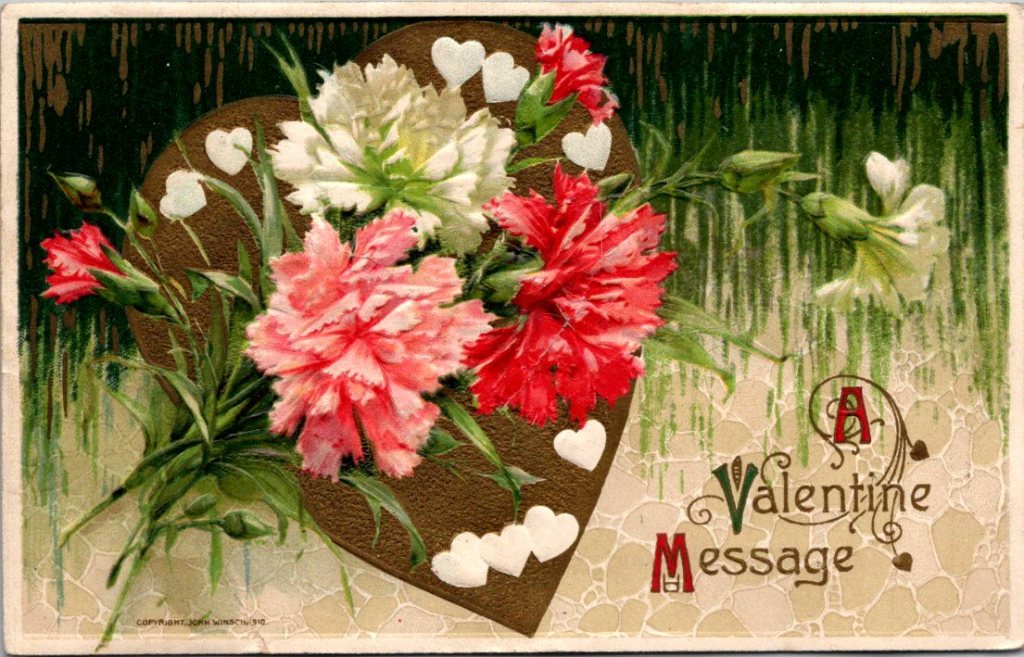
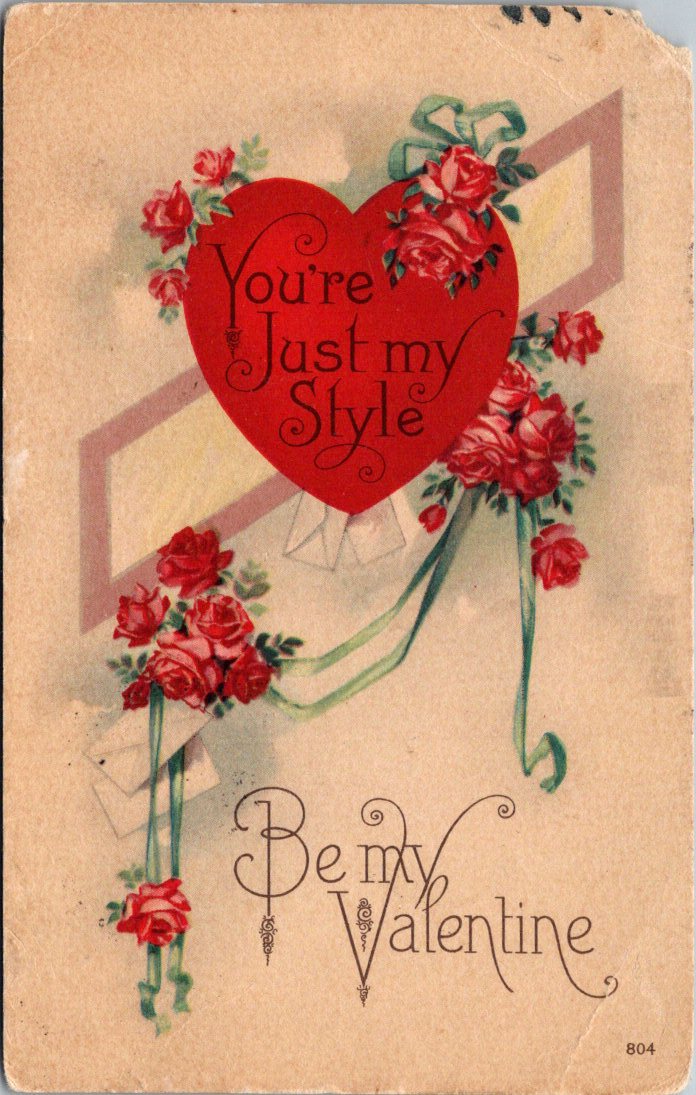
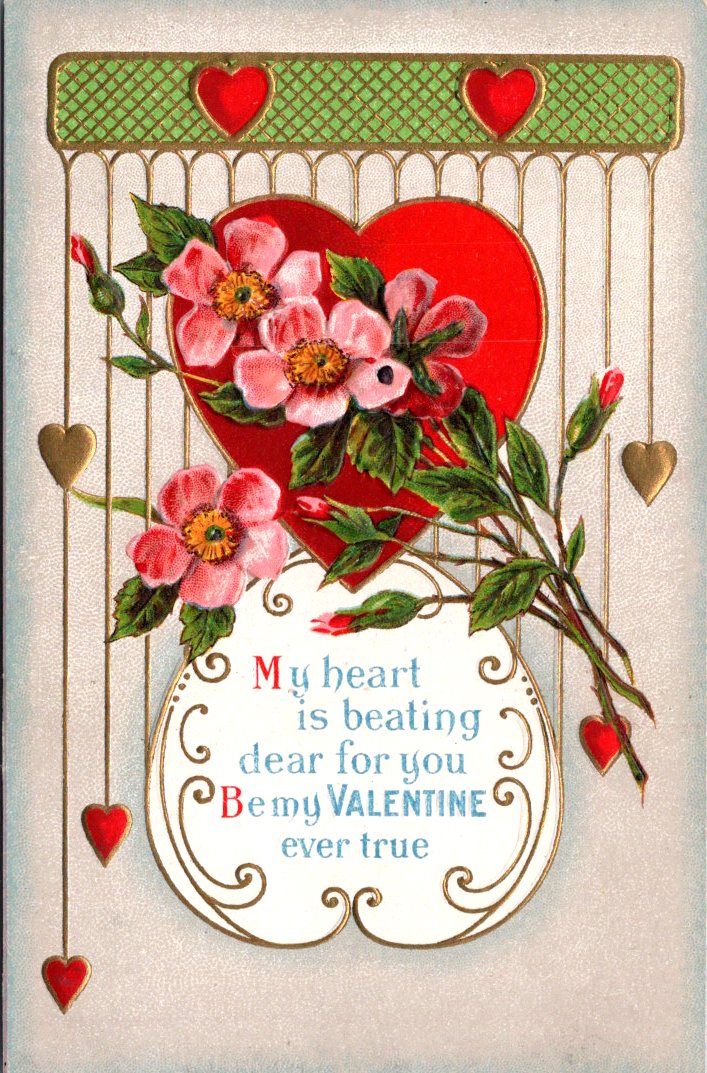
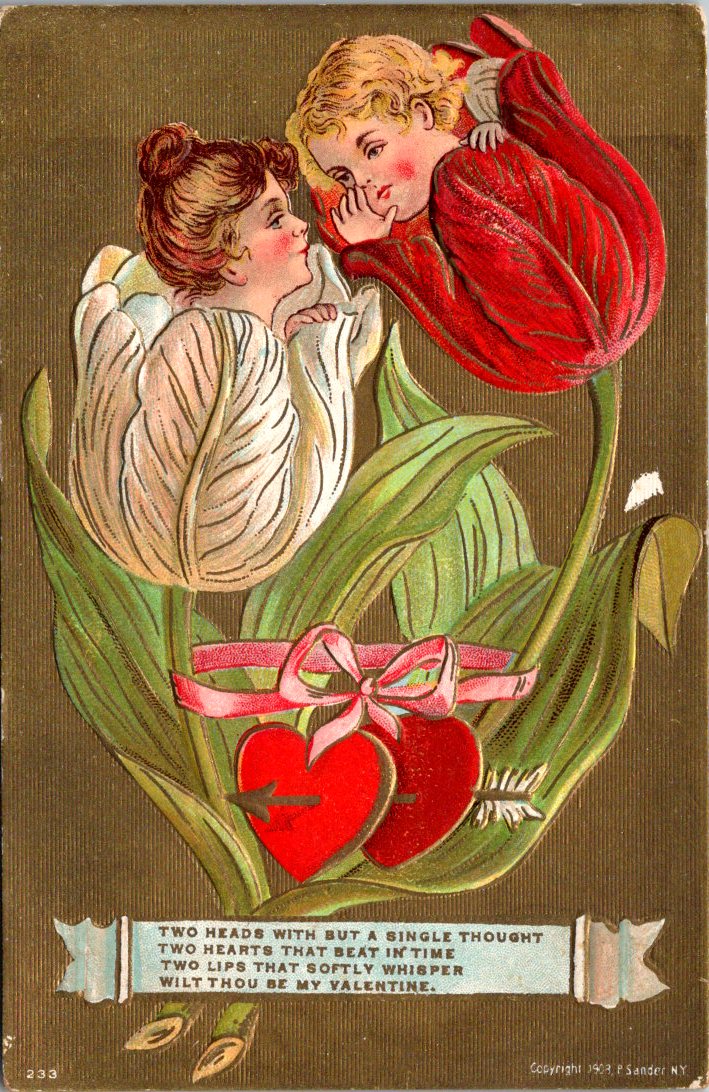
Dear readers, I promised you hearts and flowers after that awkward spell last week. First, a gallery carefully curated on the theme. Then, elucidations and another peek.
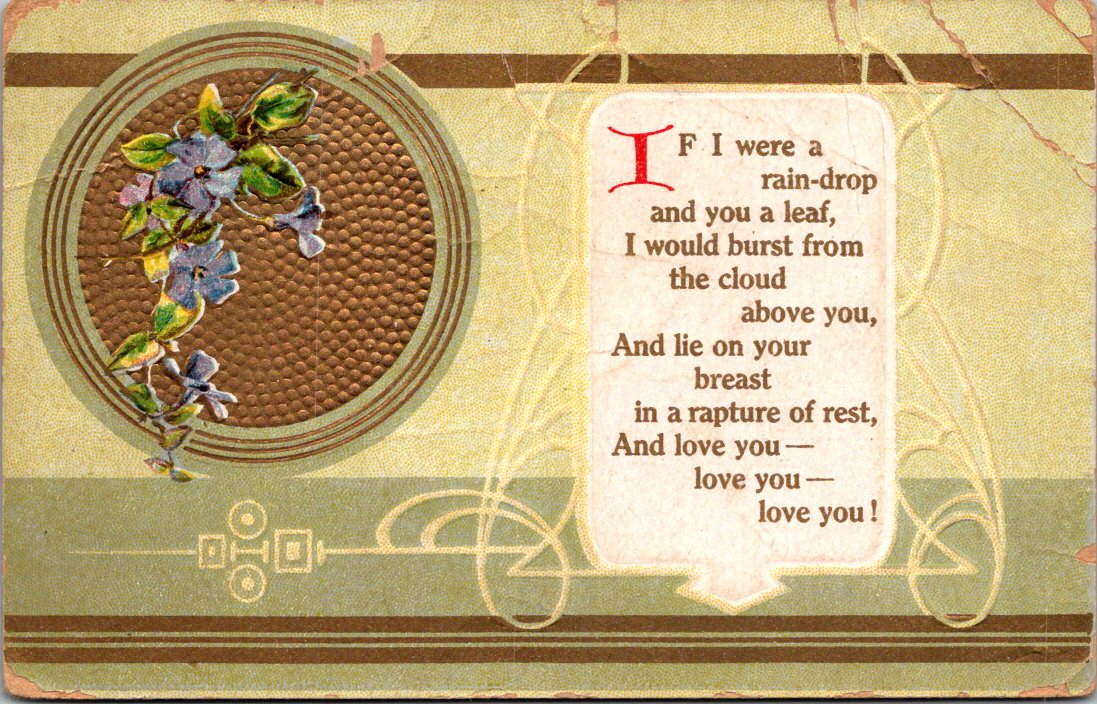
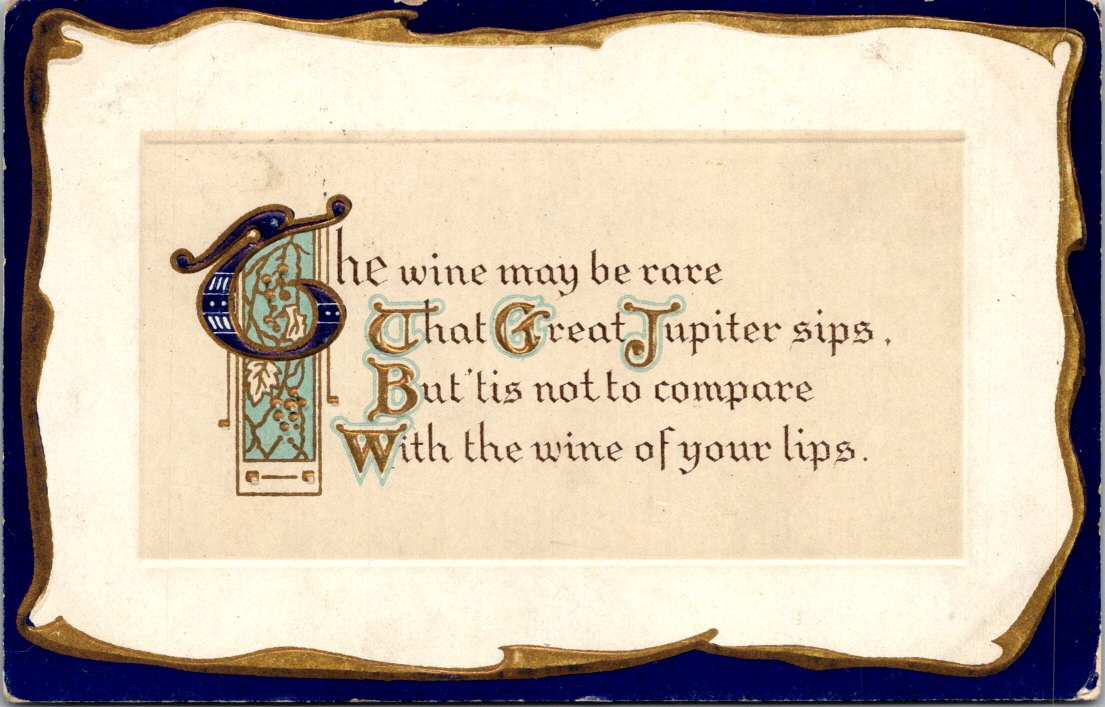
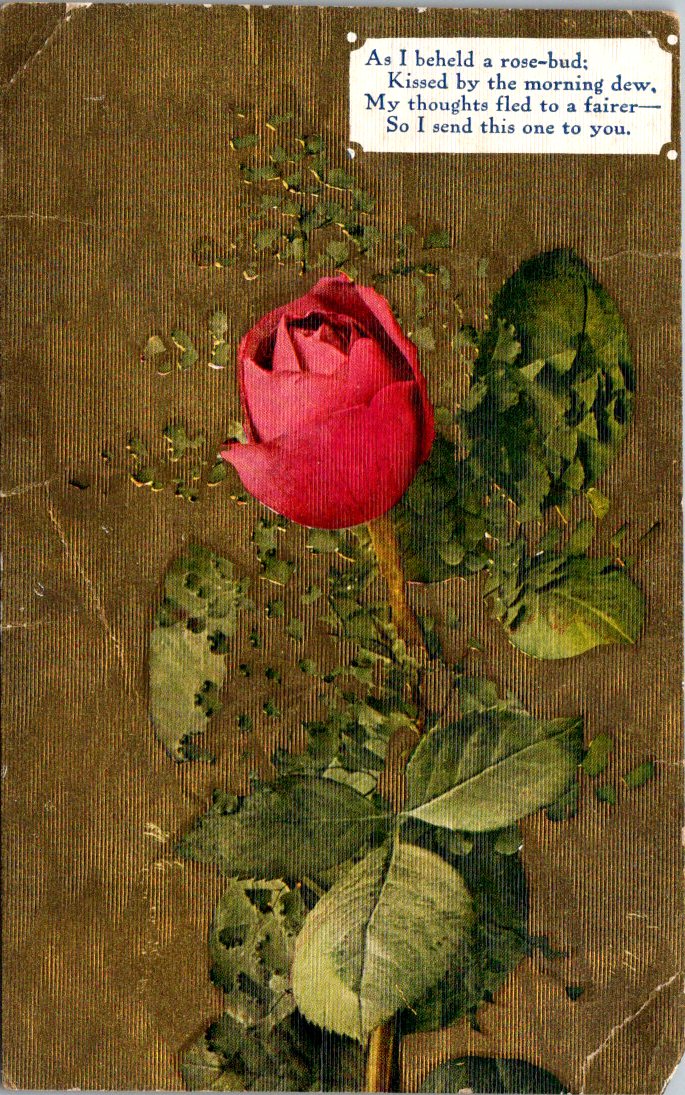
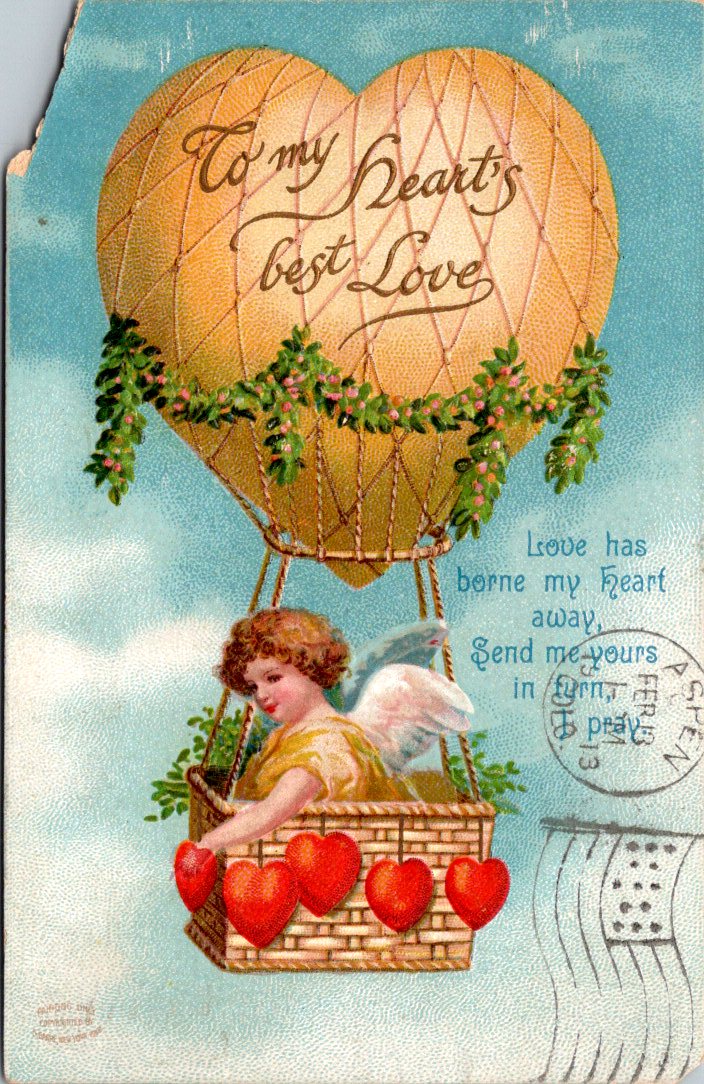
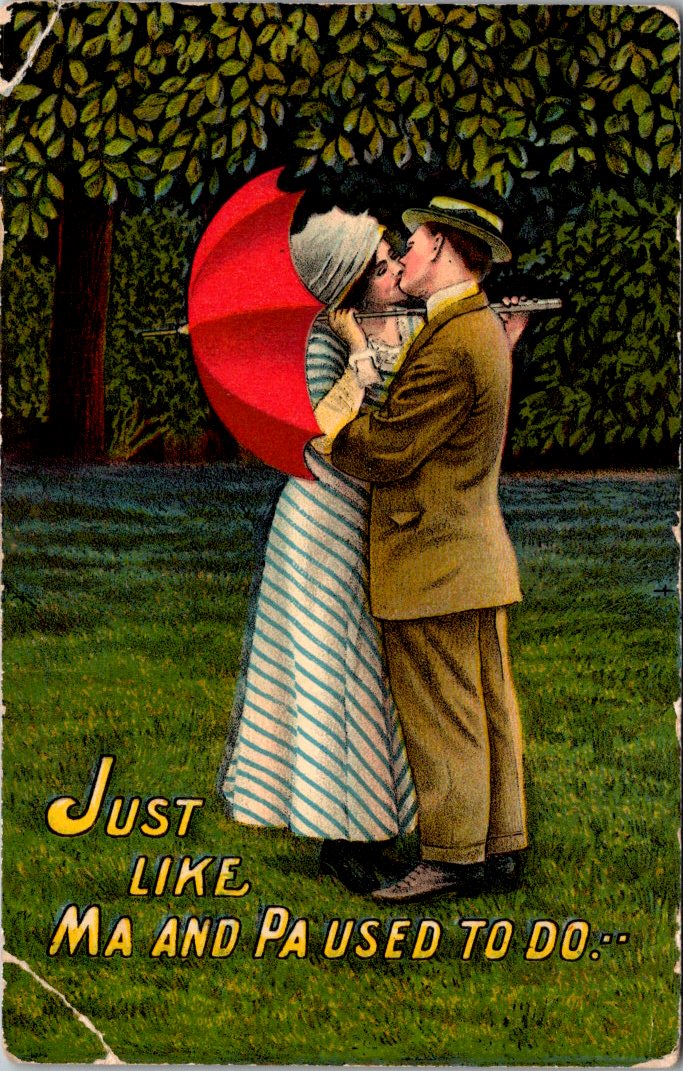
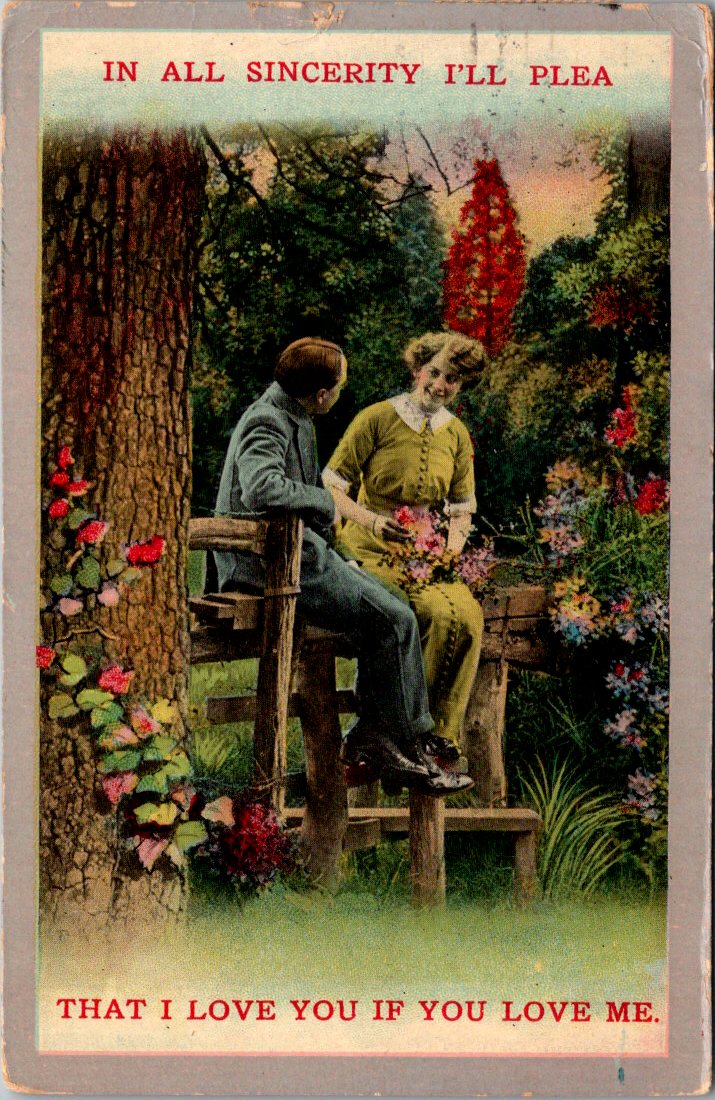
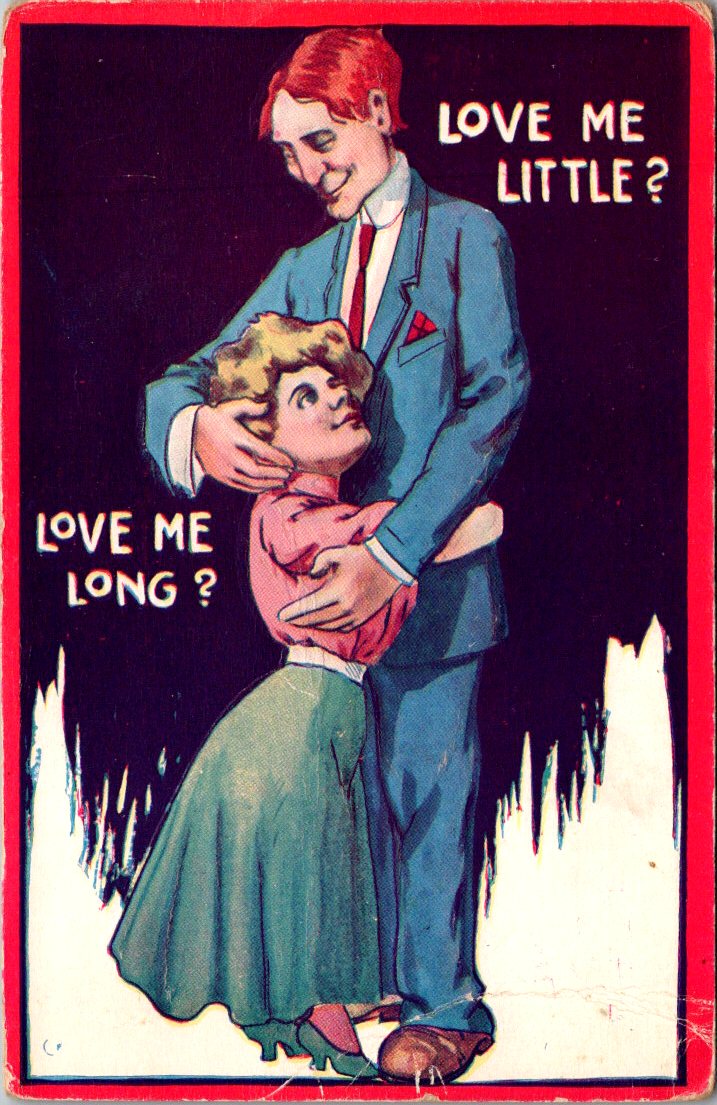
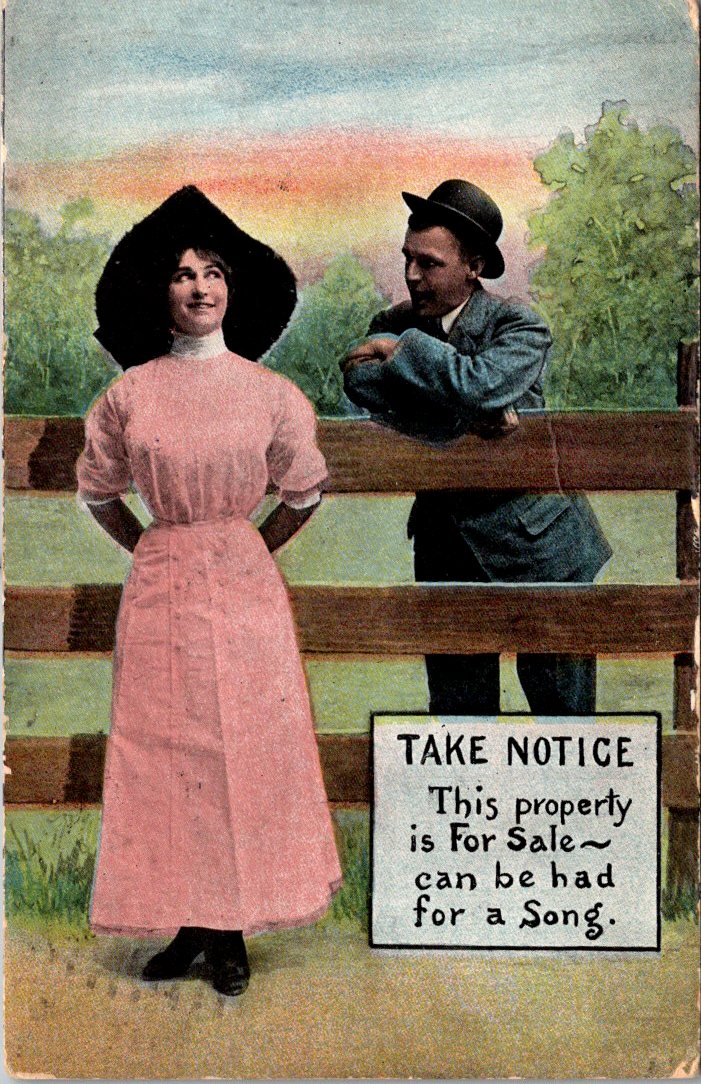
Made-for-you messages with showy sentiments on full view to your pa, your ma, and the mail carrier, too.
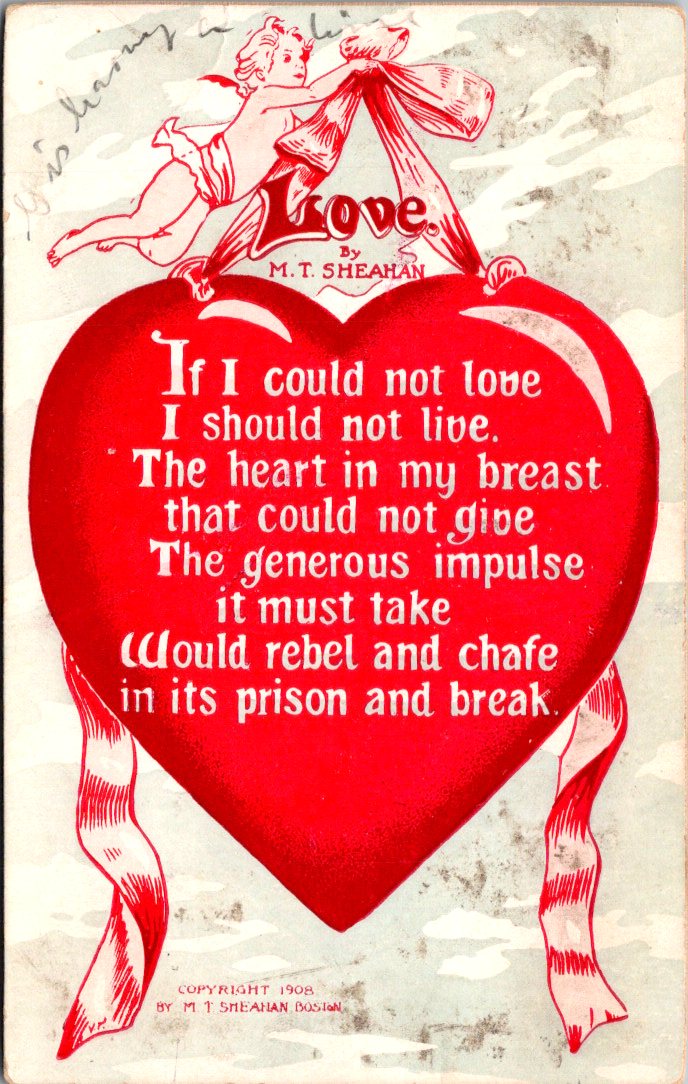
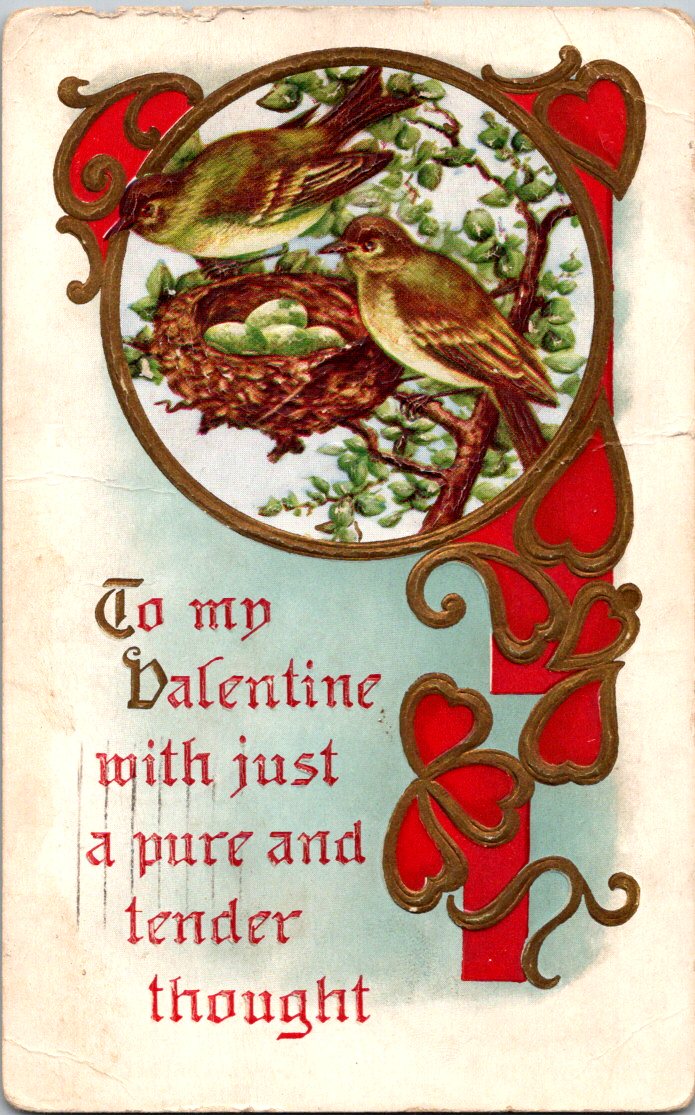
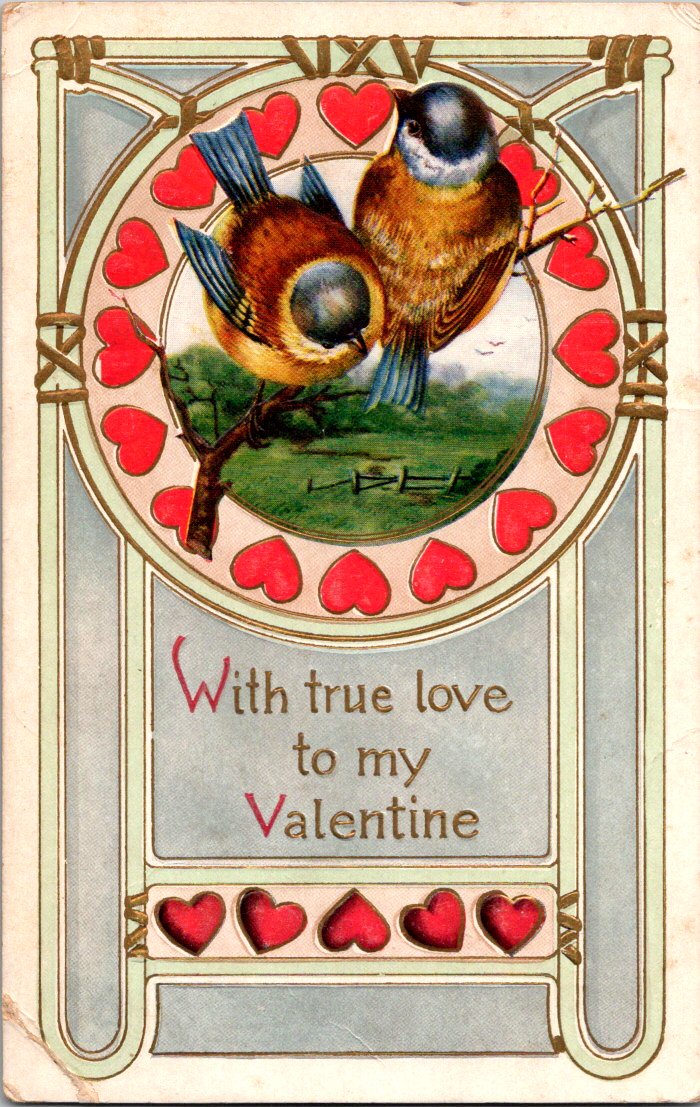
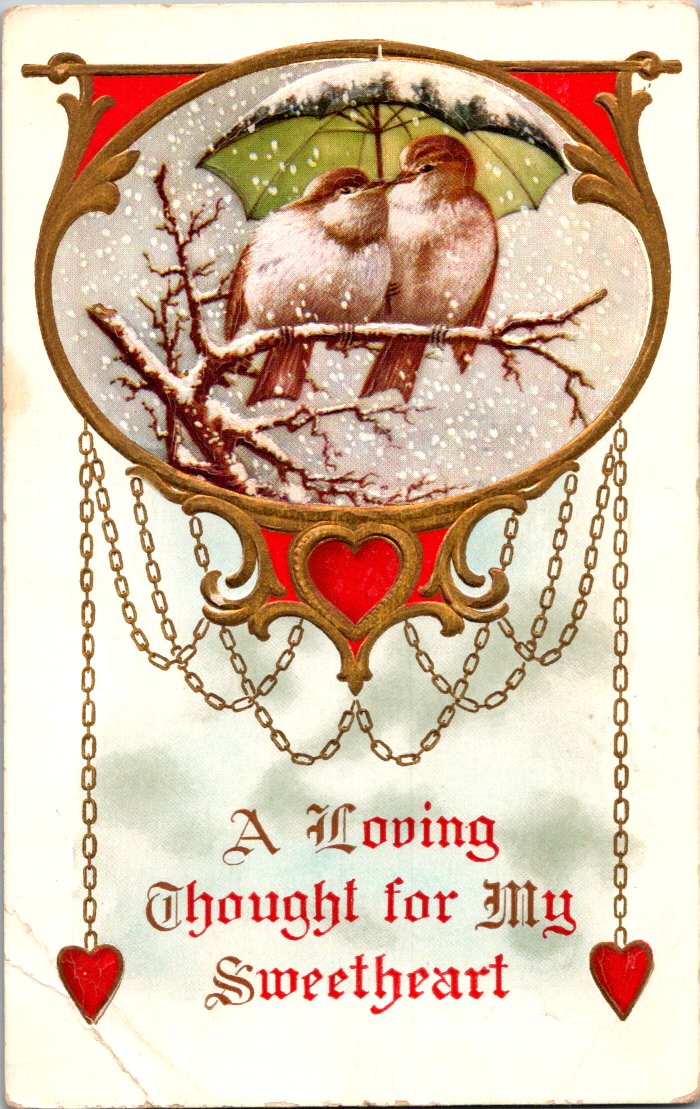
Some parts are still snowy, as love lamps flicker on in February. Hearts, words, and birds arrive in the quiet winter glow. Rest inside a circle of love. When you know, you know.
We’ll get to the hearts and flowers. But first, this is awkward.
It’s February. Congratulations if you have accomplished anything this year.
I spent the morning sorting through Valentine’s greetings. Love is in the air, and rest assured there are albums full of gorgeous arrangements and heartfelt sentiments in the weeks ahead.
But first, I need to bring up something awkward. Not everyone loves this sweetheart’s holiday. For the lovelorn, it’s excruciating. For the grieving, a sad set of reminders. For the wicked, a chance to lance the joy bubbles in the air.
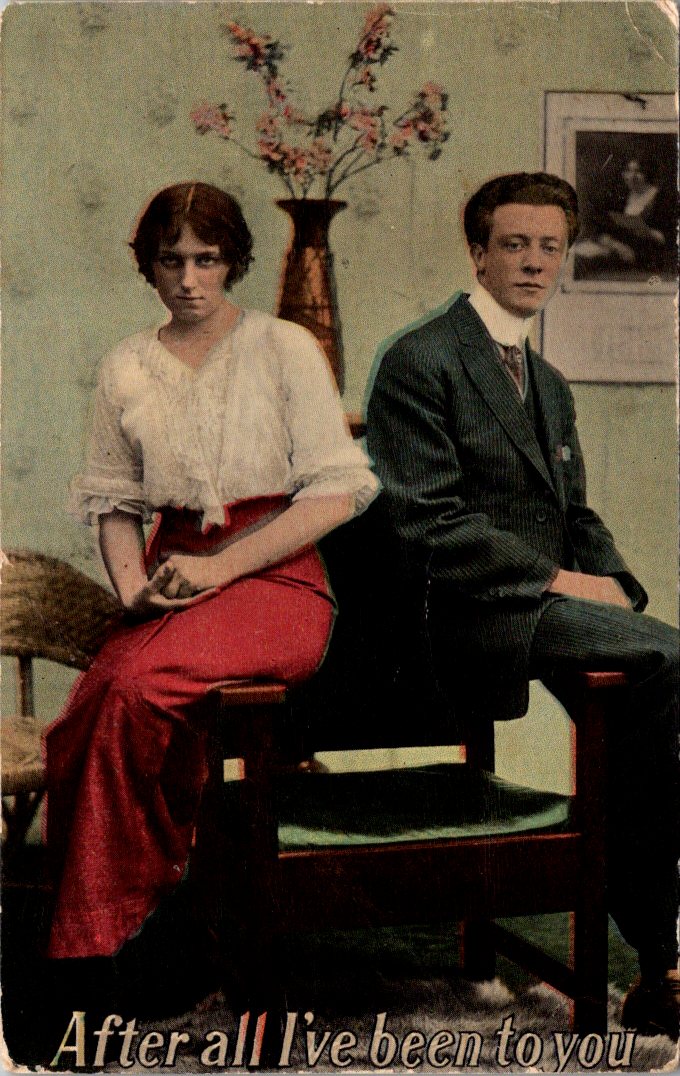
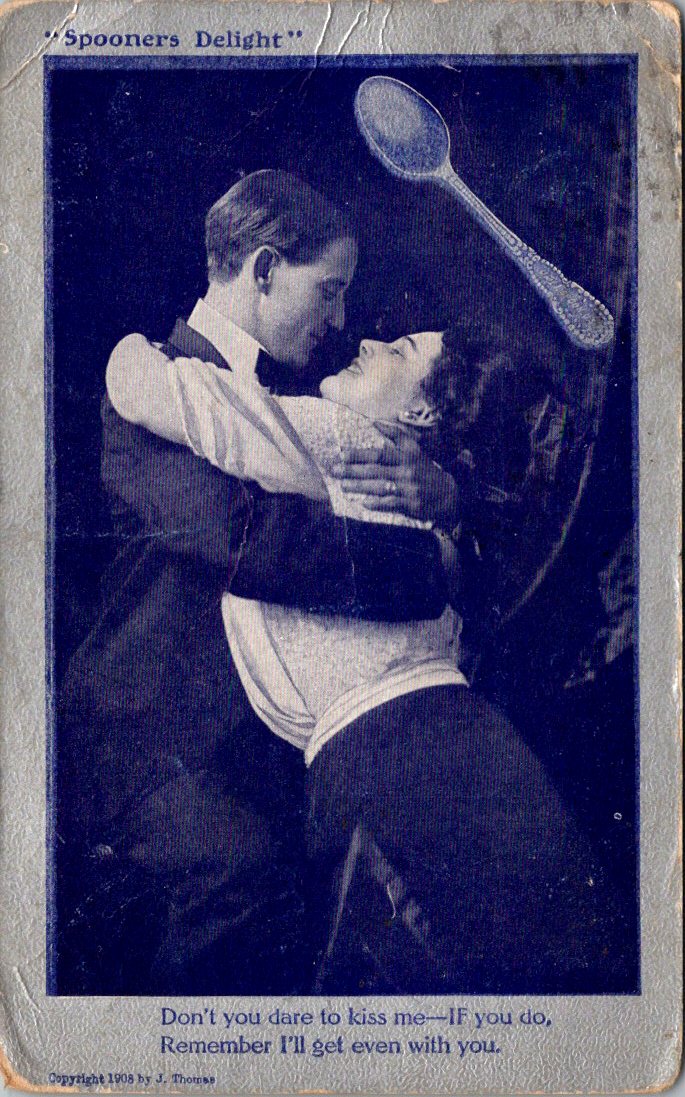
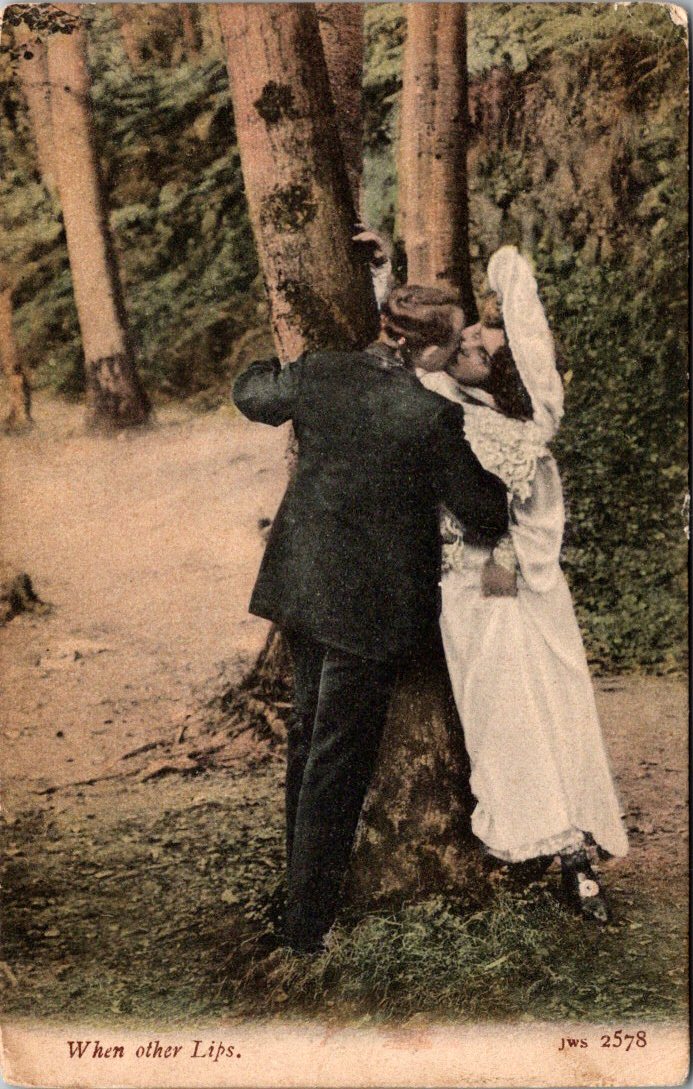
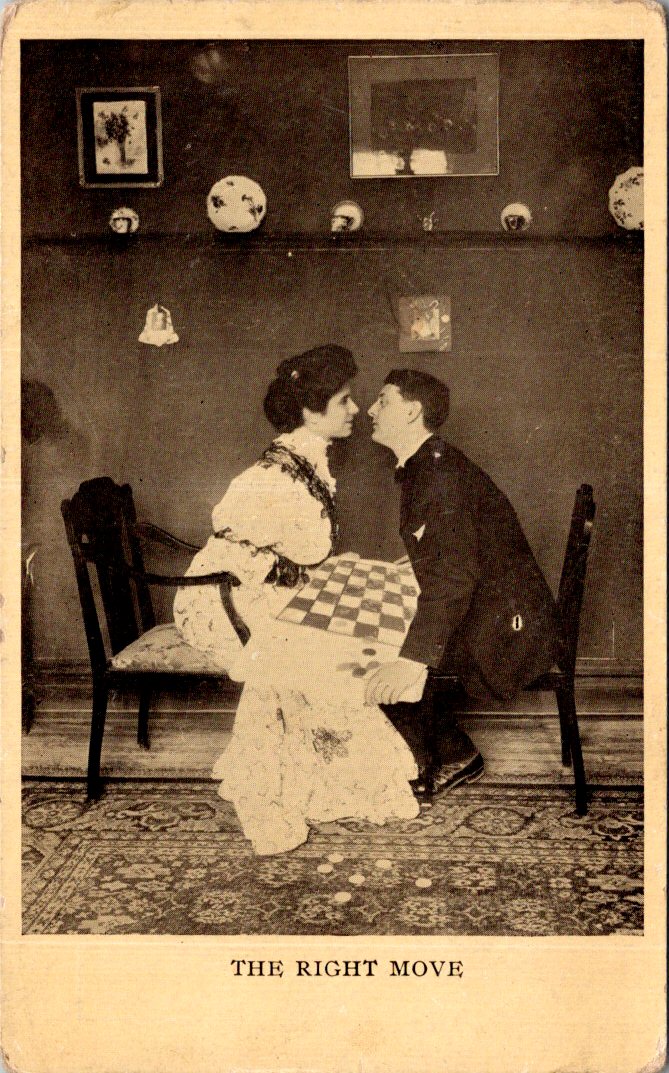
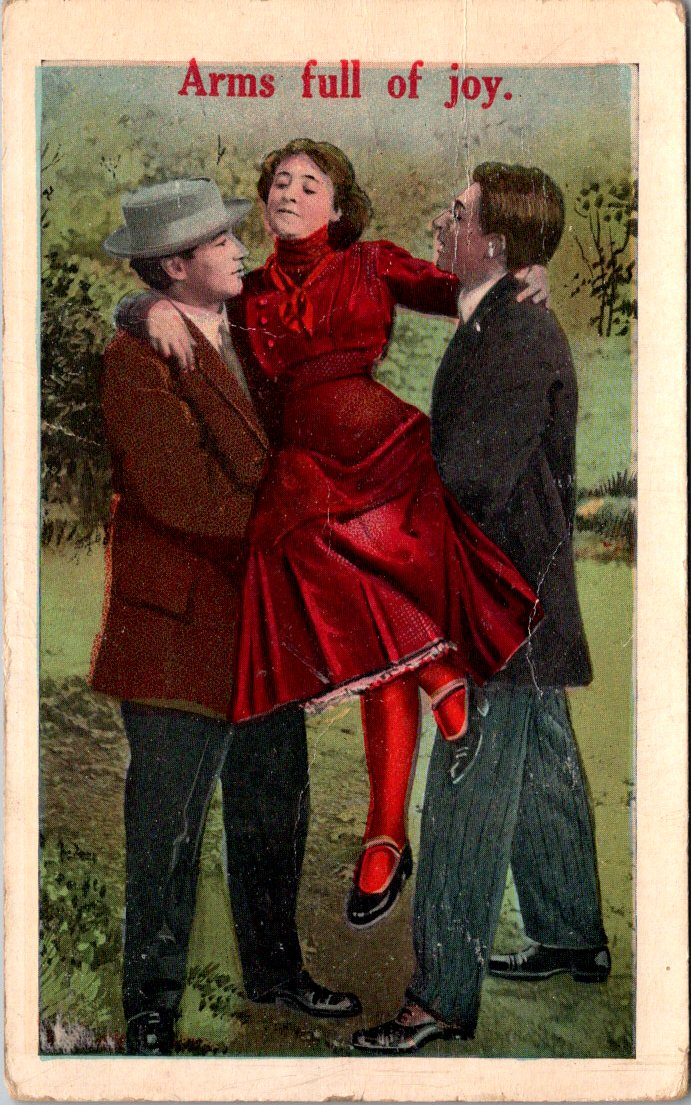
In postcards, we have to acknowledge the neck strain.
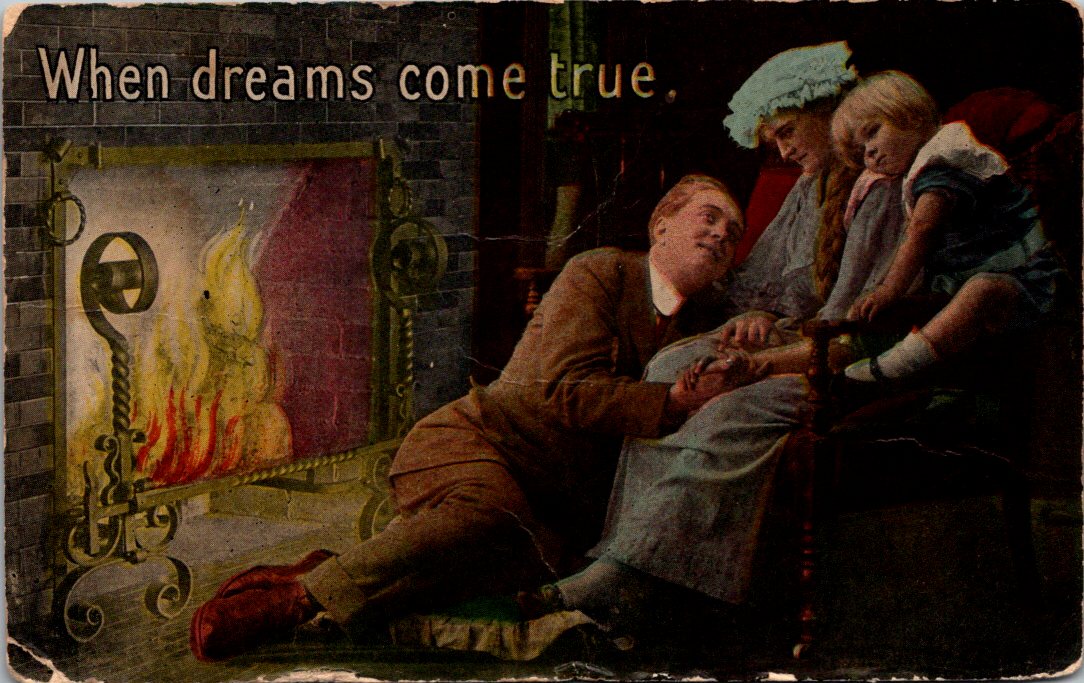
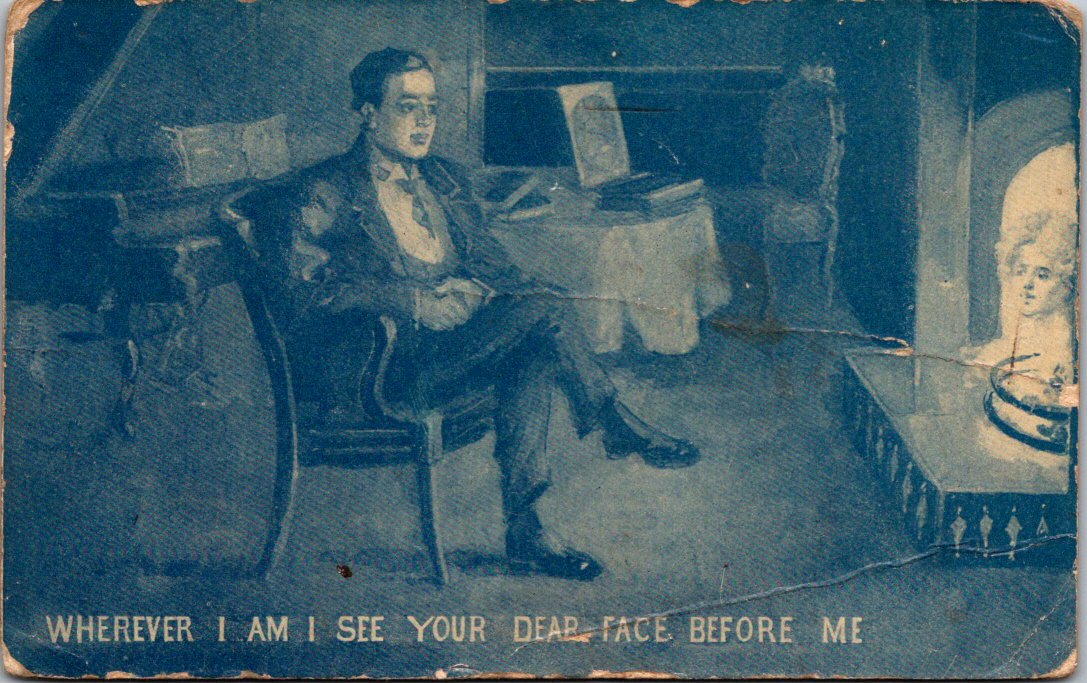
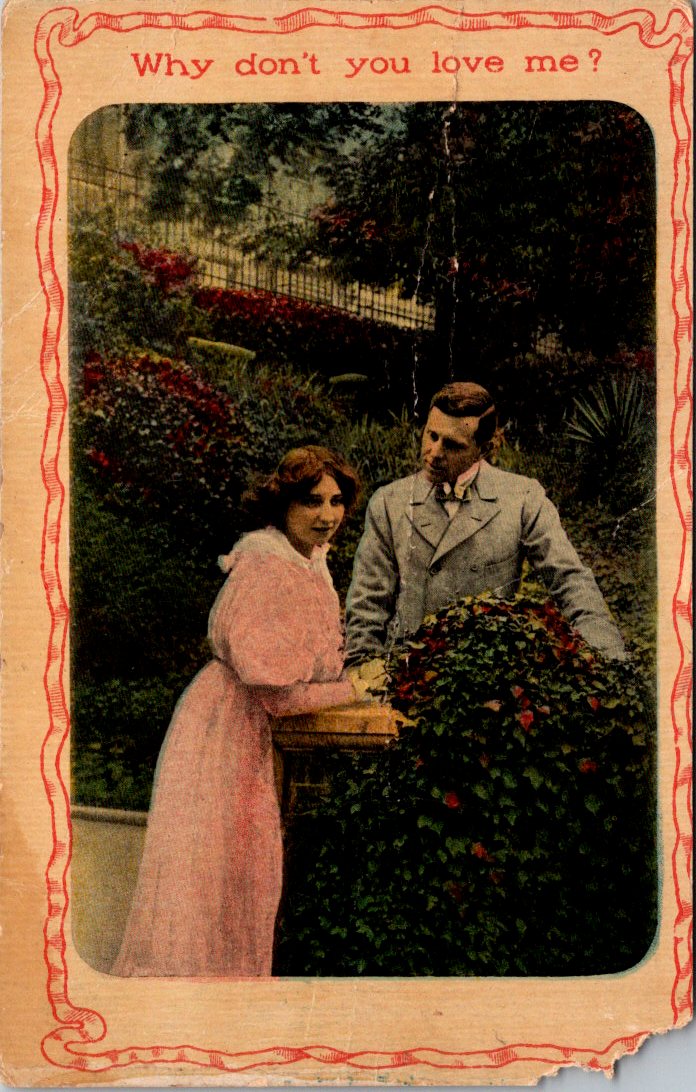
Also, captions that might have meant exactly what they suggest.
Lastly, those with an anti-Valentine vibe, a bad bargain, or even a threat!
We will return next week to the regular schedule of sweetness and light, heart and flowers, charm and chocolate, passion and promises. How… delightful!
A picture is worth a thousand words, which can be tough news for a writer. I like words and images together, and art cards are a peaceful place to be while sorting through the longer storylines happening around here.
To start an art card, I pull together a collection of cards and ephemera related to a theme or style I want to explore. Gather tools, supplies, and a drink at my art board. Set my phone aside, and pick up an exacto knife. Then, I sit down, quiet down, and begin to make meaning out of the materials in front of me. I’m nowhere near my computer or journal, but making an art card now and then is part and parcel with my writing process.
The Posted Past Art Card Gallery is inspired by so many wonderful postcard projects over the years. Worth mentioning are PostSecret, which invites anyone to share an anonymous secret on a postcard, and PostCrossing, which makes it easy to send and receive postcards around the world.
For our part, we collaborate with collage artists to make something small and special for everyone to enjoy. The artist requests a theme or two based on interests like, trees, farms, or portraits. We send an art card bundle and they create collage postcards with these materials. The postcard collages come back through the mail, celebrating the wear and tear of the postal service journey.
The Art Card Gallery is a place to see art card collages created by artists around the world.
If you’re already a subscriber, bless you for hanging on as you do. You get a little note in your inbox each Wednesday. Most times it flits away like a red cardinal, down into the cold, thatched hinterland of your inbox scroll. I know.
Introducing the Wednesday Weekly Reader, a new place to catch up with a previous story series bundled in a way that is easier to read. If you love our national parks, wonder about where the past gets lost, or know a few lonely snowbirds, a story series may meet your fancy.
Reed Fowler is a textile artist, pastor, and writer. Originally from Vermont, he now calls Minnesota home. Reed taught themselves to sew at a young age, following in the path of their grandma and aunt, and fell in love with weaving in college. Reed’s dad instilled in him an embodied love and care for the spaces and people he lives with, expressed through craft.
Reed is a member of the Weaver’s Guild of MN, and a founding member of a queer-centered intentional community, where they live with their spouse, their four cats, and housemates. They love books about magical libraries, watching reality cooking shows, and dreaming about garden layouts, systems, and tea blends.
Q: Are there stories that came to you while looking through the Art Card bundle that was sent to you?
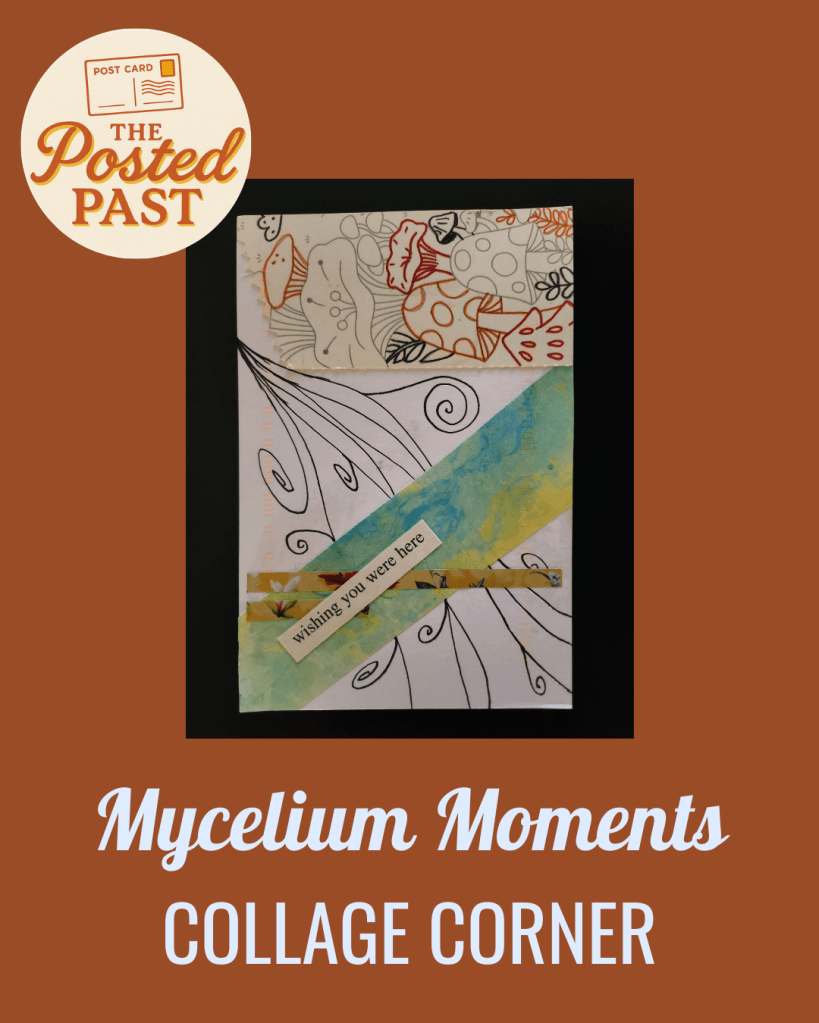
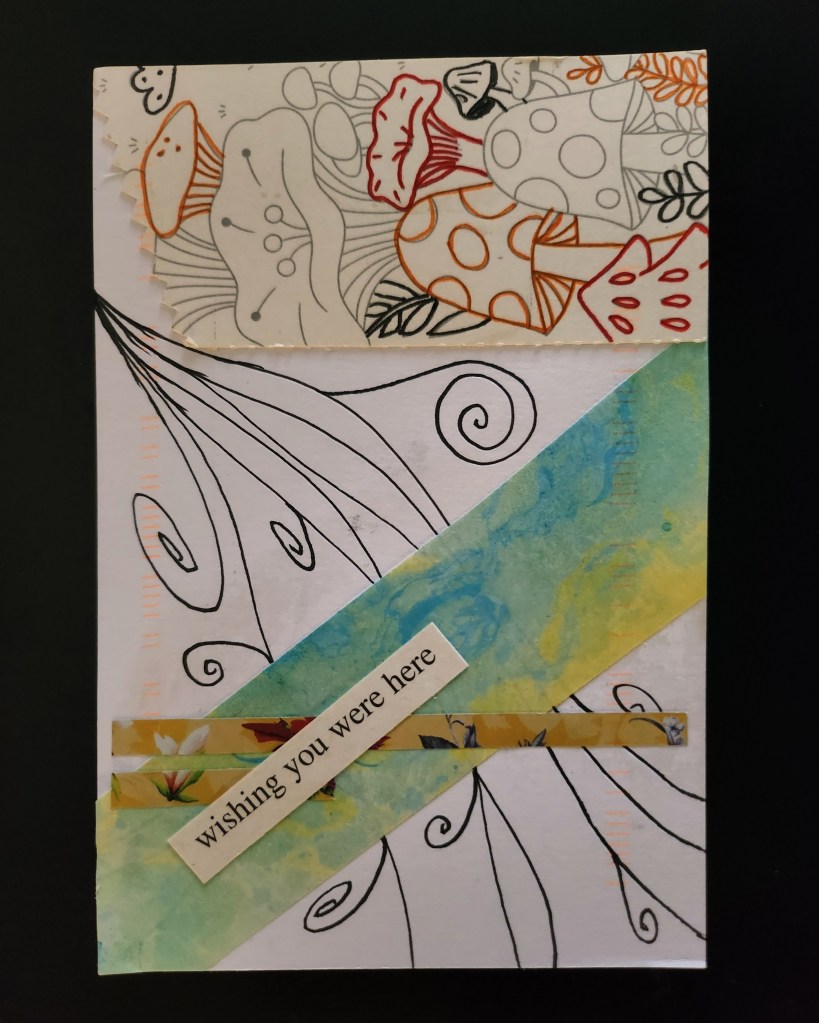
A: Unfolding pathways, roots, landscapes. Distance and closeness – across time, and geography. Timespans of creative practice, of months feeling like decades. Calling back to ourselves, to our embodiment, to the tactile. Mycelium below the surface.
Q: How has your relationship with these collages changed from first receiving the images, through the process of cutting and gluing, and to final finishing touches?
A: The relationship to empty space evolved over the course of the collages. Density, words, lines, space. I originally resisted the blank cards, choosing instead for one to collage atop an existing postcard, rather than dissembling it. The sharp contrast of new printed paper to what I knew had passed through many hands before it reached mine threw me at first.
Q: Among your creations, which images stand out and why?
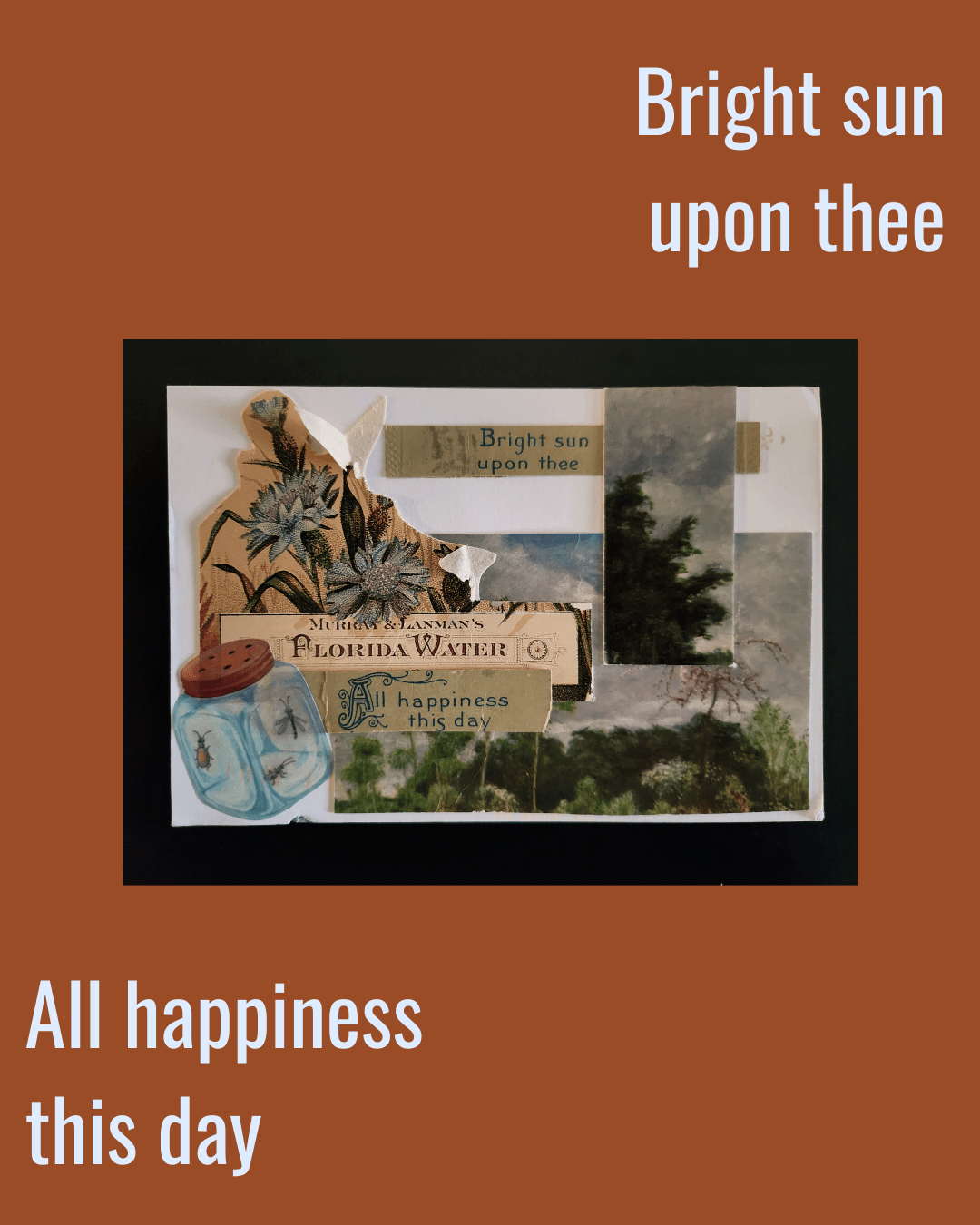
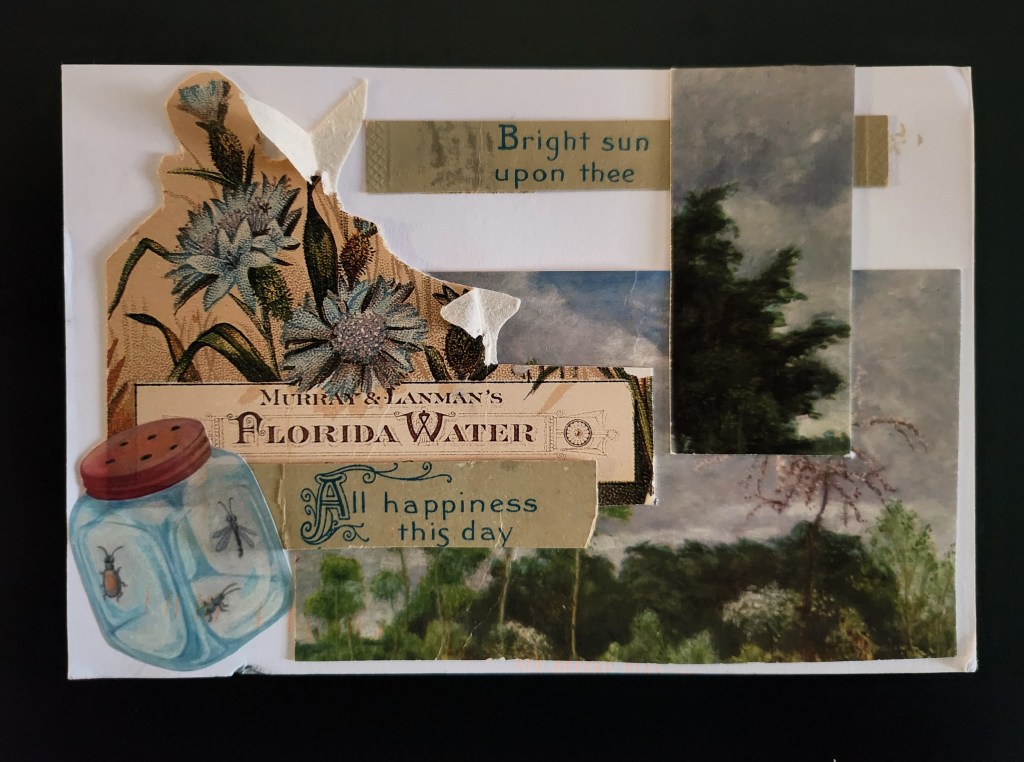
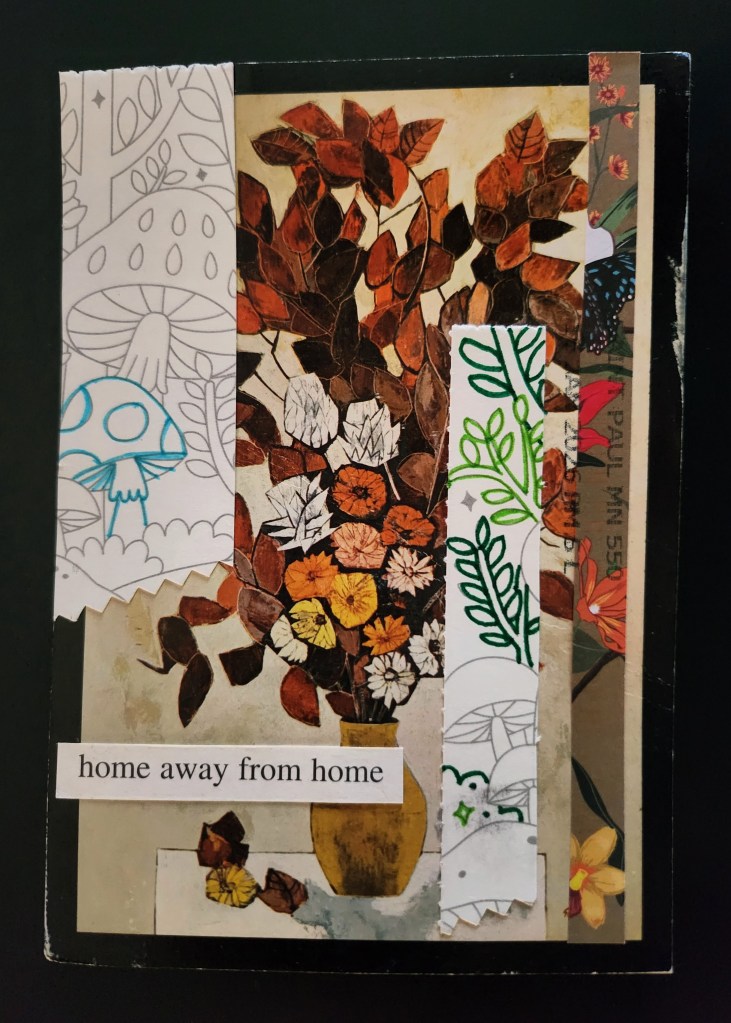
A: The “All happiness this day” was one of the hardest for me to cut into – the postcard was from the 1920’s, and was the main card I received that had writing on it – it had already gone through the mail. The final collage it’s in makes my heart happiest. The collage on the existing postcard, with the line “home away from home” feels most aligned to when I was creating it – in a cabin at a state park, celebrating my 5th wedding anniversary with my spouse, crafting by lantern-light.
Q: Is collage similar or different from your regular studio practice?
A: Collage is one element of my regular studio practice, at least for my personal creative practices. I’m primarily (currently) a textile artist – working in wool and thread and fabric. Earlier in my life, I was more of a mixed-media artist, where collage featured more heavily. So now, when I need a creative outlet just for myself, or if I’m trying to think through a project, or feeling, I’ll often turn back towards mixed-media, and collage.
Q: If you could give and/or receive a postcard from anyone living or passed, who would it be and why?
A: My late grandfather. He shaped my current path in beautiful ways that he never knew, and I’d love a chance to send him a postcard and receive one in return.
Mai’s brothers check-in and George follows up. Nina and Tom find Delia’s postcard stash, and their way home. Nora knows her way around town now. Peace is in practice, not perfect circumstances, says Mrs. Hanabusa.
Careful block letters adorned the outside of a #10 envelope. George recognized Jack’s handwriting. Precise, old-fashioned, like an architect from a bygone era. Inside, George found a letter to addressed to him, and a long list of books Jack had read. Not just titles, but notes.
The Hidden Life of Trees – I like how roots connect underground.
The Mapmakers – Bird migrations mapped with ocean currents.
A Sand County Almanac – The geese made me cry.
George sat at his kitchen table, poured over the letter twice, then kept going back to it in mild wonder. The boy was thirteen. Reading natural philosophy at a level twice his age and writing elegant, matter-of-fact prose.
George now had a collection of postcards just for his grandson. He kept an eye out for anything inspired by books, libraries, explorers, architecture, and history. But today, he had a different one in mind.
Jack – Your list made my week! You remind me why books matter. Keep reading, all of life is in there. – Grandpa
George bundled up and trudged to the mailbox in the extremely cold and icy January morning. Stood there a moment, breath visible in the air, so proud of a thirteen-year-old boy who cried over geese.
The phone rang Saturday afternoon. It was Mai.
“Dad? You busy?”
“Never too busy. What’s up?”
“So—weird thing. I heard from both Derek and Marcus this week, within a day of each other.”
George set down his coffee. Mai’s brothers were also adopted from the chaos in Laos, but by different families. Mai didn’t know or remember much as a child. They’d reconnected as young adults as they discovered their shared histories. George had met Mai’s brothers only three times, at each of their weddings. Derek, the oldest, spent his early years in an orphanage before his adoption. He now runs a tech business in Palo Alto. Marcus, the youngest, grew up in a musical family and plays professional brass in traveling shows.
“That’s wonderful. Everything okay?”
“Yeah, they’re fine. Both texted out of the blue. Derek asked about the kids, Marcus asked about you. I think they’re feeling their age,” Mai chuckled.
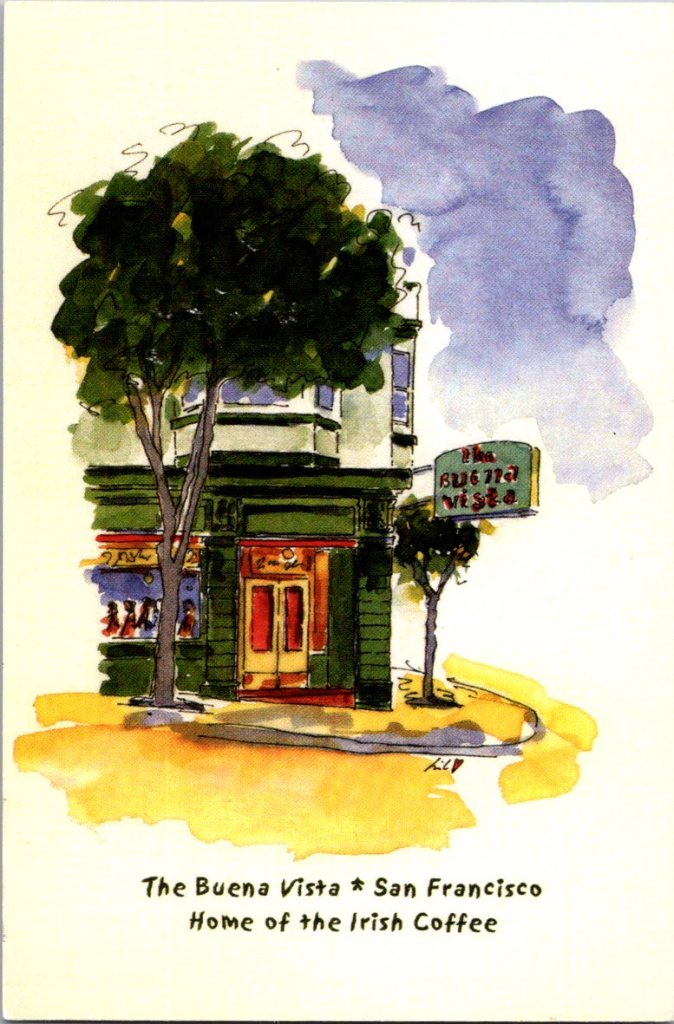
After they hung up, George sat at his table looking at his postcard stacks. He found a San Francisco classic for Derek, and an old club card from Illinois for Marcus. Relics from a jazzier time. Same short notes to both of them.
Mai says you’re doing well. Glad to hear it! – George
Nina loaded into her car early Sunday morning. Coffee in a thermos, bag full of stuff, and Mrs. Hanabusa’s advice in her head. Leave room. Her mind drifted for most of the drive, watching the sunrise over the desert and mountains to the East. She took the old road through Florence for just that reason.
Nina climbed the stairs in the worn, beige apartment complex, and knocked.
Tom opened the door looking nervous. “Hi. Come in.”
Nina noticed immediately, he was making an effort. Coffee brewing, store-bought pastries on a plate, magazines and mail in piles recently cleared from the couch. Seemed like he intended to inhabit the place, not just occupy space.
The talk was halted at first, then easier. Nina found it so strange that she grew up with the man and knew him not at all.
“I brought something,” Nina said. She pulled out all the postcards he’d sent over the years, a large batch that bulged at the seams of a padded envelope. Airport terminals, layover cities, all those airplanes. The last year had revealed so much, including the way her father had actually stayed connected in a quiet (and still insufficient) way.
“I kept them.”
“I didn’t know if you would. You weren’t always into them like we were.”
“I wasn’t. I didn’t even remember that I saved them. Found this stash looking through a bunch of old boxes, now that I know what to look for. Dad, I never made the connection before now.”
Tom smiled sheepishly, stood, went to his bedroom, came back with a shoebox full of postcards from Delia, dozens of them, saved over their entire marriage. Travel postcards from trips they’d taken together. Funny ones he’d sent her from far away places, anniversary cards.
“I couldn’t throw them away,” he said. “But I couldn’t look at them either.”
Nina picked up one after the other to read the backs. Her mother’s handwriting, cheerful, full of small news from home.
“She loved you.”
“I loved her, too, and I love you.”
They sat with the postcards spread out between them, talking about travel and their family trips together. Tom unearthed the ones Nina herself sent home from the summer she spent in France. Both were careful to keep his collection from Delia separate from the ones Nina brought. They were both still sorting through the imperfect evidence of what had been.
“Next time,” Nina promised as she left. They hugged briefly, and she hopped in the car for the drive home on the freeway with the sunset to her right.
Monday, Nina found Mrs. Hanabusa in her usual spot, the late afternoon light turning everything gold.
“How was your visit?” Mrs. Hanabusa asked without looking up.
“Good. Hard. Both.”
“That’s how it goes.”
Nina found herself marveling, again. Mrs. H’s daily practices, the flower arranging, carefully selecting which sentiments to include and which to set aside. She seemed to belong more to the glow than the room, now.
“How did you learn to be at peace in the world?”
Mrs. Hanabusa smiled slightly. “Well, I needed it and then I experienced it once or twice. It felt good, and now I have practiced enough. Every day. Some days better than others.”
Peace wasn’t a state achieved once and held static forever. It was active, chosen, renewed daily through small deliberate gestures.
“You’re practicing, too, but you don’t call it that yet. It’s nicer when you know.”
Nina thought about the drive to Tempe, the decision to keep the postcards, the inclination to let her father try, and the fear he’ll fly away again. It was not easy, definitely practice. Also, yes… nice.
Nora’s cards came less frequently through the spring. Nina recognized the sacred cycle of becoming and belonging. Nora had less to say about longing, more about the daily goings-on. She was living in Taiwan.
Hiked Taroko Gorge with work friends. Mountains are unreal—marble cliffs, jade rivers. Think of you, often. –N
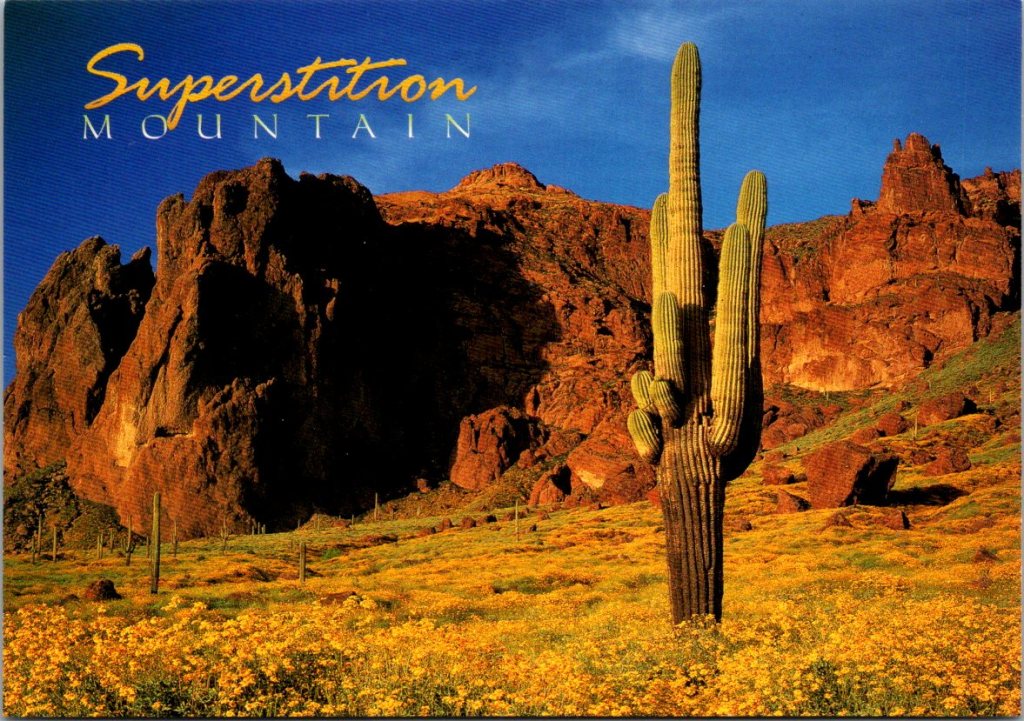
Nina pulled out a postcards of Saguaro at sunset awash with a super bloom of springtime flowers. She wrote her response, but didn’t rush it. Set it on her desk, next to the others ready to go out. There was time. Their lives would keep coming and going in a different rhythm now, and that was enough.
Though our holiday story series stops here, we hope you stay in touch! Subscribe to get a message about a postcard every Wednesday. Also, love is in the air! Next month rare embroideries.
Limited edition Cardinal on a Cactus postcards available at Tempe Yarn & Fabric and online.


 The Posted Past