Susanna’s Suitors

Fröken Susanna Pettersson of Sunnansjö, Sweden couldn’t vote, couldn’t earn, and couldn’t easily leave her small village. But in 1903, she could receive romantic postcards. She kept them. But, did she reply?

Rare Cards ~
Four Antique Swedish Postcards Sent to the Same Young Woman

In rural Dalarna, Sweden around 1903, a young woman named Susanna Pettersson receive four romantic postcards from three suitors in nearby towns. All the postcards arrived through the local mail to an address at Tjärnsvedens, Sunnansjö, in the wooded heart of Swedish folk country.
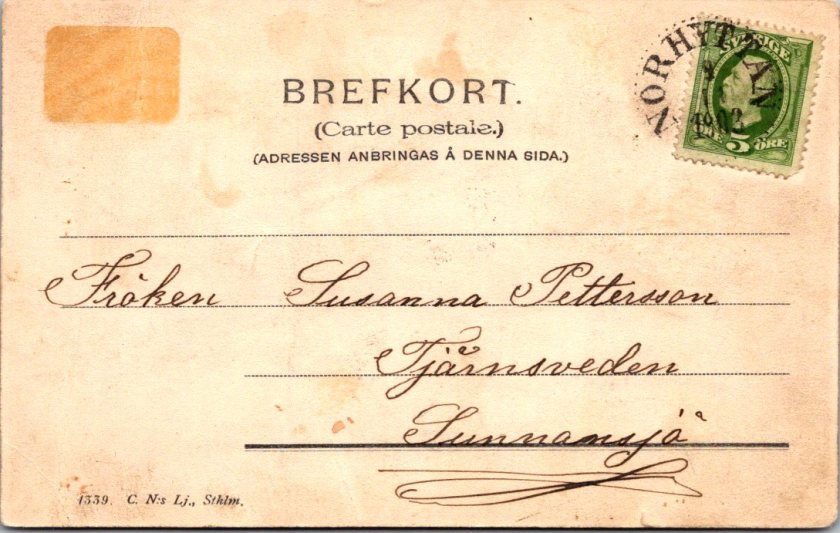
The honorific Fröken printed before her name on every card tells us she was unmarried. In early twentieth century Sweden, it was a title with genuine social weight that was relinquished upon marriage. For Susanna, the boundaries of daily life were drawn by family, church, and society. The careful correspondence of courtship may have provided a sense of choice.

In these years, postcards were at the absolute peak of a golden age. Dominated by the German printing industry and distributed across Europe and abroad, romance cards were a technically sophisticated and lucrative niche in a rapidly growing economy.

These exquisite cards were chosen deliberately by suitors to convey a range of emotion, laden with symbolic images and verses of serious sentiment. In our case, the hand-scripted messages are overt. To send such a postcard was a cautious and considered act, even a declaration. To receive four such cards suggests a woman who inspired intention.

In the early 1900s, Scandinavia was reckoning with questions of identity and sovereignty that touched daily life and daily culture, woven in with the cultural flowering of Larsson, Lagerlöf, Ibsen, Grieg, and Munch. Sweden itself was unsettled. The union with Norway, in place since 1814, was fracturing toward its peaceful but charged dissolution in 1905.

Borlänge, just down the road from Sunnansjö, was growing fast around iron and steel, drawing young men out of villages like Susanna’s into an industrializing economy. The authors of these cards may themselves have been young men who moved away to seek their futures, writing back to Susanna across a widening distance of place and era.
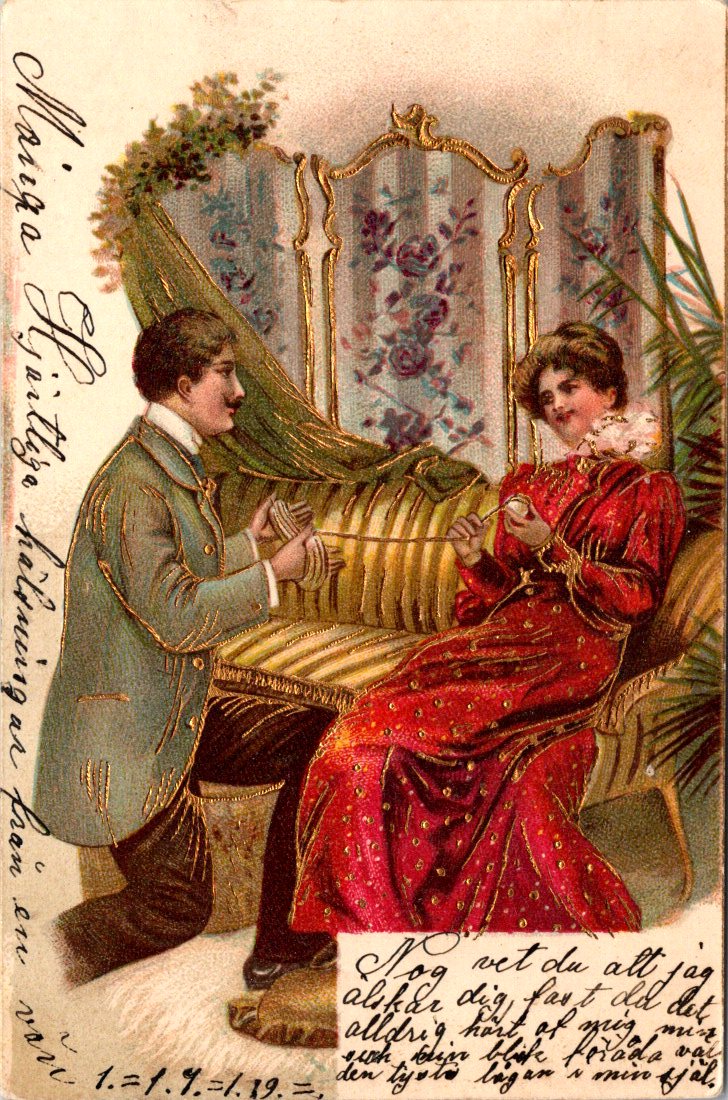
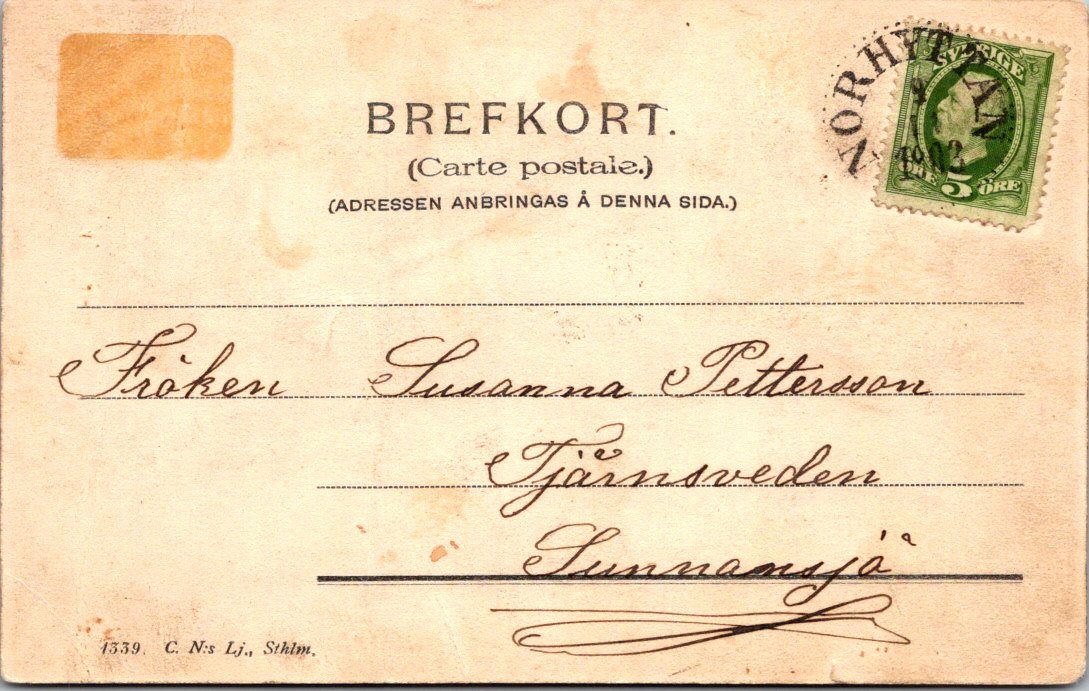
Card 1 ~ Suitor 1 from Norhyttan

Front: An elegantly dressed couple in a richly appointed interior — man in blue-grey jacket, woman in red and gold dress — seated before an ornate folding screen painted with roses. Tropical palm in background.

Många Hjärtliga helsning av han ere…

Many heartfelt greetings from him who is [yours]…

Back: Addressed to Fröken Sanna Persson, Tjärnsvedens, Sunnansjö. Note the affectionate diminutive Sanna rather than the formal Susanna used on other cards. Swedish 5 öre green stamp, Norhyttan postmark, circa 1902.

Correspondence: Lower right, heavily scripted in a practiced pen-and-ink hand. Left margin written vertically. Lower left coded notation: 1. = 1.9. = 1.19. =

Nog vet du att jag älskar dig, fast du det aldrig hört af mig, min och din blick föråda val den tysta lågan i min själ.

You surely know that I love you, even though you have never heard it from me. Mine and your glance betray the silent flame in my soul.

Production and Collector Notes: Premium chromolithograph with gold embossing, likely printed in Germany or Austria. Numbered series notation, Serie 193. Embossed romance cards of this quality with intact original Swedish correspondence are increasingly scarce. Of interest to collectors of Scandinavian ephemera, Edwardian romance, and social history researchers.
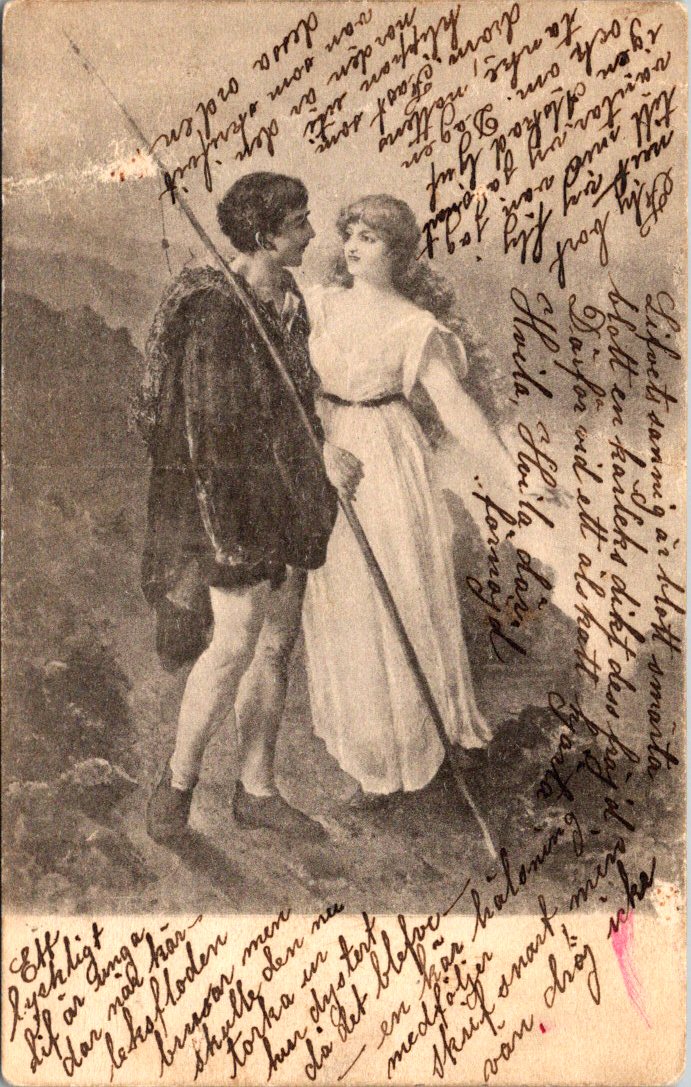

Card 2 ~ Suitor 1 from Norhyttan

Front: An archetypal couple stands on a rocky highland landscape with a misty and dramatic backdrop. A man in rough tunic carries a tall staff next to a woman in flowing white dress with loose hair.

Back: Addressed to Fröken Susanna Pettersson, Tjärnsvedens, Sunnansjö. Swedish 5 öre stamp, Norhyttan postmark.

Correspondence: Densely written in heavy hand-scripted text running in multiple directions across the image.

Elfligt lyckligt är att änga — då ned har bäksfloden bringar men nu skralla den nu torka in text hur dyster då det blefo…

Blissfully happy it is to linger — when down the brook brings / but now how gloomy / when it became…

Production and collector notes: Sepia-toned romantic lithograph published in Stockholm by C. Ns Lj., Sthlm. Series 1339. Domestic Swedish production rather than imported German print, comparatively less common for this period and market. The heroic Nordic couple reflects romantic aesthetic prominent in Scandinavian visual culture of the early 1900s. Dense multi-directional handwriting across the image face is biographically significant. Of interest to collectors of Swedish ephemera, Scandinavian social history, and scholars of private correspondence.
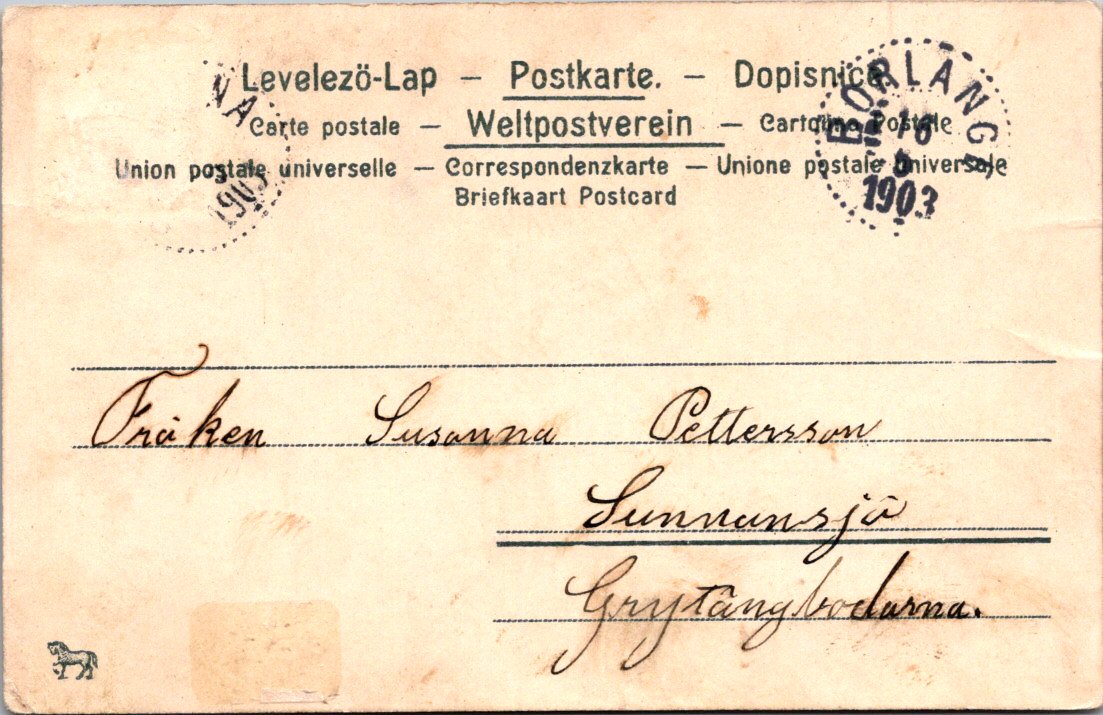
Card 3 ~ Suitor 2 from Borlänge

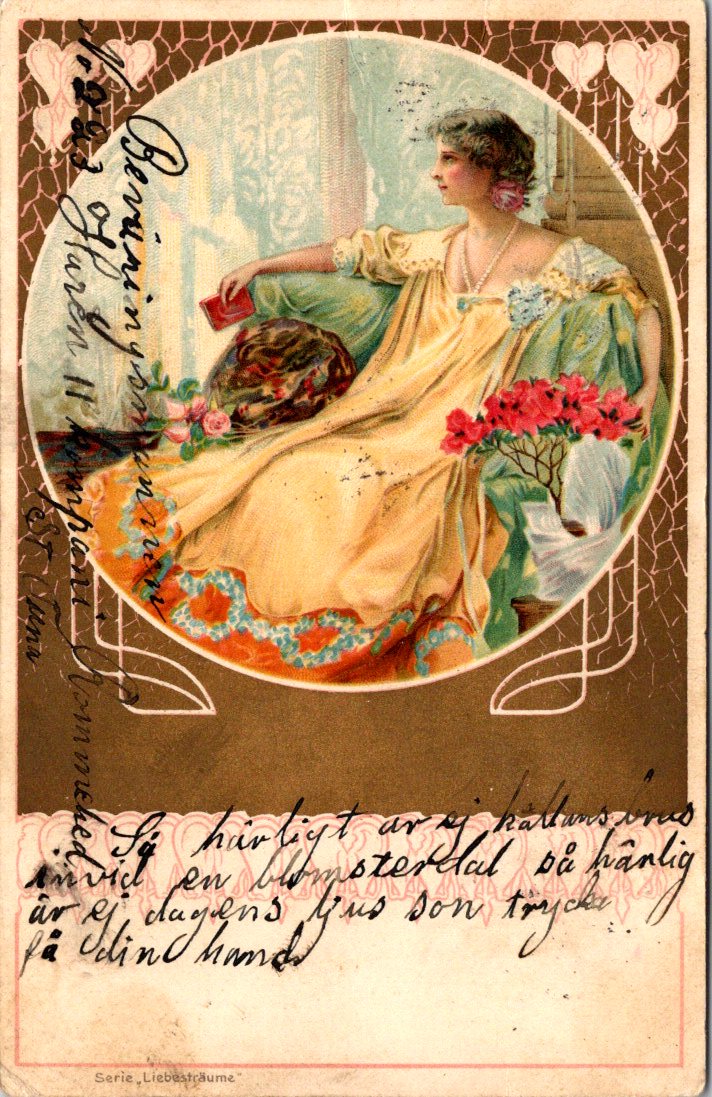
Front: A young woman in a golden-yellow gown reclines on a chaise surrounded by red azaleas and roses, holding a small red book or letter, gazing pensively to one side. Circular vignette set against a rich gold ground with pink Art Deco lattice decoration and heart motifs in each corner.

Back: Addressed to Fröken Susanna Pettersson, Sunnansjö, Gryftångbodarma. The address variation roughly translates to ‘summer farm buildings’ suggesting that Susanna was not at her main home but was staying at a seasonal outpost. Postmark, Borlänge, 1903. Small printer’s horse mark, bottom left.

Correspondence: Rounder and more casual hand-script. Left margin may be a name or family reference.

Så härligt är ej källans öras invid en blomstertal så härlig är ej dagens ljus son tryckt få din hand.

Not so lovely is the murmur of the spring, beside a flower-tale so lovely — not so bright is the light of day, as when pressed upon your hand.

Production and collector notes: Art Nouveau chromolithograph, Serie “Liebesträume” (Dreams of Love), produced by a quality German publisher and distributed internationally, reflecting Germany’s dominant role in the European postcard market of this era. Art Nouveau romance cards with intact Swedish correspondence and Borlänge postmark are notably scarce. Of interest to collectors of Art Nouveau ephemera, Scandinavian material culture, and historians of industrializing Sweden.
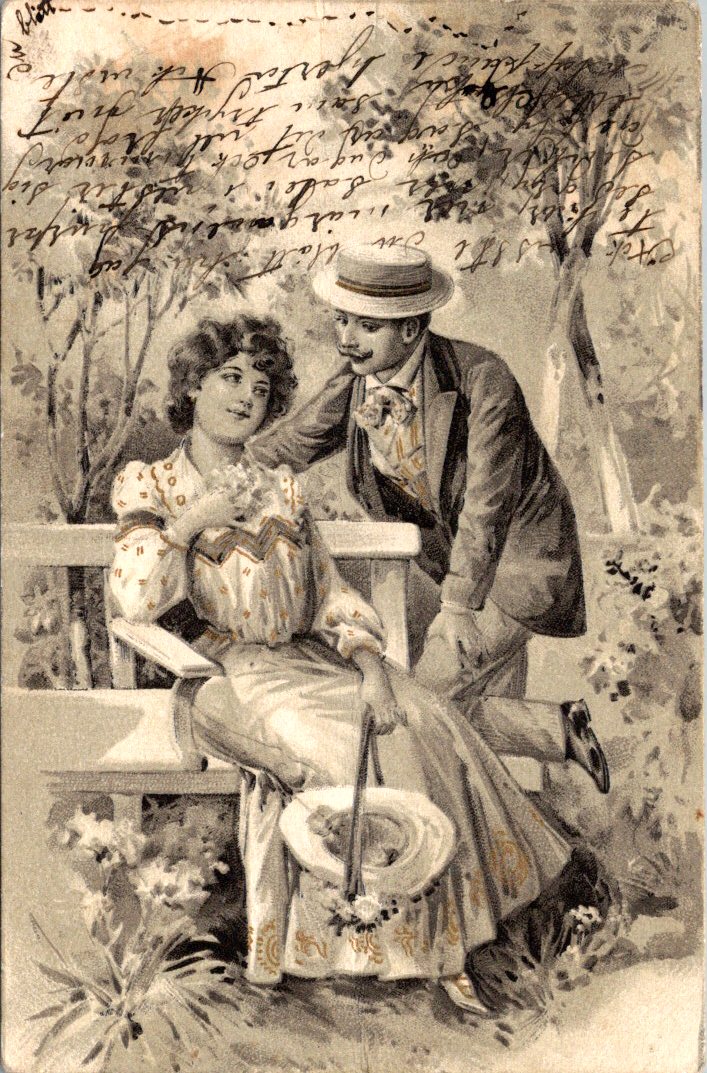
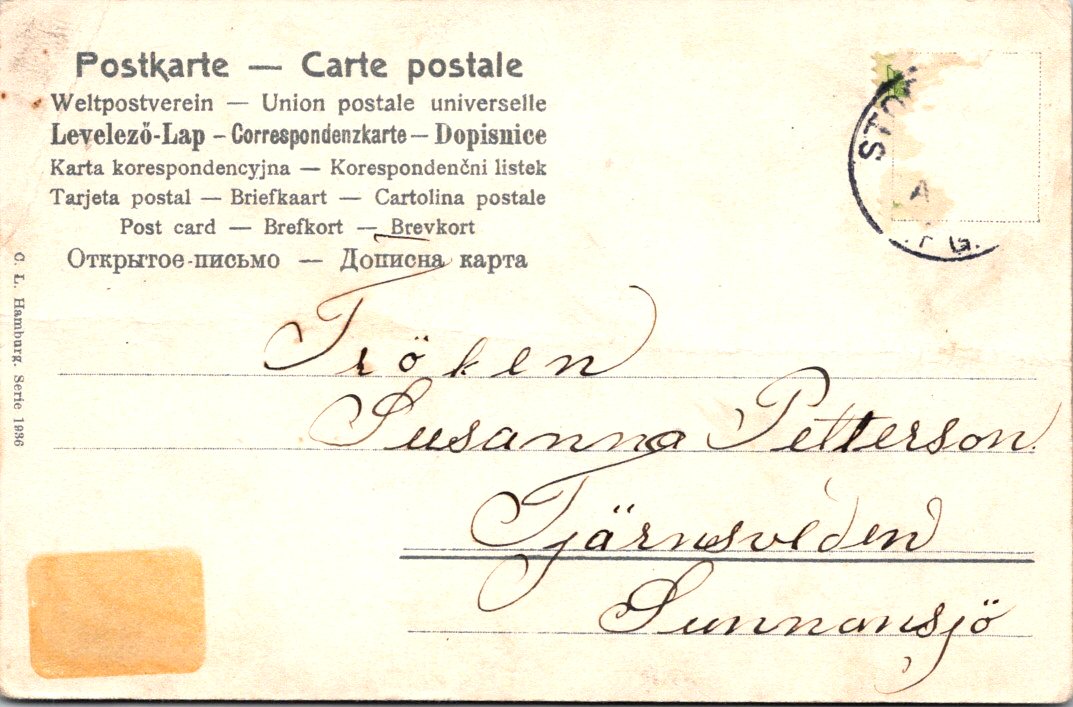
Card 4 ~ Suitor 3 from Stockholm

Front: A couple in a garden setting — woman in white and gold embroidered dress seated on a bench with flowers and parasol. Man in dark suit and straw boater hat leaning toward her attentively. Flowering trees surround them.

Back: Addressed to Fröken Susanna Petterson, Tjärnsvedens, Sunnansjö. Postmark origin reads Sto-, stamp damaged, full date not legible. Almost certainly Stockholm, circa 1903.

Correspondence: Written across the upper image in a compressed angular hand, distinct from both previous writers. Faded pen and ink, with partially legible fragments.

Bätt… polset… och mer… bättre…

Better… better… and more… better…

Production and collector notes: Sepia lithograph with gold highlights published by G. L. Hamburg. Serie 1896, a respected German publisher. Hamburg-published cards with intact Swedish correspondence and Stockholm postmarks from this period are collectible. Of interest to collectors of German-published romance cards and Edwardian Scandinavian ephemera.


Susanna Pettersson lived in a world that offered her limited formal choices. But in a small wooden house in Dalarna at the beginning of the last century, she could make her own quiet judgments. She could choose carefully.

Three suitors, three futures. Did she answer any of them? Whether she eventually became Fru or remained Fröken, we can’t discern from the evidence here. All we know is that she kept those four cards all those years.


A Streetcar Back in Time

Room enough for all of us to go from here to there, and back again.

Featured Postcard~
New Orleans French Market A CENTURY AGO

An early 20th century scenic postcard showcases the iconic French Market in New Orleans’ French Quarter.

Front of the card: The photograph shows the vestibule of the historic French Market, featuring tall, weathered French/Creole Colonial columns supporting a slatted roof. Perspective draws the eye down the long corridor, emphasizing the market’s impressive scale. The covered walkway displays produce, baskets, and merchandise on tables and in crates. The image captures a rare moment when the hallway of vendors face the camera. Hand-colored rose tones reflect the market’s timeless atmosphere with pops of green and blue artfully applied. Caption: Vestibule, French Market, New Orleans, La.

Back details: The left panel explains the market’s history:

This card shows the interesting old columns erected, 1822. While the roof of the market has been repaired many times, the old columns have stood as originally put, without fire aid to the injured.

Published by Lipsher Specialty Co., 320 Magazine St., New Orleans. Standard divided back format with decorative script and postage rates listed: Domestic One Cent, Foreign Two Cents.

Historical significance: The postcard documents the French Market’s appearance in the early 20th century. Established in the 1790s, the market served as a vital commercial hub where vendors sold fresh produce and handcrafted goods. Instructions to “Take French Market car from Canal St.” reflects the streetcar system and emphasis on tourism. This postcard dates to 1922-1925, based on combined evidence of one-cent postage, the specific streetcar reference, and hybrid halftone-collotype printing (Aquatone process was patented in 1922).

Condition and Appeal: The card displays excellent color saturation, with clear and interesting details and minimal defects. Tiny nicks on two corners, with yellowing on the reverse typical of age. Image and text provide valuable historical context, appealing to collectors of New Orleans memorabilia, architectural history enthusiasts, and those interested in early 20th century American commerce. The French Market remains active today, making this postcard a fascinating glimpse into its enduring legacy as a cornerstone of New Orleans culture.

Today’s Art Card & Gallery

The gallery features Landscapes by Larry L’Ecuyer, and here is a fun art card from Anne this week. Winner, winner, chicken dinner!


open call for art cards!

The World’s Smallest Artist Retreat (our P.O. Box) is awaiting your art card submission. Details here!

Art card kits ~ gift or fun for you!

Our Art Card Kits are perfectly-packaged as a fun, creative activity for you and a friend to complete in as little as an hour or made into a lovely afternoon.

Something from Nothing

In her latest essay, Anne explains what we’re doing here 🙂

Still in the Ring

Here we go! The Posted Past heads into the fall season with rare cards, a new gallery, and a social mission to trade loneliness for connection.

featured postcard~
rare novelty card still holds a mystery

An early 20th century novelty postcard featuring humorous photography and personal correspondence from Missouri.

Front of the card: The photograph shows a young Black man in white shirt, suspenders, and dark trousers, grinning while holding a large broken umbrella overhead in a playful pose. Below reads the humorous caption “A little disfigured, but still in the ring”—typical novelty humor from the postcard craze era. A black border frames the photograph on cream cardstock.

Back details: The reverse bears “Carbon Photo Series No. 513” identifying the commercial publisher’s series. Addressed to Miss Grace Skillman in Pleasant Hill, Missouri, with a green 1-cent Franklin stamp and clear 1908 postmark. The handwritten message describes an exhausting early morning wait in Lee’s Summit for “Brother and Frank,” and promising a longer letter that evening.

“Still in L.S. haven’t slept but about ten minutes. My eyes looks like two burnt holes in a blanket. Brother and Frank hasn’t come yet. I will wait till 7.30 and then go home. Will write tonight. Just finished my breakfast. I will eat if not sleep. I got here ten till five.

Condition and Appeal: The sepia-toned image displays characteristic early photography with some age spots, and a nicked corner. The image and reverse side remain in good condition with clear photography and legible handwriting. The “Carbon Photo Series” indicates premium production using carbon-based printing methods prized for superior image quality and archival stability. Grace Andre Skillman was born in Pleasant Hill in 1889, making her nineteen when she received this card. The message and the lack of formal salutation and signature suggest this is casual ongoing family correspondence. As a result, the author of the postcard remains a mystery.

Vintage novelty postcards are increasingly collectible, especially numbered commercial series with documented recipients. Collectors of African-Americana may find the image appealing and relatively rare. The combination of carbon printing technology, humorous subject matter, and personal correspondence is of interest to collectors of vintage photography, postcard enthusiasts, genealogy researchers, and those focused on early 20th century American social history and communication.

Introducing~
The Posted Past Art Card Gallery

A selection of Larry L’Ecuyer’s watercolor landscapes are on display in our Online Art Card Gallery. Fitting as our first show. Enjoy!

Watercolor postcard showing a serene lake scene with mountains in the background and tall grasses in the foreground
Countdown to a Lakeside Getaway, 2025, Larry L’Ecuyer, watercolor on postcard

NEWS & UPDATES~
art card call for submissions is open

The World’s Smallest Artist Retreat (our P.O. Box) is awaiting your art card submission. Follow one rule to join the next open show. Details here!

Art card kits now in stock

Our Art Card Kits are perfectly-packaged as a fun, creative activity for you and a friend to complete in as little as an hour or made into a lovely afternoon.

The kit includes two postcard blanks, six vintage finds curated to the chosen theme, and a bundle of collage goodies for your whimsy. There is a free gift inside, too!

Once you’re done, surprise someone with an original art card in their mailbox. Or, send it back to us to include in the next online show. Either way, you’ll have cultivated a little joy in your garden.

Order your kit here 🙂

Wise Eyes

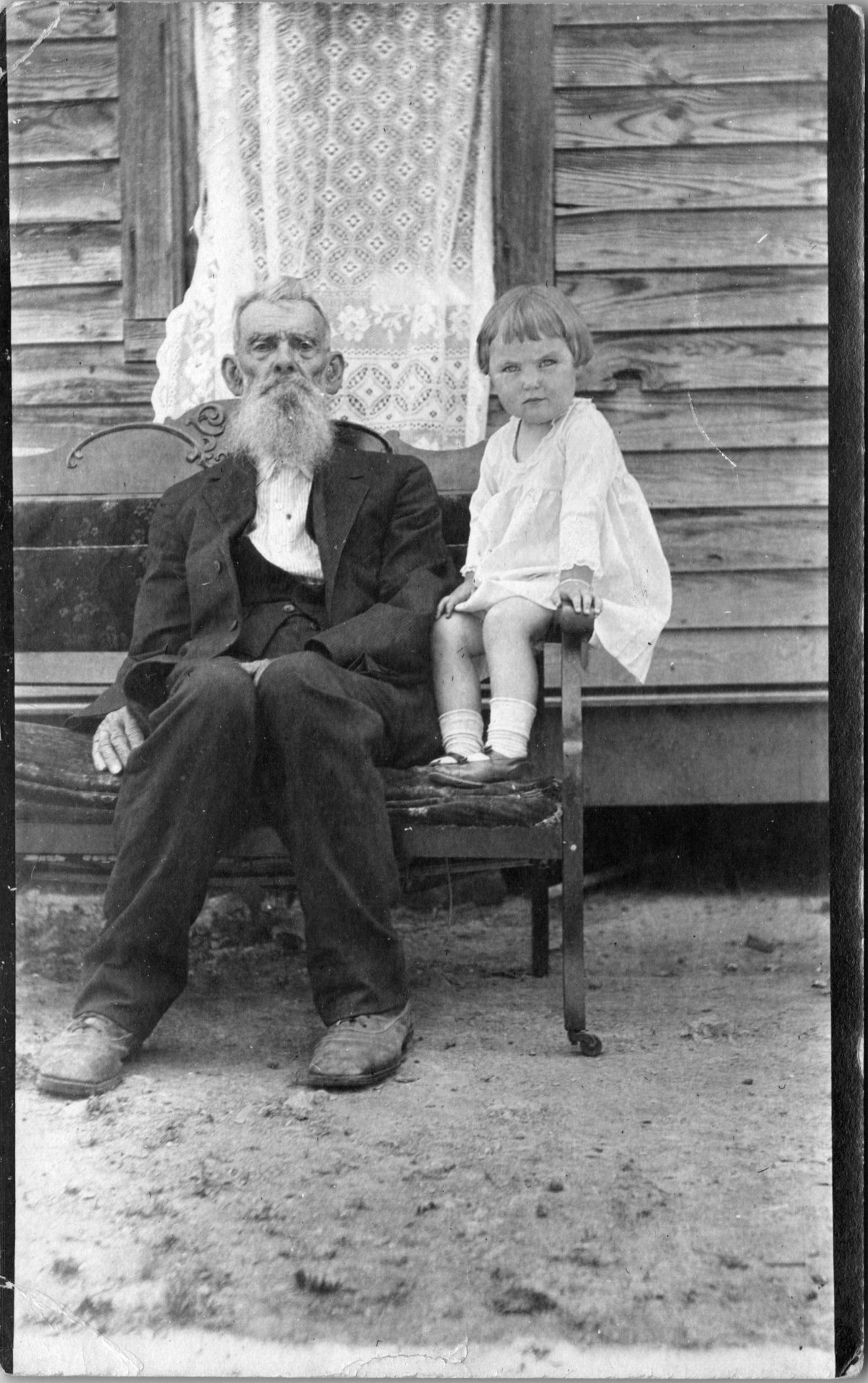
Old Rufus Dale had seen a thing or two, and Irene had her suspicions.

An early 20th century real photo postcard (RPPC) showing a poignant intergenerational portrait.

Front of the card: The photograph captures an elderly man with a distinctive long white beard, dressed in a dark suit, seated on a dilapidated wooden loveseat or couch in front of a clapboard house. Beside him sits a young child in a white dress, perched on the arm of the furniture. Behind them a decorative lace curtain hangs outside the open window. The setting appears to be rural America.

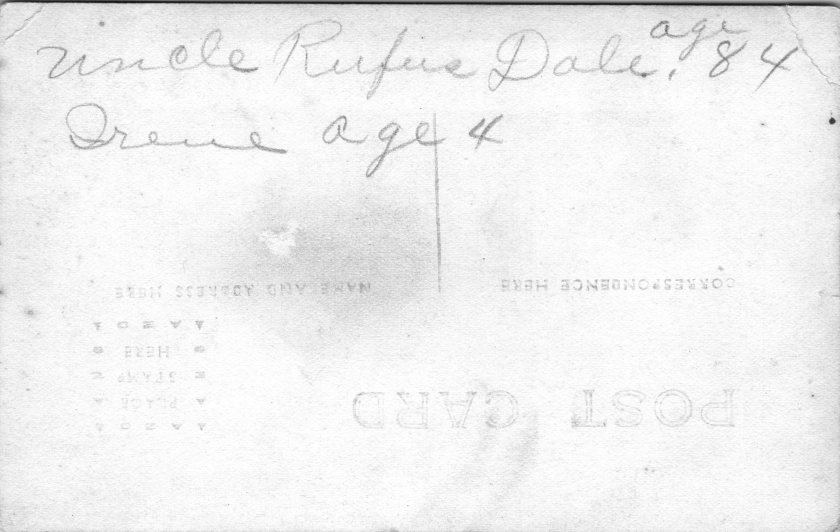
Back details: The reverse shows the handwritten inscription in pencil, Uncle Rufus Dale, age 84 and Irene age 4. We can assume a family relationship, likely between grand-uncle and grand-niece.

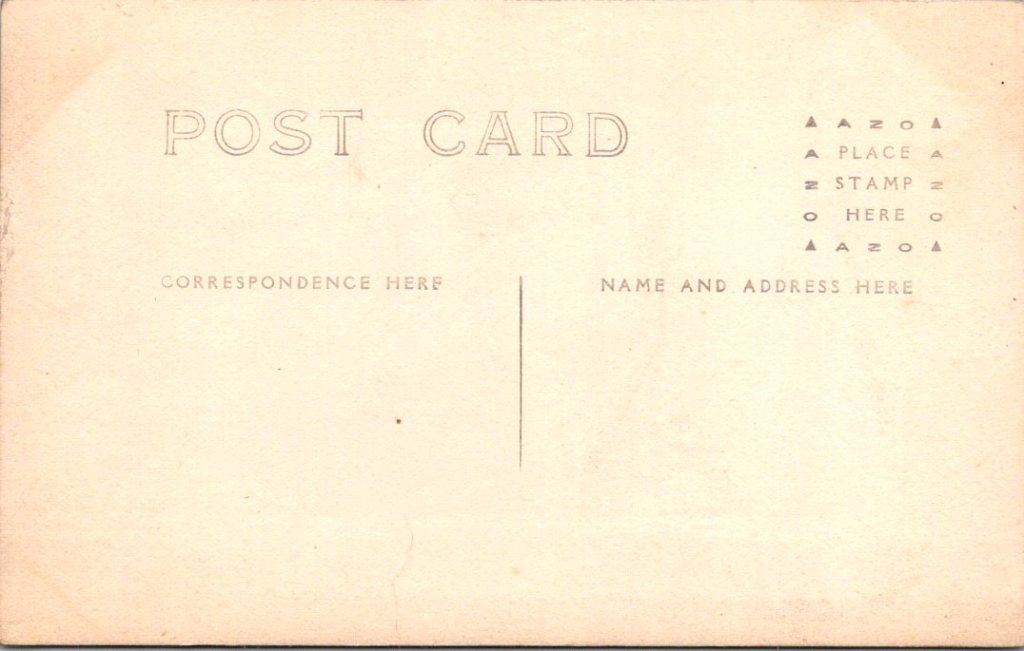
Condition and Appeal: The real photo postcard is in excellent condition front and back, unposted with helpful writing, and an AZO indicia dating the item between 1904 and 1918. The subject matter and production method suggest this is a unique image and object, with no known duplicate.

RPPCs are quite collectible, especially those with interesting and clear photographic subjects. The rural American family setting, the age gap between subjects, and the excellent condition make this item more desirable, appealing to collectors of early photography, genealogy researchers, postcard collectors, and those interested in American family and social history from the early 1900s.

[Note: Summer focus is on detailed captions. Essays return in September!]

Silent Stare from Last Century

The news these days deserves a long silent stare. Here is one from a horse. A century or more later… still no.

[Note: Summer focus is on detailed captions. New essays return in September!]

A vintage real photo postcard shows a dappled gray horse standing in a farmyard setting. The well-built animal is wearing a halter and is positioned in profile to show its conformation. A person in a hat and dark clothing stands beside the horse, likely the owner or handler. The American rural backdrop includes wooden farm buildings and bare winter trees. The ground is packed earth typical of a working farm. The photograph has the characteristic appearance of an early 20th century image, with some evidence of a stylized border in the exposure. The postcard is in excellent condition front and back, unposted with no writing, and an AZO indicia dating the item between 1904 and 1918. The subject matter and production method suggest this is a unique image and object, with no known duplicate.

Hats Are No Joke

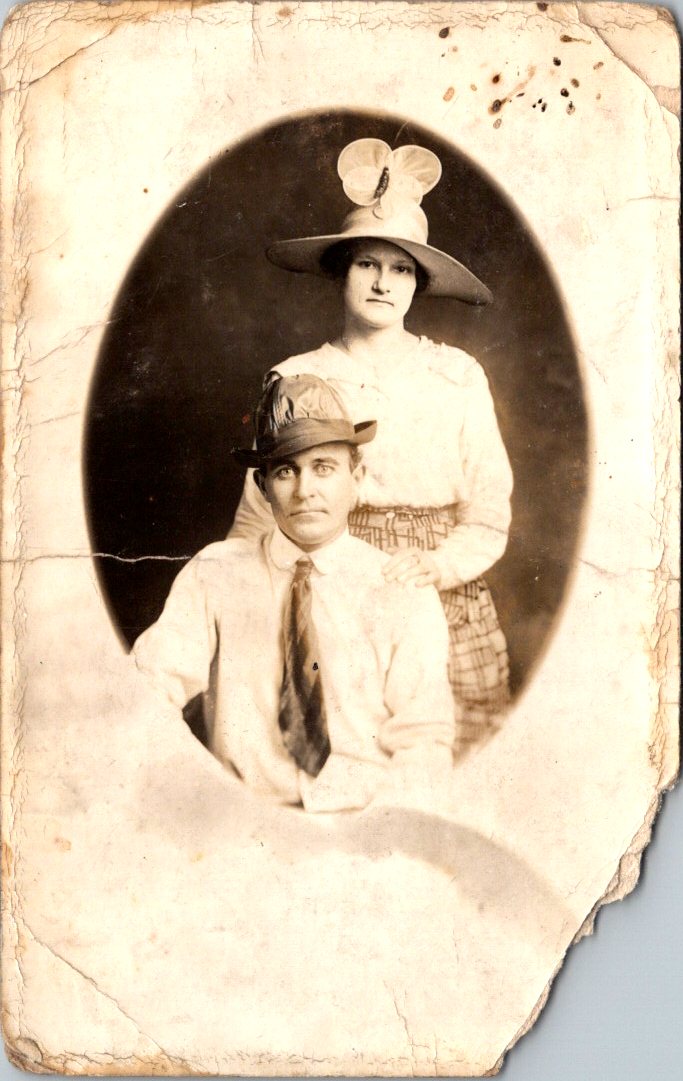
Is this a portrait of the couple or their hats? Feathers in the band. Fascinator with a wide brim. Stories behind their eyes and more clues in their clothes. The real photo postcard went unsent. Pasted inside an album once, and then lost for 100 years.

A sepia-toned oval portrait photograph from around 1910 showing a couple in formal attire. The woman stands behind the seated man, wearing a wide-brimmed hat decorated with a large bow or fabric flower. She’s dressed in a light-colored blouse with puffy sleeves and a geometric patterned skirt with a button at the waist. The man sits in front wearing a white long-sleeved collared shirt, striped tie, and a small hat with multiple feathers in the brim. Both subjects have neutral expressions typical of formal photography from this era. The real photo postcard shows significant age-related damage, with cracked and yellowed edges, stains, and deterioration around the borders, characteristic of an early 20th-century item previously collected in an album.

Panoramic Phoenix

Rare panoramic postcards from the Haines Photo Company capture Phoenix on the cusp of the century.

As American cities boomed in the early 1900s, panoramic postcards emerged to document their transformation. The Haines Photo Company of Conneaut, Ohio seized this opportunity, operating from about 1908 to 1917. Photographers crisscrossed the country capturing these distinctive wide-angle views of evolving American cityscapes, like Phoenix, a fledgling desert outpost poised for dramatic growth.

Phoenix in 1900 numbered just 5,554 residents. Though small, it already served as Arizona’s territorial capital with statehood just twelve years away. These panoramic postcards reveal a city establishing the foundation for its explosive future growth.

Washington and First Streets

The first panorama captures Phoenix’s commercial core at Washington and First Streets. Electric streetcar tracks cut through the unpaved road—these trolleys had replaced horse-drawn versions in 1893, modernizing city transit. Desert mountains loom in the distance while palm trees line parts of the street, evidence of successful irrigation in this arid landscape.

A prominent building with a tower dominates the background. Pedestrians stroll the sidewalks alongside horse-drawn carriages, as automobiles remained rare luxuries. Sturdy two and three-story commercial buildings reveal a city with ambitions beyond its frontier origins.

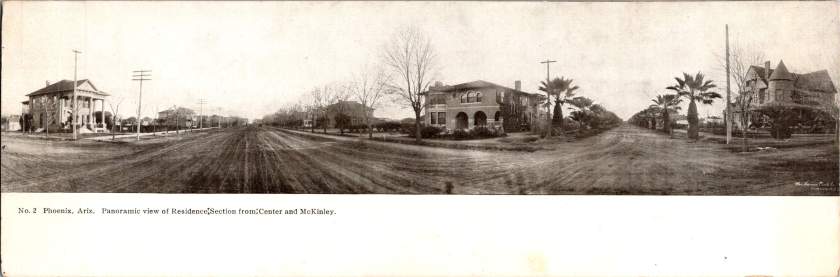
Residences at Center and McKinley

The second view shifts to Phoenix’s growing residential district at Center and McKinley. Here, successful merchants and professionals built impressive homes along wide, unpaved streets. Both palm trees and deciduous trees (some leafless in winter) frame the elegant residences.

These neighborhoods developed as streetcar suburbs, allowing prosperous residents to escape downtown congestion while maintaining business access. Homes display fashionable Colonial Revival and Craftsman styles with generous porches and elaborate details. Unlike cramped eastern cities, Phoenix boasted detached homes on spacious lots—a pattern that would define its future growth.

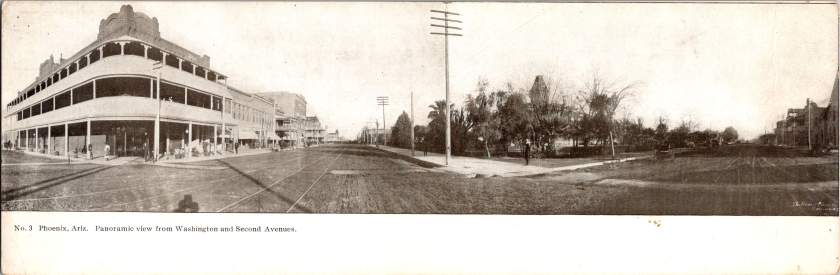
Washington and Second Avenues

The third panorama returns us to the commercial district. A substantial three-story building with multiple balconies dominates the left side. Was it a hotel or major retailer? Streetcar tracks again slice through the broad dirt roadway. A park or green space appears across the street, providing rare desert shade.

Notice the shadow intruding on the lower left? It’s the silhouette of our photographer with tripod-mounted camera. Was this F.J. Bandholtz, a prominent panoramic photographer who worked with Haines?

Washington and First Avenues

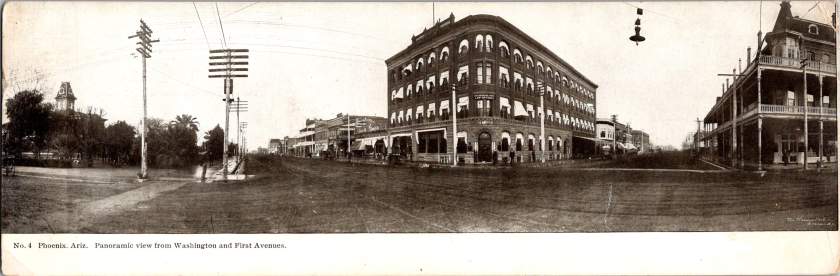
The fourth panorama captures Phoenix’s financial center. A four-story brick building with numerous arched windows dominates the scene. This building houses the Phoenix National Bank with law offices above, very likely belonging to Joseph H. Kibbey, a former Territorial Supreme Court Justice (1889-1893) and Arizona Territorial Governor (1905-1909).

Founded in 1892, the Phoenix National Bank had become Arizona’s largest by 1899, with deposits totaling $692,166. Telegraph and electrical poles with multiple crossbars line the street, demonstrating developing infrastructure. The dirt streets accommodate both pedestrians and horse-drawn vehicles, though automobiles were beginning to appear.

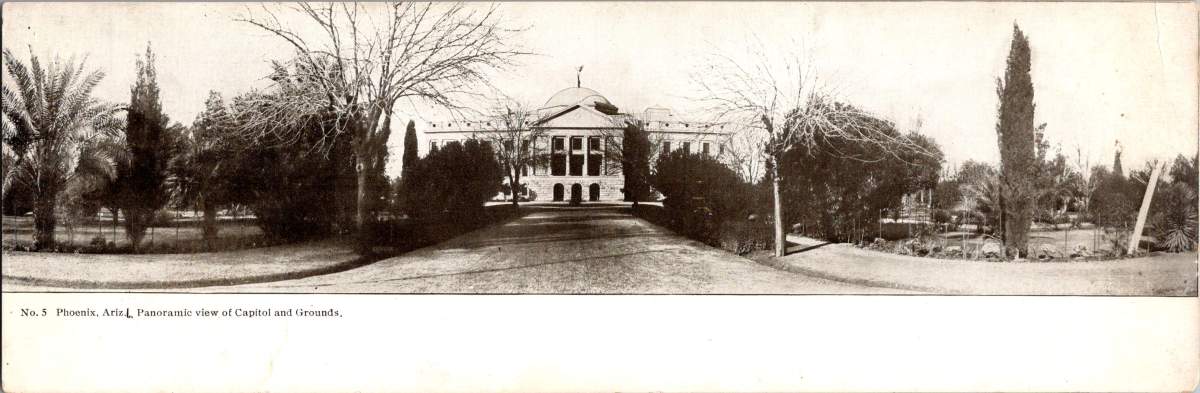
Capitol Grounds

The fifth panorama showcases Arizona’s territorial capitol. This impressive domed structure, completed in 1900 at a cost of $130,000, sits back from the road on a donated 10-acre plot at Washington Street’s western end. Formal gardens with cypress, palms, and ornamental plantings surround the building, irrigation transforming these arid landscapes.

Governor Murphy dedicated the building on February 25, 1901. At the time, the capitol complex embodied Phoenix’s civic ambitions and push toward statehood. Now the main building is home to the Arizona Capitol Museum, connecting present-day Phoenix to its territorial roots.

Phoenix Indian School

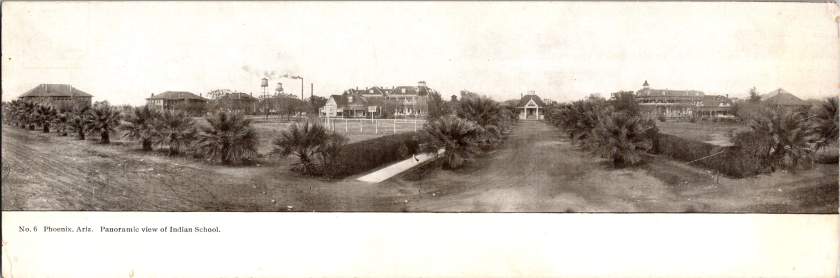
The final panorama depicts the Phoenix Indian School campus with its multiple buildings, some with smoking chimneys, surrounded by palm trees. Established in 1891, this federal boarding school implemented the government’s brutal and coercive Native American assimilation policies. Located on 160 acres north of downtown, the campus featured brick and frame buildings for classrooms, dormitories, workshops, and administration.

The school expanded rapidly from 42 students initially to 698 by 1900, representing 23 tribes from across the Southwest. Operating until 1990, the school’s complex history reflects the often painful relationship between the federal government and Native peoples, and Phoenix’s role in executing national policies.

The Haines Photo Company

These remarkable panoramic images came from the Haines Photo Company of Conneaut, Ohio. From 1908 for about a decade, they specialized in wide-angle photography of towns and cities across the United States. The Library of Congress preserves over 400 of their photographs documenting America’s evolving landscapes and cityscapes.

Technological innovations in cameras and film made panoramic photography possible. Companies like Haines used specialized equipment to capture expansive views with exceptional clarity. They printed these as postcards for both tourists and locals proud of their developing communities. The panoramic format perfectly suited sprawling western cities like Phoenix that grew horizontally rather than vertically.

Who actually pressed the shutter remains mysterious. The Library of Congress identifies F.J. Bandholtz (Frederick J. Bandholtz, born circa 1877) as a prominent panoramic photographer working with Haines. The shadow in the third image provides our only glimpse of the person behind the camera—a tantalizingly incomplete clue to their identity.

Fast Growth in Phoenix

The early 1900s transformed Phoenix through several key developments. Roosevelt Dam (completed 1911) secured reliable water and power for the Valley. The Santa Fe, Prescott and Phoenix Railway (1895) connected the city to northern Arizona while streetcars improved local mobility. Institutions like the Carnegie Free Library (1908) and Phoenix Union High School (1895) established cultural foundations. Economic activity diversified beyond the “Five Cs” (copper, cattle, climate, cotton, and citrus) to include banking, retail, and professional services.

Statehood on February 14, 1912 elevated Phoenix’s status as capital. These postcards hint at those century-old aspirations—a frontier town rapidly becoming a modern American city. Phoenix’s population doubled from 5,554 in 1900 to 11,134 by 1910, and surged to 29,053 by 1920, launching a growth trajectory that would eventually make it one of America’s largest cities.