Shakespearean Soap

In the 1880s, someone figured Shakespeare had the perfect verse for selling soap.

Rare Cards ~ Seven Victorian Trade Cards Selling Dobbins’ Electric Soap

In Shakespeare’s As You Like It, Jacques delivers his monologue in Act II, Scene VII, observing human life with world-weary detachment. He sketches out seven distinct chapters of a human life, from mewling infancy to toothless old age, with equal parts affection and irony. One of the most quoted passages in all of Shakespeare, by the 1880s it was deeply embedded in popular culture — the kind of verse that some households knew by heart.

“All the world’s a stage, and all the men and women merely players.”

Dobbins’ Electric Soap was manufactured by I. L. Cragin & Co. of Philadelphia and had been on the market since the mid-1860s. By the early 1880s, the company was advertising heavily through trade cards, chromolithographic collectibles that matched the indulgences of the Gilded Age. Cragin’s innovation was to produce not a single card but a series of seven that required the collector to buy a bar of soap each time. Get the certificate from your grocer, and the full set arrived by mail free of charge.
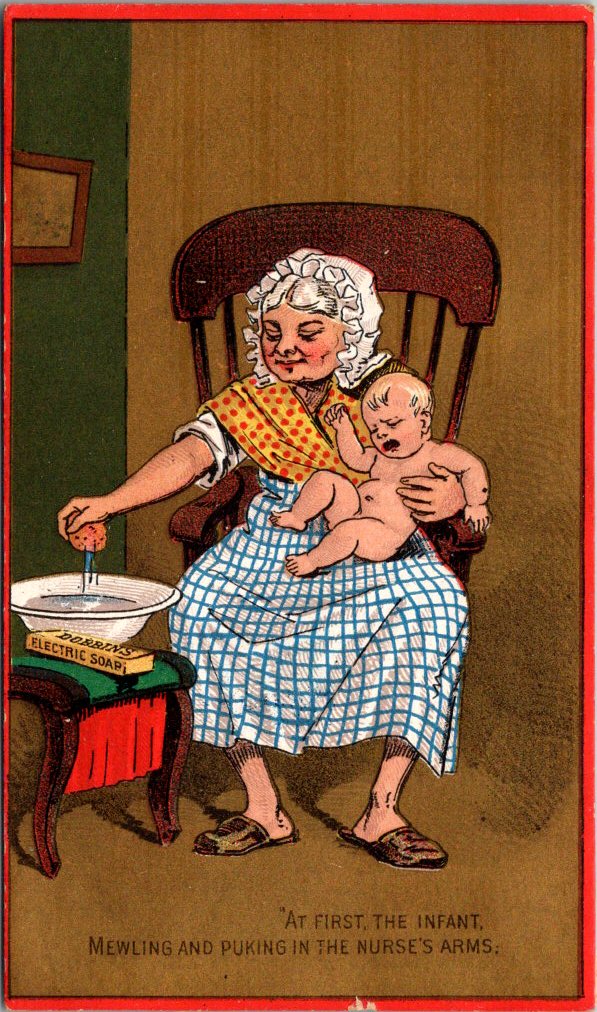
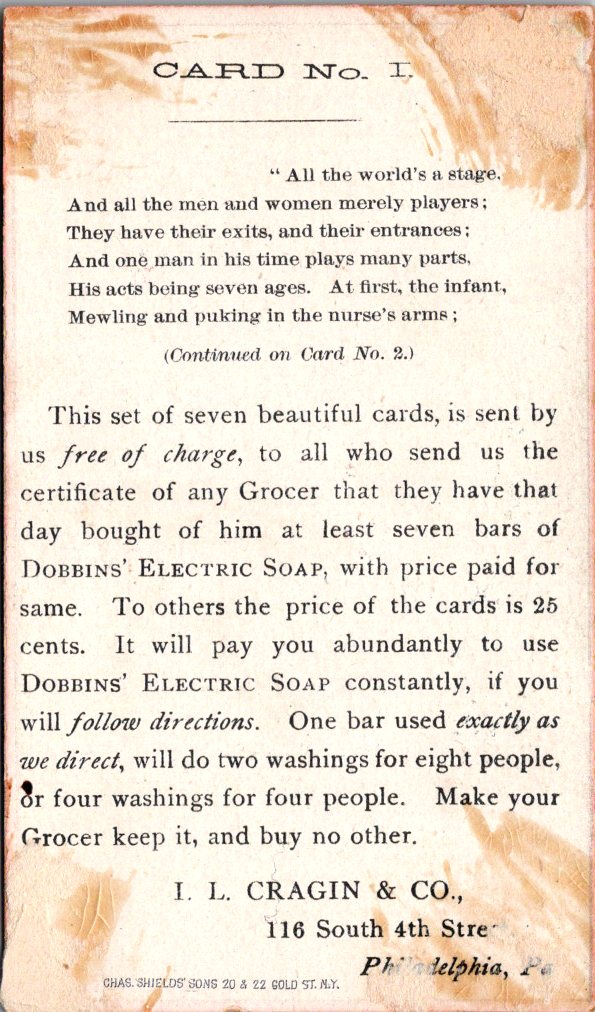
Philly, 1880s. Shakespeare meets laundry.

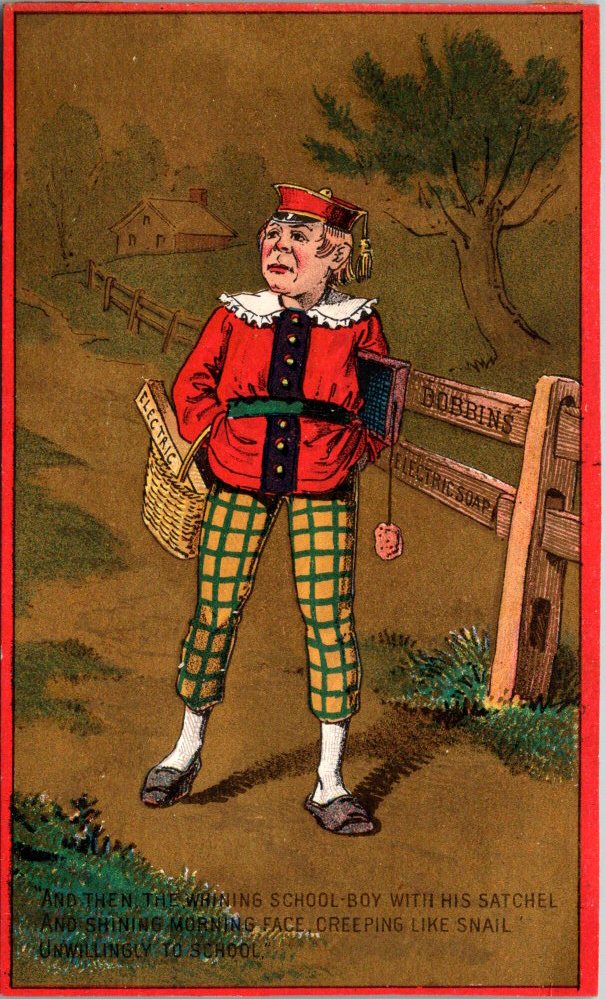
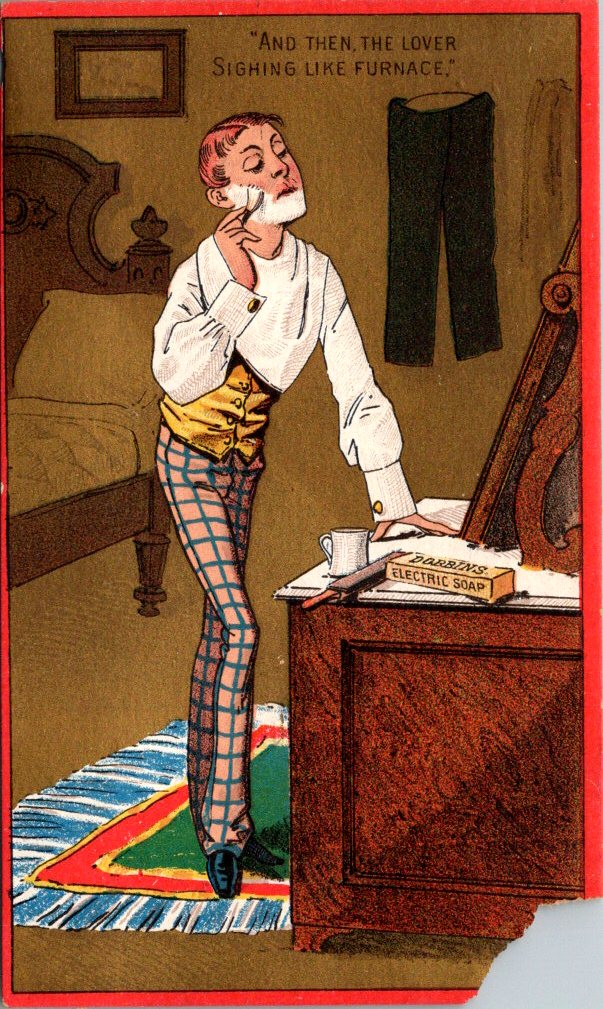
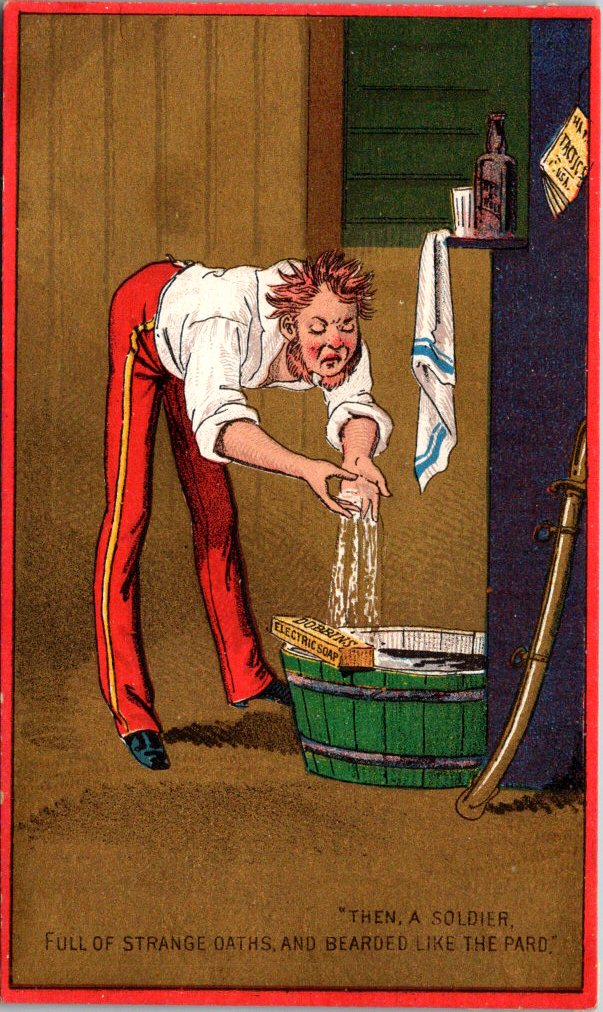
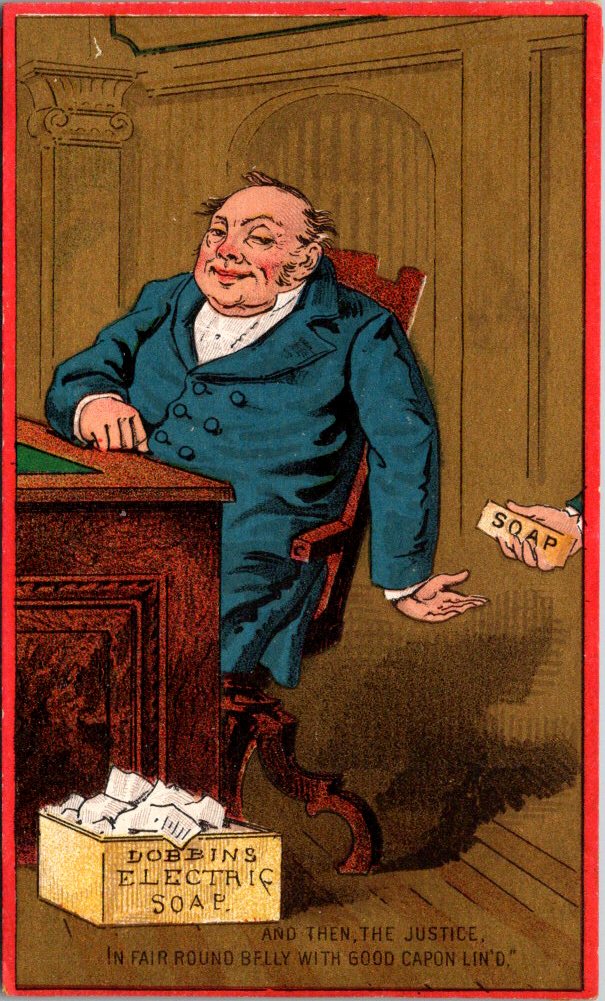
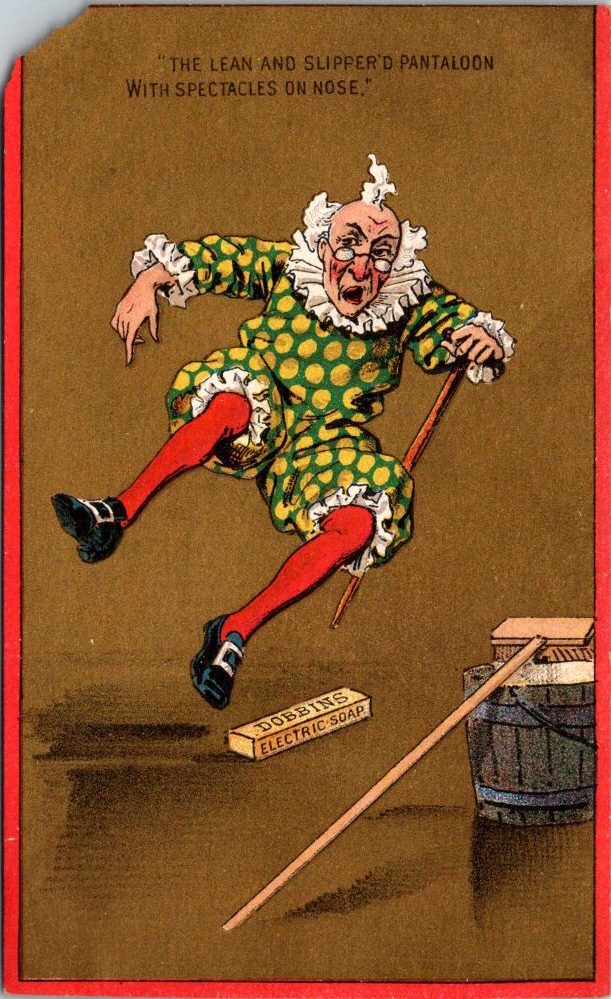
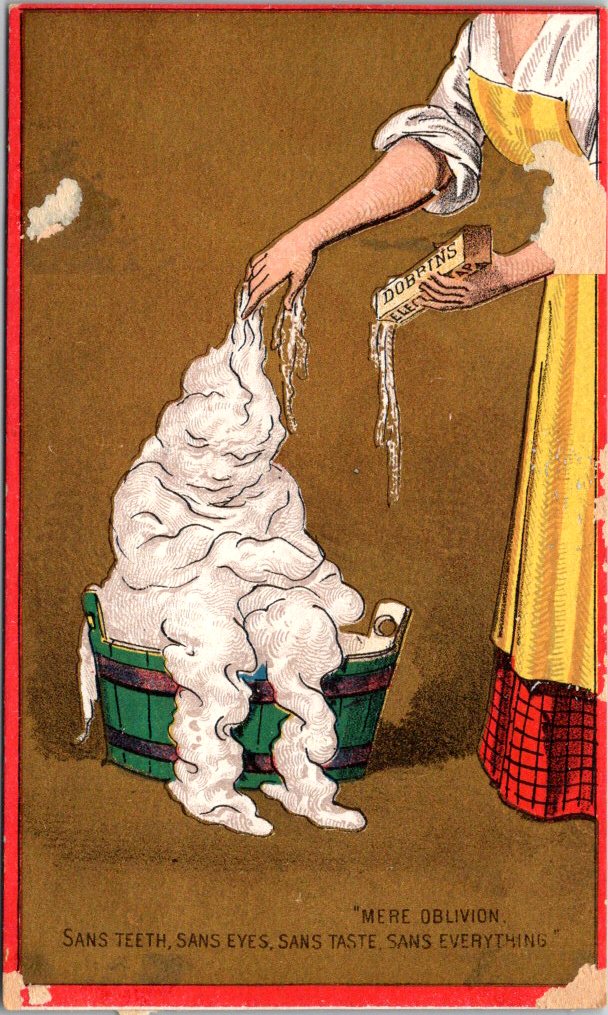
Front: Each card is a vivid chromolithograph on a warm gold ground with a bold red border, a consistent visual identity that makes the cards a set. The figures are drawn in a coarse comic style, expressive and exaggerated, with each character placed in a domestic or outdoor scene with a bar of Dobbins soap nearby.

First, a round-faced nurse in a white mobcap seated in a rocking chair, holding a squirming naked infant over a washbasin. Card Two shows a sulky schoolboy in a red jacket and yellow-green plaid knickerbockers, satchel over one shoulder. The lover on Card Three is a lanky figure in a gold waistcoat and plaid trousers, leaning against a bureau in a disheveled bedroom.

The soldier on Card Four is wild-haired and red-faced, bent over a green barrel-tub in his uniform trousers and braces, and a sword against the wall behind him. Card Five presents a rotund man in a blue coat, leaning back in his chair with the serene self-satisfaction of someone accustomed to receiving gifts. Card Six is an elderly Harlequin figure in a polka-dotted costume with red stockings, tumbling in mid-air. The final card is a woman in a yellow apron leaning over a green wooden tub, and a billowing human figure made entirely of suds.

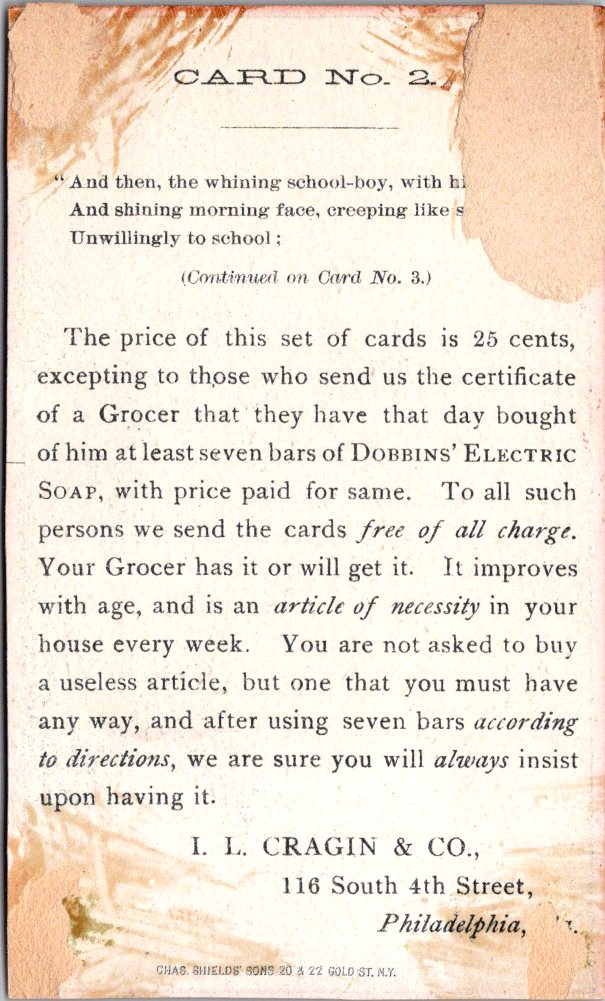
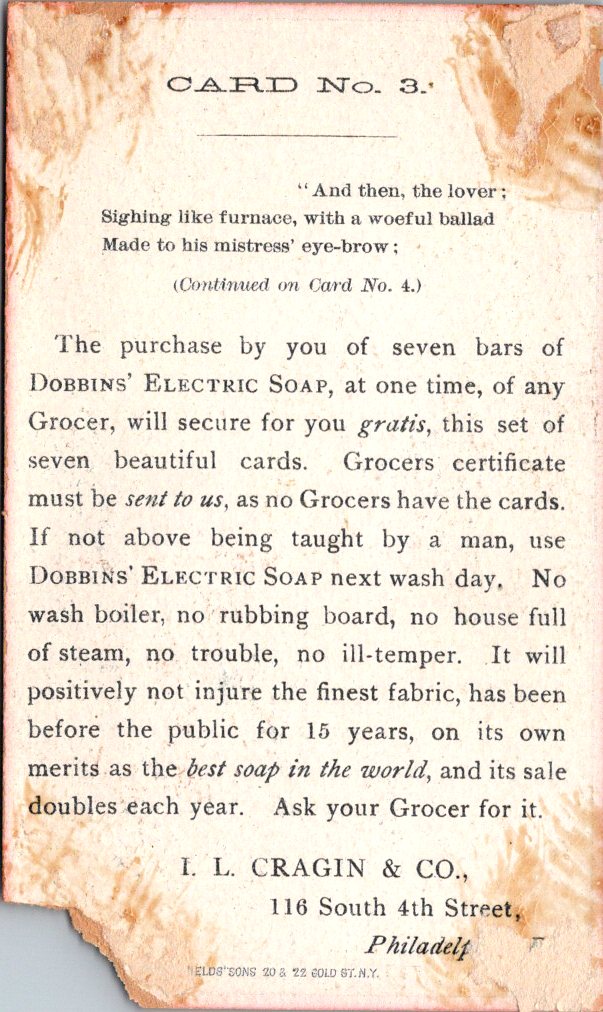
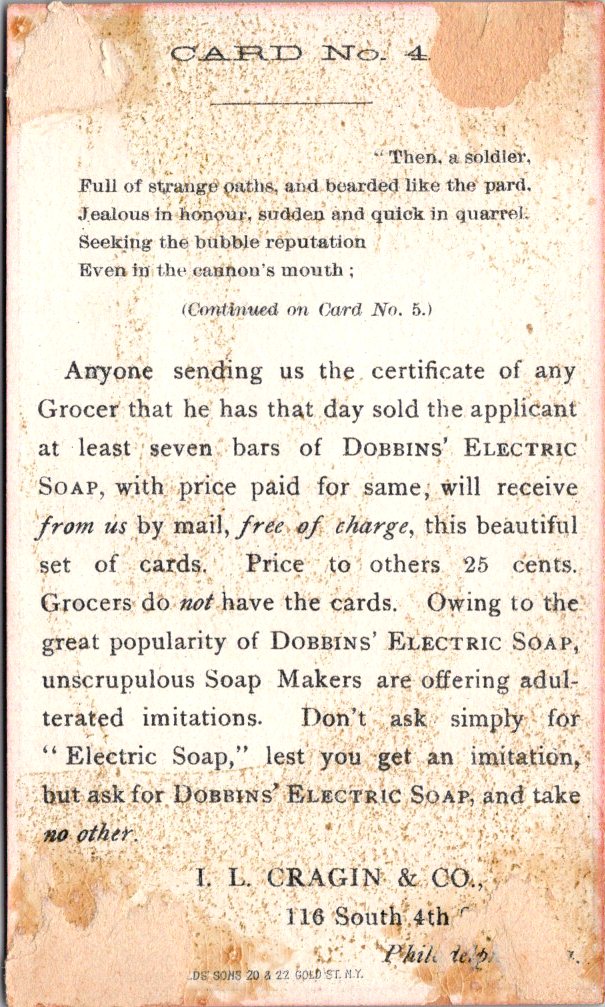
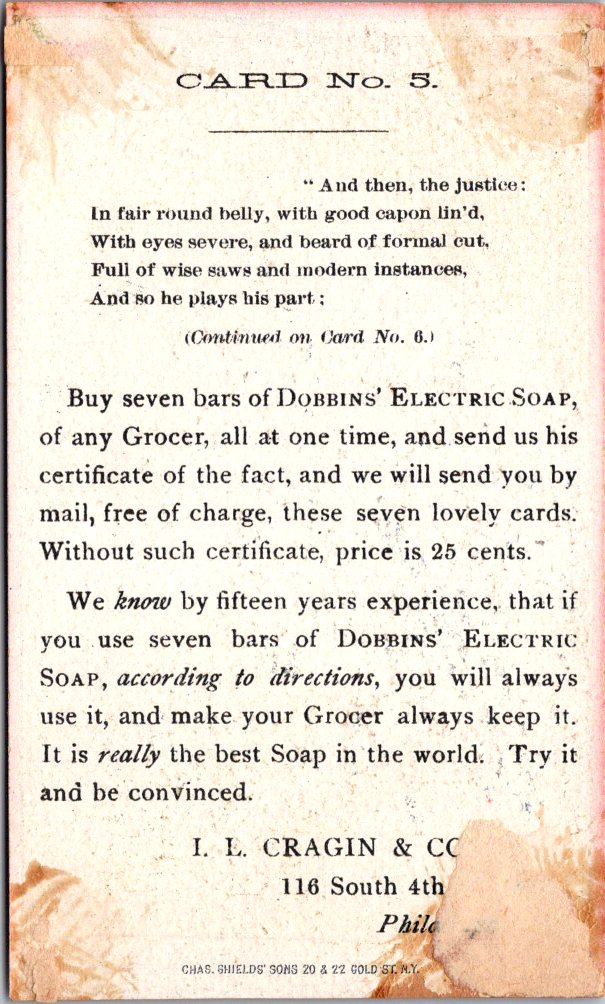
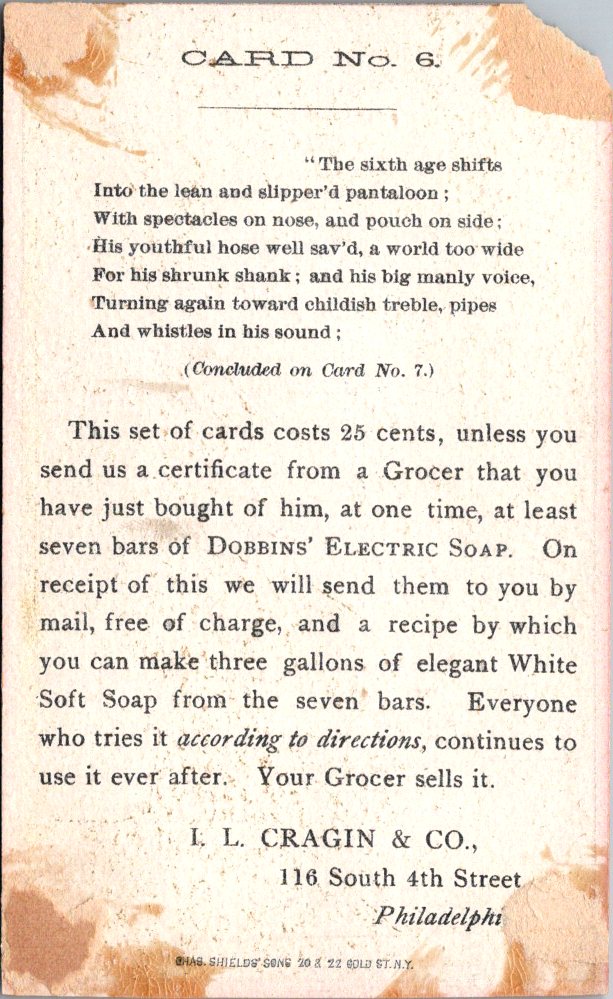
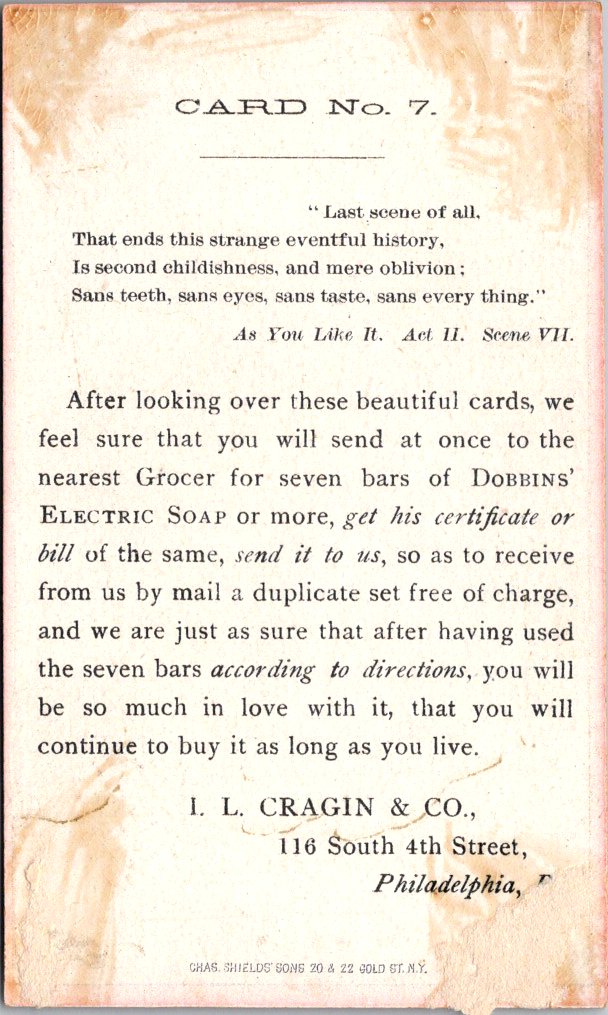
Reverse: Black text on cream stock with the full Shakespeare speech across all seven cards, each picking up the verse where the last left off. The final card identifies the source: As You Like It, Act II, Scene VII.

Below the verse, each card runs a version of the same offer in slightly varied language: collect a grocer’s certificate for each bar purchased and mail seven of them to 116 South 4th Street, Philadelphia. Without the certificate, the price for the set is 25 cents.

Each card presents a few product features: no wash boiler, no rubbing board, no house full of steam. Card Four warns against unscrupulous imitations and instructs buyers to ask for Dobbins’ Electric Soap by name. The printer’s imprint for Chas. Shields’ Sons, 20 & 22 Gold Street, New York appears at the foot of each reverse.

Production: These high-quality commercial chromolithographs likely date to the early 1880s, after the business had been in operation for more than a decade. The color registration is precise throughout, the figure work confident and expressive, and the gold-and-red palette gives the set a unified identity that still reads as a coherent series. The illustration style and rich production values mirror the opulent aspirations of the era.

Collectibility: Complete sets of themed trade card series are uncommon; most were distributed individually and rarely survived intact. The Shakespeare framework, the quality of the printing, and the conceptual ambition of the campaign make this set particularly distinctive. It appeals to trade card collectors, Victorian advertising historians, Shakespeare enthusiasts, and ephemera collectors with a taste for the literary and the delightfully absurd.


new Rarities Room

Our new space for the old stuff that no one ever threw away – yay!
Property Past

Tricky, sticky stories arise at the sight of buildings in the landscape. Evidence (or absence) of us along the way.

As landscapes, last week’s real photo postcards (RPPC) asked for nothing. Trees, frozen roads, animals burrowing in snow—they floated free of context. We could easily appreciate them without knowing where they might be.

Buildings are different. A structure says someone decided, planned, risked, and accomplished. They hauled materials, drove nails, painted trim. Buildings demand explanation in ways that hills might easily demure.

Reading postcards slowly reveals patterns. The undivided back means pre-1907. The real photo process suggests a local photographer, or maybe an itinerant professional documenting a place too remote to the reach of commercial postcard companies. Paper stock, indicia, stamps and cancellation, faded handwriting and previous labeling, even image placement and crop—these technical details narrow the place possibilities.

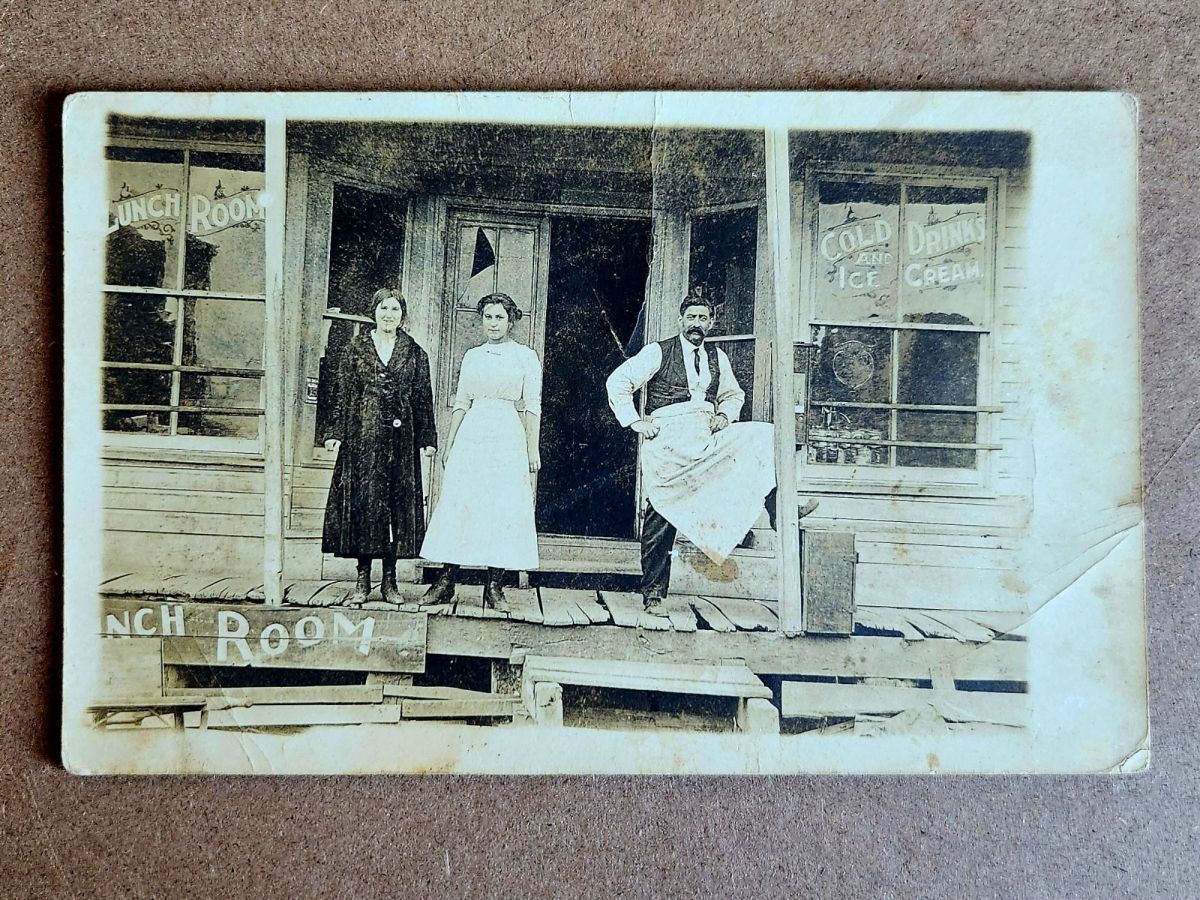
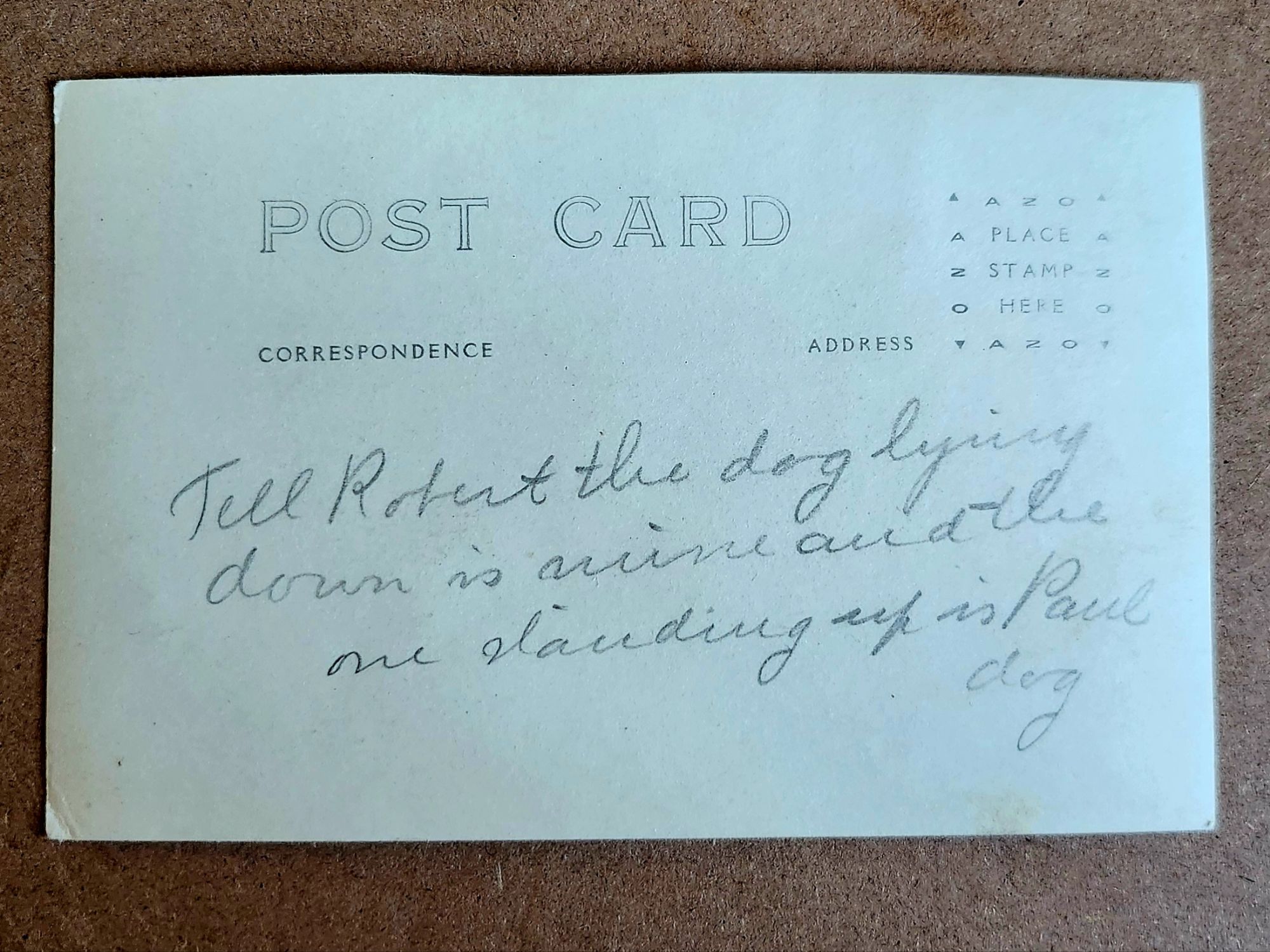
But they don’t yet answer another question: Who are Robert and Paul?

Tell Robert the dog lying down is mine and the one standing up is Paul dog

What We Might Know

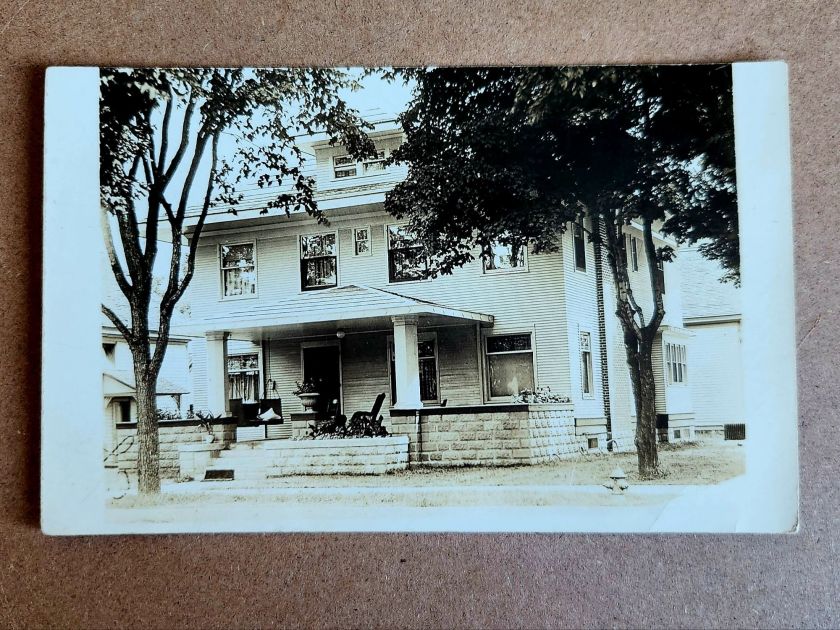
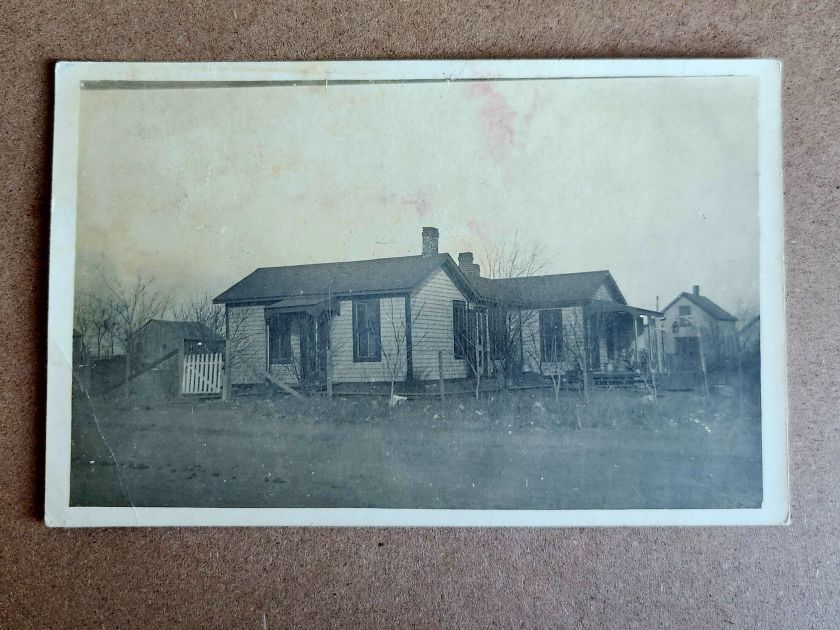
A two-story house with a generous porch is carefully centered in one photograph. Mature trees in the foreground. Curtains hang in the windows. Someone lived here and wanted to show their pride. Or, was it for sale?

The architectural details offer more clues. Clapboard siding, stone or brick foundation, decorative porch elements—not fancy, but intentional. It seems to be in a neighborhood with sidewalks. In an era between 1900-1920, somewhere in the Midwest or West judging by lot size. Also, a fire hydrant.

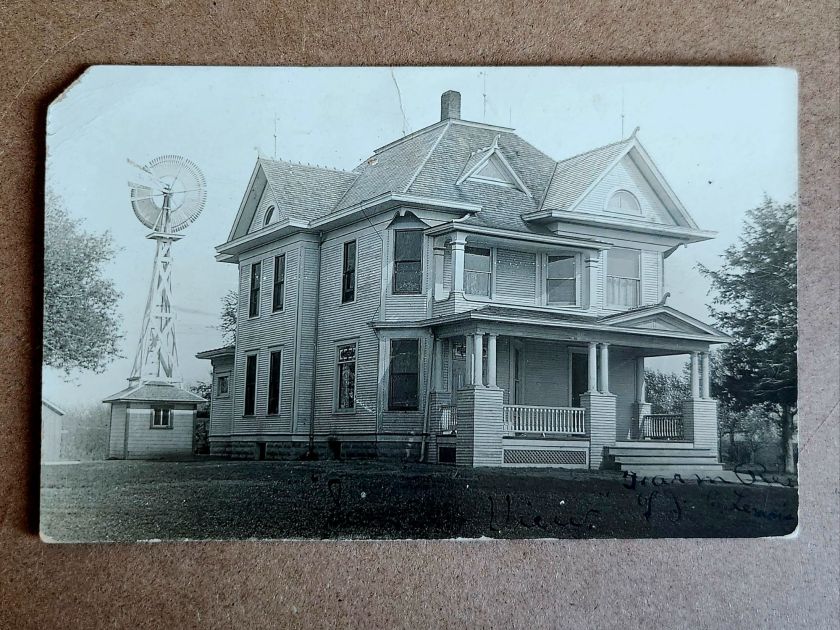
The windmill in another image dates itself. Windmills were an important utility and industry, and that style had a particular era. The house beneath it—elaborate Queen Anne with corner turret, ornamental shingles, and ornate columns—speaks to aspiration. Someone had big plans. This is visible evidence. When and where becomes roughly recognizable.

But, the people who stood on that porch remain absent and enigmatic. Who were they? What is happening here? A creative tension is mounting between the realm of evidence and the pull of story.

Sensing Stories

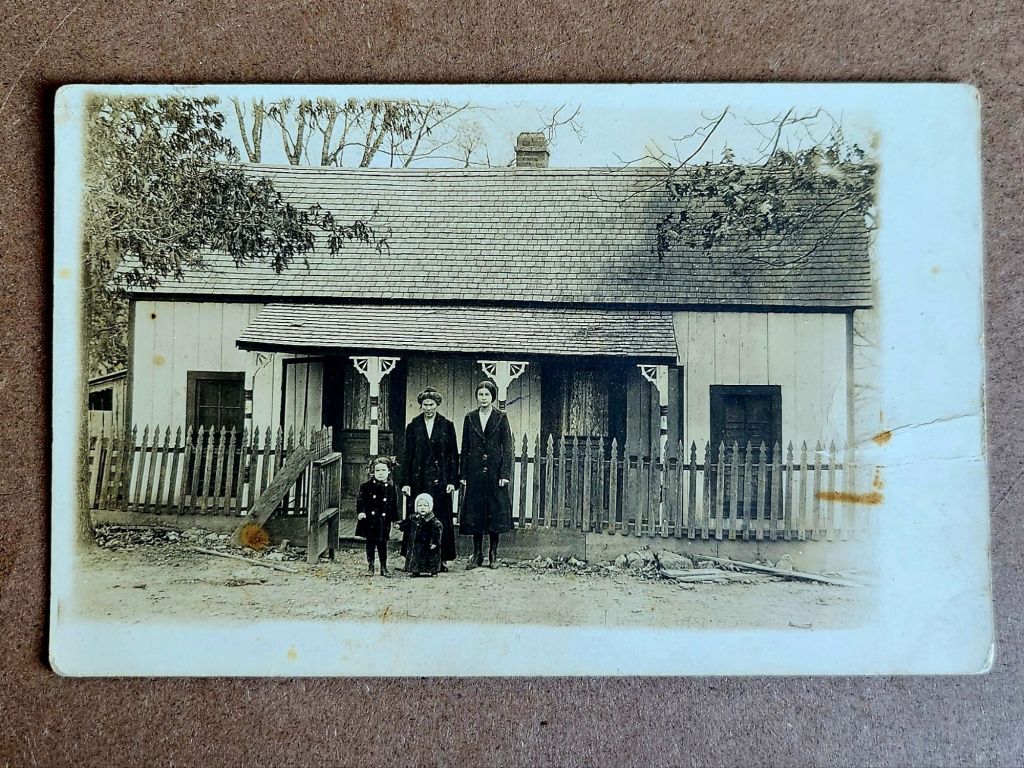
Two women stand in front of McMann Boarding House wearing identical striped dresses. The building is simple—board and batten, minimal trim, the kind of structure that goes up first and fast in a growing place.

The photograph has a vertical tear, the exposure is bad, and time has degraded it. But the sign remains legible: McMann Boarding House. Finally, a name.

Who was McMann? Who are these women? Employees? Vacationers? The photo is both casual and deliberately staged. What might the matching dresses mean? Pride? Subjugation?

Reading their faces, we fill in the narrative, almost immediately and sometimes inescapably. Relationships, motivations, futures take shape unbidden. This is exactly what we both invited and warned of last week—making it up. Always dangerous, sometimes worthwhile.

The impulse to story is nearly irresistible. A name on a building. Two women in matching dresses. The space around the postcard lights up. Are these their stories, or our own, or a magical projection that folds time?

When the Past Chats Back

Shuffling the stack, several cards in this collection start speaking to one another. Same photographic quality. Same paper stock. Similar landscape—flat, spare, newly broken. And most telling: similar structures in states of becoming.

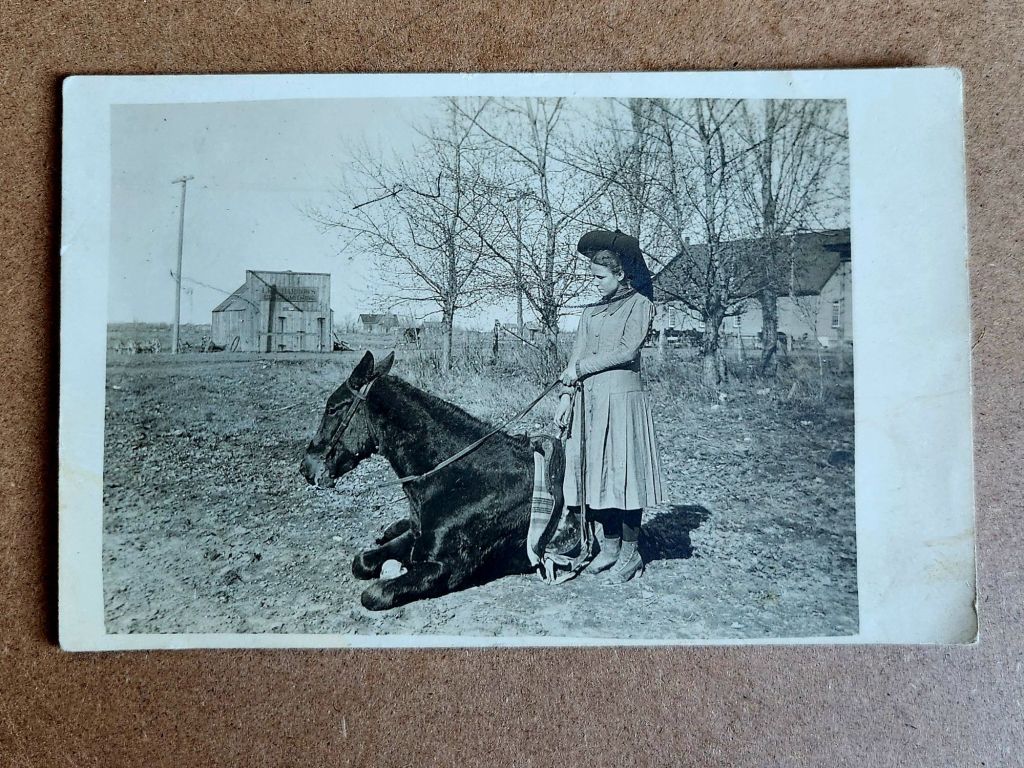
Laid out together, the pattern emerges. Houses with stone foundations and wraparound porches. An elaborate Queen Anne with a windmill. McMann Boarding House with its two women in matching stripes. A lunch room with an immaculately vernacular grand porch. Best-dressed proprietors standing proud. A girl and her horse, bare buildings behind her. A picnic under the canopy of a large tree.

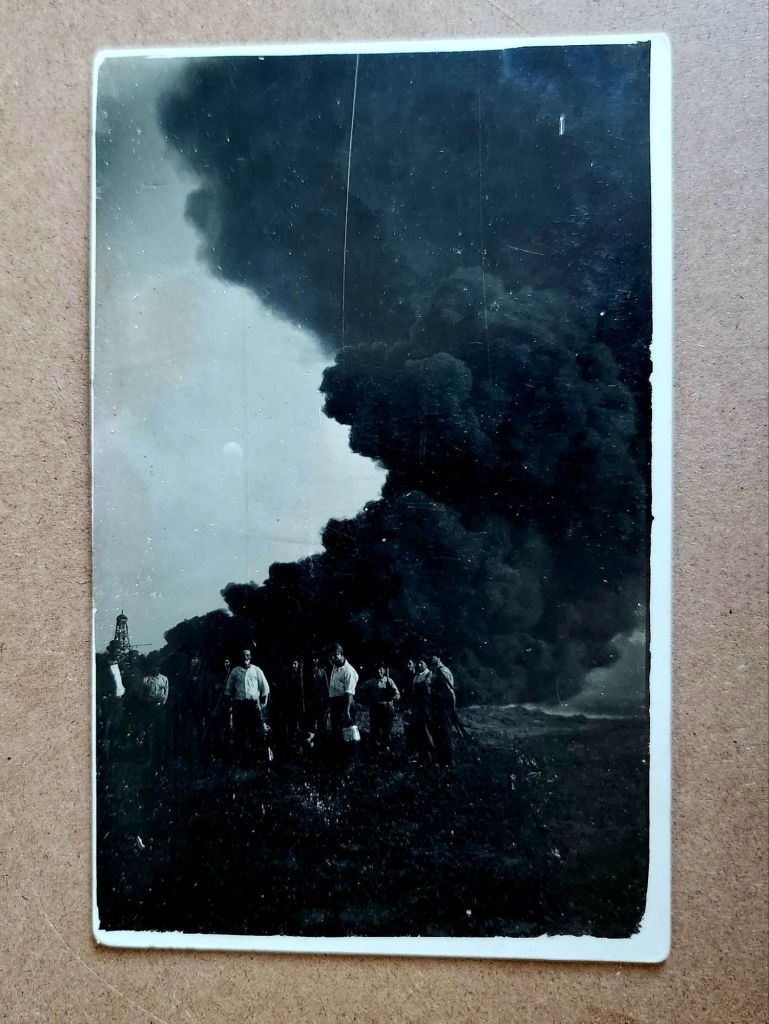
Also, a massive plume of black smoke billowing skyward, an oil derrick to the left, eight or nine men grinning toward the camera. The photograph stops everything cold. They struck liquid gold. A triumph worth documenting. Fine lines of the plumes etching through the darkest black.

These eleven images are a cluster from the same story—a town emerging around oil. Homesteaders and entrepreneurs arriving in a place that may have been open prairie five years earlier. Building homes, businesses, infrastructure for both industrial productivity and social life. Documenting the process with real photo postcards, for themselves or to send East. Their message: we have arrived safely and are in luck.

From Here to Now

This is a founding, the moment a place began and the stakes changed. These aren’t isolated buildings anymore and oddly they seem less like photos, too. We know there is a community taking shape and the evidentiary questions multiply. Who were they, by name? What brought them here? Did this place survive or vanish?

And harder, deeper, more consequential questions: Who lived here before? What animals and habitats were displaced? What did the derricks do? For them, and also to us.

Boom town logic. Extraction economy. Infrastructure dependencies and family injuries inherited. Cultural degradation, and environmental costs still being paid. This isn’t quaint history. This is the beginning of something we’re grappling with today.

Suddenly our imaginative stories contract and we now seek facts. The boarding house proprietor’s daily life can be imagined, but not separated from a place built on oil speculation. The architectural ambition of that Queen Anne deserves appreciation, but it went up in a town that might have lasted ten years or a hundred, depending on the wells. The buildings aren’t innocent, and we are implicated.

More in Store

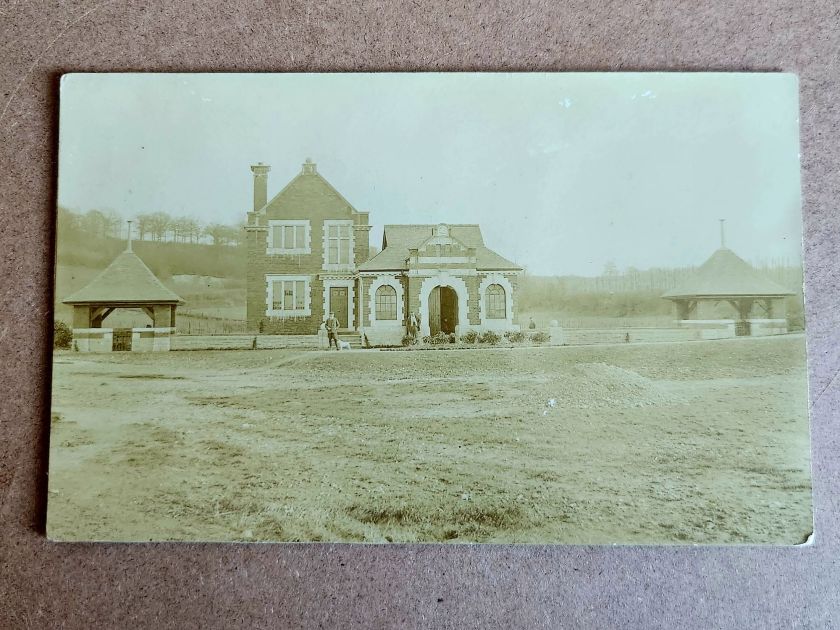
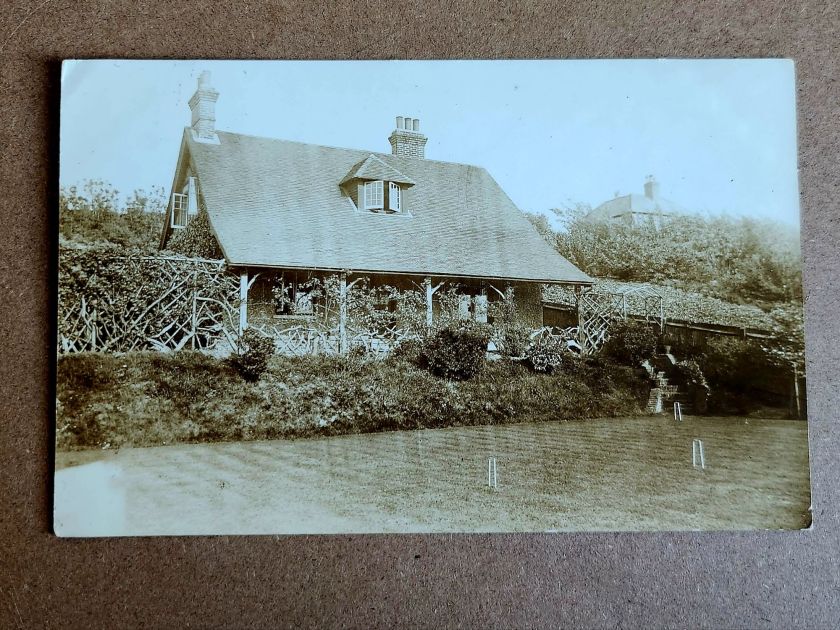
Another stack of postcards might be related to this cluster—similar age, similar style, possibly the same region, likely at later dates. And then a few unrelated ones, probably European based on the architecture.

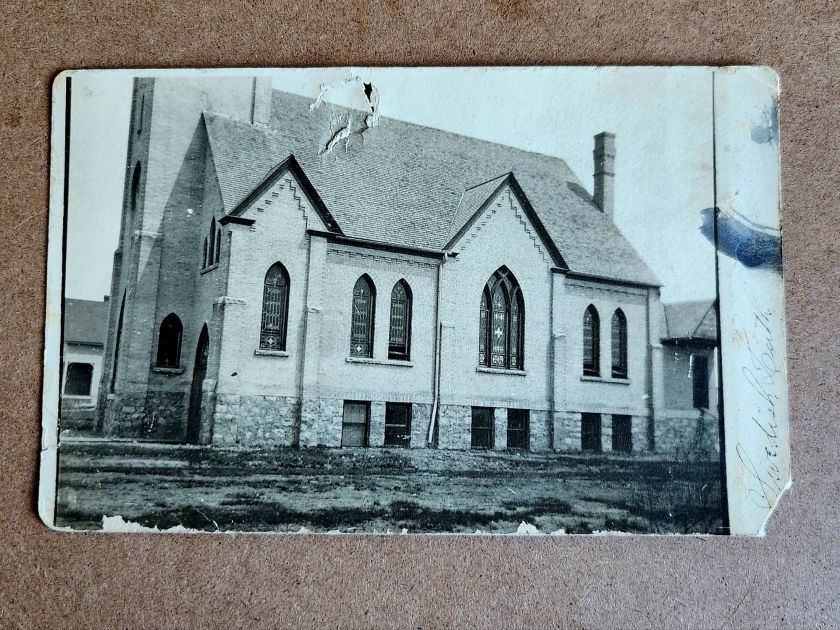
Not every fragment connects or resolves. Some buildings will remain singular, their stories unrecoverable. Churches and homes, beautiful structures, carefully photographed. Loved locally today as a memory or a ruin, perhaps.

Not everything needs a narrative. Some images can just be enigmatic. Evidence of care, of craftsmanship, of a moment someone thought worth preserving. These evocative details lead to fiction, which makes its own case for history and the preservation of minute detail.

But this cluster won’t let go. They connect to another stack, and soon we’ll know more. Next week we’ll meet the people themselves, looking back at us.

All of the Above

Words to heed and repeat, and a life’s work to regard.

George Washington Carver Educational Postcard

This vintage educational postcard (likely printed in the mid-1960s) features quotations from agricultural scientist George Washington Carver (1864-1943), displayed on an exhibit at George Washington Carver National Monument. The card presents Carver’s thoughts on success, preparation, and nature alongside his portrait. Carver, born into slavery, became a prominent botanist and inventor who developed hundreds of uses for crops like peanuts and sweet potatoes while teaching at Tuskegee Institute for 47 years.

I love to think of nature as an unlimited broadcasting system, through which God speaks to us every hour, if we will only tune in. — George Washington Carver

The George Washington Carver National Monument, established in 1943 near Diamond, Missouri, was the first U.S. national monument dedicated to an African American. Located at Carver’s birthplace, it preserves his legacy and the 1881 Moses Carver house where he lived as a child. The National Park Service now manages the 240-acre nature preserve and historic site.

To Read More:

• National Park Service – George Washington Carver National Monument: https://www.nps.gov/gwca/

• Tuskegee University Archives – George Washington Carver Collection: https://www.tuskegee.edu/

• Smithsonian National Museum of American History – George Washington Carver: https://americanhistory.si.edu/

• Library of Congress – George Washington Carver: https://www.loc.gov/

• Iowa State University – George Washington Carver Papers: https://www.library.iastate.edu/

Call for Submissions Open Now!

The summer slow-down is coming to a close, and The Posted Past is launching into a new phase as a social enterprise. On Wednesdays, you’ll still receive a weekly wander through postcard history, along with a new focus on rare cards, and a regular review of the art cards we receive at the World’s Smallest Artist Retreat (our P.O. Box). More inspiration as our circle expands. Wisdom, wisecracks, and butterfly wings. See you in September… next week!