Our Need for Novelty

Copper maps. Wooden cards. Puzzle prints. Discover how obsolete technologies transform into art and craft, and explore why we can’t stop reinventing the perfect postcard.

In this age of instant digital communication, the persistence of physical postcards presents an intriguing contradiction. These rectangular pieces of cardstock—designed to carry both image and correspondence through postal systems without an envelope—serve as artifacts of a communication method that had its heyday a century ago. But rather than disappear entirely, postcards have evolved in novel ways that tell us even more about who we are.

Why We Seek the New

Humans have always been drawn to novelty. Our brains light up at the unfamiliar—it’s a survival mechanism that once helped our ancestors notice changes in their environment that might signal danger or opportunity. But our relationship with novelty runs deeper than vigilance. We seek out new experiences, objects, and sensations even when no practical threat or benefit is apparent.

This human attraction to novelty serves several purposes. First, it provides simple pleasure—the dopamine release that accompanies discovery keeps us engaged with our surroundings. Second, it helps us learn and adapt—new situations force us to develop new skills. Third, it offers social currency—being the first to discover, own, or report something novel (even if untrue!) gives us a kind of status within our communities.

Perhaps most fundamentally, novelty helps us fight against the deadening effect of habituation. We become blind to what remains constant around us, a psychological phenomenon called “sensory adaptation.” Think of how you stop noticing a persistent background sound, like traffic noise. Novelty jolts us back into conscious appreciation, like noticing the birdsong instead, making us sense the familiar differently.

With mass-produced consumer goods, we often pursue novelty through customization or unique variants—like these postcard alternatives. They satisfy our craving for something special while maintaining connection to recognizable forms. Even novelty doesn’t stray too far from the familiar.

Technology Becomes Art

As technologies age and are replaced by more efficient methods, something interesting happens—the displaced technology often shifts from the realm of utility to the realm of artistry and craft. What was once valued primarily for function becomes appreciated for form, precision, and the visible human touch.

Letterpress printing was an extraordinary innovation of its time and once the standard for all printed matter. It was largely replaced by offset printing in the 20th century and later the digital methods we use today. But rather than disappearing, letterpress evolved into a premium craft, prized for its tactile quality and visible impression on paper—characteristics that were originally just side effects of the technique, not its intended purpose.

The same transformation happens with many technologies: vinyl records, film photography, mechanical watches. As digital alternatives take over the functional role, the analog predecessors become vessels for history, craftsmanship, ritual, tactile pleasure. They move from being tools to being experiences.

This pattern helps explain our collection of novelty postcards. Somewhere in the middle of last century, the standard paper postcard was functionally superseded by digital communication, freeing it to evolve into these more elaborate, less practical forms. They represent a technology in its artistic phase—no longer bound by strict utility, but free to explore expressive and sensory possibilities, along with kitsch and commercialism.

Utah in Copper Relief

The copper-embossed Utah souvenir represents one of the more elaborate departures from traditional postcard design. The metallic rectangular plate features a raised topographic outline of the state with embossed illustrations of regional landmarks and attractions. The word UTAH is prominently displayed at the top, while places like Vernal, Provo, Cedar City, and St. George are labeled at their approximate locations. The copper medium gives the piece warmth, with a decorative scalloped border framing the state’s geography and securing the paper card below.

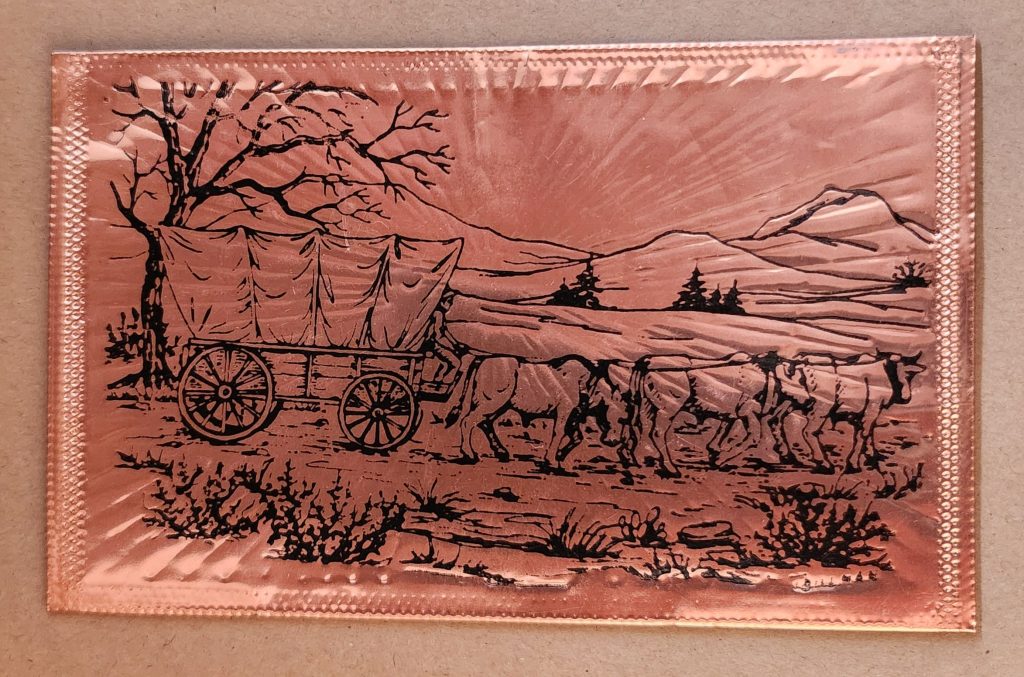
The manufacturing process likely involved die-stamping or embossing thin copper sheeting, a technique that dates back to the late 19th century and regained popularity in mid-20th century souvenirs. The tactile nature of the raised elements invites touch, creating a multisensory experience unavailable in traditional flat postcards. The utility of this object as actual correspondence is significantly diminished—the copper surface resists easy writing, and its weight requires additional postage and hand-canceling. It’s more a miniature commemorative plaque that happens to maintain postcard dimensions.

Woodsy Aesthetics

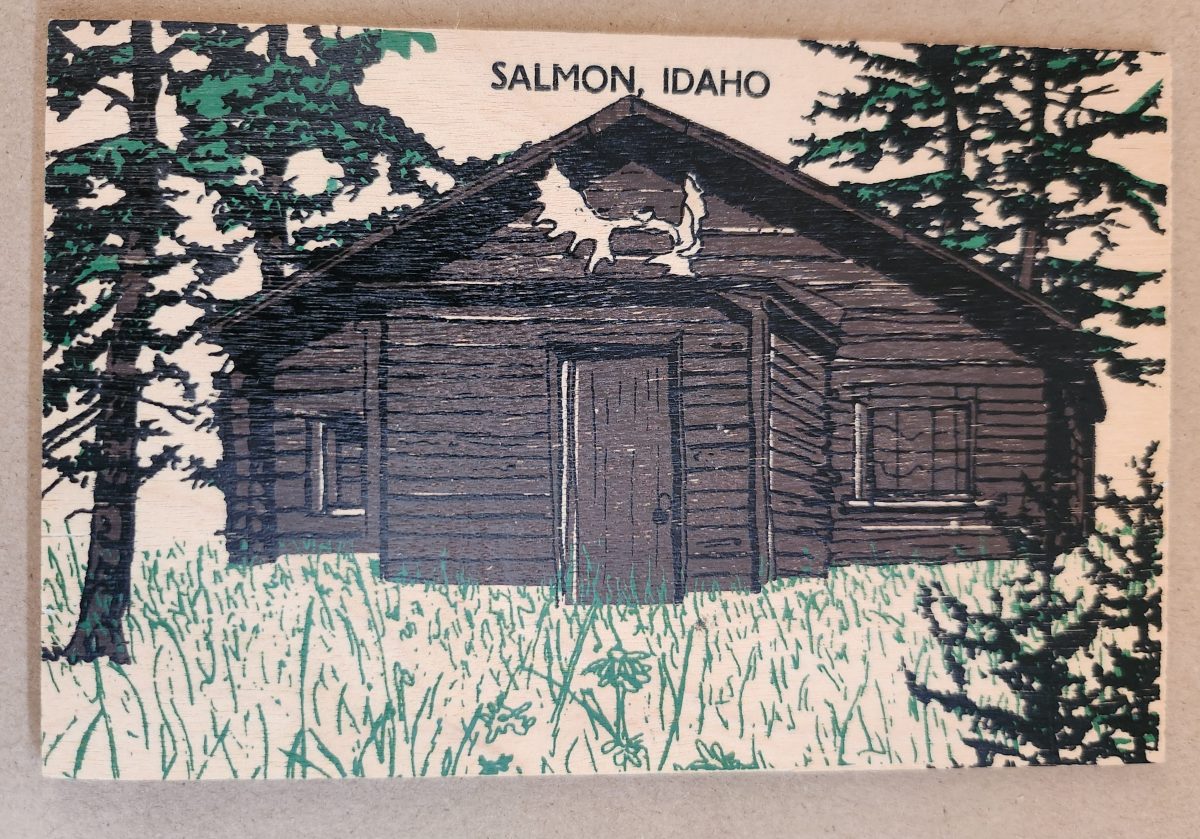
Let’s look closer now at a novelty postcard featuring a cabin in Salmon, Idaho, printed onto a thin wooden substrate and depicting a rustic cabin nestled among stylized pine trees. The scene employs a limited color palette—brown and black for the structure and green for the surrounding vegetation—lending it a deliberately simple aesthetic that echoes both woodcut prints and traditional lithography.

The simple text at the top identifies the location without intruding on the scene. The artwork itself employs minimal detail, capturing the essence of rural life rather than photographic accuracy. The manufacturing process of printing onto thin wood veneer allows for mass production, while adding a specific scene, location name, and ink color for customization.

This card’s rustic medium and subject matter work in harmony, creating a self-referential object where the material reinforces the message—a wooden card depicting a wooden structure set within a forested landscape. The medium becomes part of the message, suggesting authenticity through material consistency. Though mass-produced, it strongly evokes a rural sensibility.

Framed Vistas

Our souvenir from Yellowstone National Park adopts yet another approach. This card features a stylized illustration of Yellowstone’s grand canyon and waterfall printed on cardstock and mounted on a wooden backing.

The artwork employs a palette of oranges, purples, blues, and whites to capture the dramatic landscape, with the falls rendered as a white vertical streak against colorful canyon walls. Dark silhouettes of pine trees frame the scene, while puffy clouds hover in a light blue sky, held inside a purple border. The stylized typography echoes vintage travel posters from the early to mid-20th century. The entire image is mounted or printed on a natural wood base, visible as a frame around the illustration.

This card’s production combines offset printing with a wooden substrate—a look that recalls both traditional woodblock prints and mid-century travel advertisements. The design deliberately evokes an era of American national park tourism when artistic posters commissioned by the Works Progress Administration and the National Park Service established a distinctive aesthetic for natural landmarks.
Playful Puzzles

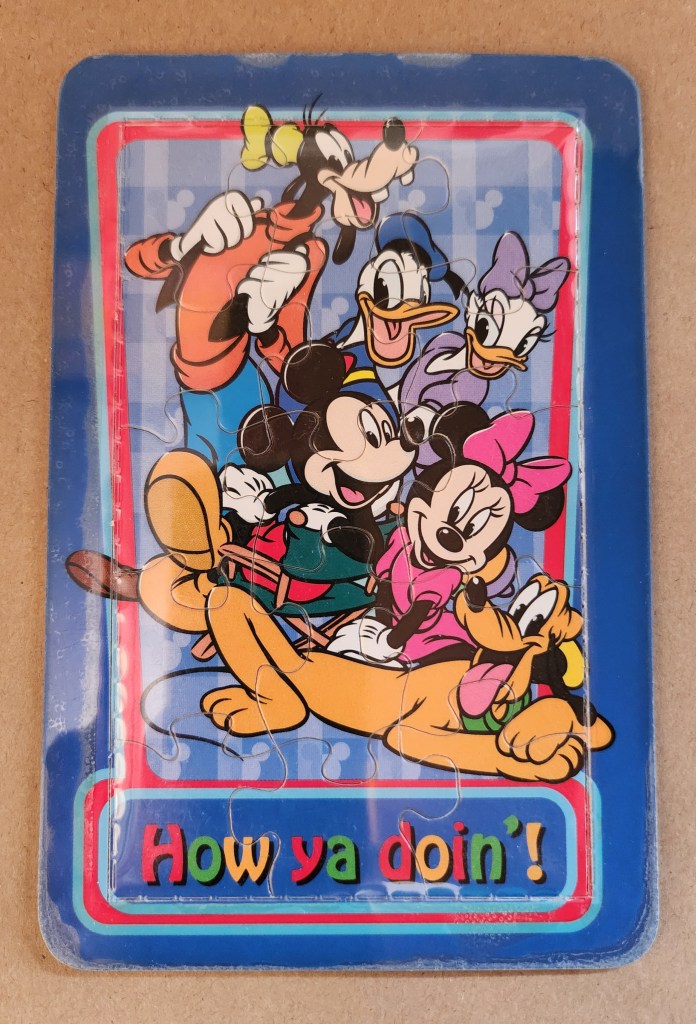
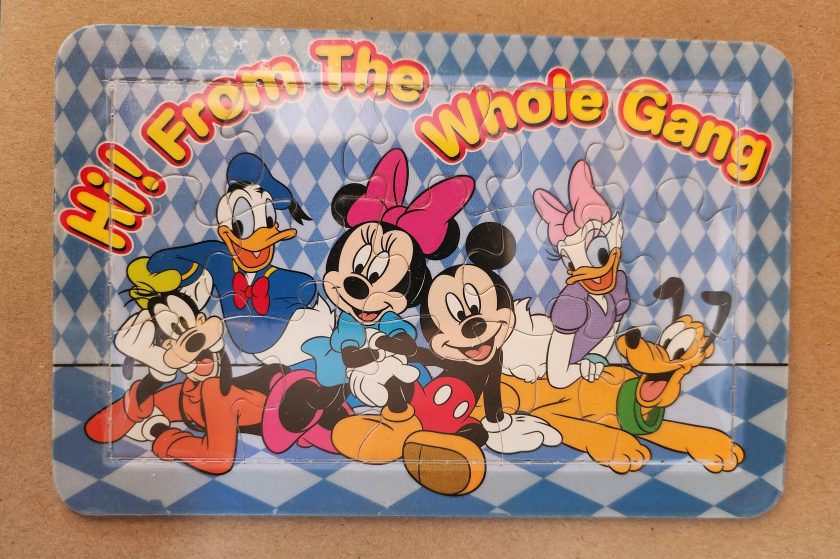
The Disney puzzle postcard introduces an element of interaction we haven’t seen before. This card features Mickey Mouse, Minnie Mouse, Donald Duck, Daisy Duck, Pluto, and Goofy arranged in a group pose against a blue-and-white checkered background. The message reading “Hi From The Whole Gang” in bubble text curves around the edge of the image.

This item turns a postcard into a simple jigsaw puzzle—die-cut pieces that can be jumbled and reassembled to reveal the printed image. The manufacturing process involved full-color printing followed by precision die-cutting to create interlocking puzzle pieces, then applying a thin adhesive film to maintaining the card’s overall integrity for mailing.

This souvenir represents a curious hybrid—a postcard that actively invites its own disassembly. The Disney characters themselves represent another layer of nostalgia, combining America’s animation icons with the traditional postcard format to create an object that references multiple forms of 20th-century popular culture simultaneously. But only modern technology could accomplish these manufacturing details, a playful combination of familiar and fresh.

Magnetic Memories

The Will’s Hardy Trees and Seeds magnetic card is the one in our set with the most layers of both meaning and making. See packets, postcards, fridge magnets, and agricultural Americana all combine in this take home treasure.

The 1909 seed catalog cover is a contemporary image inspired by the real-life Oscar H. Will & Co. of Bismarck, North Dakota. The vibrant illustration displays pansies in various colors—purple, yellow, orange, pink, and white—arranged in a bouquet. Text identifies the company’s 26th year of operation and describes their products as the “choicest and most beautiful on earth”.

A small purple circle overlay on the plastic film cover announces the item’s true nature: a magnetic postcard to send as a gift. Despite its historical appearance and postcard dimensions, the object is actually a refrigerator magnet that merely references seed catalog and postcard aesthetics. The production involved digital printing on magnetic sheet material, applying a printed paper backing, and slipping into a plastic cover with instructions to mail the gift in an envelope.

As a novelty item, it reveals a peculiar circularity. A reproduction of a commercial artifact (seed catalog) transformed into a correspondence medium (postcard) further transformed into a decorative household item (refrigerator magnet). Somehow, we love each iteration all the more.

Nostalgia Squared

What these examples share is a relationship with nostalgia that operates on multiple levels. They aren’t simply nostalgic; they engage in a looping nostalgia—nostalgic representations of already nostalgic forms.

The copper Utah relief draws upon mid-century tourist souvenirs, themselves designed to evoke frontier-era maps and territorial markers. The Salmon cabin employs modern production techniques to simulate traditional woodcuts nad print, which were themselves often romanticized depictions of rural life. The Yellowstone cards references mid-century national park posters that were already stylized interpretations of natural wonders. The Disney puzzle incorporates cartoon characters who have become nostalgic cultural icons, presented in the format of childhood games. The Will’s Seeds magnet reproduces early 20th-century commercial art that was, even in its original context, employing Victorian aesthetic sensibilities.

This layering of reference creates objects that are remarkably dense with cultural signifiers despite their modest physical dimensions. They offer not just a connection to place and time but to the ways we’ve represented ourselves and our interests through commercial souvenirs.

Our apparent need for novelty, then, might be better understood as a need for continual context. Each new postcard iteration doesn’t merely replace what came before; it absorbs and references it, creating objects that function as compact archives of our evolving relationship with the characters and places we cherish.

These novelty postcards sit at an interesting crossroads of commerce, craft, and communication. They represent what happens when a formerly utilitarian object—the humble postcard—is freed from its purely practical obligations and allowed to evolve along lines dictated by sentiment, aesthetics, and novelty.

In a world increasingly dominated by digital experiences, these physical novelties offer something screens cannot—texture, weight, presence. They satisfy our hunger for the tangible. Their quirky, sometimes impractical forms speak to a human need more fundamental than efficient communication: the need to hold something unique in our hands, and to feel a physical connection to places we’ve been and experiences we’ve had.

The postcard itself is and was a very simple concept and object that, over time, has become a medium for ongoing conversations about permanence and impermanence, about what we value over time, and about the tension between utility and sentiment. In their various novel forms, these more-than-postcards tell us about places we’ve been and how we’ve chosen to remember and delight in those places—a correspondence not just between people, but between past and present.
Mattoon through Mayme’s Eyes

Sisters Mayme and Carrie stay in touch as Mattoon IL grows from a creek-side town to a modern crossroads before the war, 1910-1918.

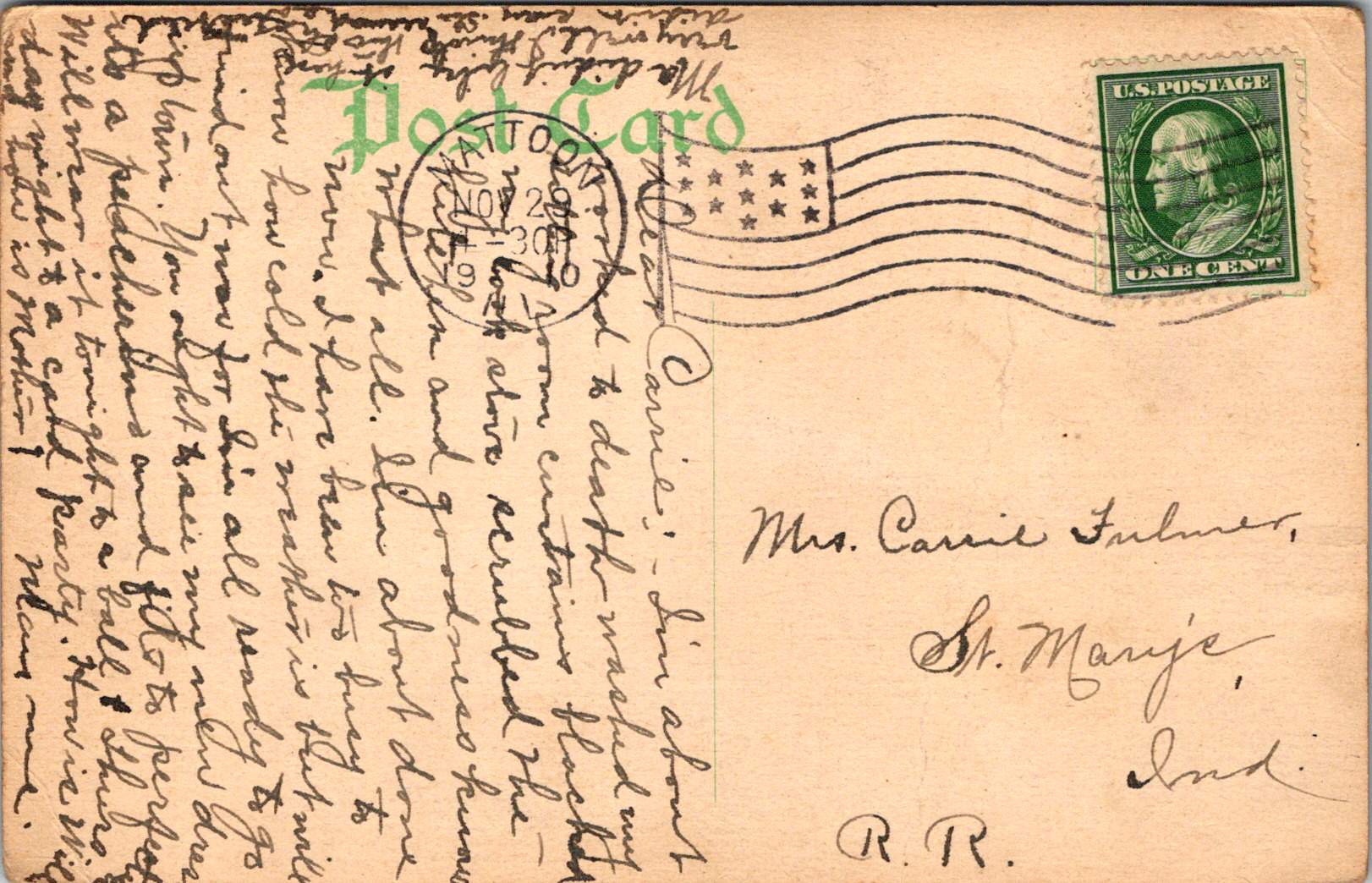
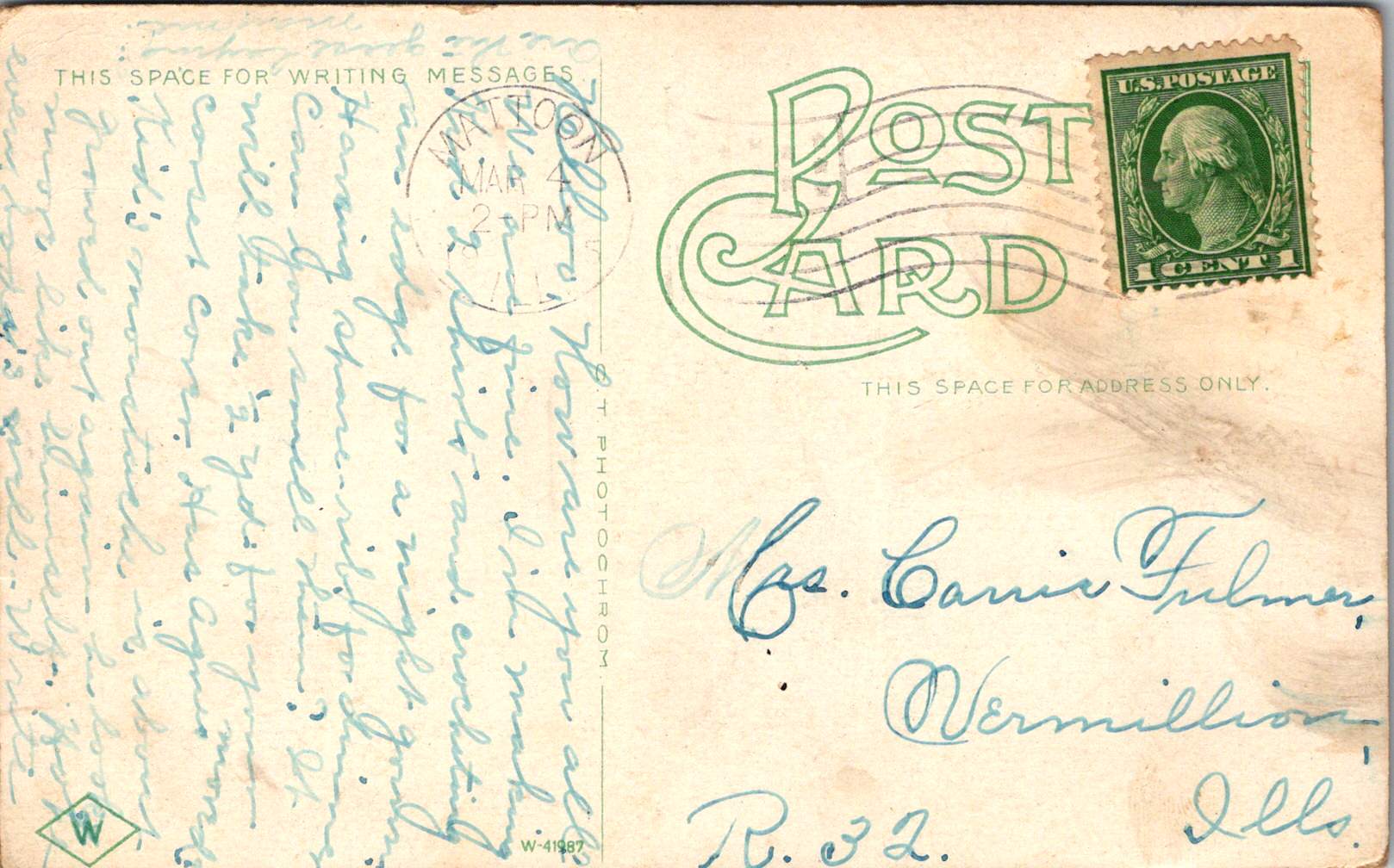
Between 1910 and 1918, a series of postcards traveled between Mattoon, Illinois, and St. Mary’s, Indiana. On one end was Mayme, the author, who had made her home in the bustling railroad town of Mattoon. Her sister Carrie, who remained in St. Mary’s, received and kept the cards, now more than a century old. These correspondence cards—adorned with images of Mattoon’s infrastructure and landmarks—captured more than just personal exchanges between siblings. They documented a profound moment in America’s transformation from a rural society to an industrialized nation, with small Midwestern cities like Mattoon serving as microcosms of this national metamorphosis.

Nature and Community

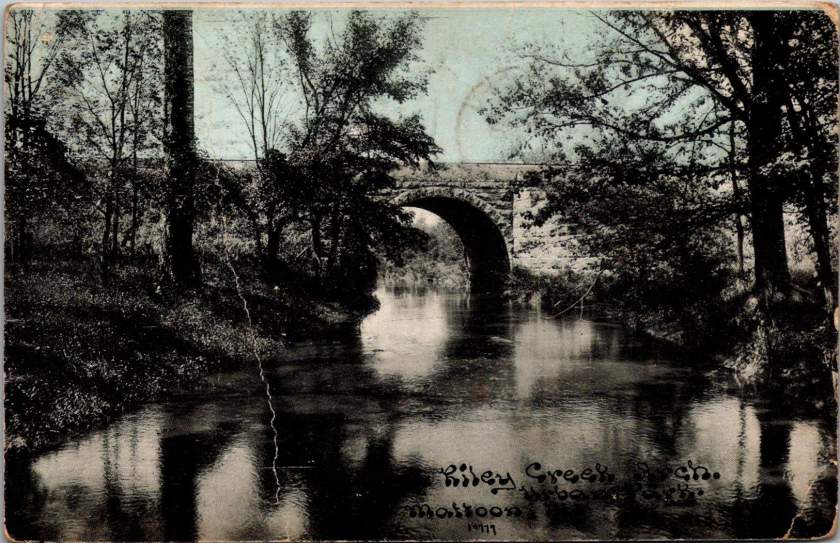
Mayme sent the first postcard on November 29, 1910, bearing an image of Riley Creek with its stone bridge arch—a glimpse of the natural landscape that surrounded the growing town of Mattoon. This serene view of the creek precedes the increasingly industrialized town that Mattoon was becoming. Founded in 1855 and named after William B. Mattoon, a partner in the construction firm that built the Illinois Central Railroad, the town served as a critical junction between the Illinois Central and the Terre Haute & Alton railroads.

The stone bridge spanning Riley Creek represents essential infrastructure that connected different parts of the community and facilitated transportation within and beyond the town. Such bridges were vital elements in expanding road networks that would eventually complement the railroad’s dominance in transportation.

Mayme wrote about burdensome domestic chores and a new dress for an upcoming ball that she would wear again to a Thursday card party. She was participating in the social life of a community that was growing from its natural surroundings into a prosperous small city.

I’m about worked to death, washed my sitting room curtains, blackened my cook stove, scrubbed the kitchen and goodness knows what all…

Industry and Infrastructure

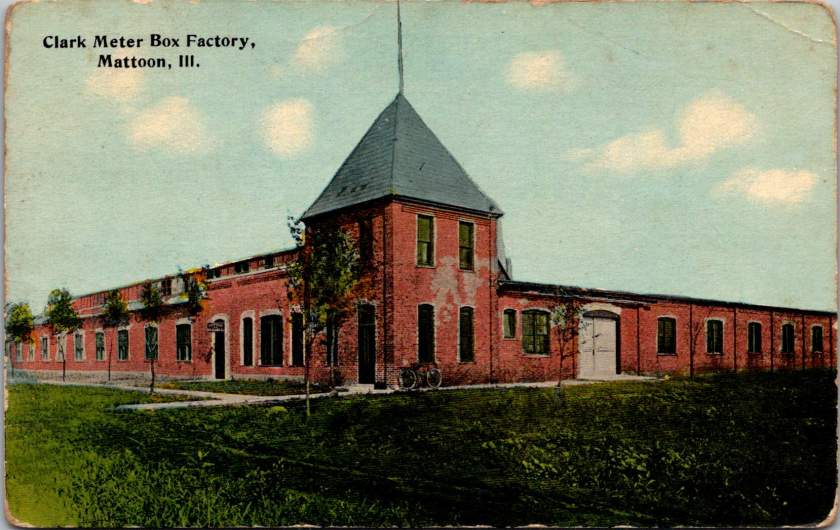
By 1914, Mayme was sending postcards that highlighted Mattoon’s industrial development. One image showcased the substantial Clark Meter Box Factory, with its distinctive tower and solid brick construction. America’s industrial expansion was moving beyond major manufacturing centers into smaller towns and cities. The factory produced meter boxes for utilities—products essential to the electrification and modernization sweeping across America in the early 20th century.

While Mayme reported her handiwork at home like knitting, crocheting, and gardening, the meter box factory represented the industrial world that was transforming the American economy. Manufacturing facilities like this provided jobs that attracted workers and their families to communities like Mattoon, contributing to urban growth and economic diversification beyond traditional agricultural and railroad employment.

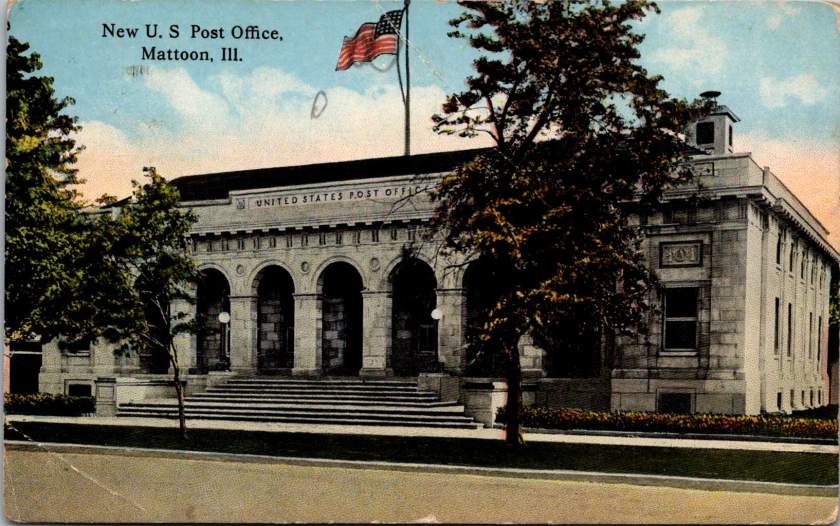
Also in 1914, Mayme sent a postcard showcasing Mattoon’s “New U.S. Post Office,” a stately neoclassical building with grand arches and an American flag prominently displayed. This wasn’t merely a functional building but a statement of federal presence and civic achievement. During this period, post offices in American towns weren’t just mail facilities—they were symbols of connection to the national government and markers of a community’s importance.

The grandeur of Mattoon’s post office reflected the federal government’s expanding role in American life—a time when postal services were being standardized and rural free delivery was connecting previously isolated communities. The building is a physical manifestation of the communication network that allowed Mayme’s postcards to travel to Carrie with such regularity.

Hospitality and Social Life

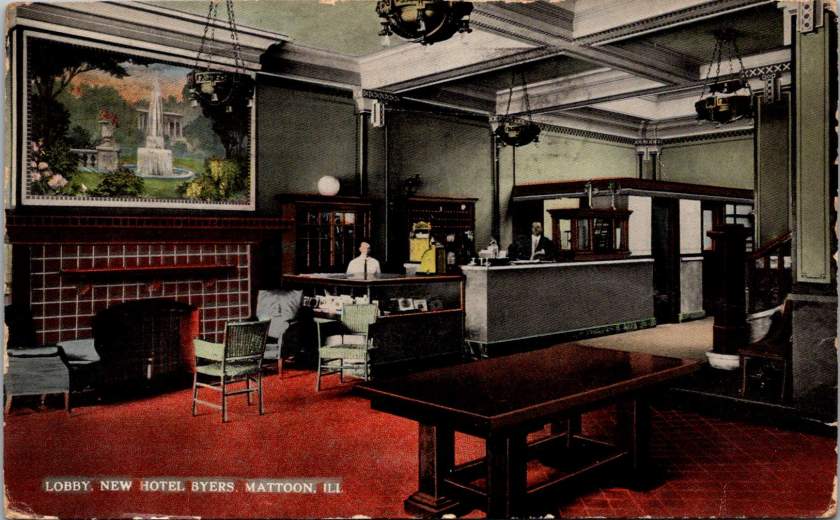
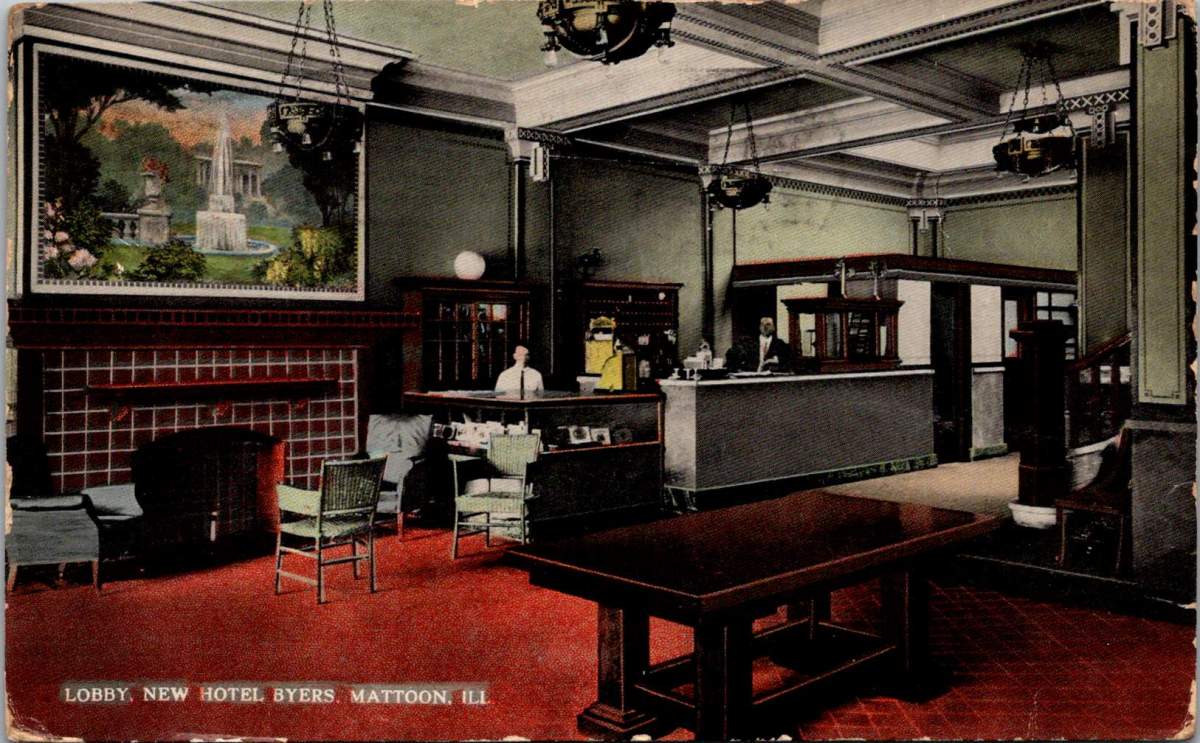
In 1915, Mayme’s postcard featured the lobby of the Hotel Byers, offering a glimpse into the social aspirations of Mattoon during this era. The elegant interior, with its decorative fireplace, ornate hanging lamps, and comfortable seating area, represented the town’s desire to provide metropolitan amenities. Hotels like the Byers served not just as lodging for travelers but as social centers for the community.

For Mayme, the hotel offered refined experiences and social mobility. The hotel’s ballroom would have served as the venue for the dances she mentioned, while its dining room hosted the card parties that figured prominently in middle-class social life. These gatherings provided opportunities for networking across class lines, connecting domestic and railroad workers’ families with merchants, professionals, and industry owners.

The “new” Hotel Byers replaced an older establishment of the same name that had served Mattoon since the late 19th century. This newer iteration, constructed around 1914, was a modern hotel that served as crucial infrastructure for a growing city with ambitions to attract business and industry. The hotel’s construction coincided with a period of economic optimism in Midwestern towns before America’s entry into World War I, when many similar communities were upgrading their commercial buildings as part of the broader Progressive Era emphasis on civic improvement.

Railroad Town

The last postcard featured the “Illinois Central Subway” in Mattoon, which wasn’t an underground transit system but a distinctive sunken railway passage that bisected the town. This engineering feature allowed trains to pass through without disrupting street-level traffic, a forward-thinking design that embodied the marriage of infrastructure and everyday life. The buildings lining the upper level of the postcard show Mattoon’s commercial district that grew directly alongside the railroad—their proximity a testament to the symbiotic relationship between commerce and transportation.

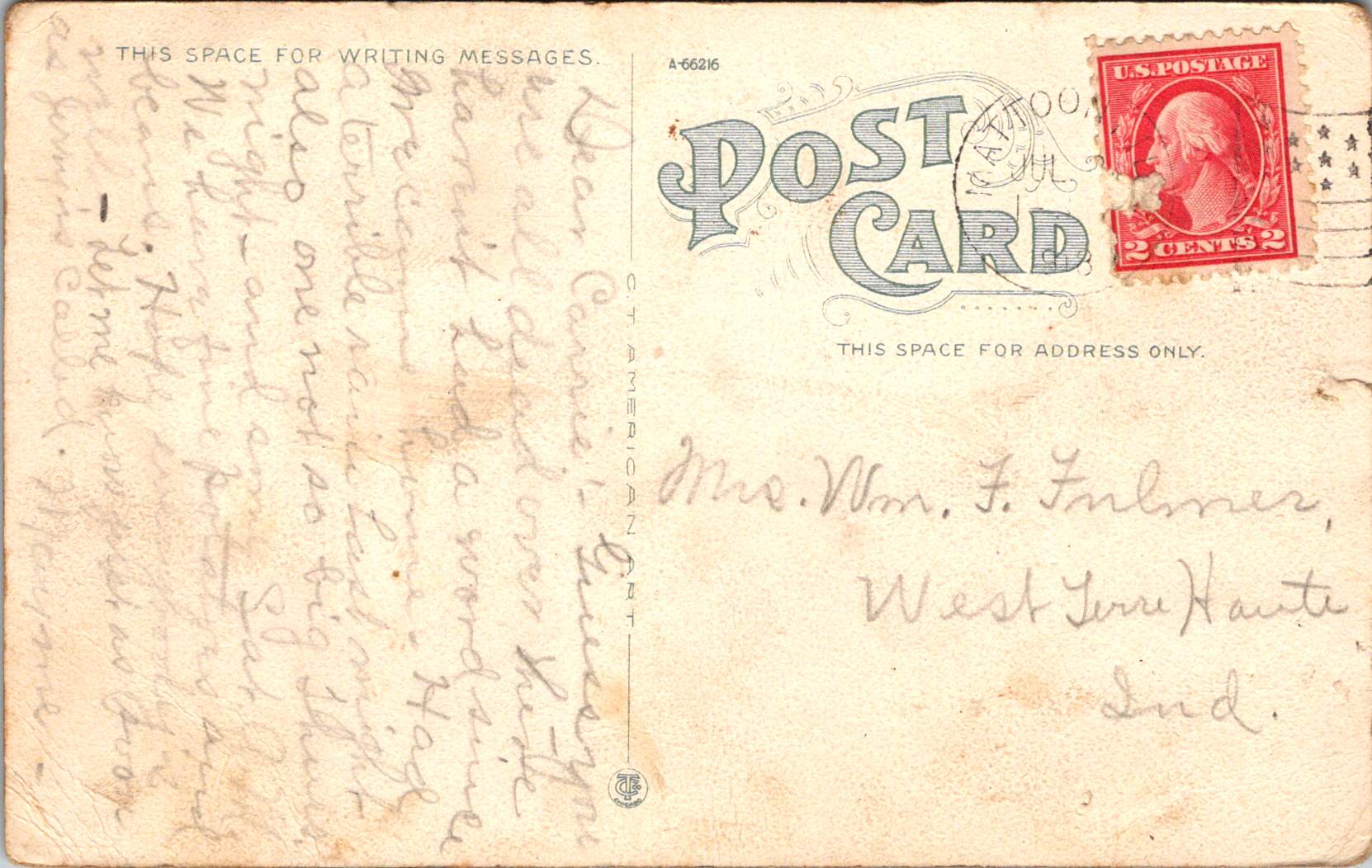
Hope everybody’s well. Let me know just as soon as Jerry is called…

War Shadows

By July 1918, Mayme’s tone had shifted. Her ominous request to let her know “as soon as Jerry is called” reveals the long shadow cast by World War I over these Midwestern communities. The United States had entered the war in April 1917, and the military draft was touching families across the nation.

The war accelerated many of the industrial and social changes already underway in towns like Mattoon. Labor shortages created by military service opened new employment opportunities, particularly for women. The focus on wartime production reshuffled economic priorities. And the specter of loss hung over families, even as daily life continued.

While Mattoon’s industrial capacity may have contributed to the war effort through manufacturing, the human cost was felt intensely in personal correspondence like this.

Two Sisters

Throughout these exchanges, we see two different life trajectories embodied by the sisters. Mayme chose life in a developing industrial town, participating in its social events and domestic economy while witnessing its physical transformation. Her postcards—featuring Mattoon’s architectural achievements and industrial facilities—suggest a certain pride in her adopted community.

Carrie eventually married a man named Earl, and they moved around a bit. Both sisters maintained domestic skills—knitting, crocheting, sewing, and food production—that connected them in conversation even as the world around them changed. Their correspondence across state lines preserved family bonds—a common experience as increased mobility dispersed American families. The railroad and postal service made this ongoing connection possible.

Postcards and Other Passions

Alongside any earnest effort to declutter, minimize, or embrace a modest lifestyle, there are delightful rebellions brewing in the corners of our homes, on our bookshelves, and in our hearts. Collecting – postcards, stamps, or any manner of curious objects – is among a great many pastimes that bring us joy.

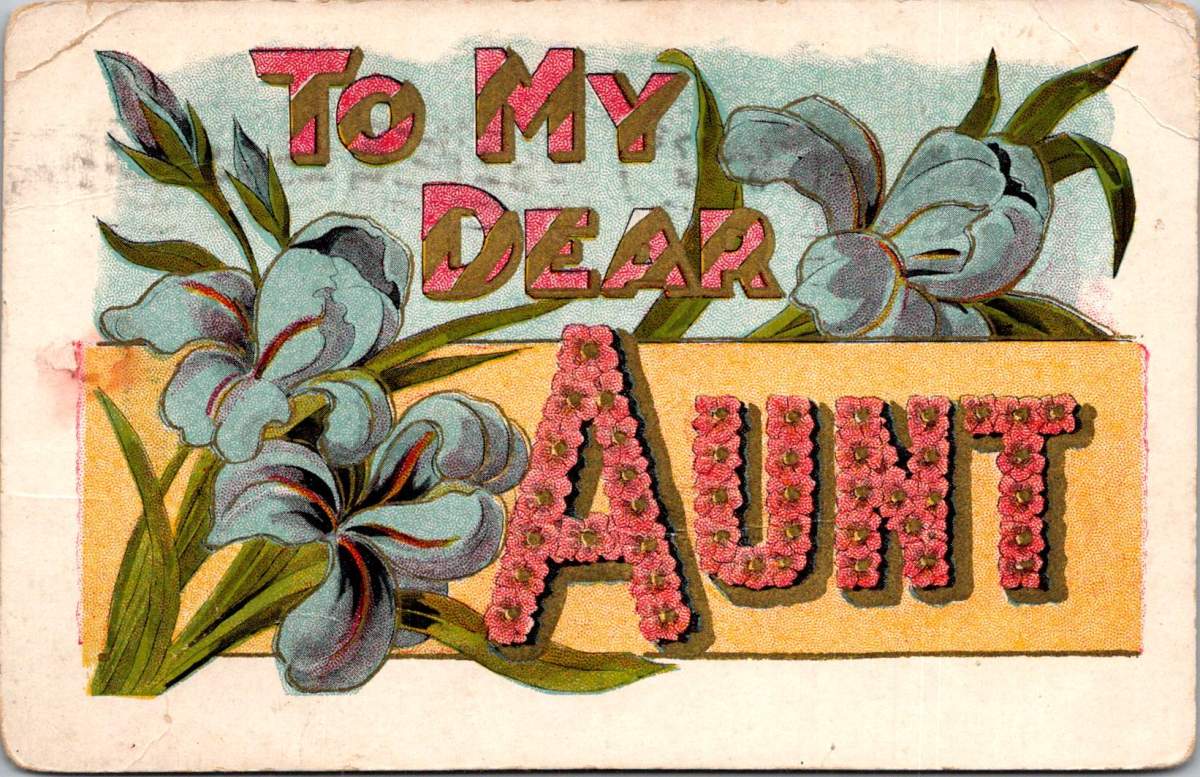
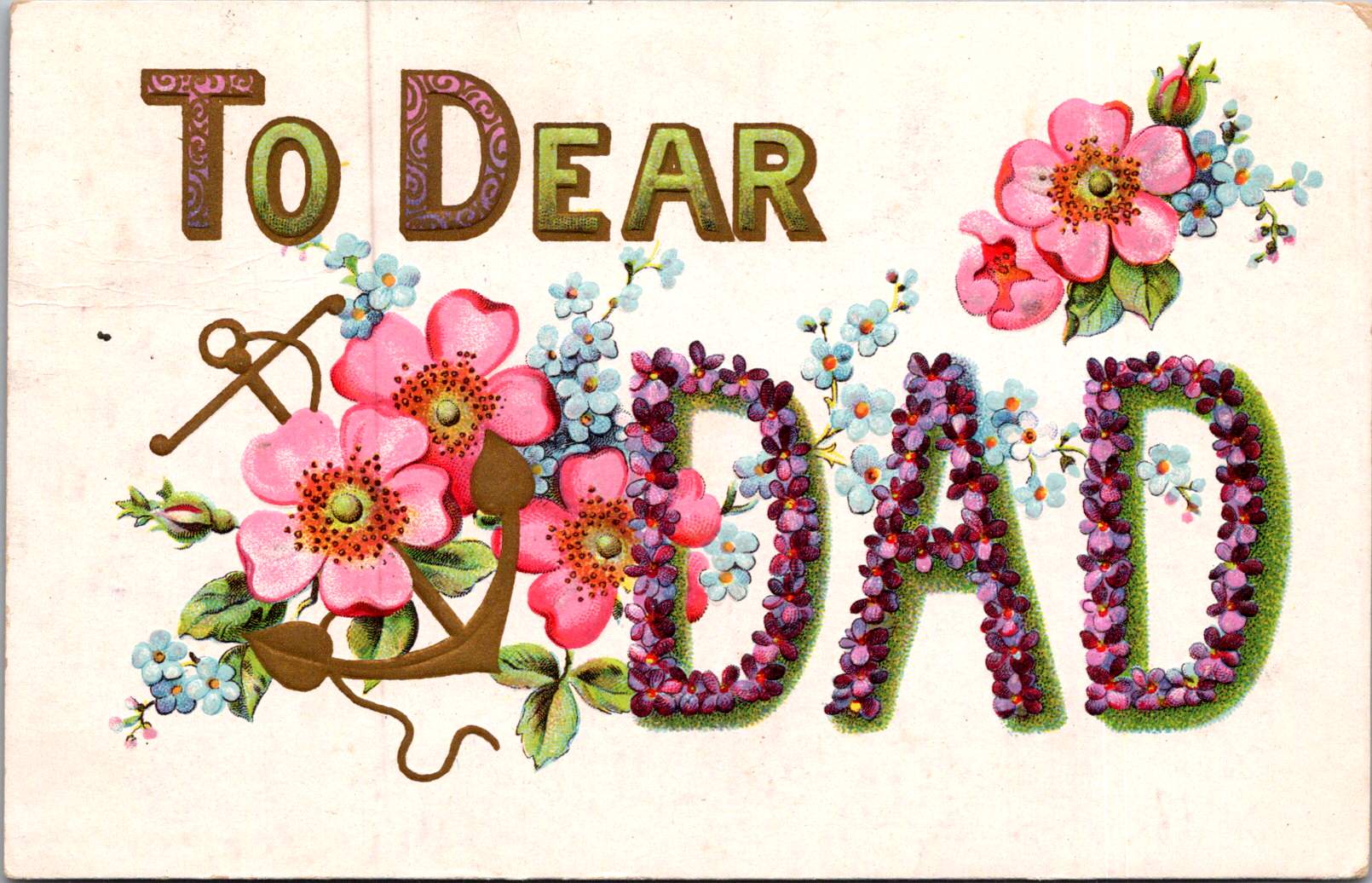
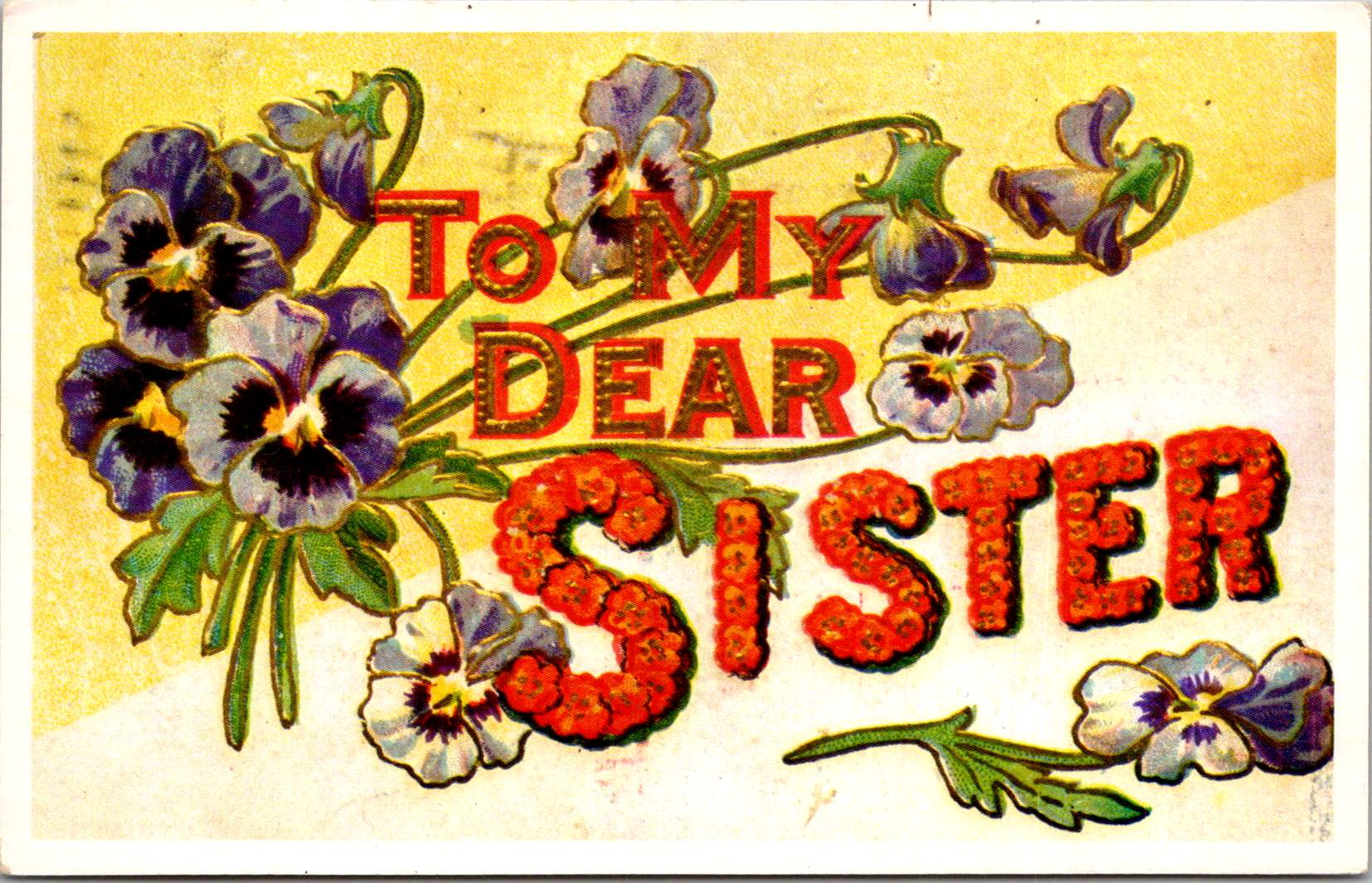
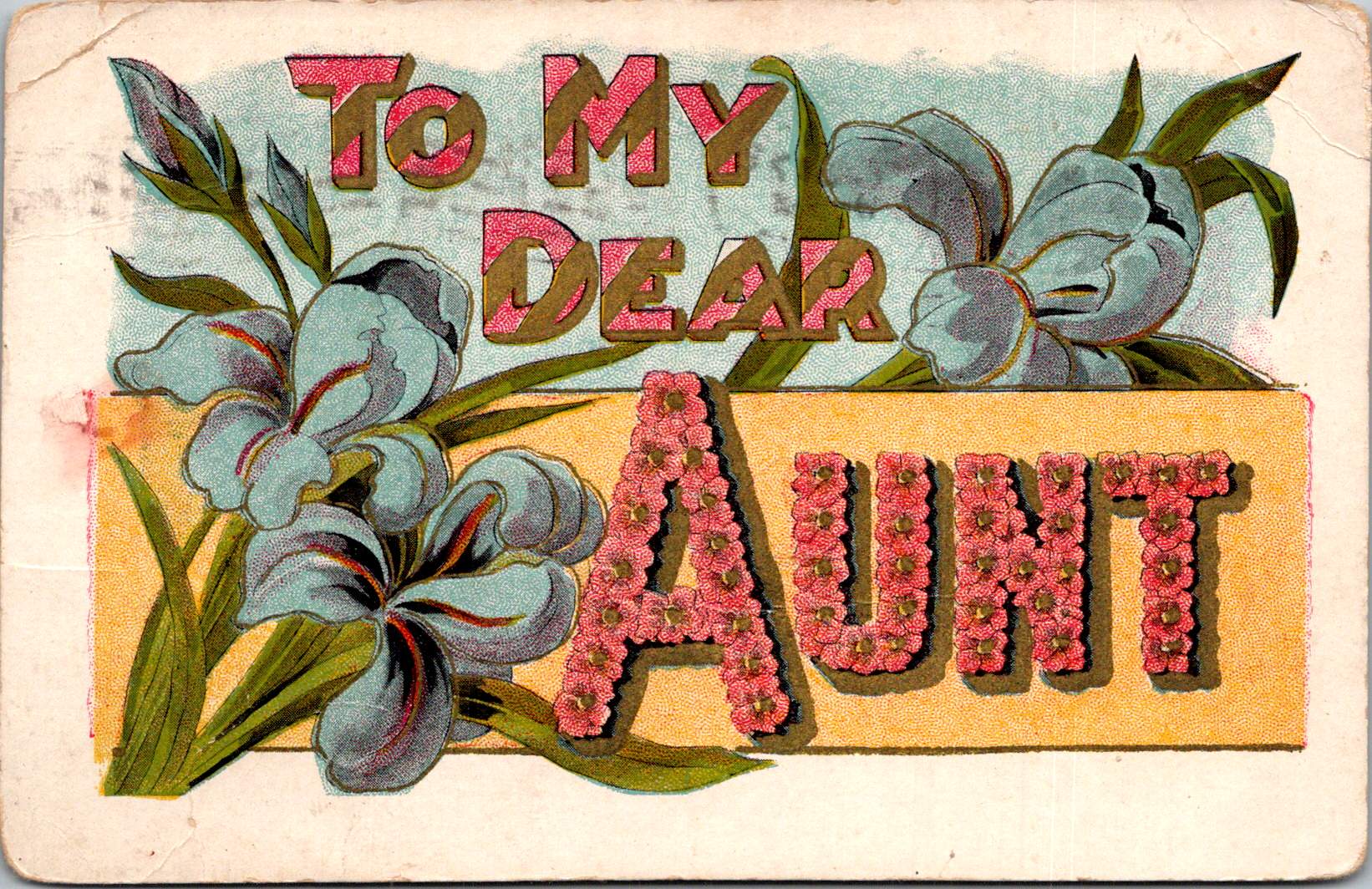
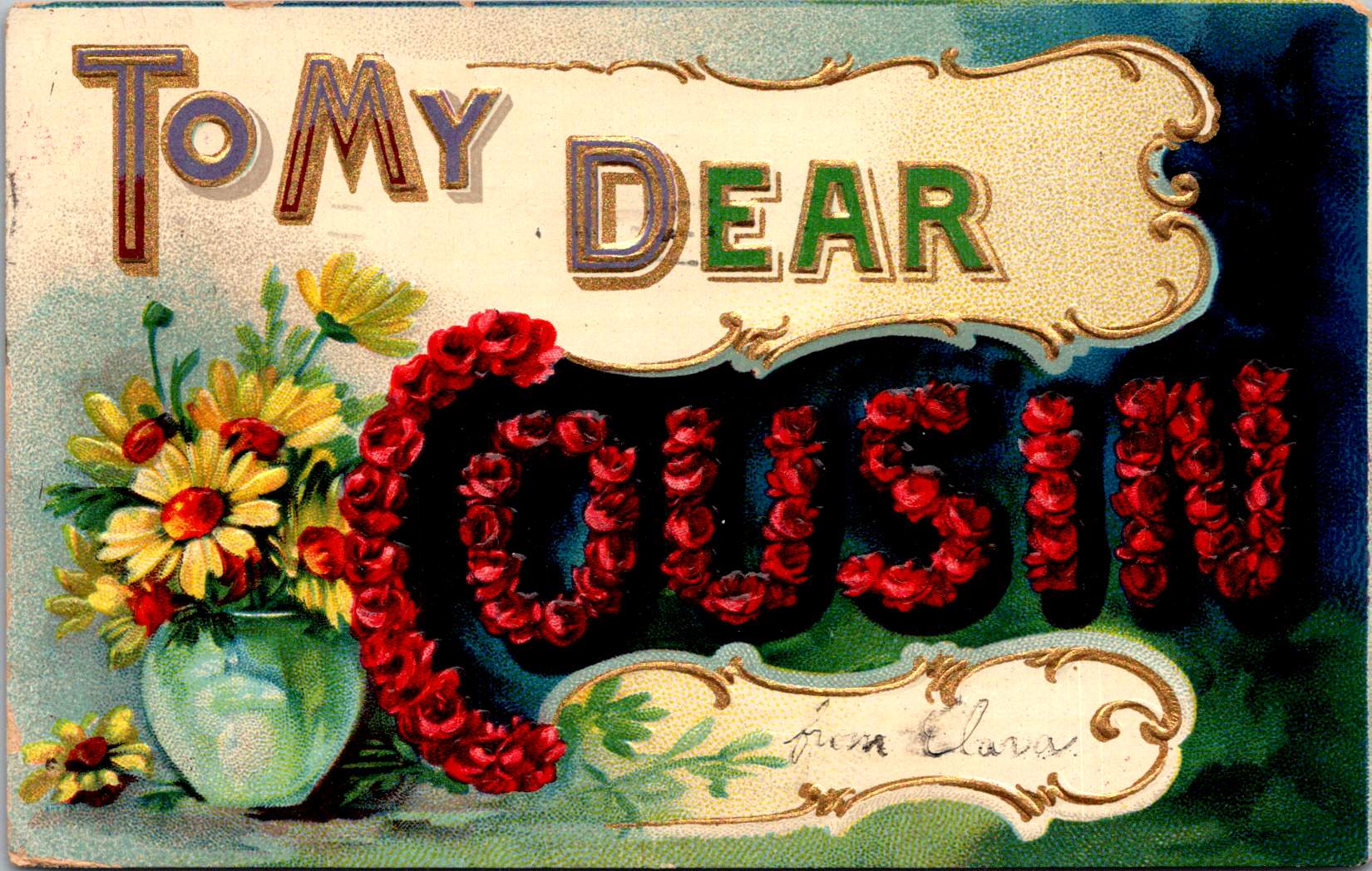
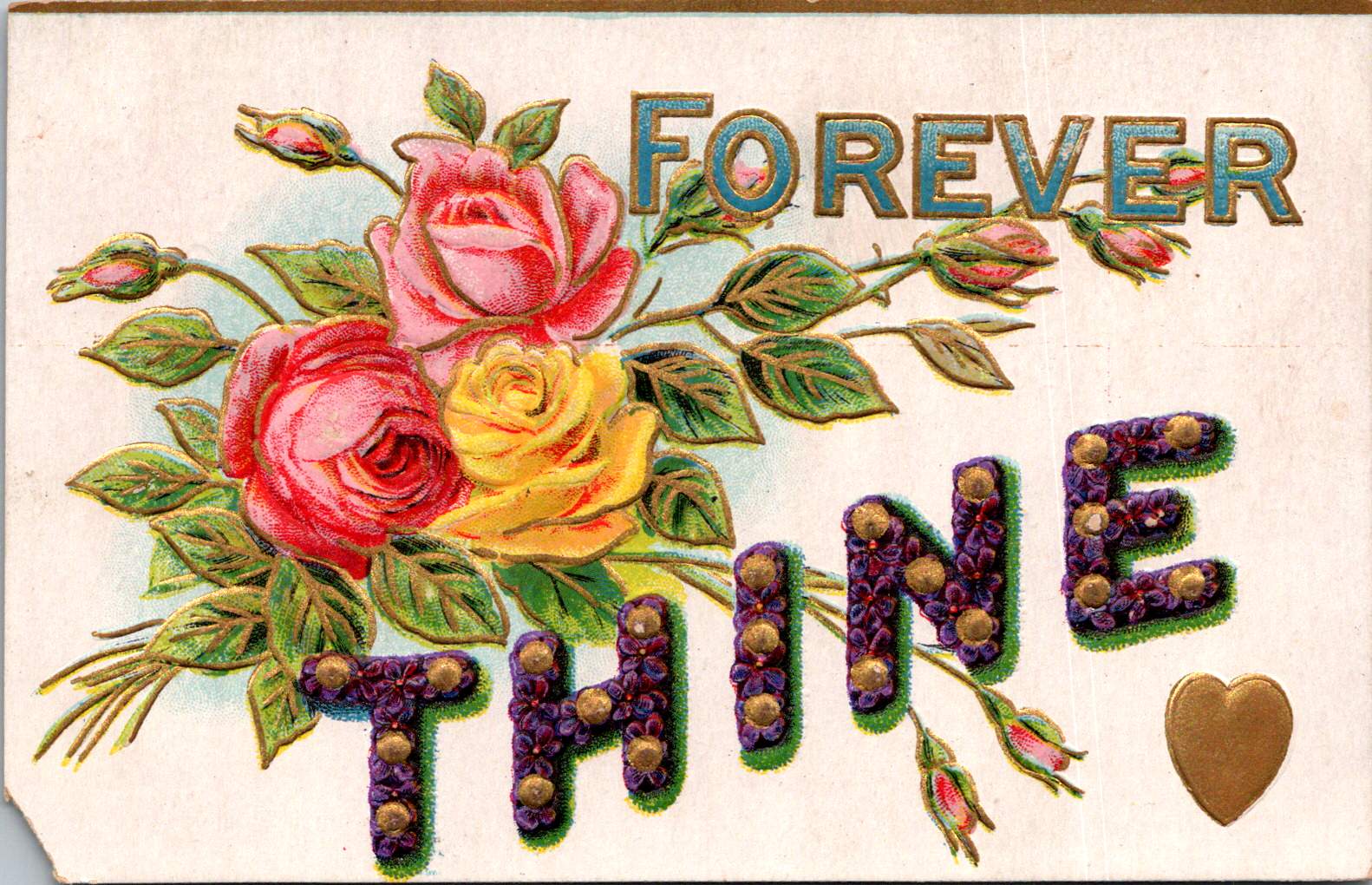
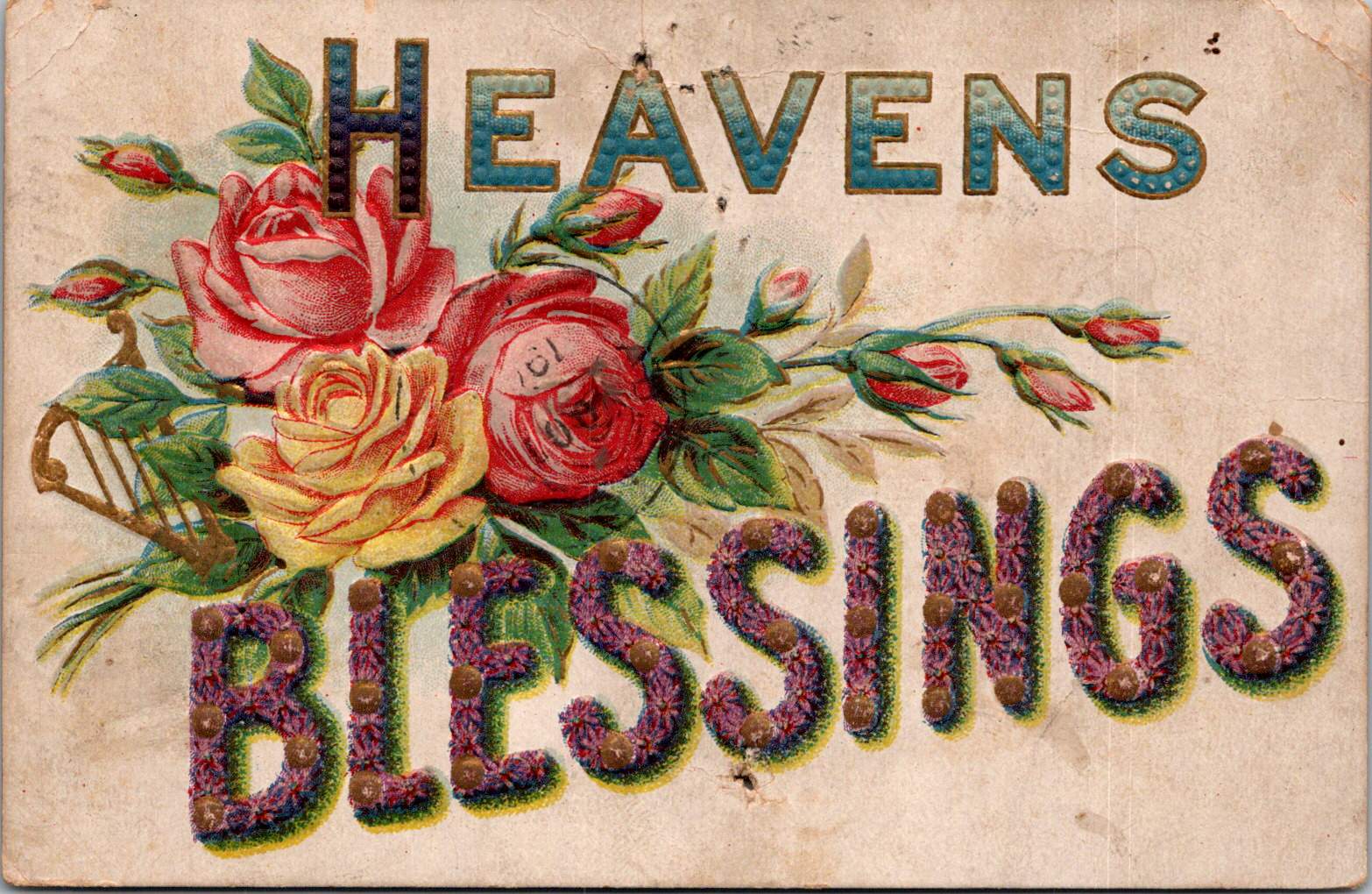
Let’s start with a set of floral letter postcards that captured my heart and imagination recently. For me, they’re time capsules from the Edwardian era, each one a miniature masterpiece of design and sentiment.

Delicate flowers intertwine with bold capital letters, spelling out affectionate greetings to mothers and fathers, aunts and cousins, and more. Blue irises dance around pink and gold lettering, while red roses form the word ‘cousin’ against a dramatic dark background. It’s Victorian drama meets Art Nouveau flair, all condensed into a 3.5 x 5.5 inch rectangle. The colors are vibrant, defying the century they have traveled to meet our modern eyes.

But why do these particular postcards make my collector’s heart skip a beat? It’s not just their undeniable aesthetic appeal, though that’s certainly part of it. They’re windows into history, offering glimpses of a time when sending a beautifully designed card was a primary way of keeping in touch with loved ones. Each handwritten message on the back (like the one postmarked July 10, 1909) is a tiny slice of someone’s life, preserved for over a century.

Thrill of the Hunt and the Joy of Design

There’s also the thrill of the hunt. Finding a matching set among thousands of vintage postcards is like piecing together a particularly beautiful puzzle. Each new discovery brings an aha and a sense of completion. It’s a patience game, sure, but the payoff is worth it.

These postcards, with their intricate details and bold typography, have stood the test of time. They’re just as appealing now as they were when they were first printed. Collecting them isn’t just owning pretty objects – it’s a chance to examine, hold, preserve and share a piece of design history, a snapshot of the aesthetic sensibilities of a bygone era.

Collecting is deeply personal. While I pour over century-old postcards, my neighbor friend is curating an ever-expanding collection of adorable bird figurines. He’s particular about it too – they have to be a specific kind, from a specific place, at a specific price point. He watches the bird market, adds to his collection strategically. To a non-birder, it might seem quirky. But watch him arrange his birds, carefully considering where each one fits, and you’ll understand something profound about him: he’s a person who experiences quiet joys.

First and foremost, collecting is about falling in love with something uniquely suited to you. It’s about creating space in your life – physical and emotional – for the things that bring you joy. It’s about curating, admiring, and sharing a part of yourself through the objects you choose to surround yourself with. My friend curates his bird collection, brings them out by the seasons, delightful arrangements that invite family and friends to enjoy, too.

All the People, All the Collections

This philosophy extends far beyond postcards and bird figurines. Think about the philatelists out there, losing themselves in the minute details of postage stamps. Each tiny square is a work of art, a nugget of history, a passport to another time and place.

Or consider the sports enthusiasts, their shelves lined with signed jerseys and game-used equipment. For them, these aren’t just objects – they’re tangible connections to moments of athletic glory, to the heroes they admire.

History buffs might seek out Civil War relics or Space Age memorabilia, each artifact a physical link to events that shaped our world. And in our digital age, even contemporary collectibles are thriving. From limited edition vinyl figures to exclusive sneaker releases, people are finding new ways to express their passions through the objects they collect.

What unites all these diverse collecting interests? The deep connection to a particular passion or area of interest that only you can know. Whether it’s a century-old postcard or a just-released collectible figurine, these objects become repositories of personal meaning and cultural significance for their collectors.

Hobbies and Pastimes

Collecting, in its various forms, is just one of many popular ways Americans choose to spend their leisure time. Zoom out for a moment and consider the broader landscape of hobbies and pastimes in the United States.

Reading continues to be a widely enjoyed pastime, with many people diving into both physical books and digital formats. It’s an accessible hobby that caters to diverse interests and can be done almost anywhere.

Gardening has seen a surge in popularity, especially in recent years, as people seek to connect with nature and perhaps grow a bit of their own food. Cooking and baking remain perennially popular, with the rise of cooking shows and online recipes making it easier than ever for people to explore new cuisines and techniques at home.

Exercise and fitness activities, including running, cycling, and yoga, are on the rise as people focus more on health and wellness. Crafting hobbies like knitting, crocheting, and DIY projects have seen renewed interest, offering a creative outlet and the satisfaction of making something by hand.

Photography has become more widespread with the improvement of smartphone cameras, allowing more people to capture and share moments from their daily lives. Not only do I collect floral postcards, I take pictures of beautiful flowers every chance I get!

Hiking and outdoor activities are popular, and of course, sports – both playing and watching – continue to be a major part of American culture and a popular pastime for many.

Passion Has Purpose

What drives us to spend our precious free time on these pursuits? The benefits are numerous and far-reaching.

On a personal level, hobbies provide stress relief and relaxation. They offer an escape from daily pressures and can be a form of meditation, helping to reduce stress and anxiety. Many hobbies involve learning new skills or improving existing ones, which can boost self-confidence and cognitive function. They provide a creativity outlet, stimulating imagination and innovative thinking.

There’s also the sense of achievement that comes from completing projects or reaching milestones in a hobby. This can provide a significant boost to self-esteem and overall life satisfaction. Regular engagement in enjoyable activities can help combat depression and improve overall mood. Having a hobby encourages better time management as we carve out time for our interests. And perhaps most importantly, hobbies can become an integral part of our identity, providing a sense of purpose and self-definition outside of work or family roles.

Many hobbies involve communities of like-minded individuals, providing opportunities for social connection and friendship. Engaging with others who share your interests can help develop language, communication and interpersonal skills. Some hobbies, especially those involving arts, crafts, or cuisines from different cultures, can broaden cultural awareness and appreciation.

These pursuits can sometimes lead to unexpected networking opportunities, potentially beneficial for personal or professional growth. Shared hobbies can strengthen family relationships by providing common interests and shared experiences. Many hobbies appeal to people of all ages, facilitating connections across generations. And hobby communities often provide emotional support, advice, and encouragement, fostering a sense of belonging.

Many hobbies, particularly those involving physical activity, contribute to better overall health and fitness. Engaging in hobbies, especially those that challenge the mind, can help maintain cognitive function as we age. Skills learned through hobbies can sometimes translate into valuable job skills or even new career opportunities. Some hobbies can evolve into side businesses or income streams. And perhaps most importantly, hobbies provide a counterbalance to work and other responsibilities, contributing to a more well-rounded life.

So, whether you’re arranging a set of vintage postcards, nurturing a garden, mastering a new recipe, or climbing a mountain, know that you’re doing more than just passing time. You’re engaging in a fundamental human activity, one that brings joy, fosters growth, builds connections, and adds richness to life.

Finding Quiet Joys

In the end, our collections and hobbies are extensions of ourselves. They reflect our interests, our aesthetics, our values, and our histories. They give us a way to tangibly interact with our passions, to create order and meaning in a chaotic world, and to surround ourselves with objects and experiences that bring us joy and inspiration.

So the next time someone raises an eyebrow at your carefully curated collection of Star Wars figurines, or questions why you spend hours perfecting your sourdough technique, remember this: in pursuing your passions, you’re not just collecting things or passing time. You’re crafting your narrative, preserving memories, expressing your unique identity, and experiencing the quiet (or not so quiet) joys that make life rich and meaningful.