A path appears underfoot every year around this time, with a slight softening of the ground and a change in the light. The road is old, but the way is new again.
Spring equinox arrives in just a few days, another moment when day and night stand in perfect balance. Nowruz, one of the world’s oldest celebrations, falls on the equinox itself, marking the moment the earth turns toward renewal. Observed for at least three thousand years across Persia, Central Asia, the Caucasus, and the diaspora communities that carry it around the world, Nowruz means new day and it begins precisely at the moment of the spring equinox.
Preparations are meticulous. The house is cleaned from top to bottom in a practice called khane-tekani, shaking out the house, to release the accumulated weight of winter. A ceremonial table is set with sprouted wheat for rebirth, vinegar for patience, garlic for health, and a goldfish in a bowl for life against all odds.
In Chinese Lunar New Year, it is the year of the horse. All the teachings of Ramadan have been quietly observed this month. Christians are entering the heart of Lent, when liturgical colors shift from penitential purple to radiant rose, and the invitation is to rejoice. World traditions share this central wisdom. To walk forward, one must first prepare.
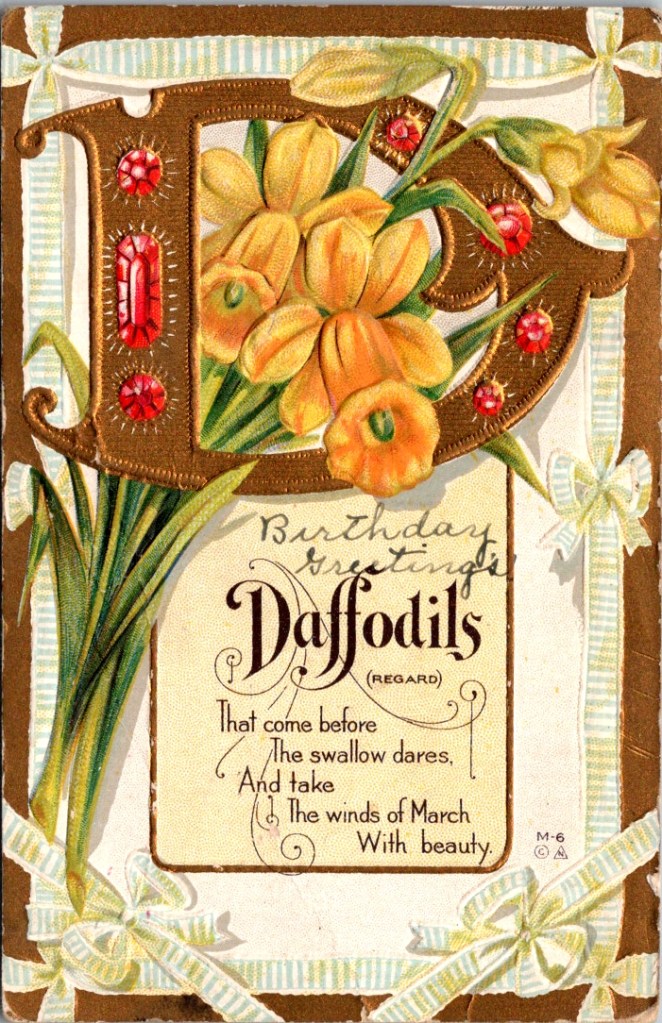
This morning my path runs along Sligo Creek near Washington DC, where the trail follows the water through an old urban forest. The snowdrops are done. Small and white and brave, they came and went in February. Crocuses are finishing now, purple and yellow scattered through the leaf litter. Daffodils line the path in both directions to proclaim the news of spring. Soon the cherry blossoms will arrive, carrying the Japanese mono no aware, bittersweet awareness as beautiful things pass.
For the next few weeks I’ll be traveling. Away from my desk and the collection. Being in motion feels at pace with the season. By early April I’ll be back in Arizona, where spring doesn’t linger the way it does in the East. The desert has its own brief, vivid version of the season. Sharp early light and cool mornings, palo verdes going yellow and the brittlebush blazing.
For me, it’s a time to toss off the heavy winter blankets, move furniture, dust out the corners, and feel all the motivations of the season. The Posted Past is making some new moves, too.
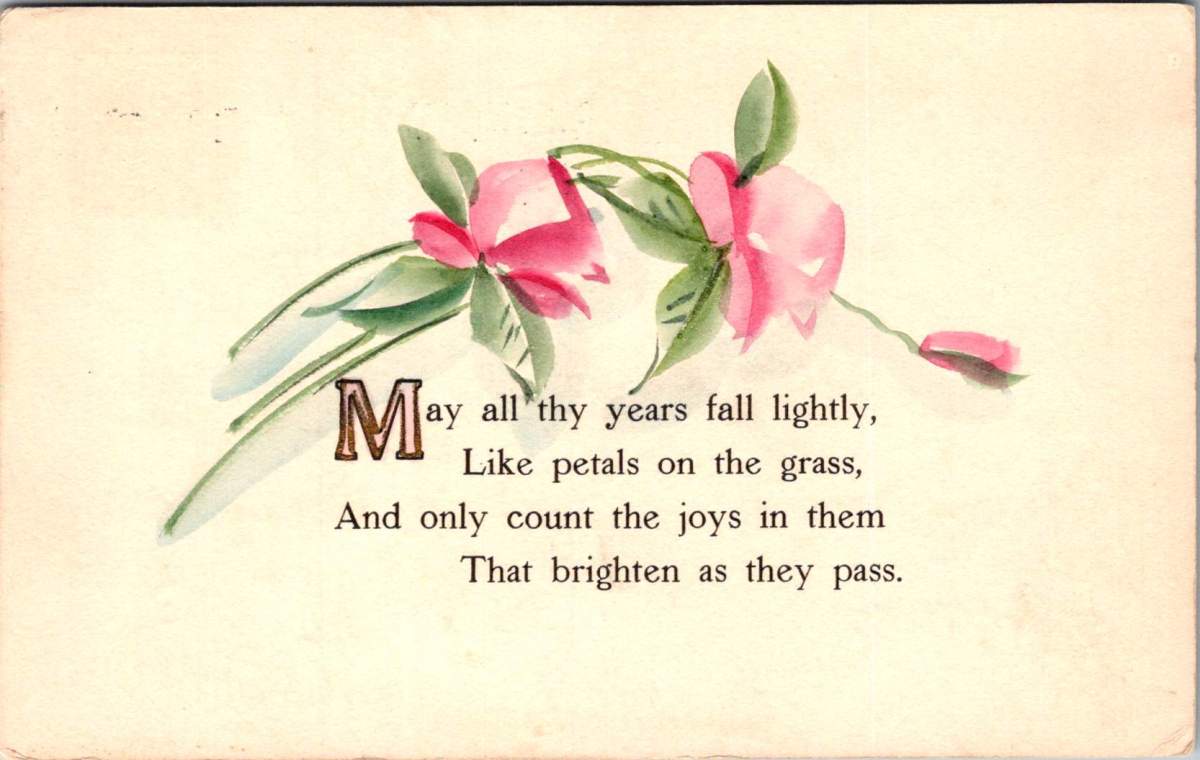
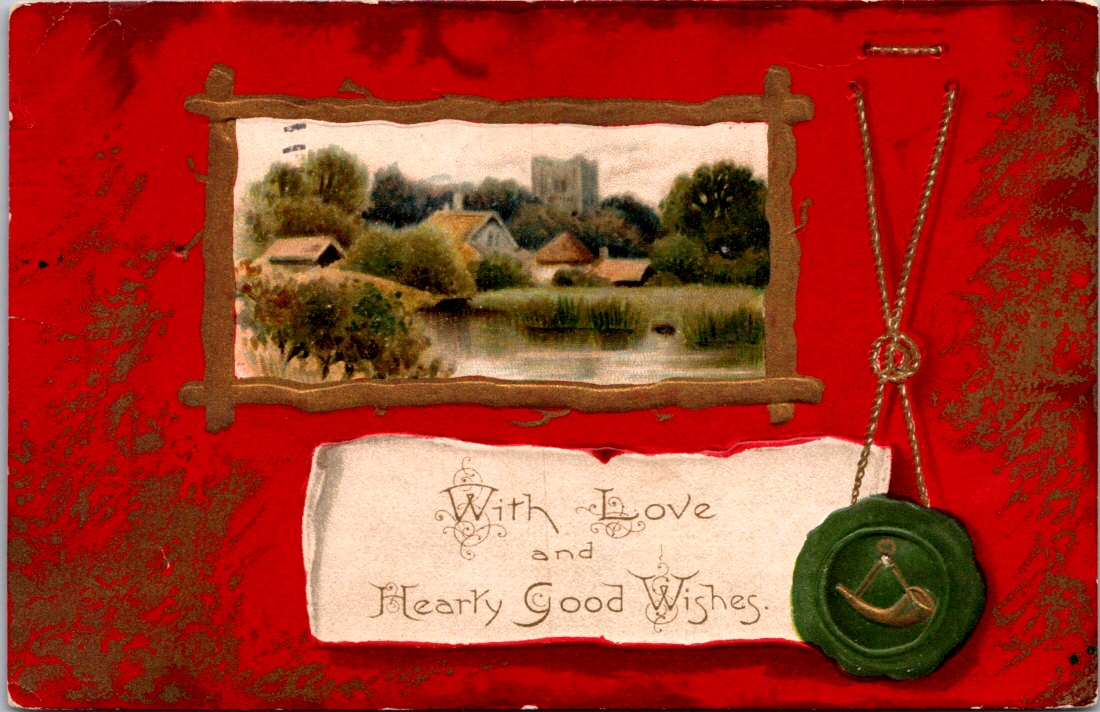
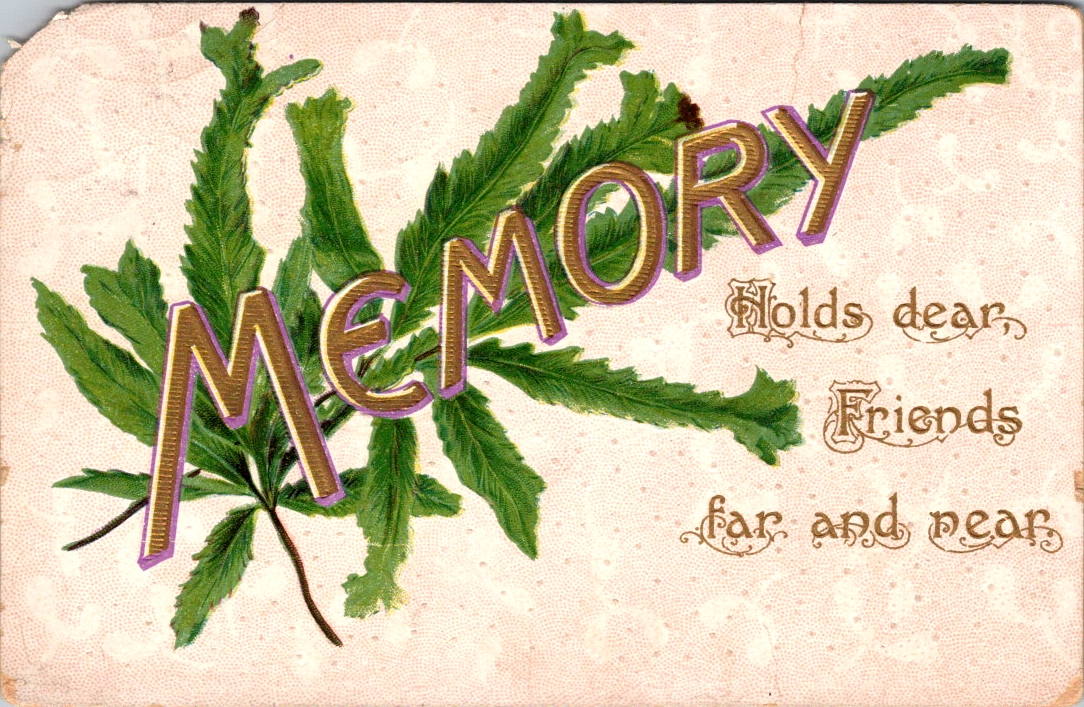
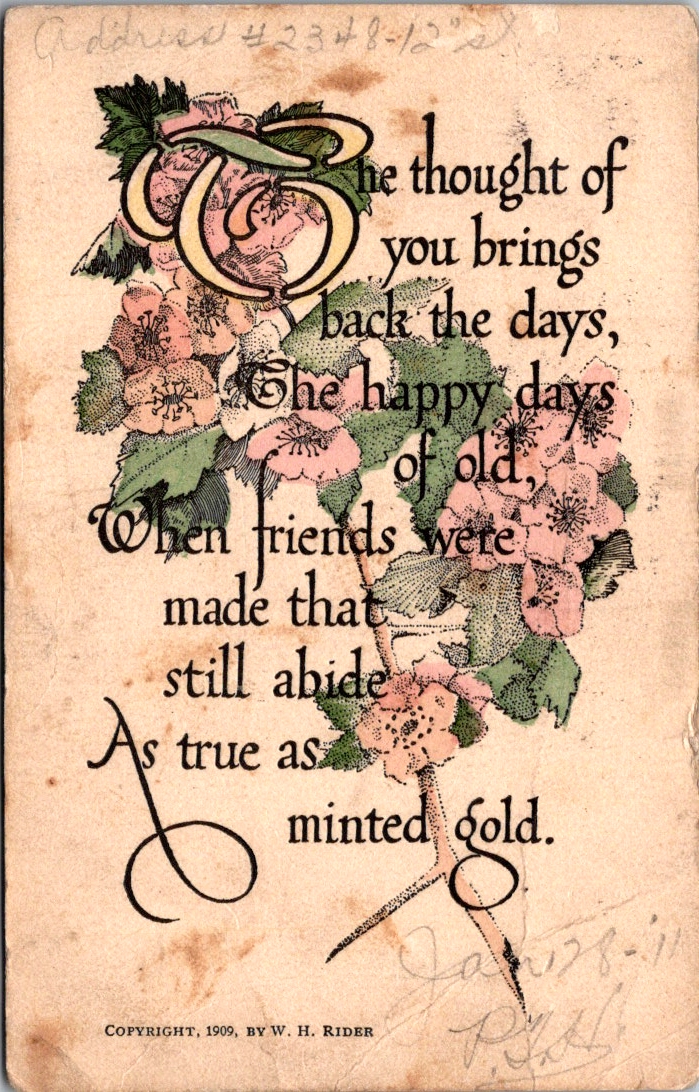
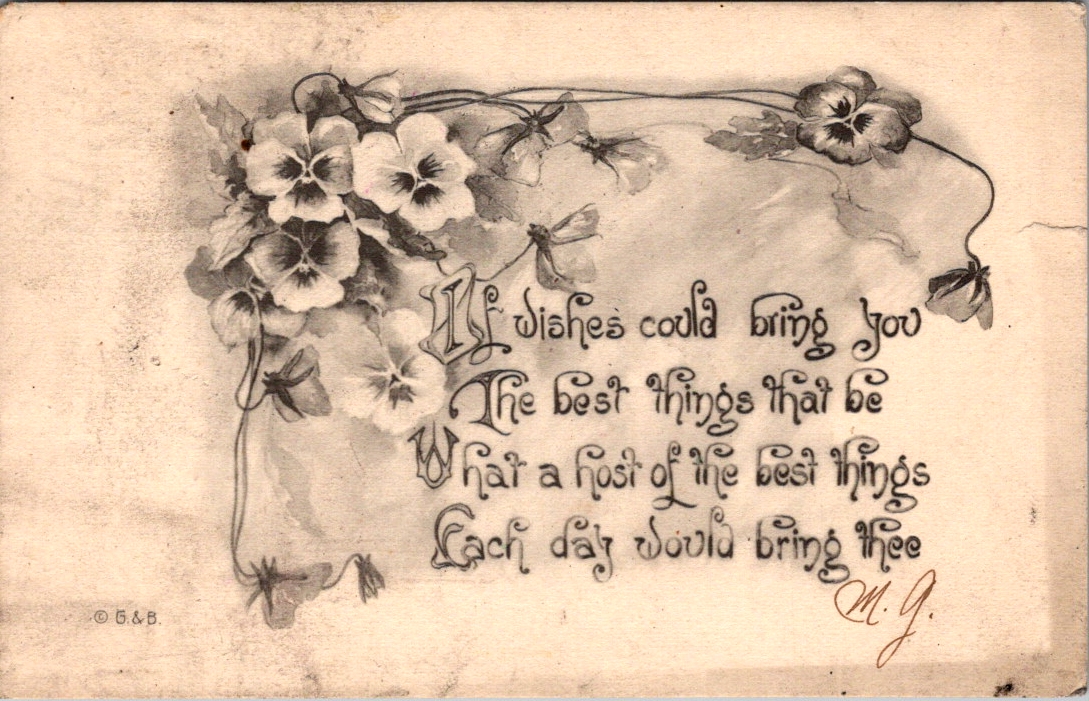
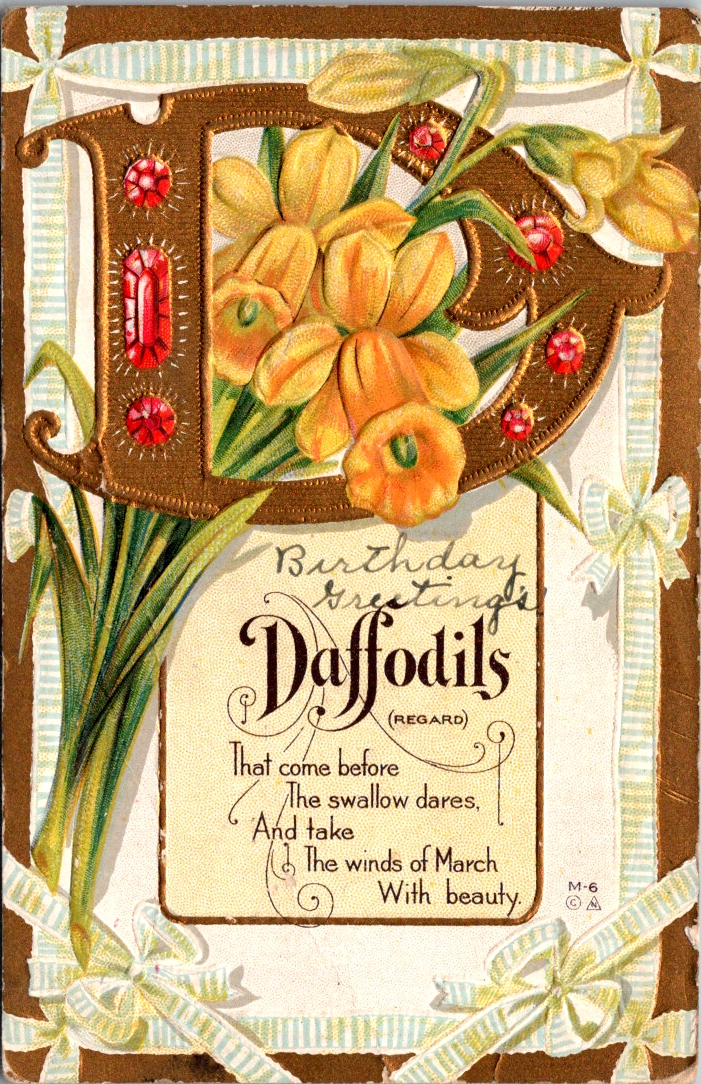
Spring greeting cards are full of flowers and fancy, and the messages give us gentle permission to start again. If you are grass-side up, count yourself among the living and the hopeful. Believe that what comes next might be better.
Take a walk this week, if you can. Clear an old task you’ve been putting off. Set the table. Notice what’s arising in your life. Greet the new day.
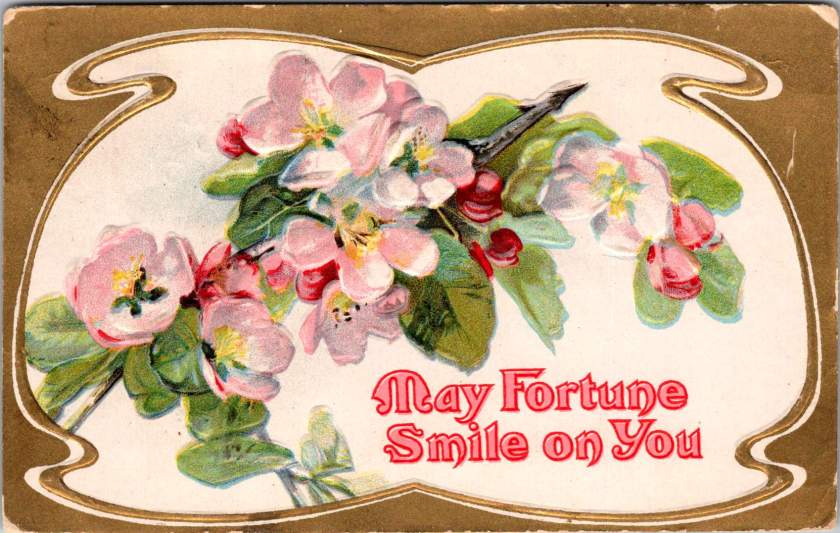
Romans advised that fortune favors the bold. In Sweden, luck never gives, it only lends. In the United States, the harder you work, the luckier you get. The Arabic proverb says, “Throw a lucky man into the sea and he’ll come up with a fish in his mouth.” A Brit might be lucky at cards, unlucky in love. In Japan, the day you decide to act is your lucky day.
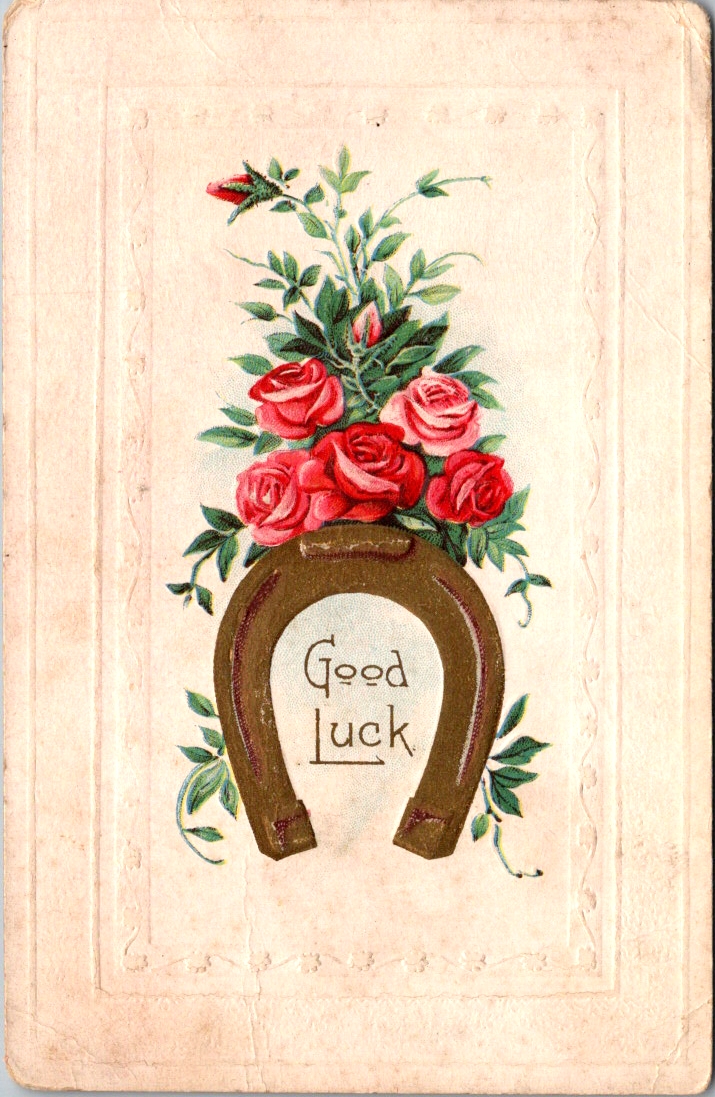
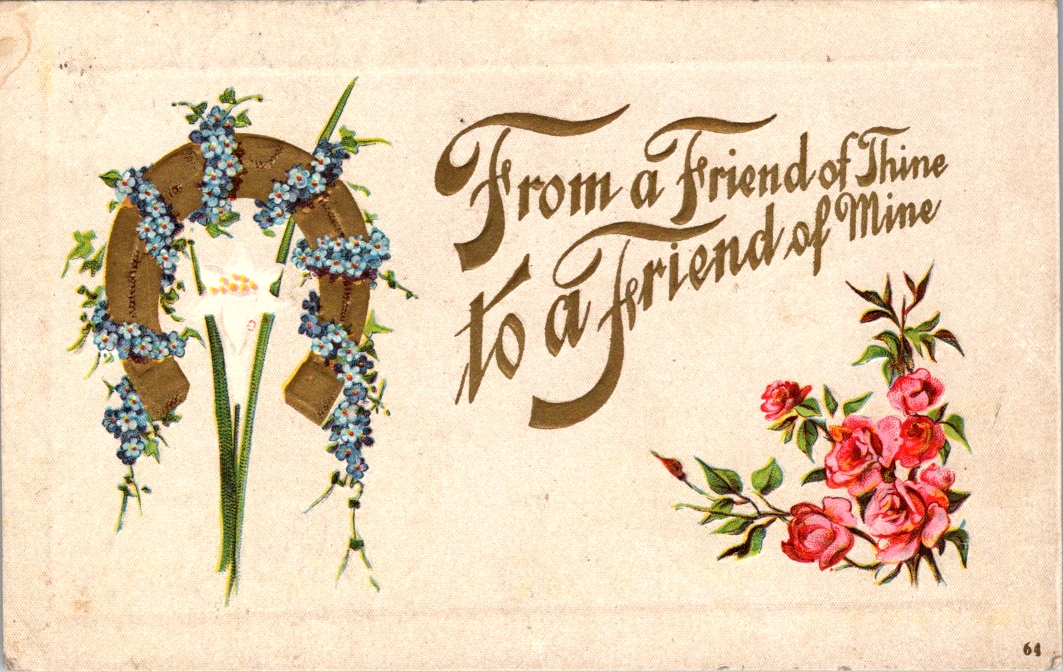
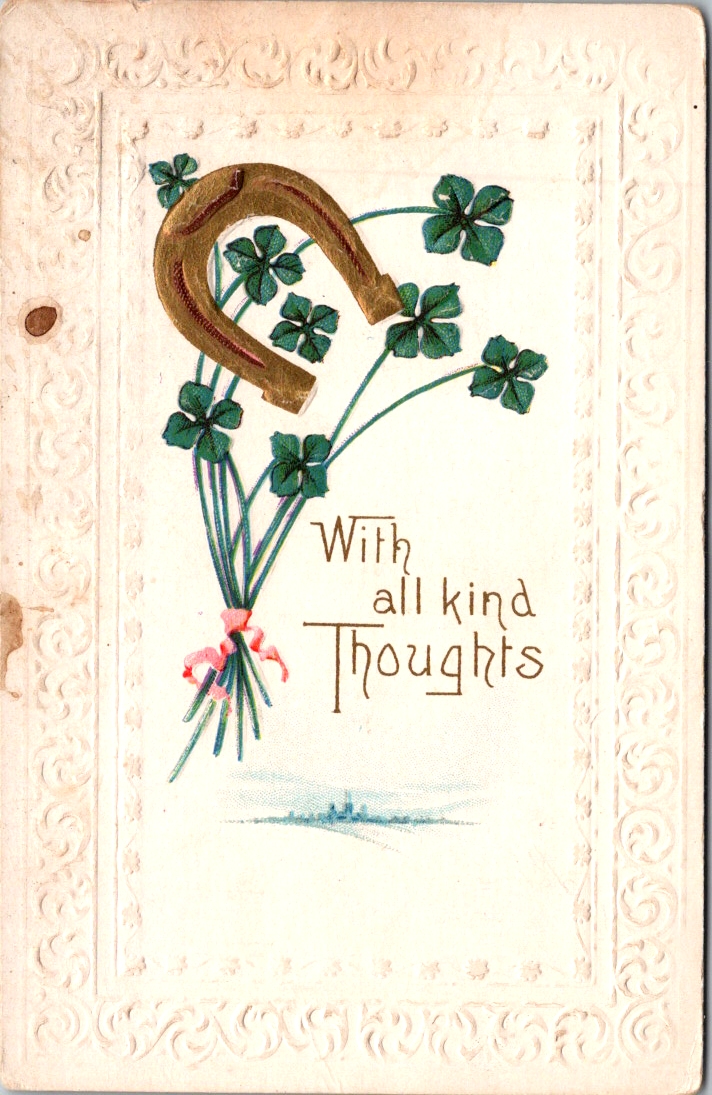
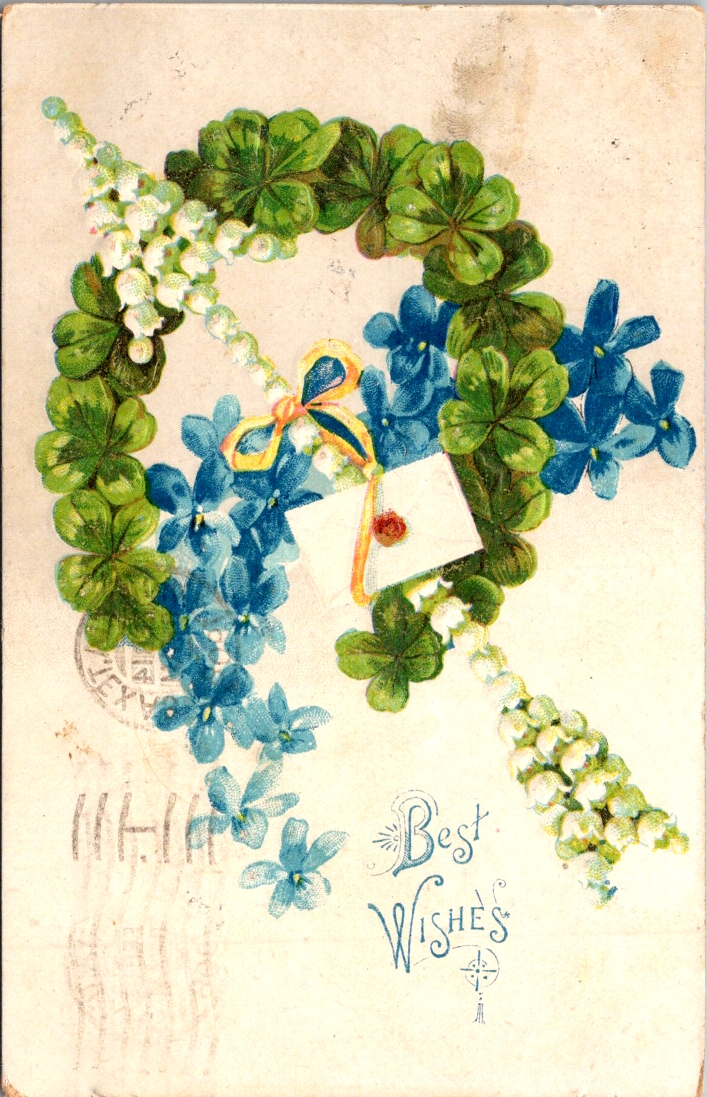
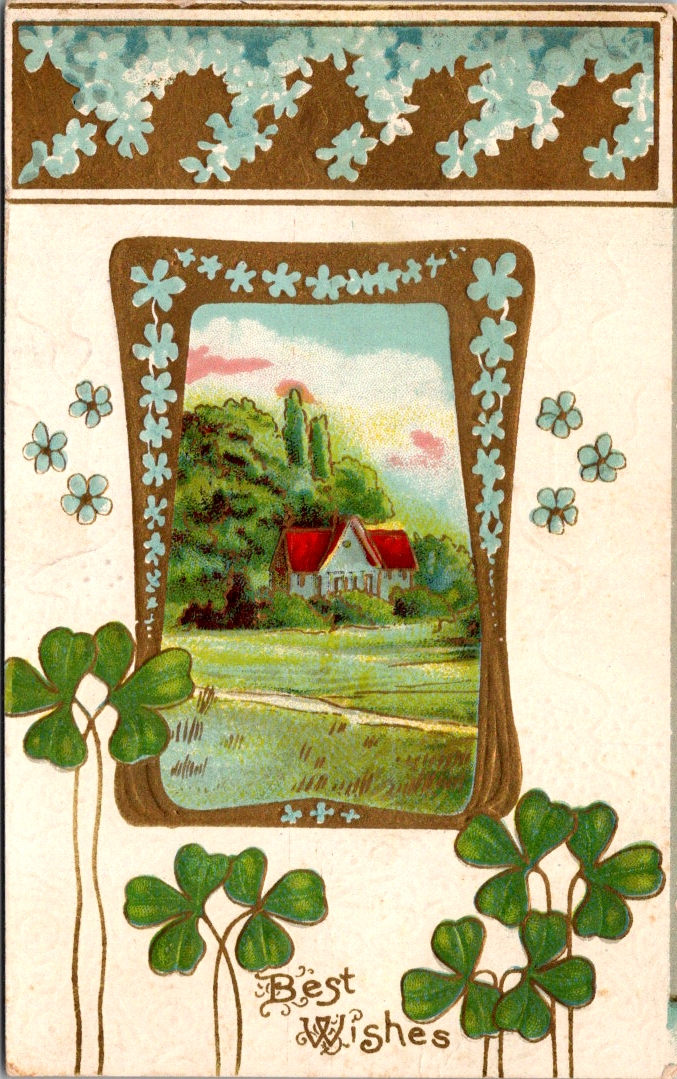
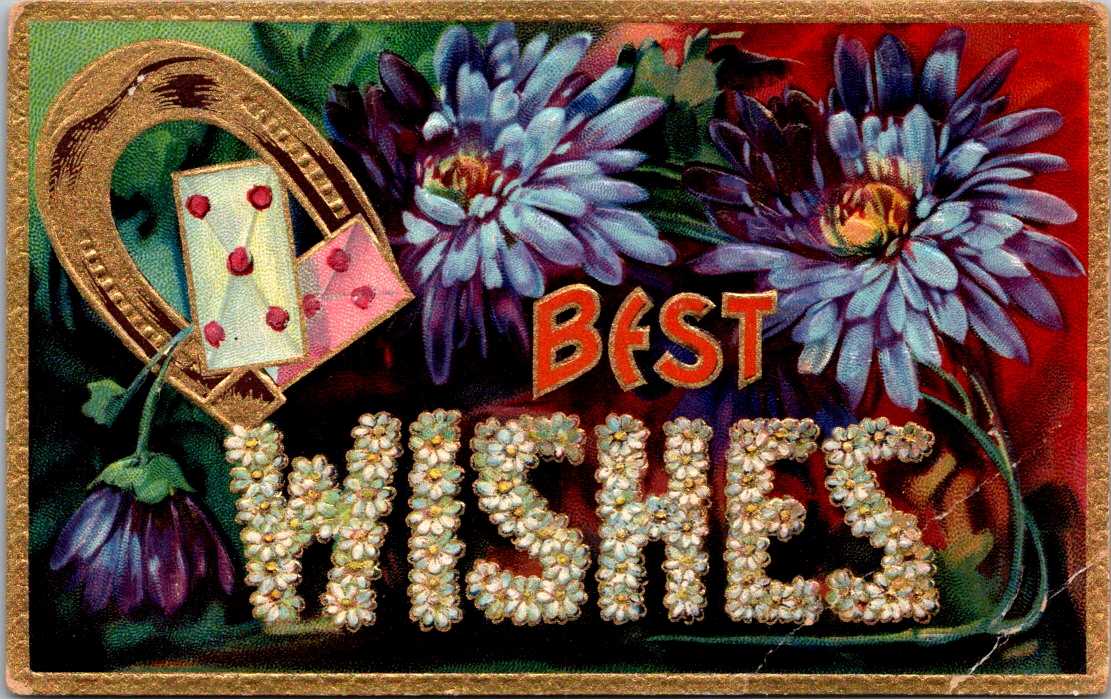
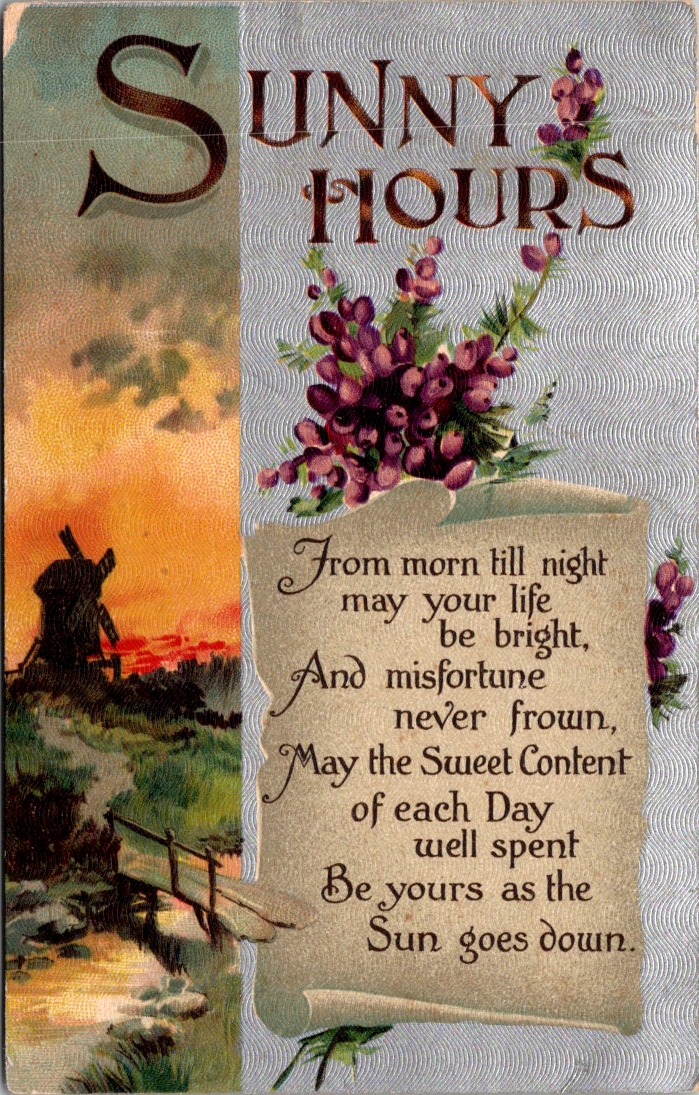
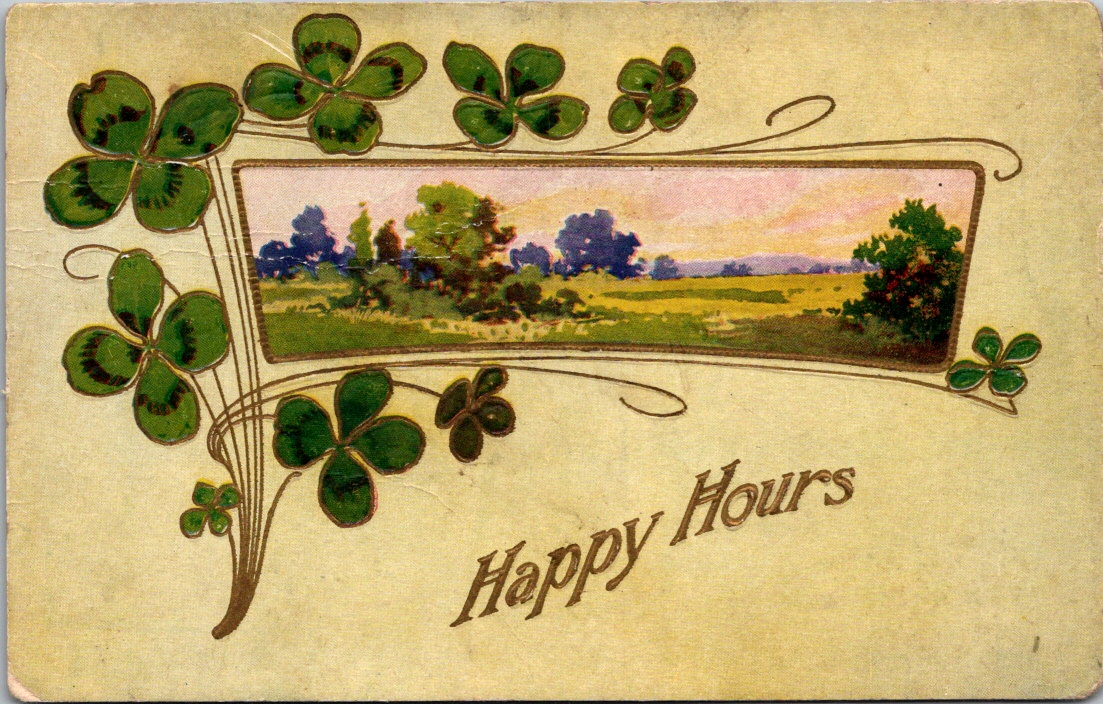
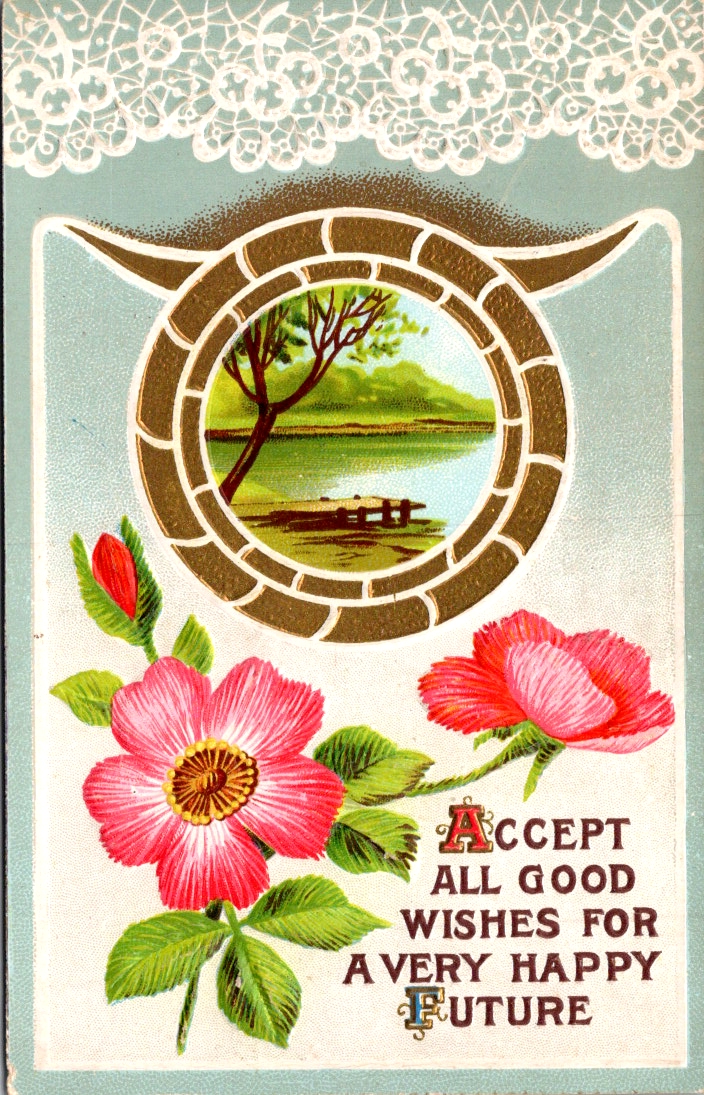
Edwardian postcards had a curious set of symbols to call forth fate and fortune. Horseshoes, shamrocks, roses, and playing cards. Small and slightly worn at the edges, these vintage greeting postcards have traveled more than a century carrying a providential wish.
Only one card in the collection actually says Good Luck. The rest offer best wishes, happy hours, and kind thoughts from me to you. As we’ll see, luck is borne of relationships (and circumstances) lifted by the charitable wish for health, wealth, and wisdom.
Some say that luck can be earned, but only a fool pursues it outright. We daydream about what fortunes may be in store, and sometimes ignore the simple sparkles that appear each day. We know, of course, that there are no free lunches. Yet, we are admonished to never look a gift horse in the mouth.
The bold assume they earned their lucky breaks. The humble suspect they’ve borrowed fortune temporarily. The superstitious are not entirely sure we should discuss it. Luck is where fate and intent find common cause, usually in the context of close friendships.
Old English had no luck. It used wyrd instead, which pointed to fate and destiny. Wyrd is the root of our word weird, which may indicate how people felt about fate. It was uncanny, inevitable, and perhaps divine. You didn’t pursue wyrd. You experienced it through awe and fear.
Somewhere around the 15th century, luk and gelucke drifted in from the Dutch and Low German. Luck was looser and more manual. Like weather, luck favored preparation and was possible to influence if you knew the right charms. The horseshoe went up above the door. The rock went in your pocket. If luck is not fate, if it is not fixed in advance, then perhaps you can do something about it. Perhaps it can be courted.
The lucky person is not the one who waits but the one who steps into the room. This is luck as a reward for courage, or at least for motion. Fate deals the cards, and we each have a hand to play.
Fortune favors the bold — fortes fortuna adiuvat ~ Terence, Roman playwright, around 151 BCE
Luck is what happens when preparation meets opportunity, and preparation is something you control. The solo pursuit of fortune is a genuine drive.
The harder I work, the luckier I get. ~ Samuel Goldwyn
But the shamrock gently disagrees. Four-leaf clovers are natural anomalies, not personal achievements. We can’t earn one, only discover it. Even if you can court luck, even if work and boldness can pull it toward you, it is never yours to fully command.
Luck never gives; it only lends. ~ Swedish proverb
Some people simply have it, inexplicably, in ways that have nothing to do with preparation or boldness or a rabbit’s foot.
Throw a lucky man into the sea, and he will come up with a fish in his mouth. ~ Arabic proverb
Some observe that luck is a finite resource and can be unwisely traded away. This may or may not be true, but as a matter of human priority it is clarifying. We each get chances to test our luck.
Lucky at cards, unlucky in love. ~ English proverb
The tension between fate and will, between earned luck and divine luck, is located in a moment of commitment. The lucky day is not the day something falls in your favor. It is the day you decide it might be worth the effort.
The day you decide to do it is your lucky day. ~ Japanese proverb
Whatever the senders intended and however the recipients replied, these cards demonstrate how providential language holds us together in anticipation of something wonderful just ahead. The possibility that things might go our way.
The symbols of luck nested together in relationship, in abundance, in the living world — a horseshoe wreathed in flowers, overflowing with roses, or flanked by shamrocks — is not an accident of Victorian design sensibility. It draws on the ancient wisdom that friends are the true source of life’s lucky breaks. Love does the work and luck gets the credit.
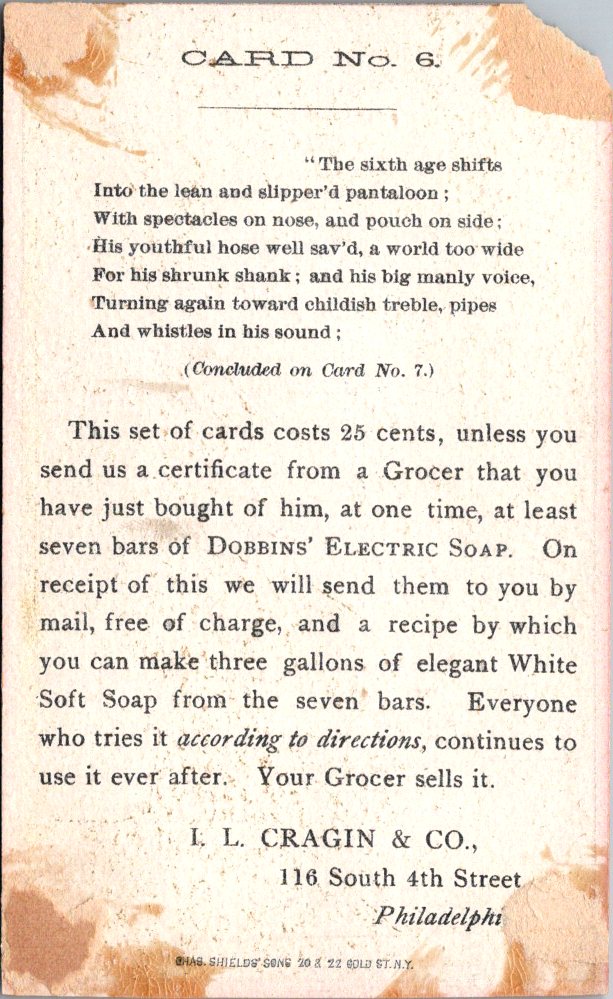
In Shakespeare’s As You Like It, Jacques delivers his monologue in Act II, Scene VII, observing human life with world-weary detachment. He sketches out seven distinct chapters of a human life, from mewling infancy to toothless old age, with equal parts affection and irony. One of the most quoted passages in all of Shakespeare, by the 1880s it was deeply embedded in popular culture — the kind of verse that some households knew by heart.
“All the world’s a stage, and all the men and women merely players.”
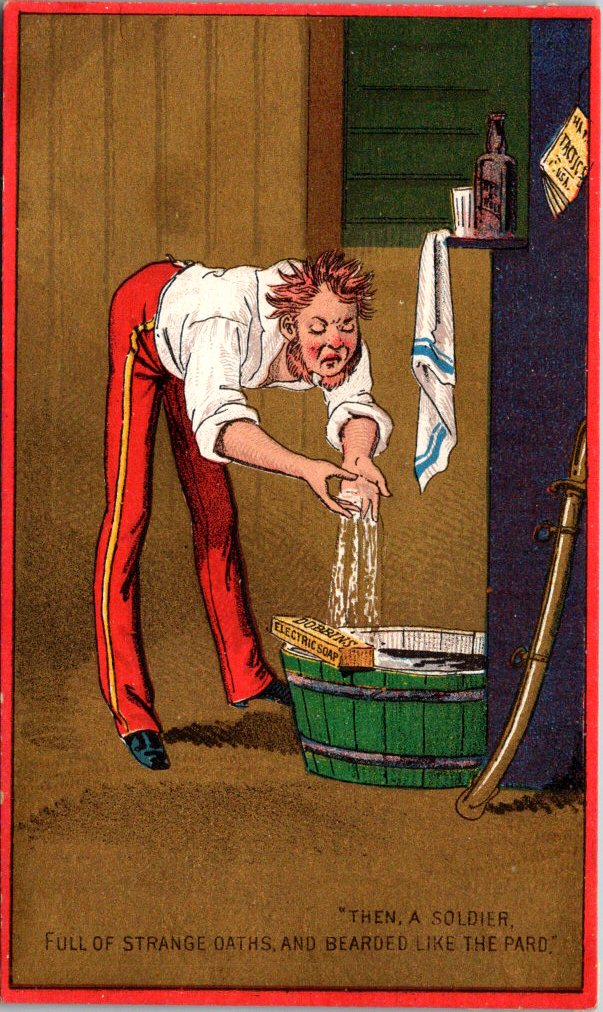
Dobbins’ Electric Soap was manufactured by I. L. Cragin & Co. of Philadelphia and had been on the market since the mid-1860s. By the early 1880s, the company was advertising heavily through trade cards, chromolithographic collectibles that matched the indulgences of the Gilded Age. Cragin’s innovation was to produce not a single card but a series of seven that required the collector to buy a bar of soap each time. Get the certificate from your grocer, and the full set arrived by mail free of charge.
Philly, 1880s. Shakespeare meets laundry.
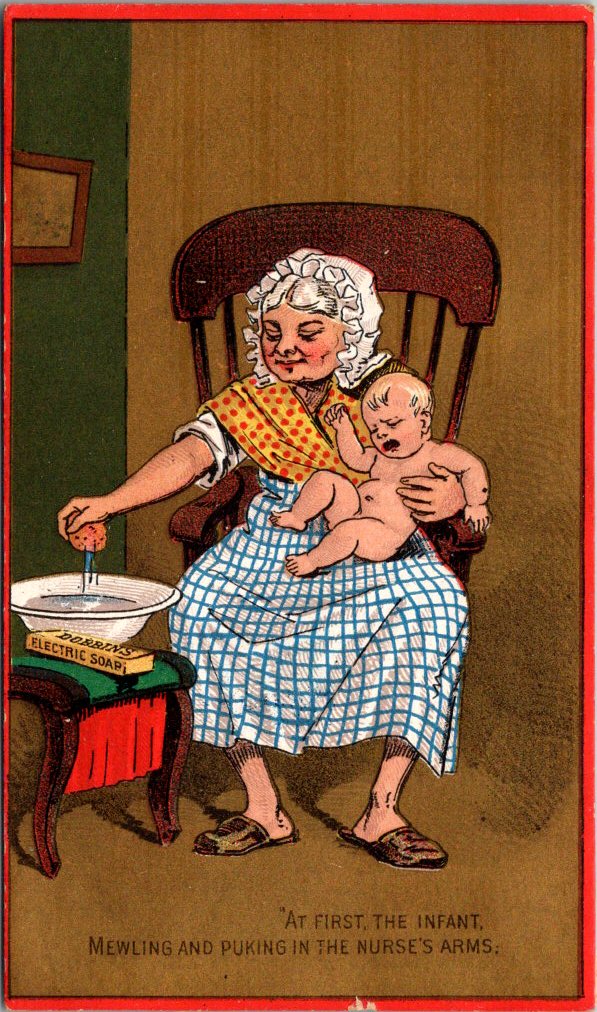
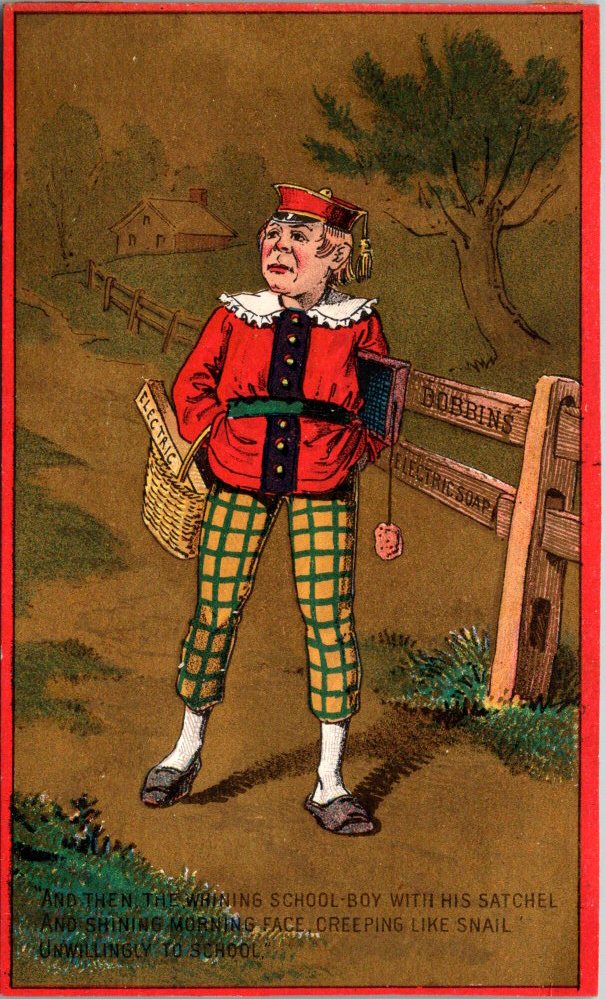
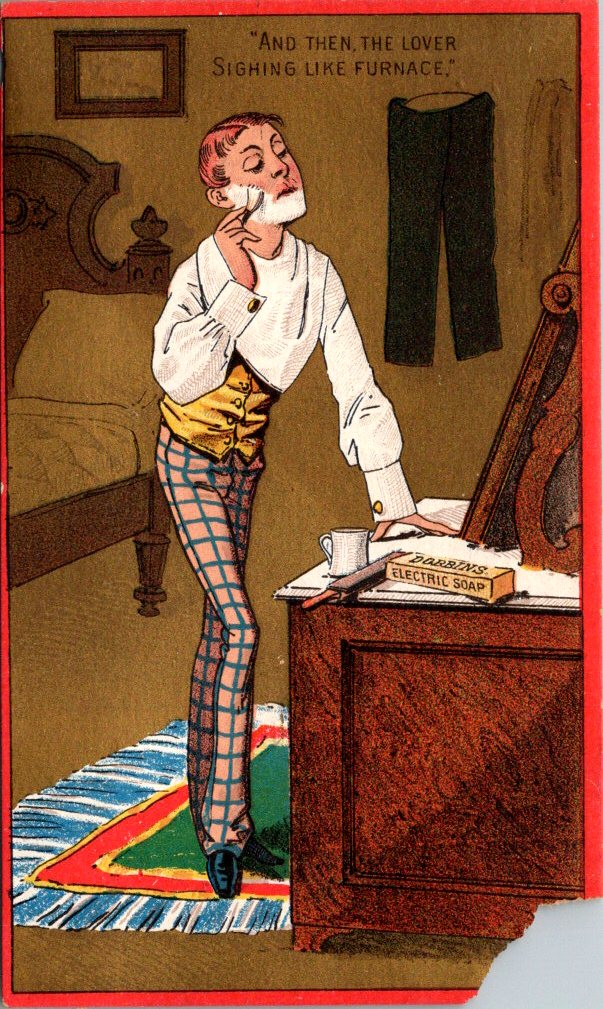
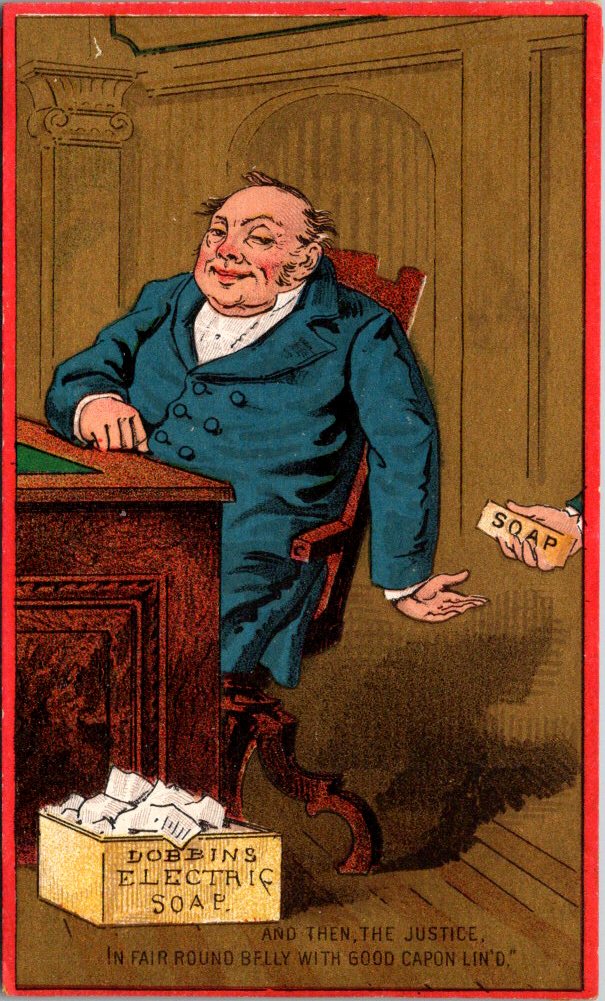
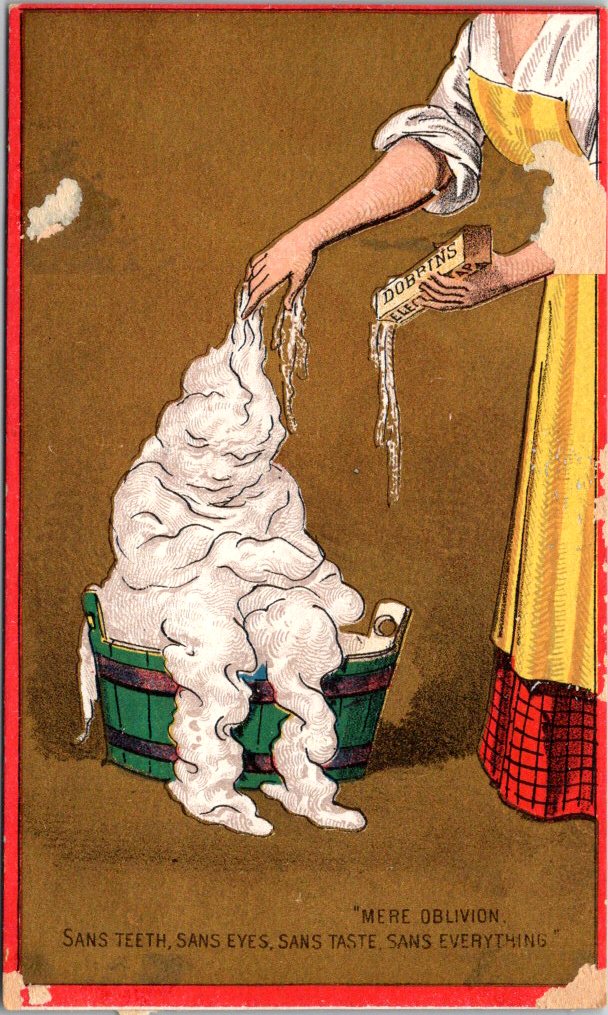
Front: Each card is a vivid chromolithograph on a warm gold ground with a bold red border, a consistent visual identity that makes the cards a set. The figures are drawn in a coarse comic style, expressive and exaggerated, with each character placed in a domestic or outdoor scene with a bar of Dobbins soap nearby.
First, a round-faced nurse in a white mobcap seated in a rocking chair, holding a squirming naked infant over a washbasin. Card Two shows a sulky schoolboy in a red jacket and yellow-green plaid knickerbockers, satchel over one shoulder. The lover on Card Three is a lanky figure in a gold waistcoat and plaid trousers, leaning against a bureau in a disheveled bedroom.
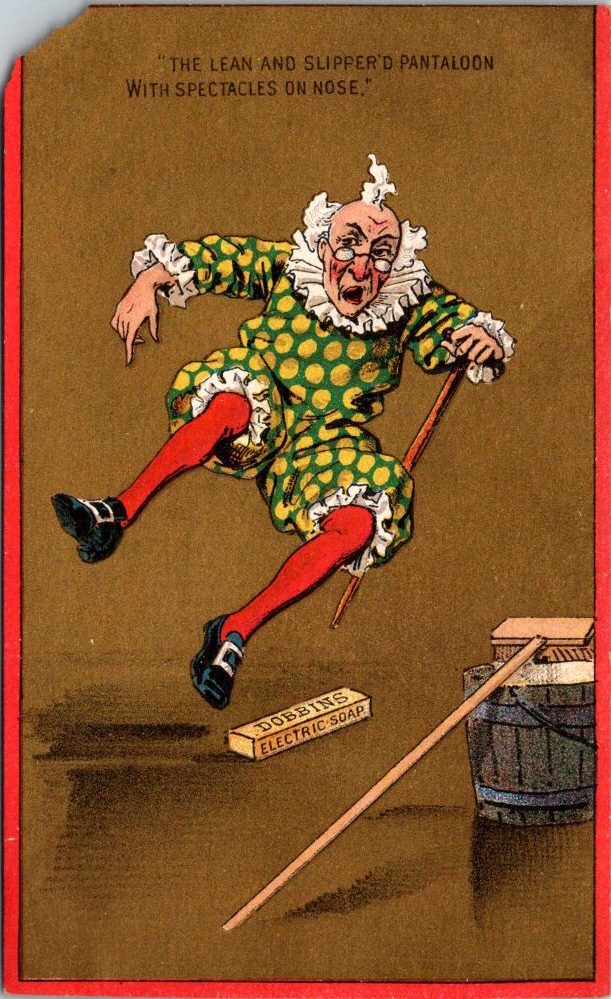
The soldier on Card Four is wild-haired and red-faced, bent over a green barrel-tub in his uniform trousers and braces, and a sword against the wall behind him. Card Five presents a rotund man in a blue coat, leaning back in his chair with the serene self-satisfaction of someone accustomed to receiving gifts. Card Six is an elderly Harlequin figure in a polka-dotted costume with red stockings, tumbling in mid-air. The final card is a woman in a yellow apron leaning over a green wooden tub, and a billowing human figure made entirely of suds.
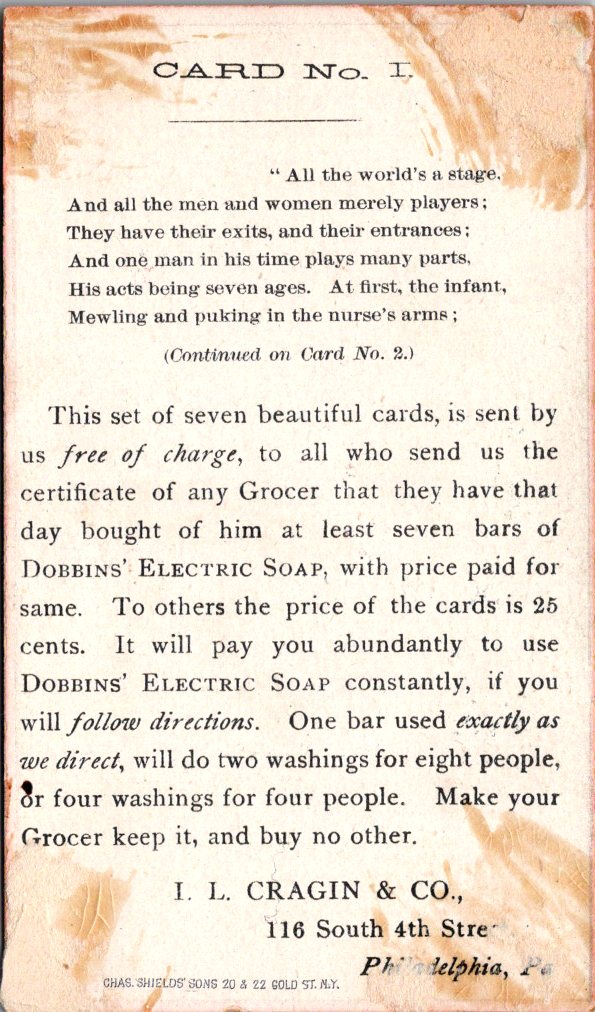
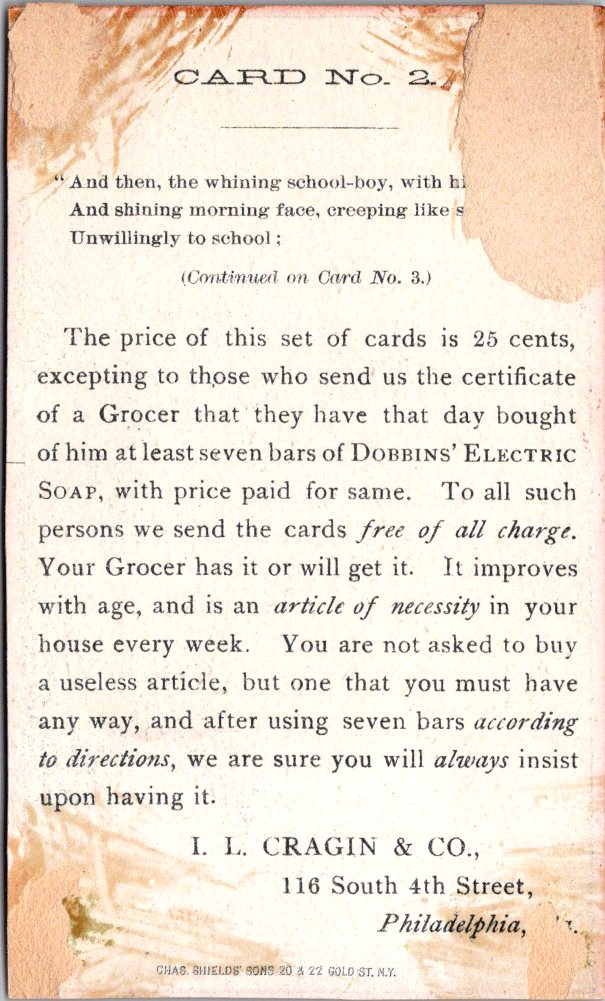
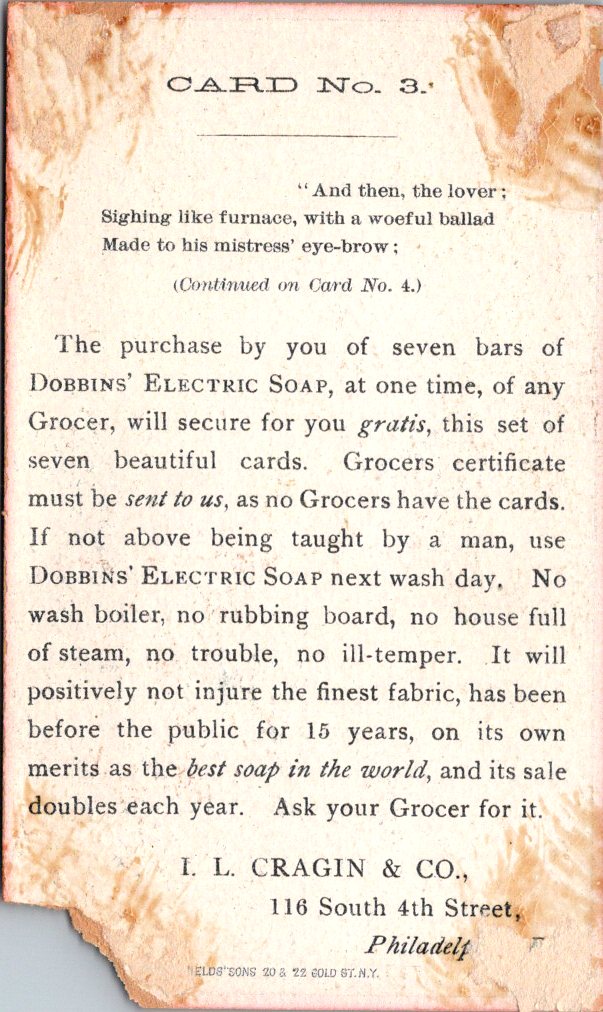
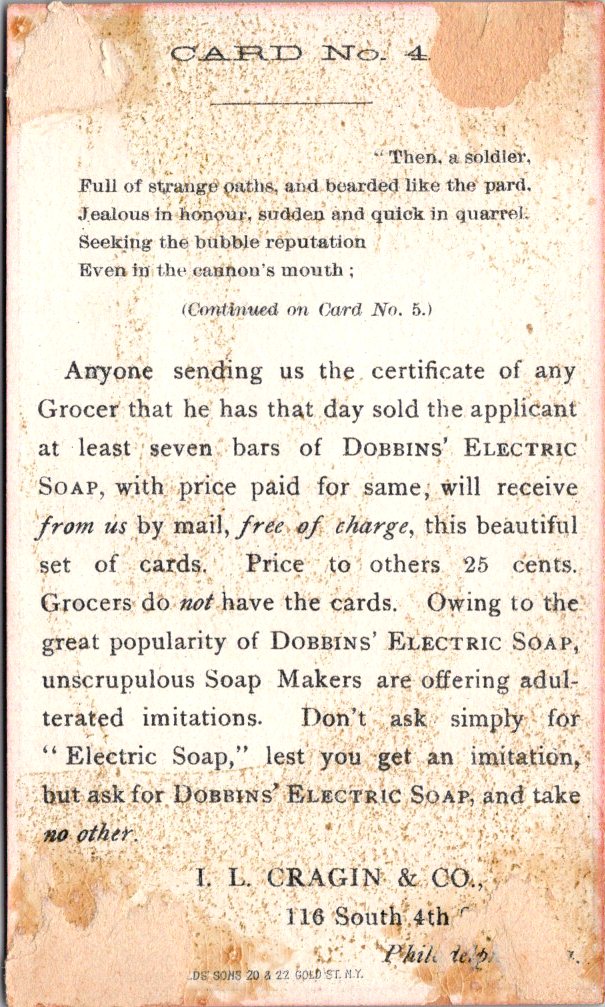
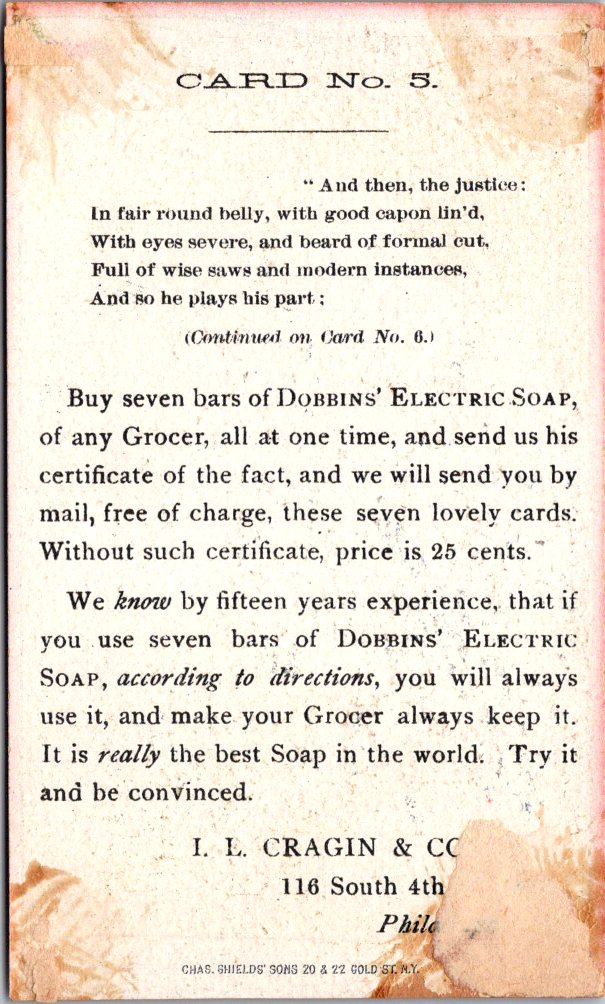
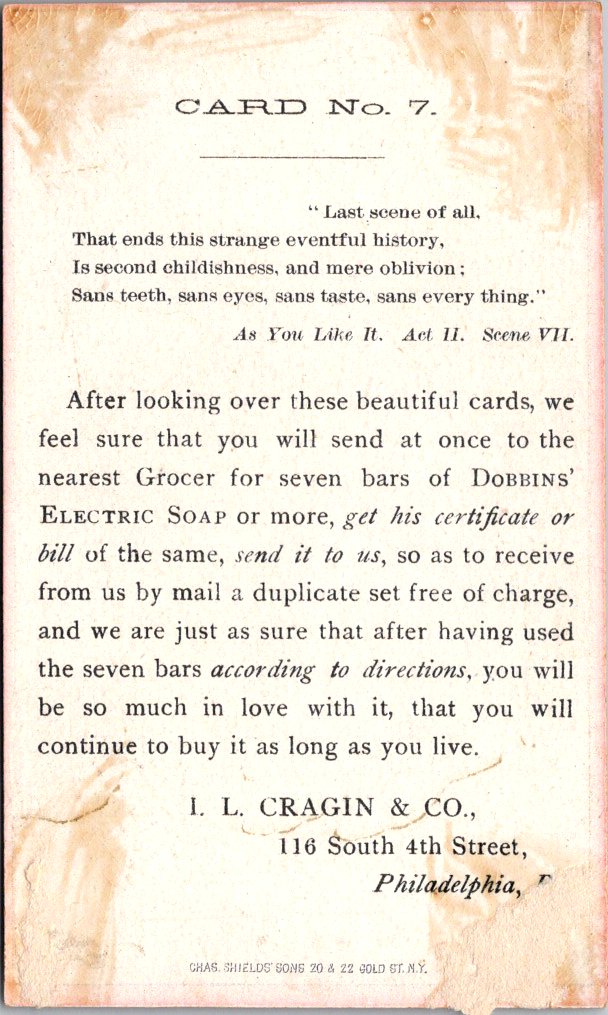
Reverse: Black text on cream stock with the full Shakespeare speech across all seven cards, each picking up the verse where the last left off. The final card identifies the source: As You Like It, Act II, Scene VII.
Below the verse, each card runs a version of the same offer in slightly varied language: collect a grocer’s certificate for each bar purchased and mail seven of them to 116 South 4th Street, Philadelphia. Without the certificate, the price for the set is 25 cents.
Each card presents a few product features: no wash boiler, no rubbing board, no house full of steam. Card Four warns against unscrupulous imitations and instructs buyers to ask for Dobbins’ Electric Soap by name. The printer’s imprint for Chas. Shields’ Sons, 20 & 22 Gold Street, New York appears at the foot of each reverse.
Production: These high-quality commercial chromolithographs likely date to the early 1880s, after the business had been in operation for more than a decade. The color registration is precise throughout, the figure work confident and expressive, and the gold-and-red palette gives the set a unified identity that still reads as a coherent series. The illustration style and rich production values mirror the opulent aspirations of the era.
Collectibility: Complete sets of themed trade card series are uncommon; most were distributed individually and rarely survived intact. The Shakespeare framework, the quality of the printing, and the conceptual ambition of the campaign make this set particularly distinctive. It appeals to trade card collectors, Victorian advertising historians, Shakespeare enthusiasts, and ephemera collectors with a taste for the literary and the delightfully absurd.
new Rarities Room
Our new space for the old stuff that no one ever threw away – yay!
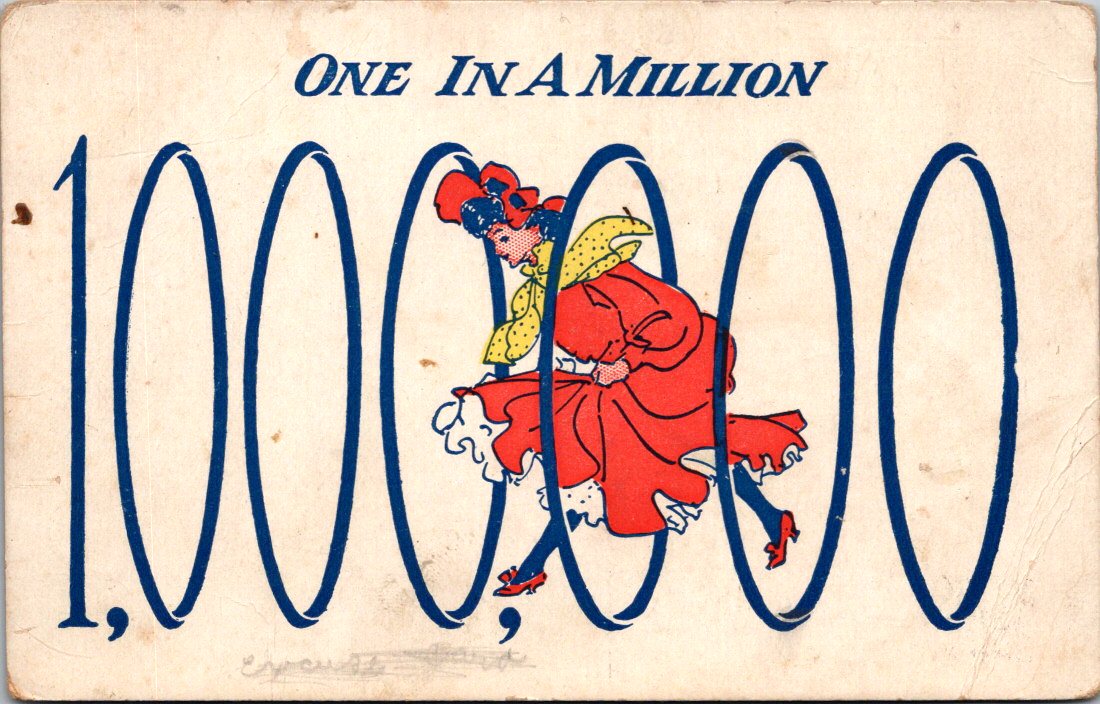
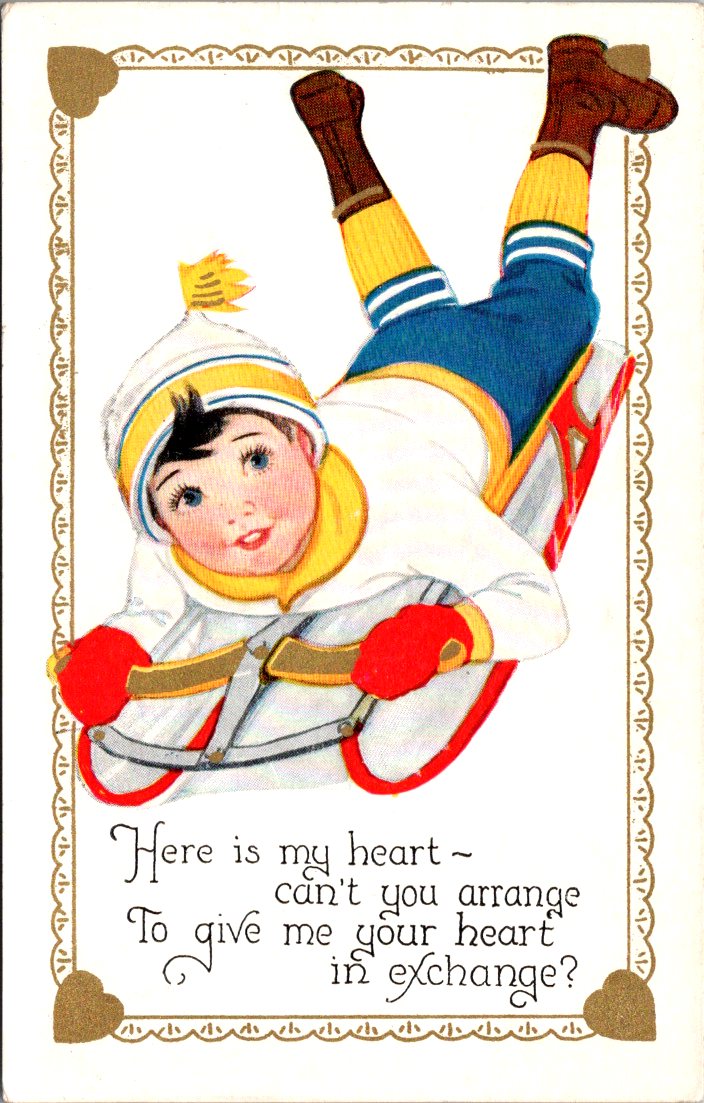
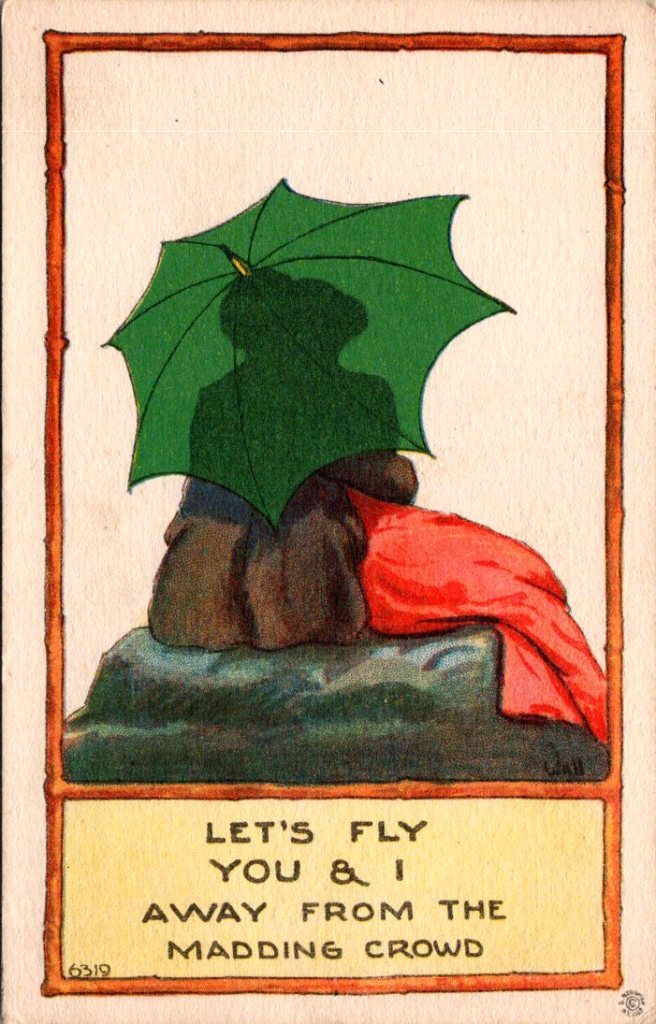
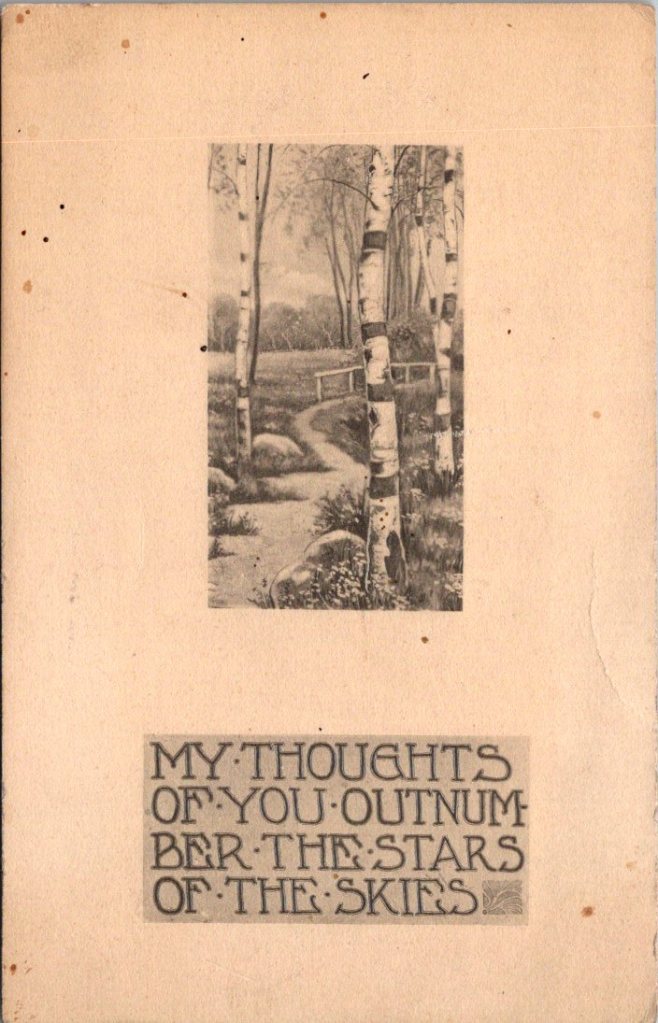
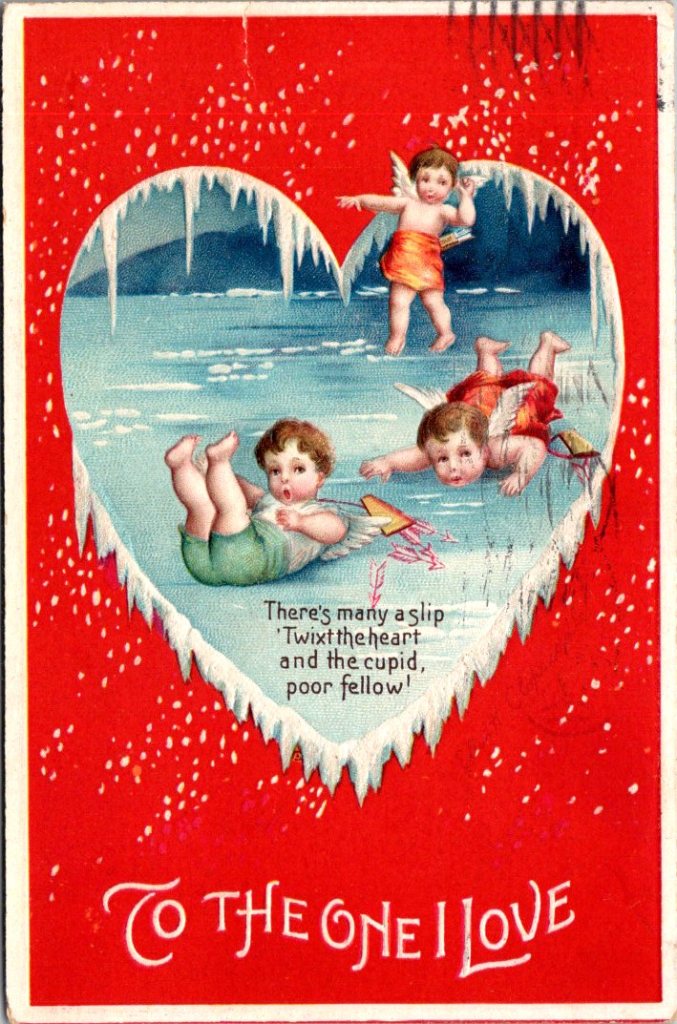
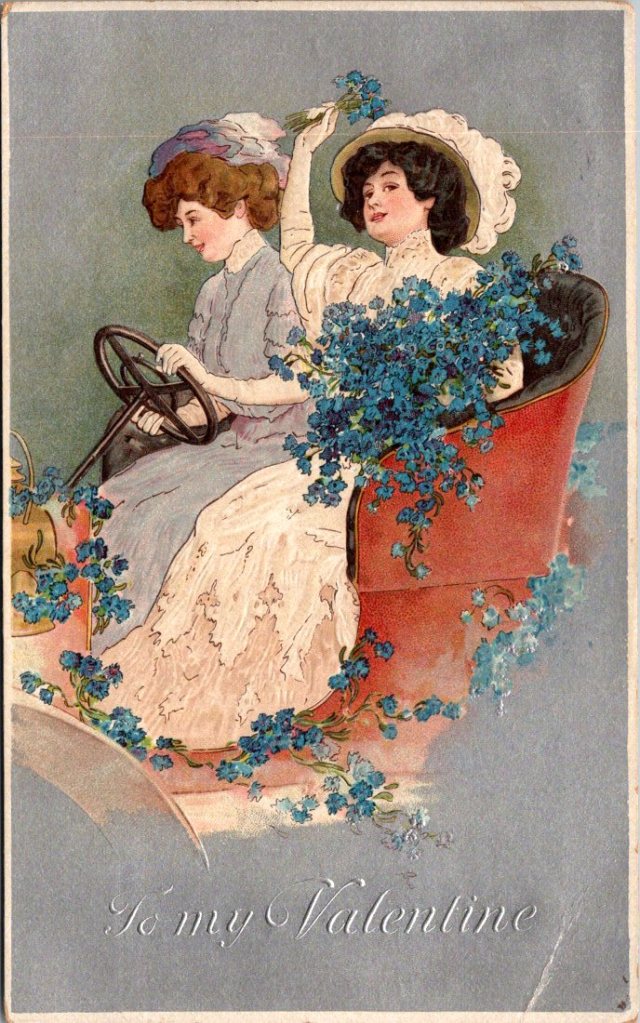
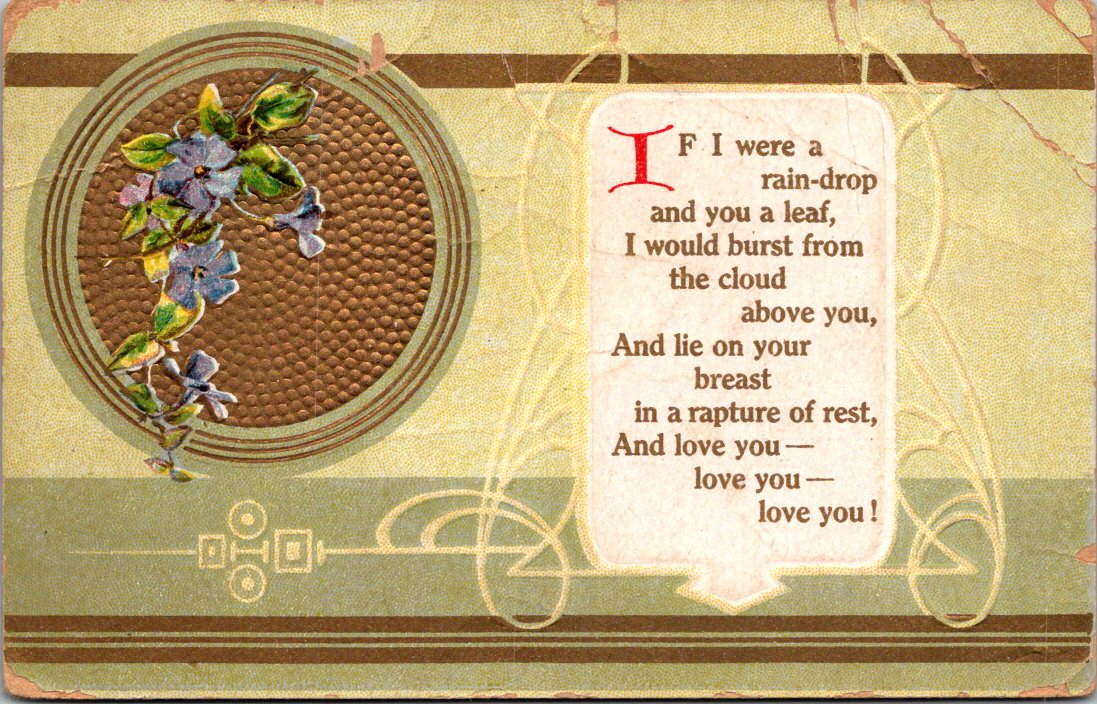
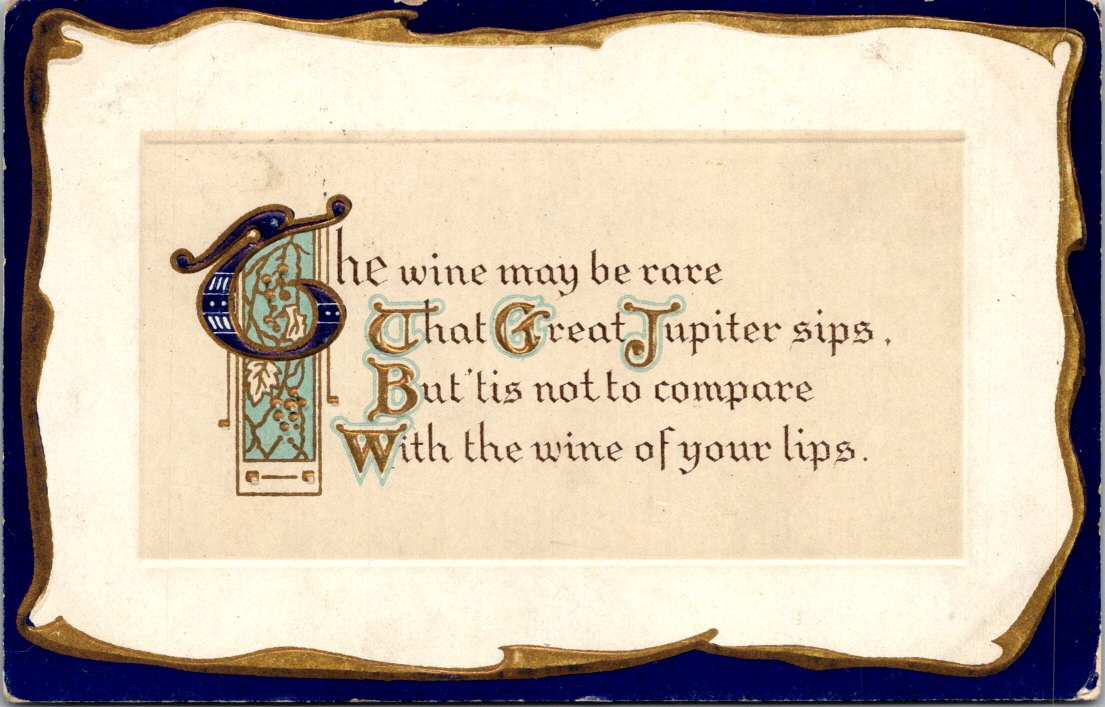
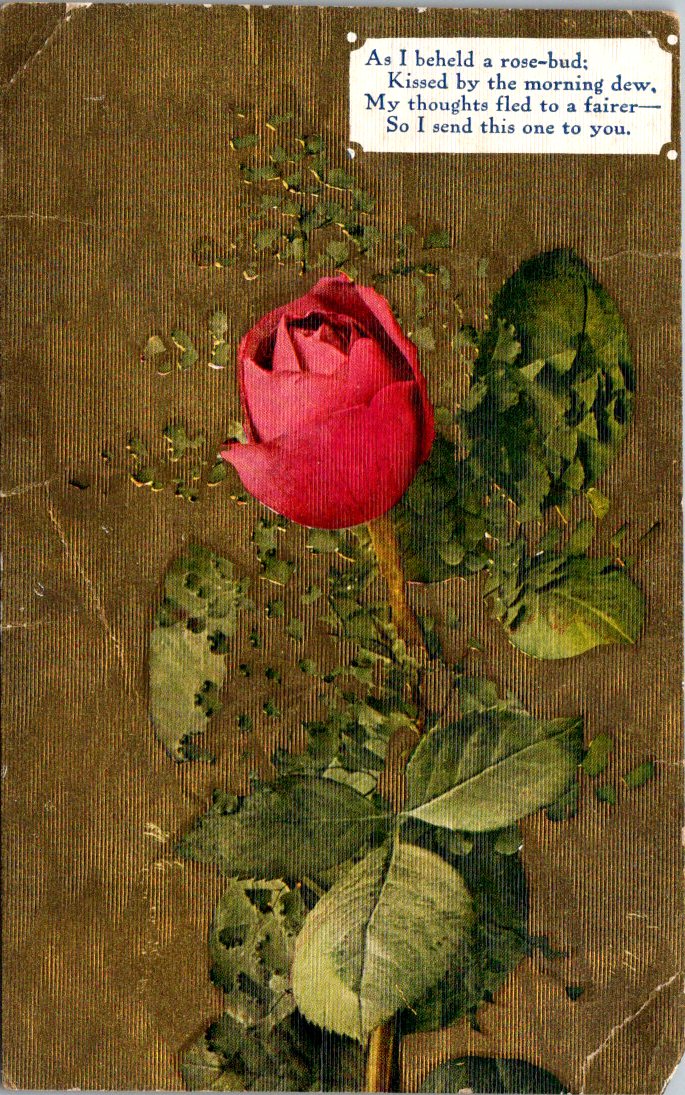
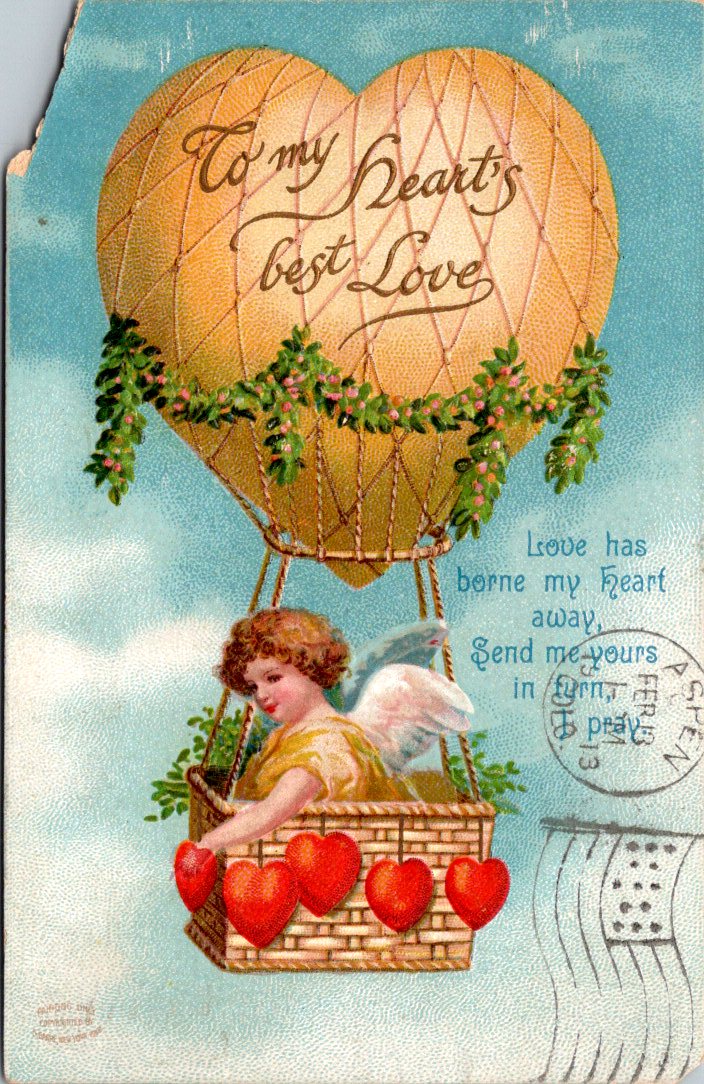
I don’t dare reveal the flipsides of the love-laced cards you’re about to see. What Ida, Minnie, or Gertrude sent or received isn’t for you or me.
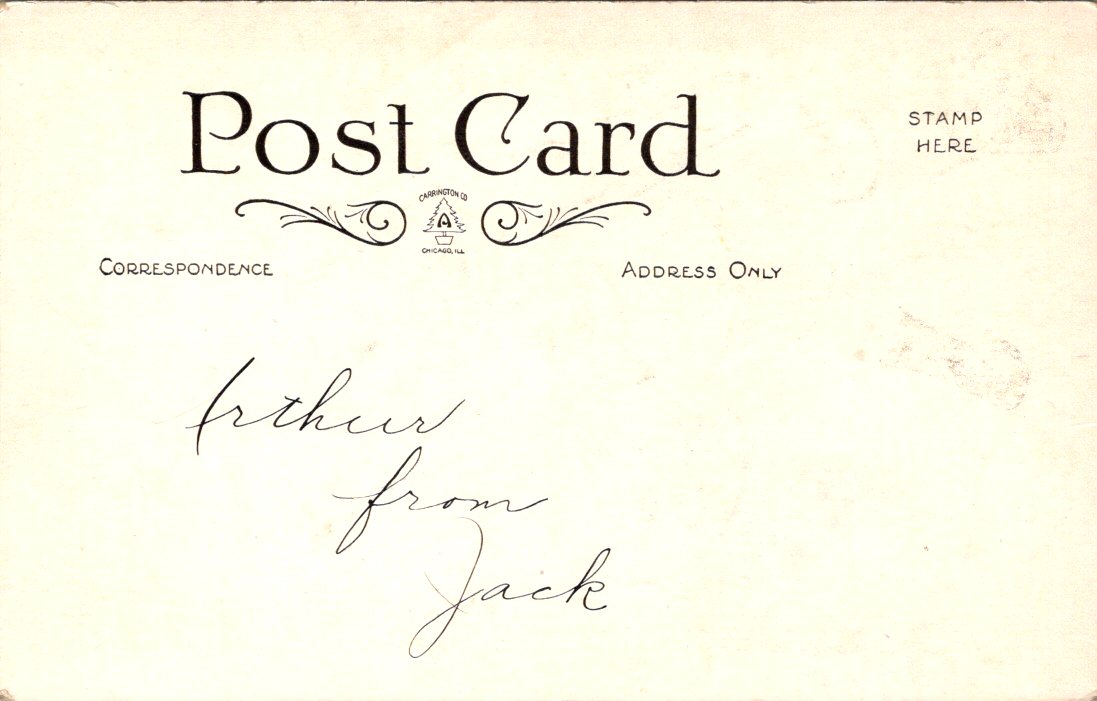
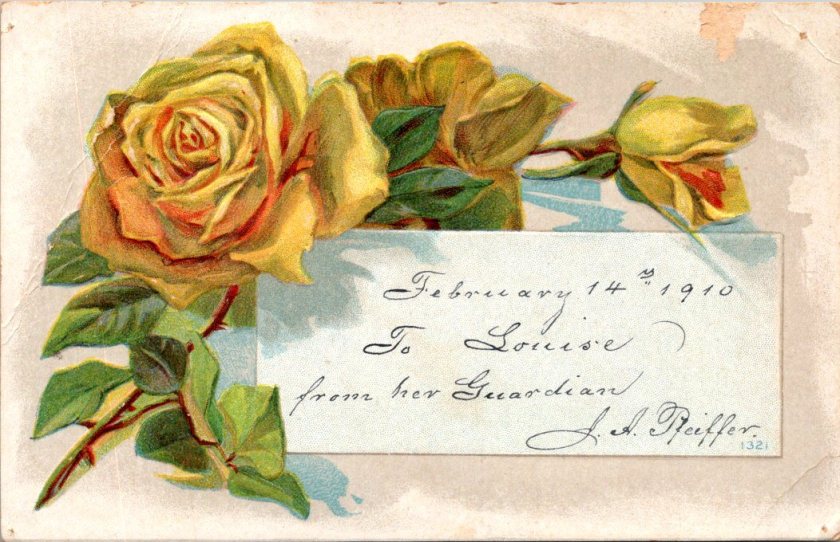
Hand-delivered to Arthur from Jack, this first example is our single exception. With a humble request and an elegant script, we can only hope the romance of a lifetime began, heated up, or settled in. Maybe it was placed on the pillow that morning, sometime before 1907 when postcards still featured undivided backs.
My own love is famously far afield. In the early days, our photograph appeared in a magazine alongside a short interview on the workings of our long-distance affair. We were an ocean away in those days, and on the adventure of a lifetime together. It could be a car drive now, albeit a very long one. Always tempting!
Obviously.
Yes, let’s do!
Finding here anywhere we meet.
Snowcrete!
Little Blue Carriage for Two
Future Flights
Love, Your Guardi-Anne.
Languages are a passion and a profession for my lady linguist. So a few more out of pure fun and fascination. Luf yah!
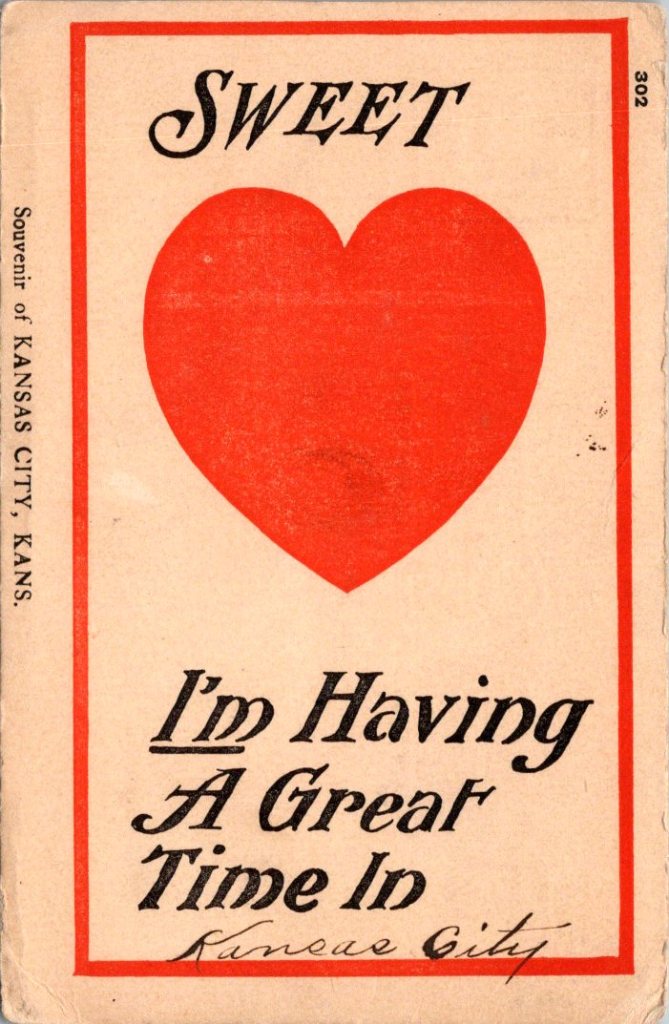
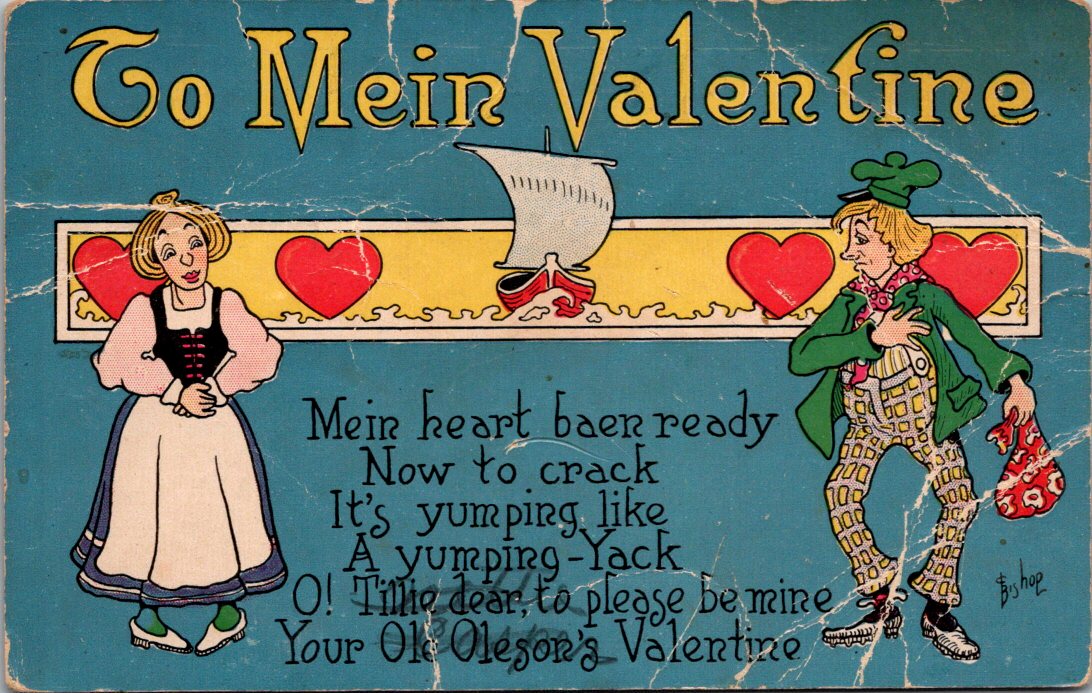
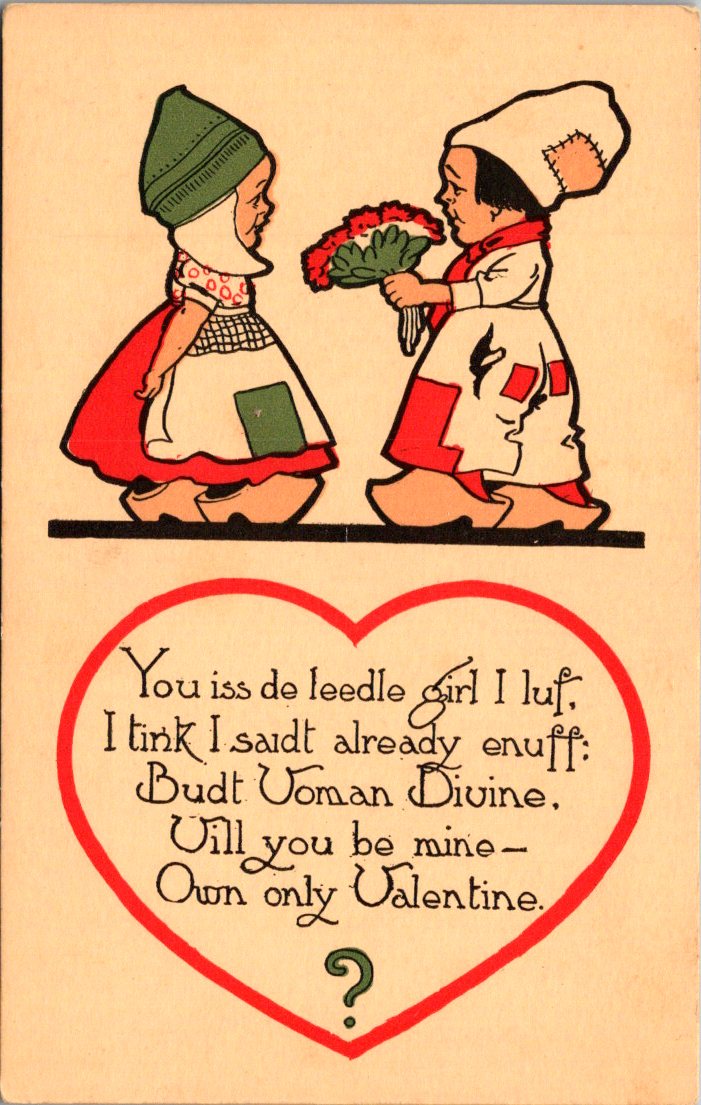
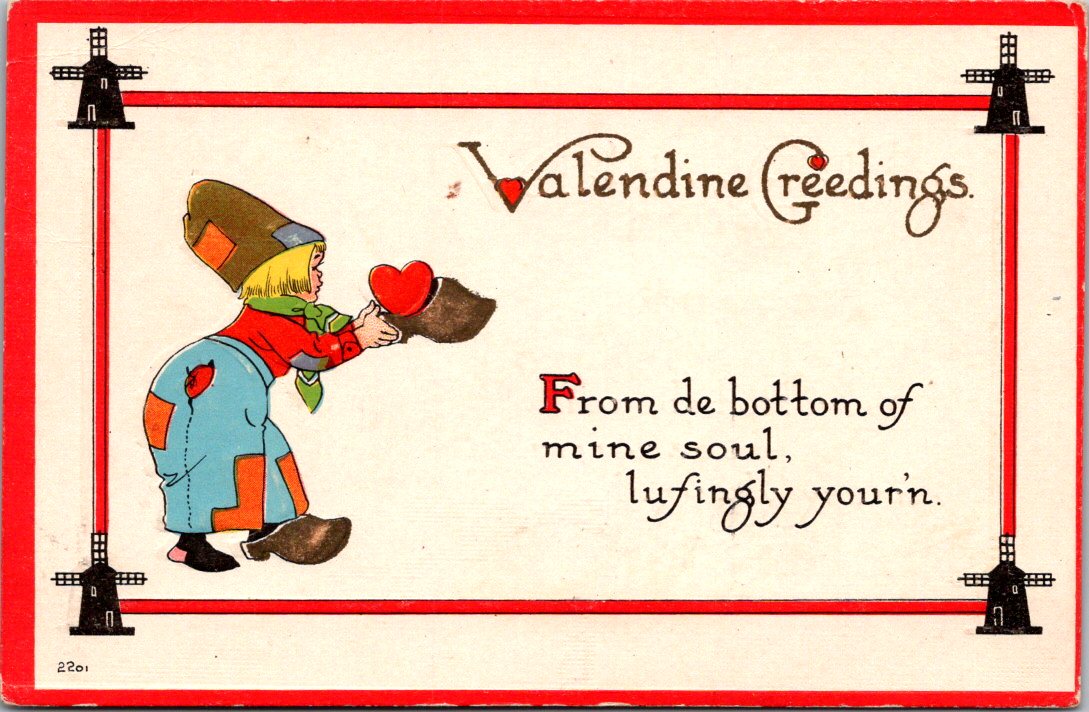
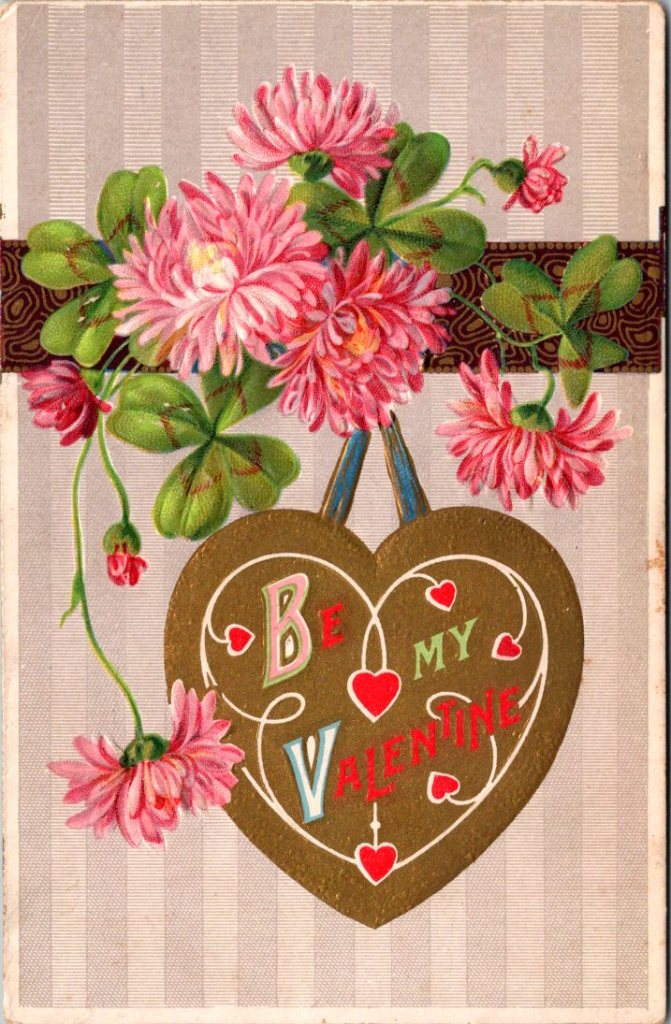
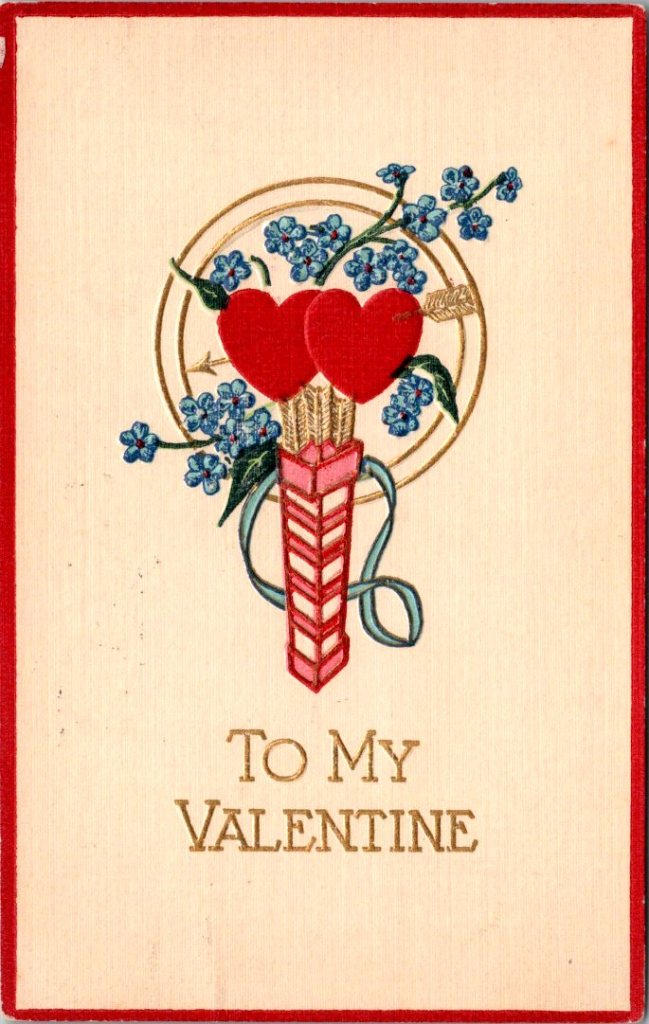
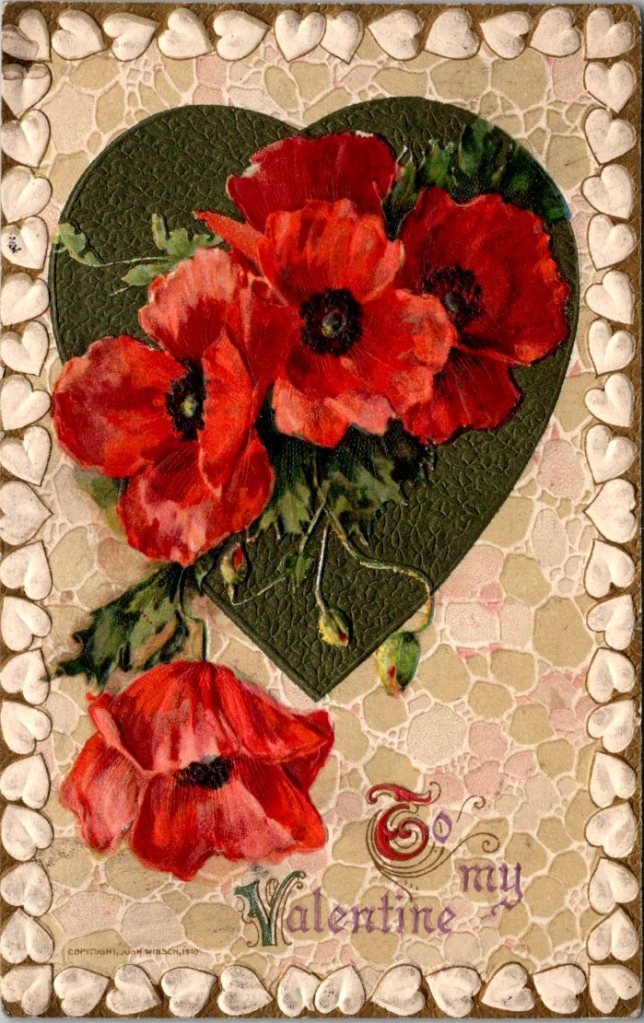
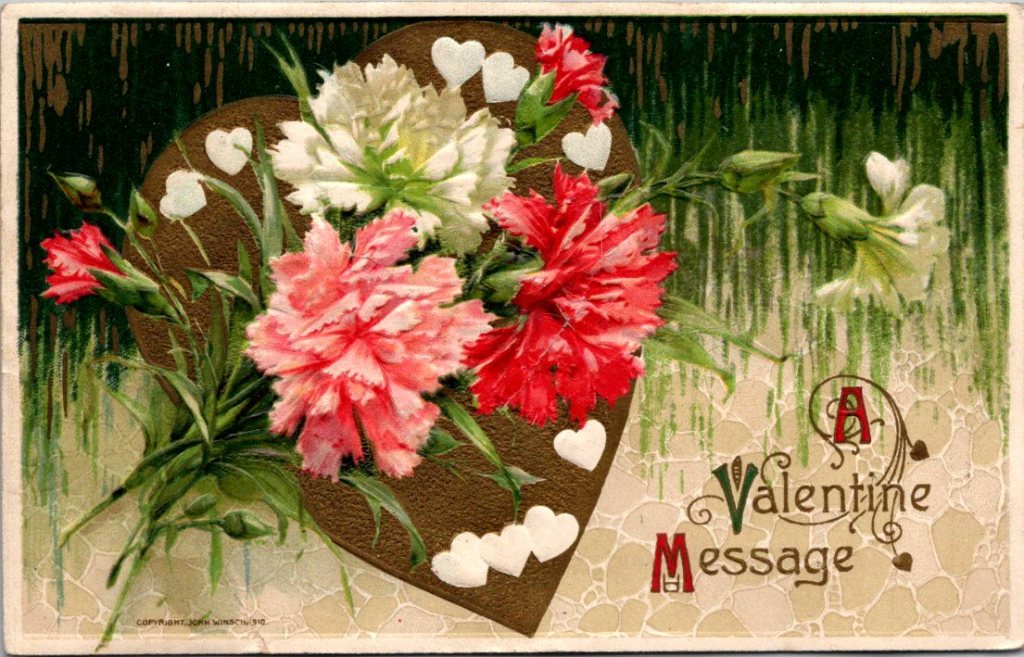
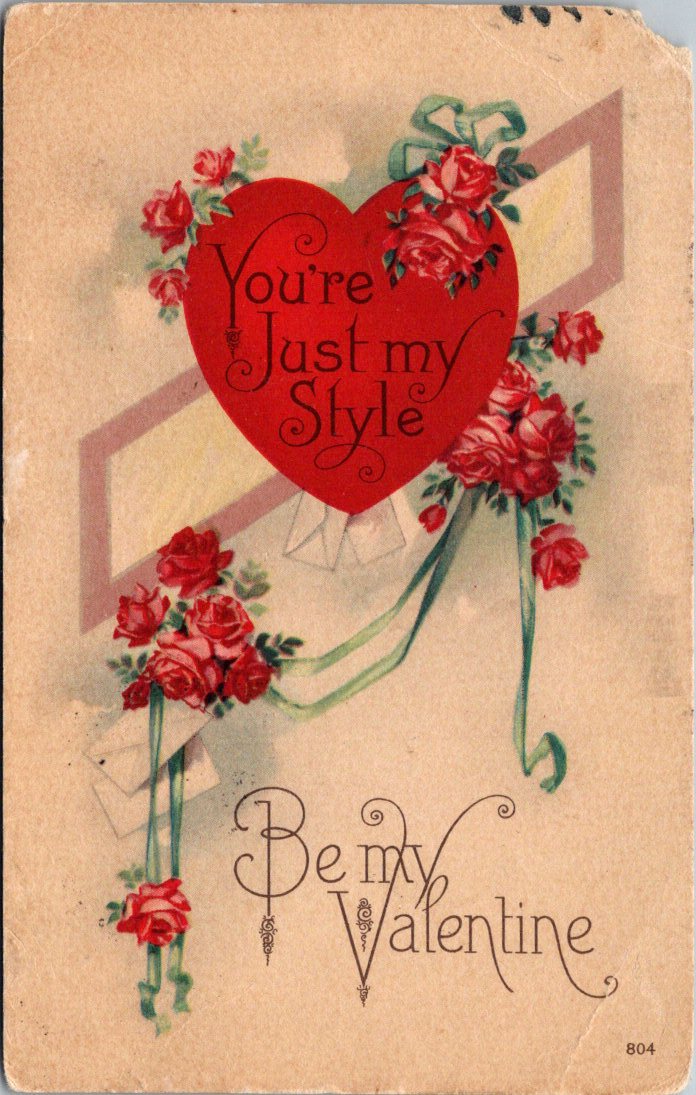
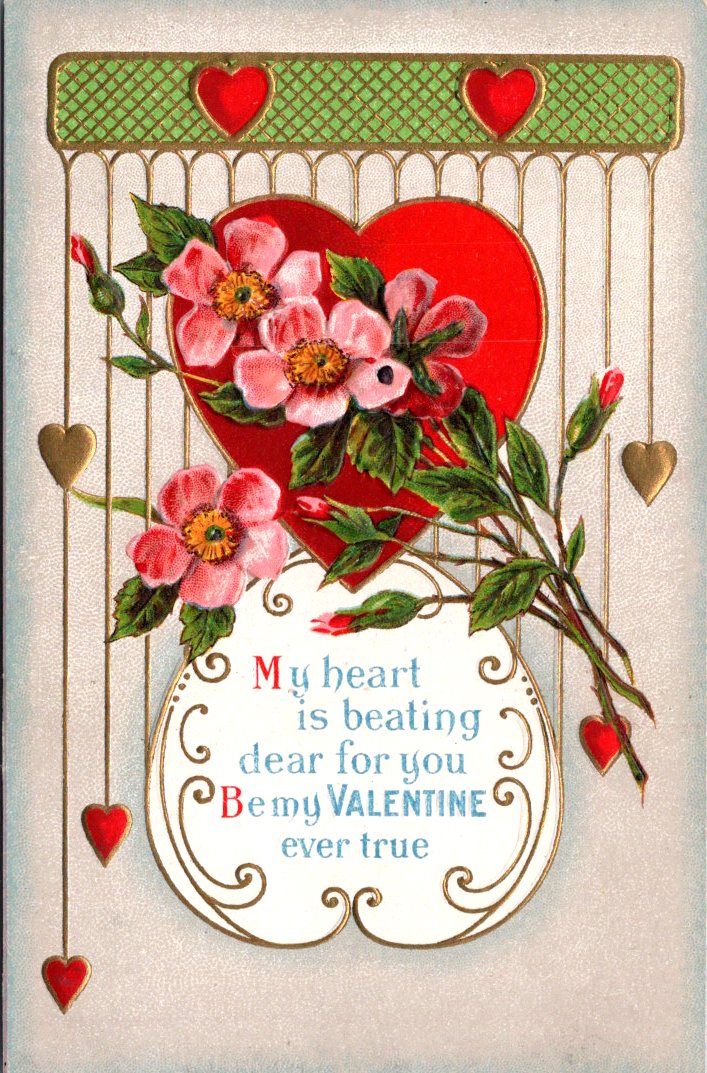
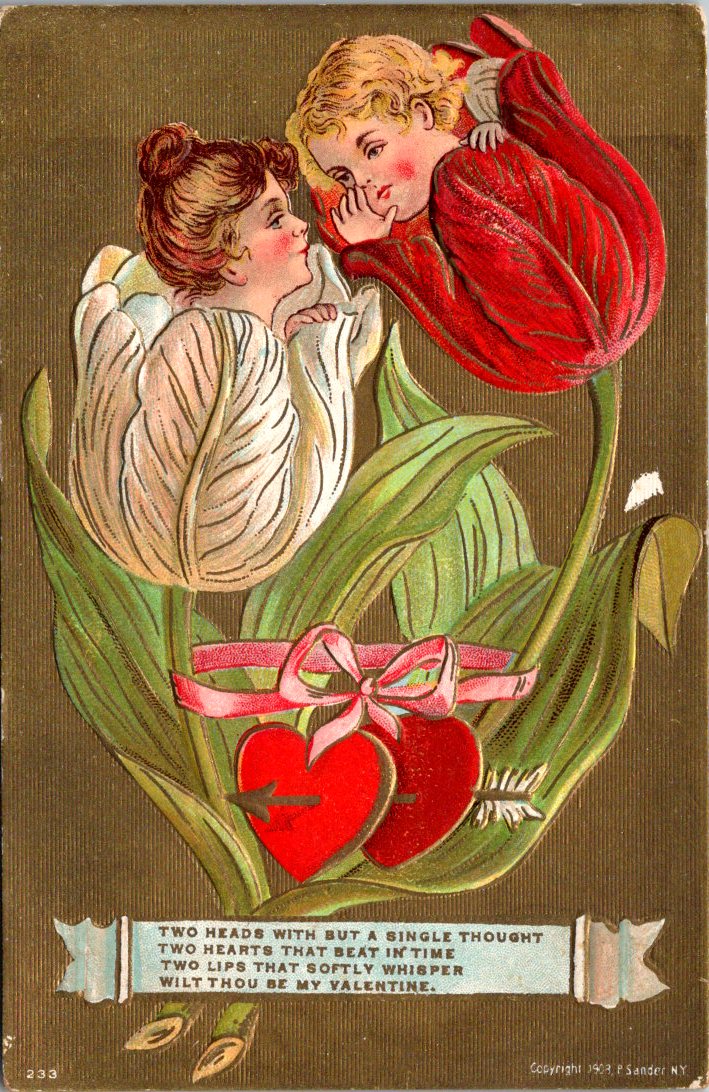
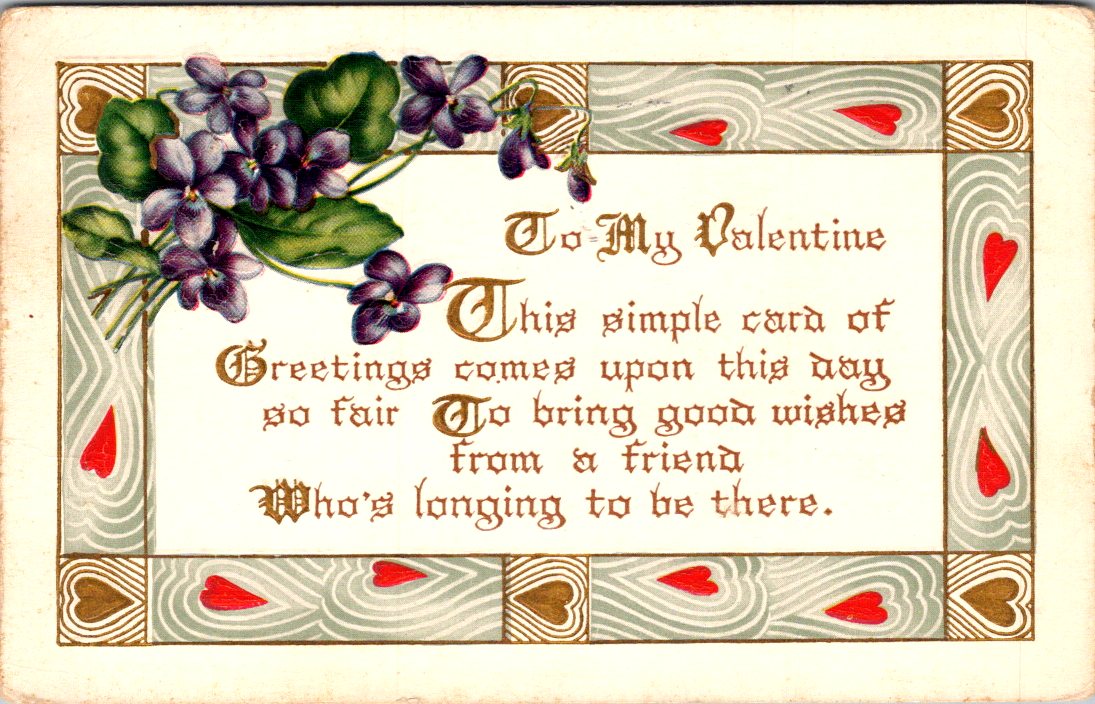
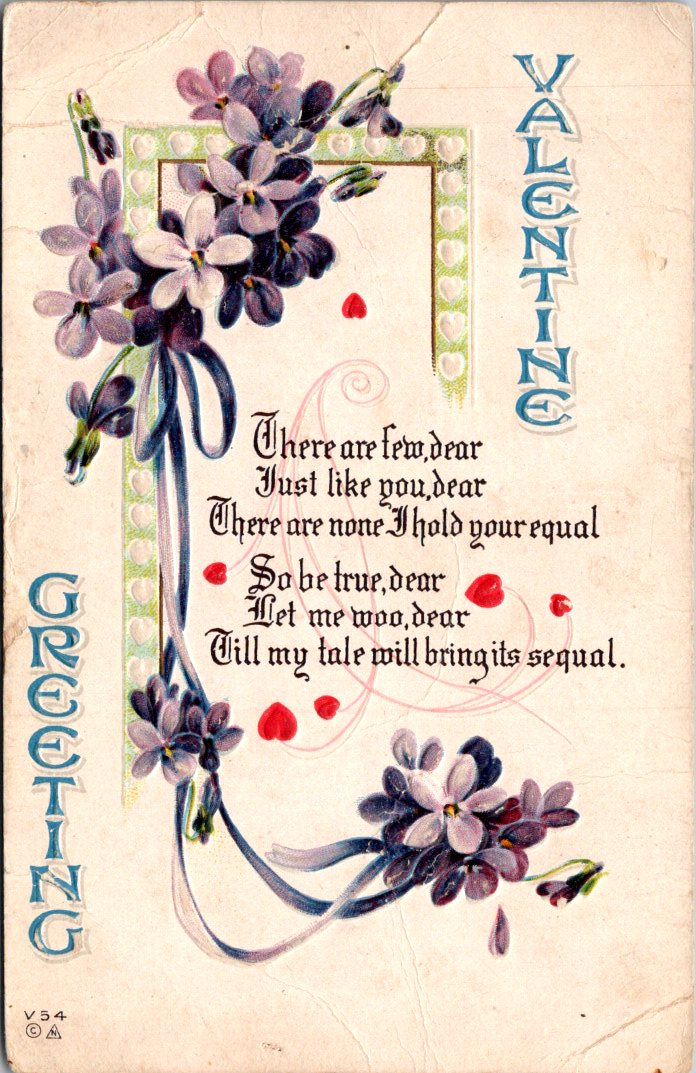
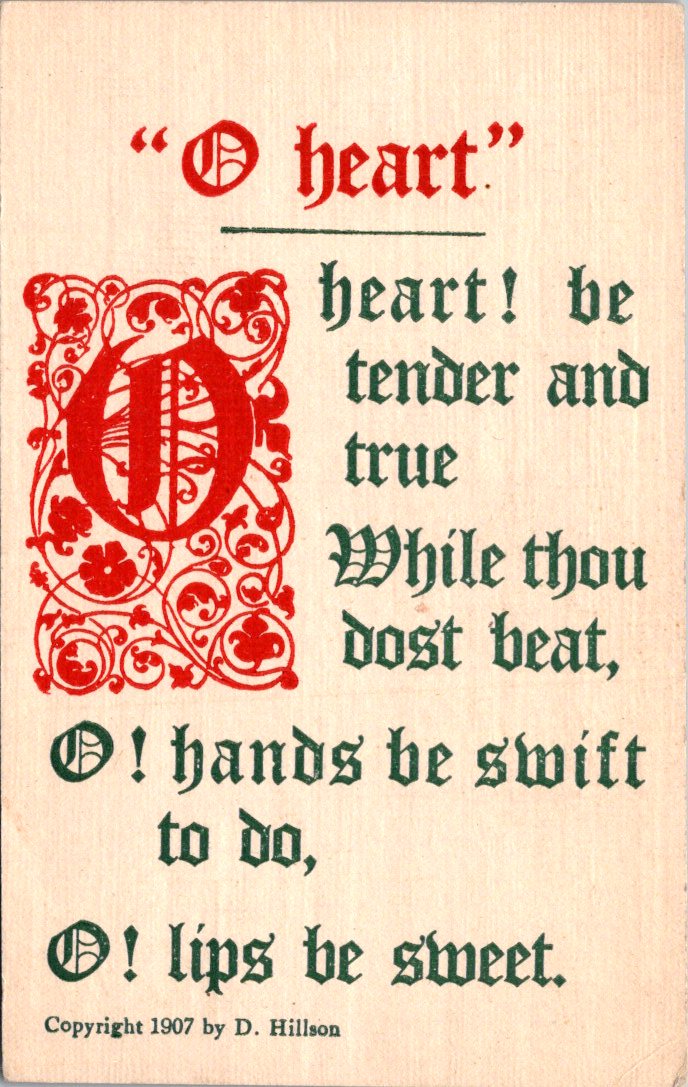
Dear readers, I promised you hearts and flowers after that awkward spell last week. First, a gallery carefully curated on the theme. Then, elucidations and another peek.
Made-for-you messages with showy sentiments on full view to your pa, your ma, and the mail carrier, too.
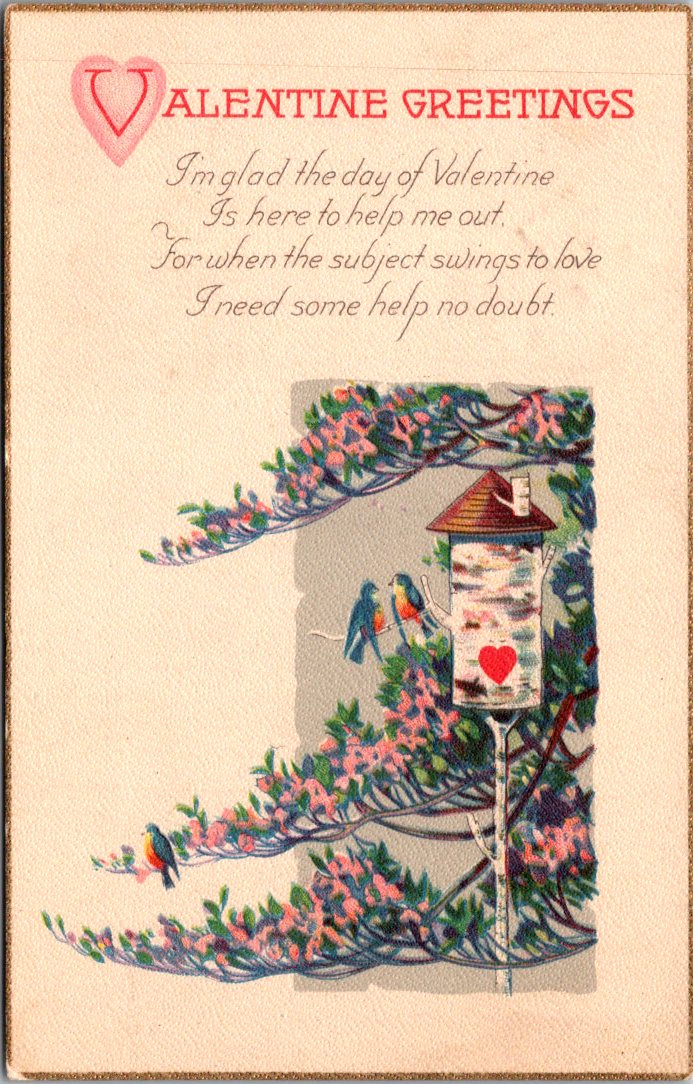
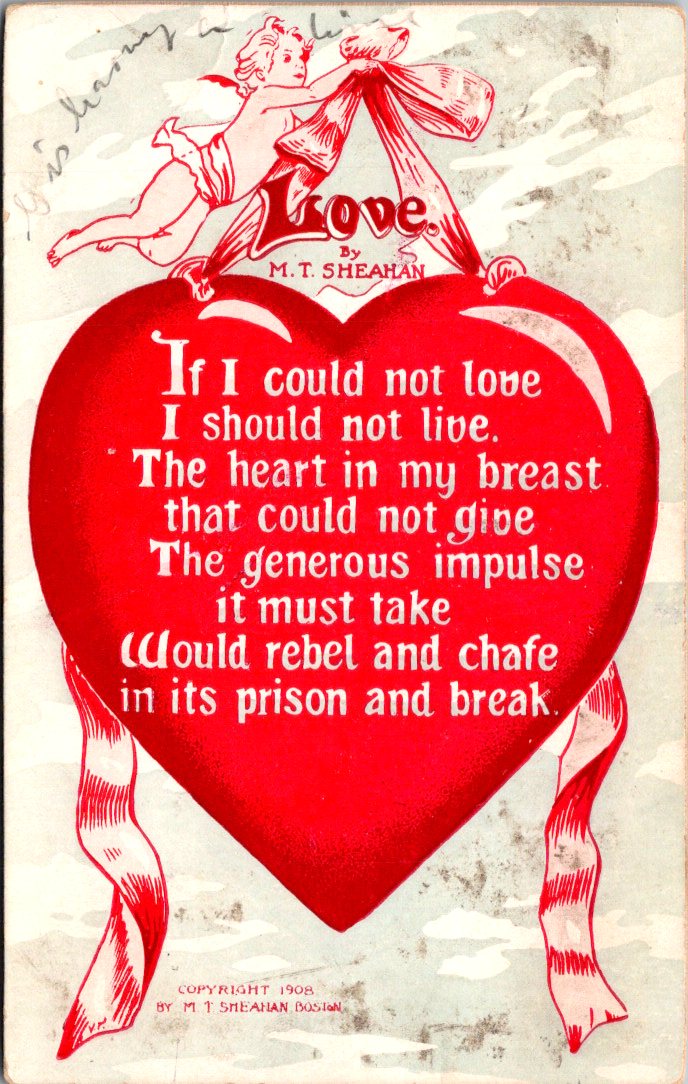
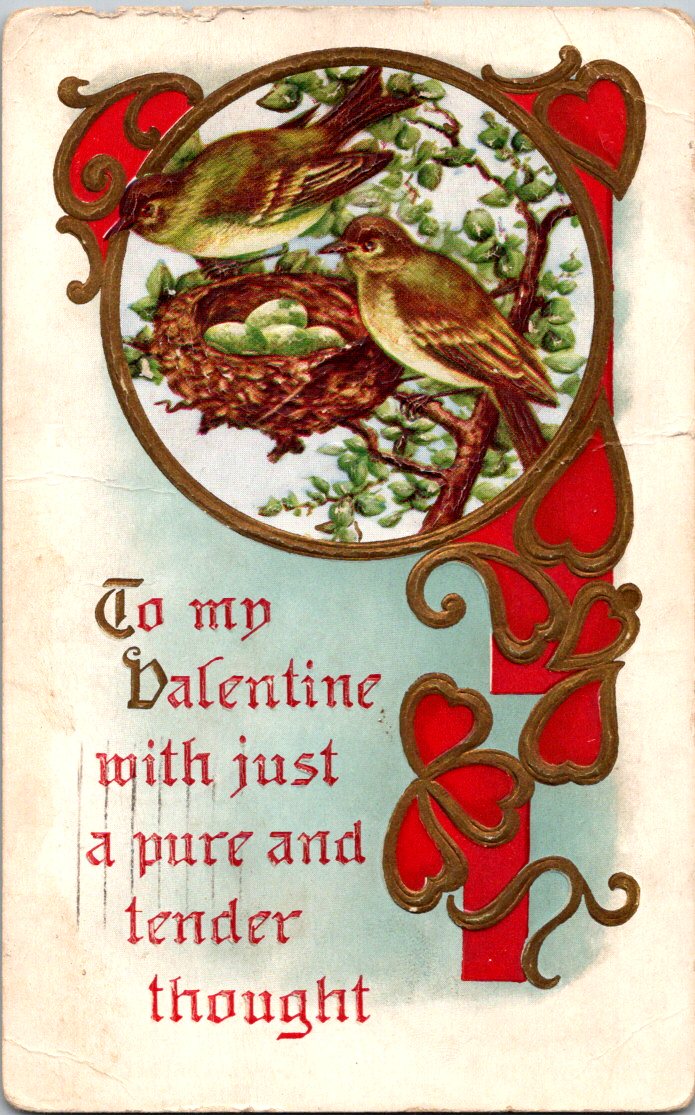
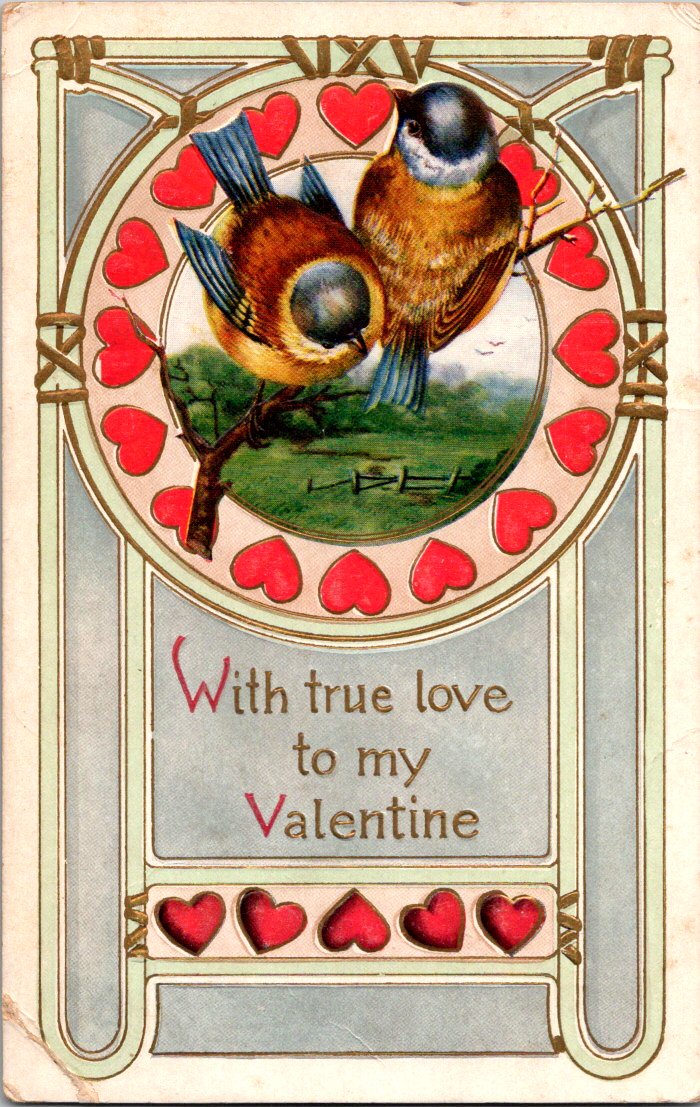
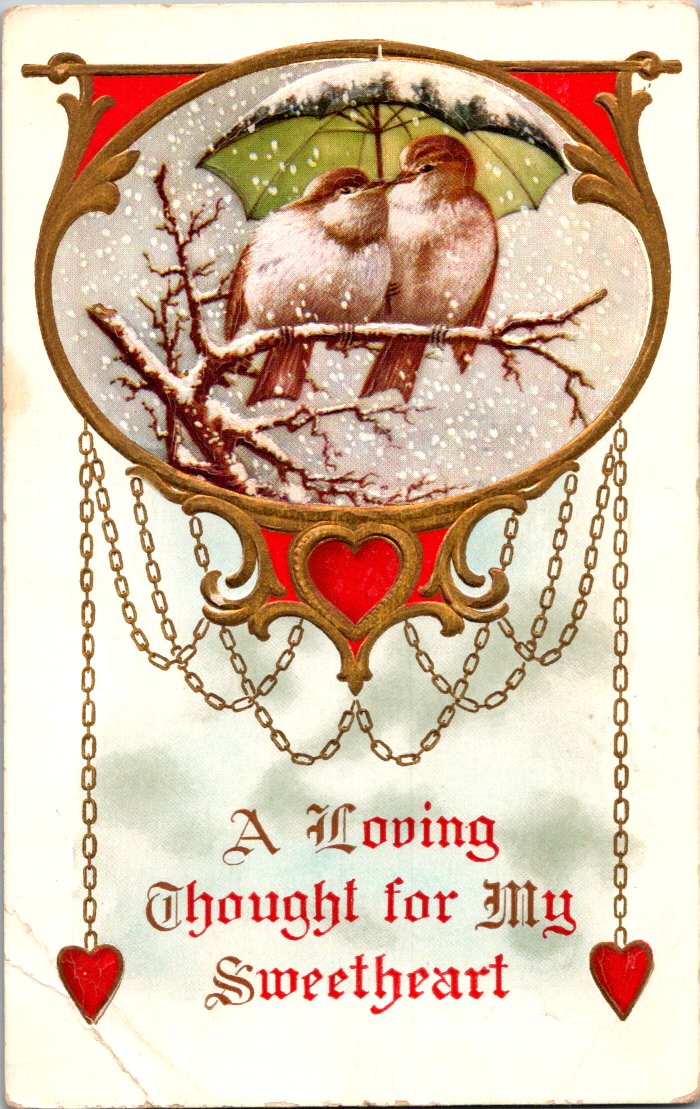
Some parts are still snowy, as love lamps flicker on in February. Hearts, words, and birds arrive in the quiet winter glow. Rest inside a circle of love. When you know, you know.
A picture is worth a thousand words, which can be tough news for a writer. I like words and images together, and art cards are a peaceful place to be while sorting through the longer storylines happening around here.
To start an art card, I pull together a collection of cards and ephemera related to a theme or style I want to explore. Gather tools, supplies, and a drink at my art board. Set my phone aside, and pick up an exacto knife. Then, I sit down, quiet down, and begin to make meaning out of the materials in front of me. I’m nowhere near my computer or journal, but making an art card now and then is part and parcel with my writing process.
The Posted Past Art Card Gallery is inspired by so many wonderful postcard projects over the years. Worth mentioning are PostSecret, which invites anyone to share an anonymous secret on a postcard, and PostCrossing, which makes it easy to send and receive postcards around the world.
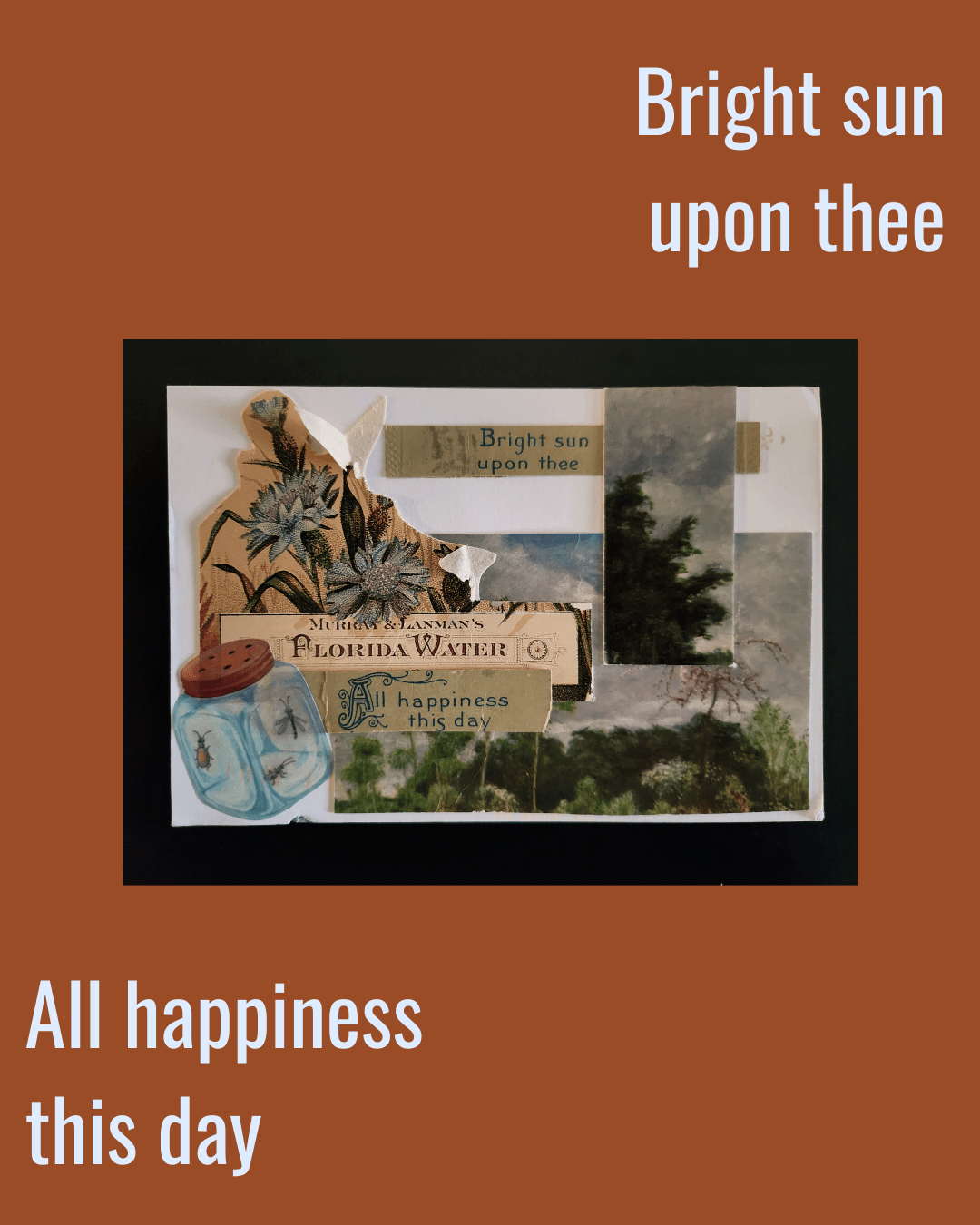
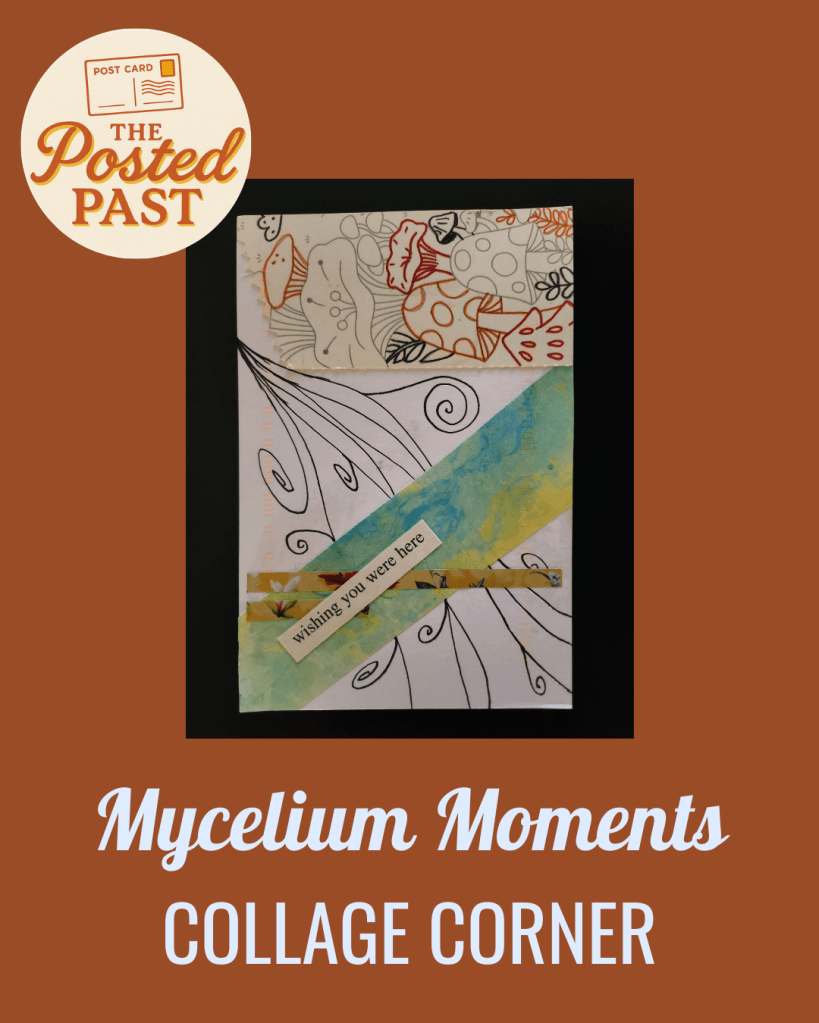
For our part, we collaborate with collage artists to make something small and special for everyone to enjoy. The artist requests a theme or two based on interests like, trees, farms, or portraits. We send an art card bundle and they create collage postcards with these materials. The postcard collages come back through the mail, celebrating the wear and tear of the postal service journey.
The Art Card Gallery is a place to see art card collages created by artists around the world.
If you’re already a subscriber, bless you for hanging on as you do. You get a little note in your inbox each Wednesday. Most times it flits away like a red cardinal, down into the cold, thatched hinterland of your inbox scroll. I know.
Introducing the Wednesday Weekly Reader, a new place to catch up with a previous story series bundled in a way that is easier to read. If you love our national parks, wonder about where the past gets lost, or know a few lonely snowbirds, a story series may meet your fancy.
Mai’s brothers check-in and George follows up. Nina and Tom find Delia’s postcard stash, and their way home. Nora knows her way around town now. Peace is in practice, not perfect circumstances, says Mrs. Hanabusa.
Careful block letters adorned the outside of a #10 envelope. George recognized Jack’s handwriting. Precise, old-fashioned, like an architect from a bygone era. Inside, George found a letter to addressed to him, and a long list of books Jack had read. Not just titles, but notes.
The Hidden Life of Trees – I like how roots connect underground.
The Mapmakers – Bird migrations mapped with ocean currents.
A Sand County Almanac – The geese made me cry.
George sat at his kitchen table, poured over the letter twice, then kept going back to it in mild wonder. The boy was thirteen. Reading natural philosophy at a level twice his age and writing elegant, matter-of-fact prose.
George now had a collection of postcards just for his grandson. He kept an eye out for anything inspired by books, libraries, explorers, architecture, and history. But today, he had a different one in mind.
Jack – Your list made my week! You remind me why books matter. Keep reading, all of life is in there. – Grandpa
George bundled up and trudged to the mailbox in the extremely cold and icy January morning. Stood there a moment, breath visible in the air, so proud of a thirteen-year-old boy who cried over geese.
The phone rang Saturday afternoon. It was Mai.
“Dad? You busy?”
“Never too busy. What’s up?”
“So—weird thing. I heard from both Derek and Marcus this week, within a day of each other.”
George set down his coffee. Mai’s brothers were also adopted from the chaos in Laos, but by different families. Mai didn’t know or remember much as a child. They’d reconnected as young adults as they discovered their shared histories. George had met Mai’s brothers only three times, at each of their weddings. Derek, the oldest, spent his early years in an orphanage before his adoption. He now runs a tech business in Palo Alto. Marcus, the youngest, grew up in a musical family and plays professional brass in traveling shows.
“That’s wonderful. Everything okay?”
“Yeah, they’re fine. Both texted out of the blue. Derek asked about the kids, Marcus asked about you. I think they’re feeling their age,” Mai chuckled.
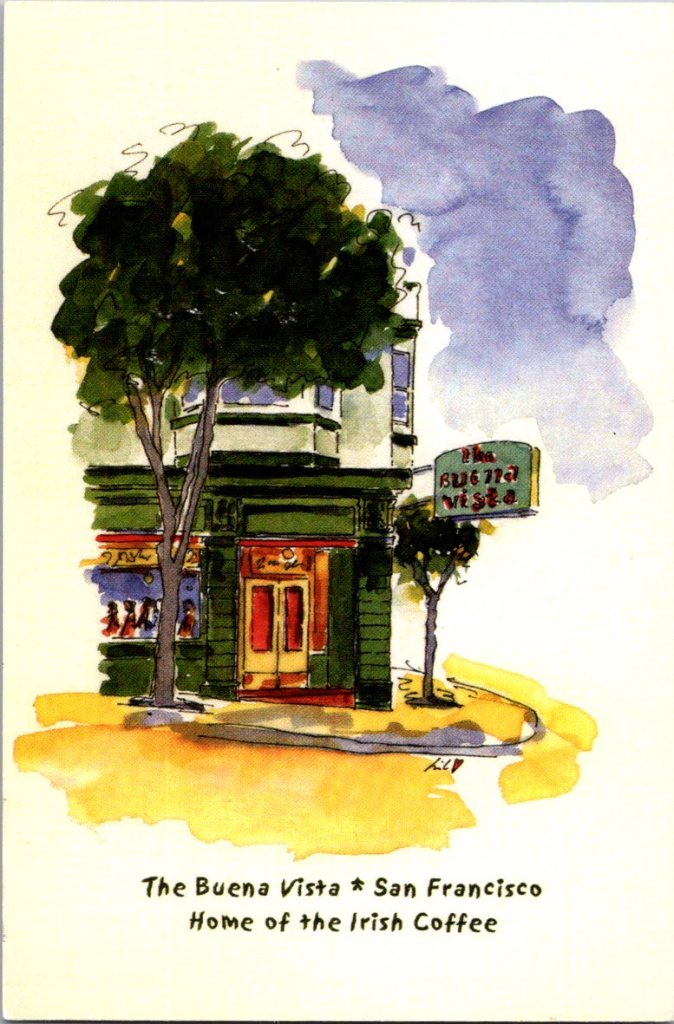
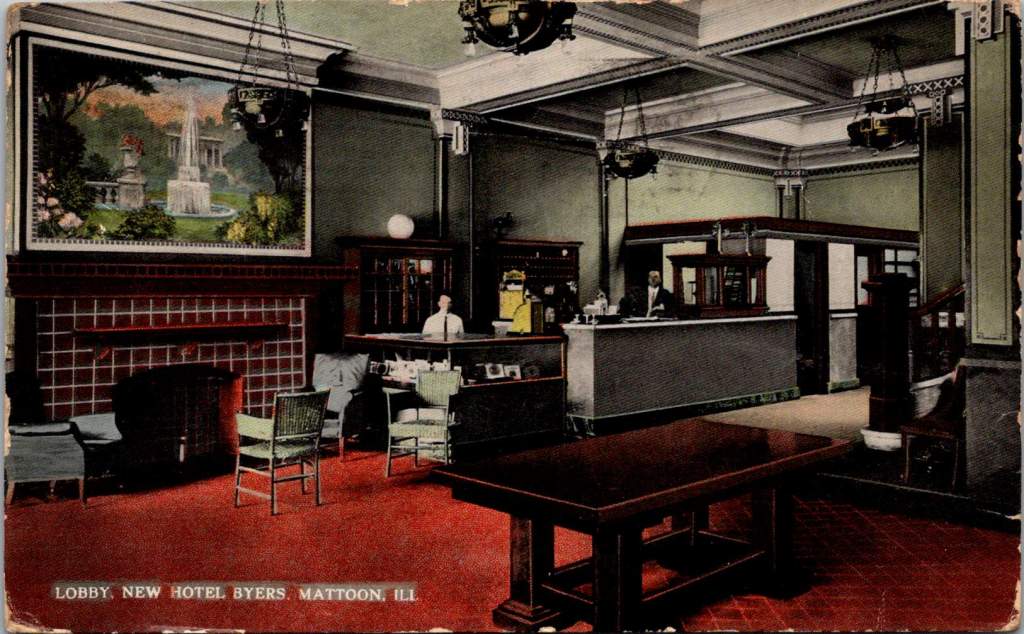
After they hung up, George sat at his table looking at his postcard stacks. He found a San Francisco classic for Derek, and an old club card from Illinois for Marcus. Relics from a jazzier time. Same short notes to both of them.
Mai says you’re doing well. Glad to hear it! – George
Nina loaded into her car early Sunday morning. Coffee in a thermos, bag full of stuff, and Mrs. Hanabusa’s advice in her head. Leave room. Her mind drifted for most of the drive, watching the sunrise over the desert and mountains to the East. She took the old road through Florence for just that reason.
Nina climbed the stairs in the worn, beige apartment complex, and knocked.
Tom opened the door looking nervous. “Hi. Come in.”
Nina noticed immediately, he was making an effort. Coffee brewing, store-bought pastries on a plate, magazines and mail in piles recently cleared from the couch. Seemed like he intended to inhabit the place, not just occupy space.
The talk was halted at first, then easier. Nina found it so strange that she grew up with the man and knew him not at all.
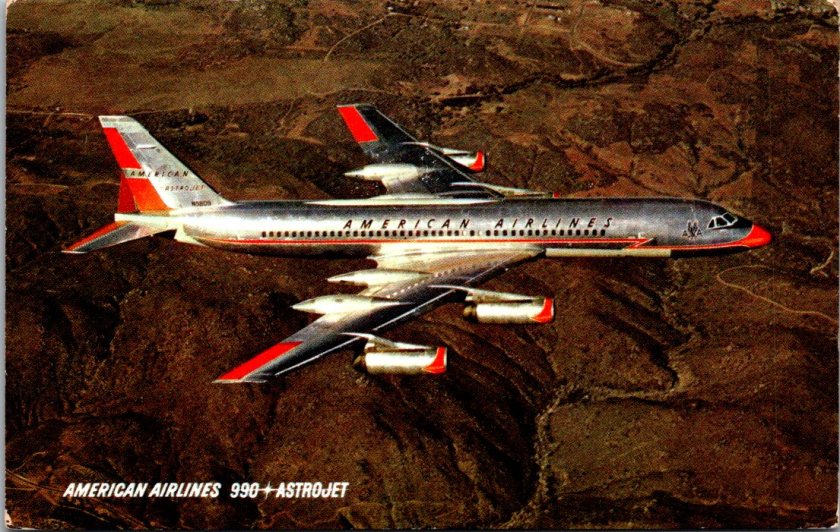
“I brought something,” Nina said. She pulled out all the postcards he’d sent over the years, a large batch that bulged at the seams of a padded envelope. Airport terminals, layover cities, all those airplanes. The last year had revealed so much, including the way her father had actually stayed connected in a quiet (and still insufficient) way.
“I kept them.”
“I didn’t know if you would. You weren’t always into them like we were.”
“I wasn’t. I didn’t even remember that I saved them. Found this stash looking through a bunch of old boxes, now that I know what to look for. Dad, I never made the connection before now.”
Tom smiled sheepishly, stood, went to his bedroom, came back with a shoebox full of postcards from Delia, dozens of them, saved over their entire marriage. Travel postcards from trips they’d taken together. Funny ones he’d sent her from far away places, anniversary cards.
“I couldn’t throw them away,” he said. “But I couldn’t look at them either.”
Nina picked up one after the other to read the backs. Her mother’s handwriting, cheerful, full of small news from home.
“She loved you.”
“I loved her, too, and I love you.”
They sat with the postcards spread out between them, talking about travel and their family trips together. Tom unearthed the ones Nina herself sent home from the summer she spent in France. Both were careful to keep his collection from Delia separate from the ones Nina brought. They were both still sorting through the imperfect evidence of what had been.
“Next time,” Nina promised as she left. They hugged briefly, and she hopped in the car for the drive home on the freeway with the sunset to her right.
Monday, Nina found Mrs. Hanabusa in her usual spot, the late afternoon light turning everything gold.
“How was your visit?” Mrs. Hanabusa asked without looking up.
“Good. Hard. Both.”
“That’s how it goes.”
Nina found herself marveling, again. Mrs. H’s daily practices, the flower arranging, carefully selecting which sentiments to include and which to set aside. She seemed to belong more to the glow than the room, now.
“How did you learn to be at peace in the world?”
Mrs. Hanabusa smiled slightly. “Well, I needed it and then I experienced it once or twice. It felt good, and now I have practiced enough. Every day. Some days better than others.”
Peace wasn’t a state achieved once and held static forever. It was active, chosen, renewed daily through small deliberate gestures.
“You’re practicing, too, but you don’t call it that yet. It’s nicer when you know.”
Nina thought about the drive to Tempe, the decision to keep the postcards, the inclination to let her father try, and the fear he’ll fly away again. It was not easy, definitely practice. Also, yes… nice.
Nora’s cards came less frequently through the spring. Nina recognized the sacred cycle of becoming and belonging. Nora had less to say about longing, more about the daily goings-on. She was living in Taiwan.
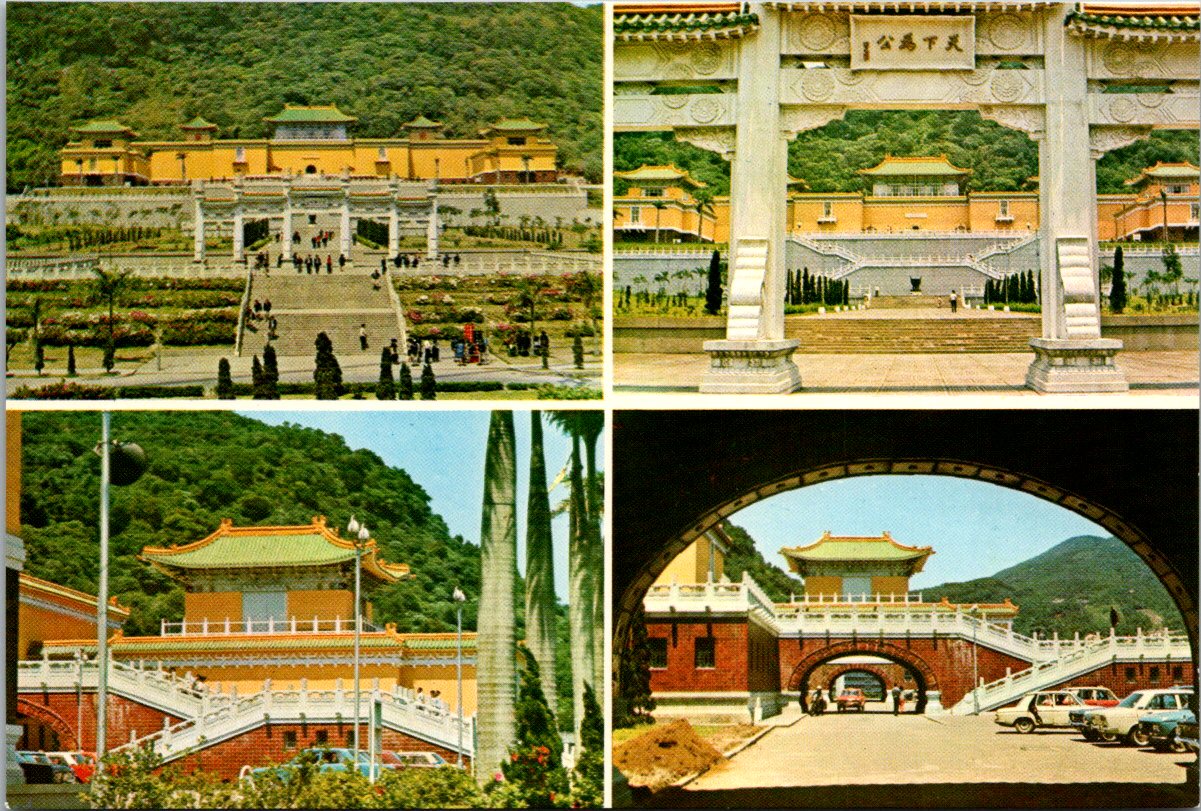
Hiked Taroko Gorge with work friends. Mountains are unreal—marble cliffs, jade rivers. Think of you, often. –N
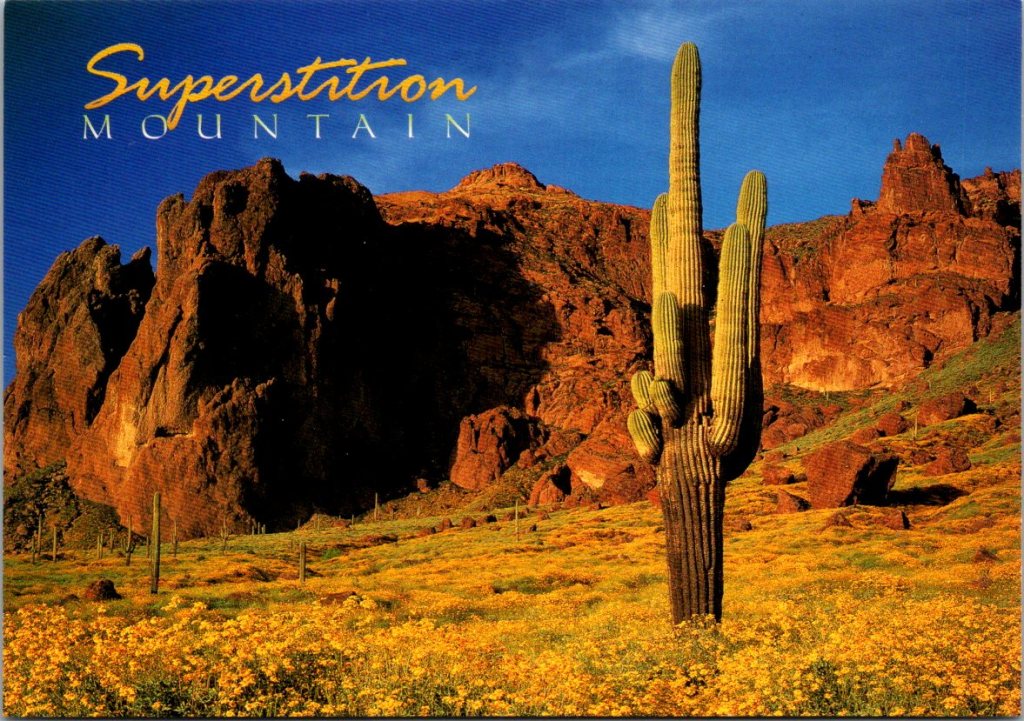
Nina pulled out a postcards of Saguaro at sunset awash with a super bloom of springtime flowers. She wrote her response, but didn’t rush it. Set it on her desk, next to the others ready to go out. There was time. Their lives would keep coming and going in a different rhythm now, and that was enough.
Though our holiday story series stops here, we hope you stay in touch! Subscribe to get a message about a postcard every Wednesday. Also, love is in the air! Next month rare embroideries.
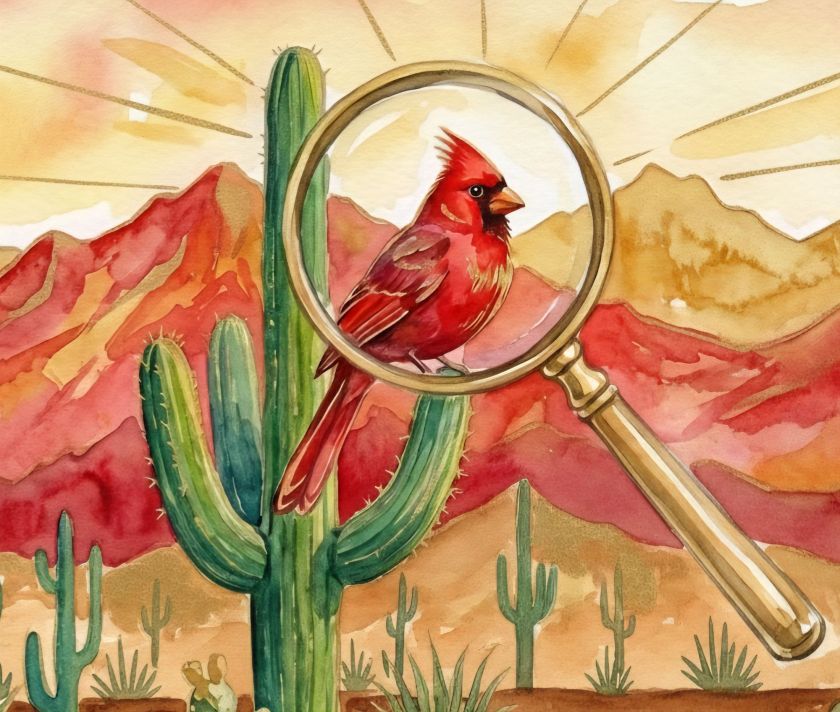
Limited edition Cardinal on a Cactus postcards available at Tempe Yarn & Fabric and online.
Each travel alone, except the air they share. Nora is happy going solo, and Tom is somewhere in between.
The teahouse was tucked next to a dumpling shop on a narrow lane in Da’an District. Nora walked past it three times before noticing the English sign: Tea by Appointment Only.
Inside, a woman near seventy arranged porcelain cups on a low table. She glanced up, assessed Nora with a single look, and gestured to the cushion.
“First time?”
“First time for tea ceremony,” Nora said. “Not first time feeling lost.”
The woman smiled. Poured water over the leaves. The scent rose—something green and grassy, nothing like the black tea Nora’s grandmother used to brew.
“Lost is good,” the woman said. “A reason to pay attention.”
Nora’s colleague Mei-Ling had taken pity after watching Nora eat lunch alone for the third week running. “You need to get out,” Mei-Ling had said. “Explore. Be alone in a place that’s not your apartment.”
So here she was. Alone. Not lonely.
Her phone buzzed. A text from Nina. Nora silenced it without reading.
The tea was bitter, then sweet. She drank slowly.
“You travel alone?” the woman asked.
“Always.”
Nora had spent years cultivating solitude—long drives through Arizona backcountry, dawn hikes in Sabino Canyon, evenings on her balcony with no one talking. She chose the Taipei assignment partly for the chance to be anonymous and untethered.
The woman poured another cup. “Tourists look for what they expect to see. Solo travelers find who is actually there, including themselves.”
Nora thought about the next postcard to Nina. She wanted to tell her about the teahouse, the silence, the strange comfort of being somewhere no one knew her name.
It’s lovely to be solo in a strange land. Watching without explaining. Moving without negotiating. I sometimes forget who I am at home.
She finished her tea, bowed to the woman, stepped back into the crowded street feeling lighter than she had in months.
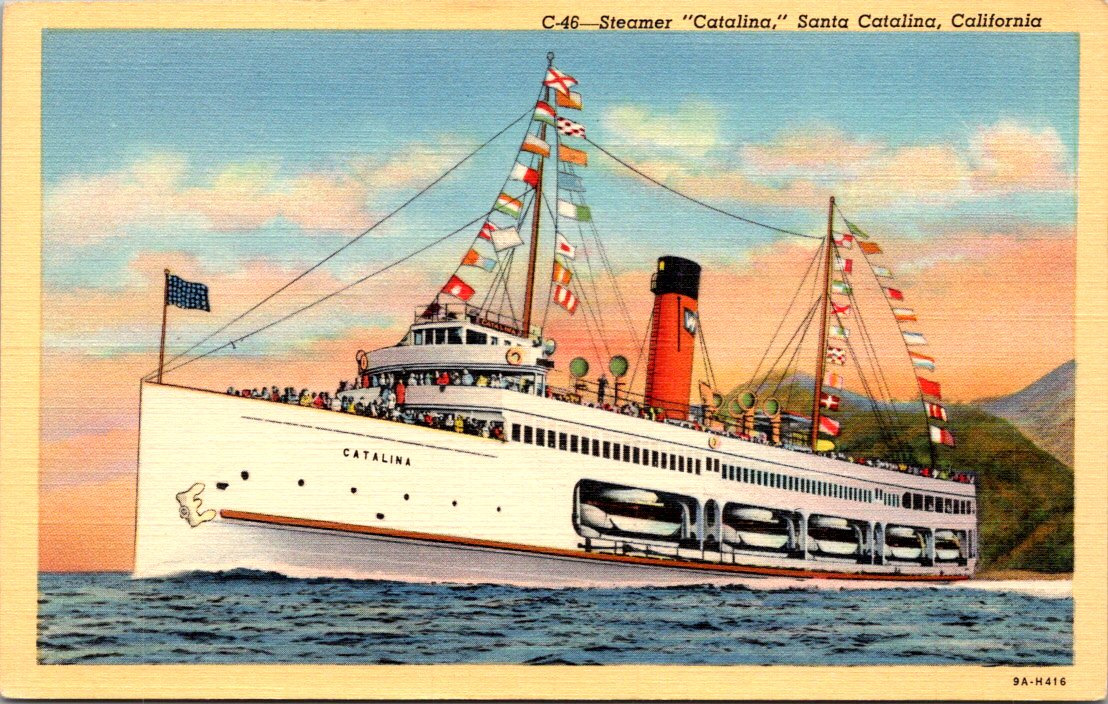
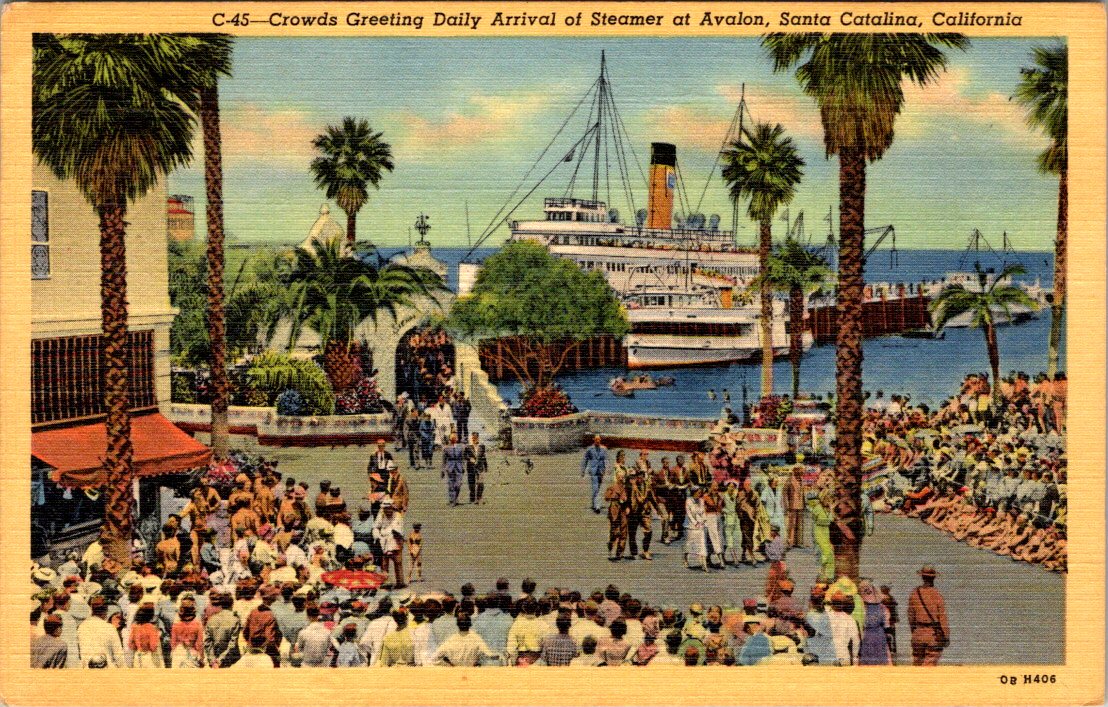
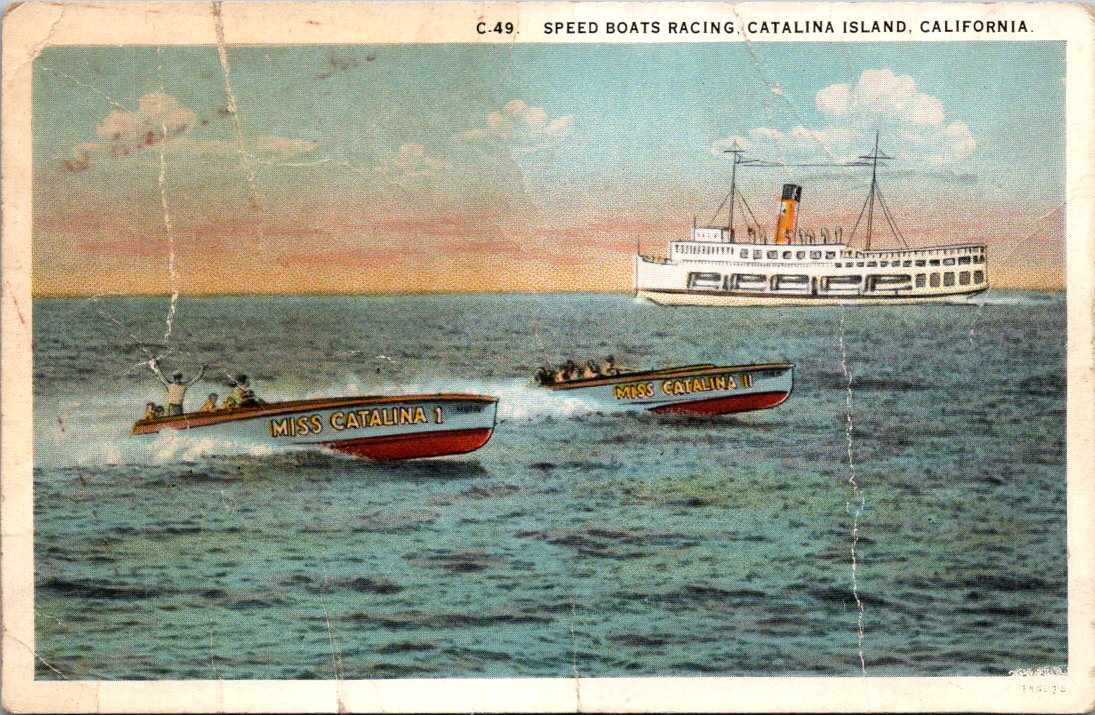
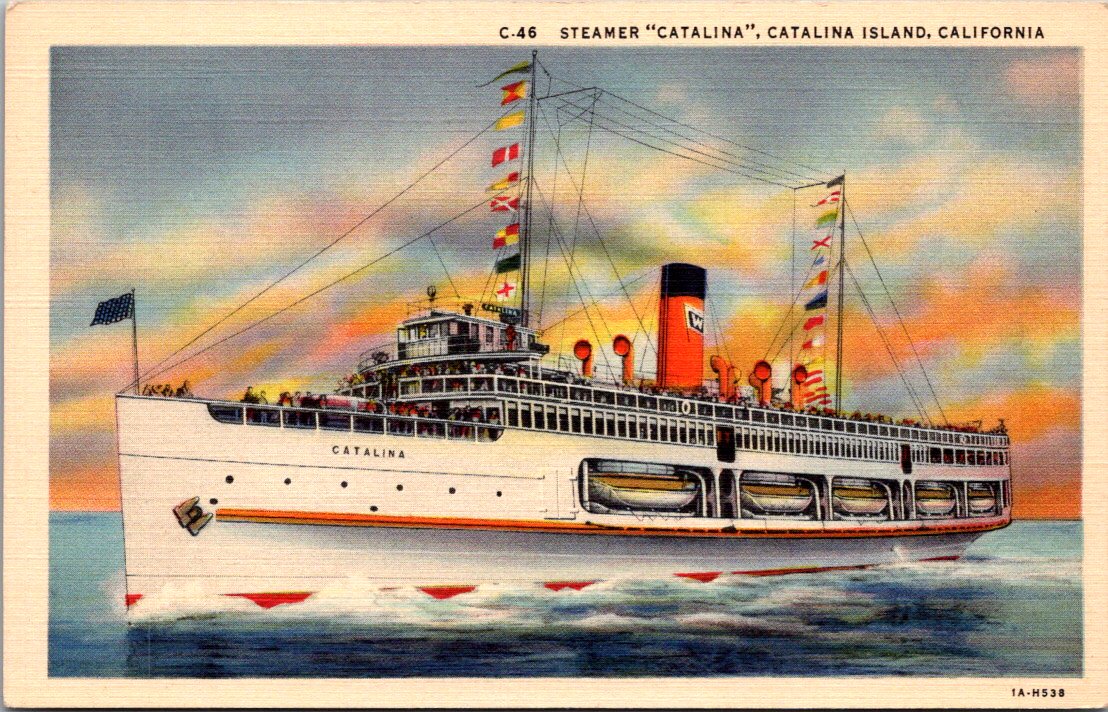
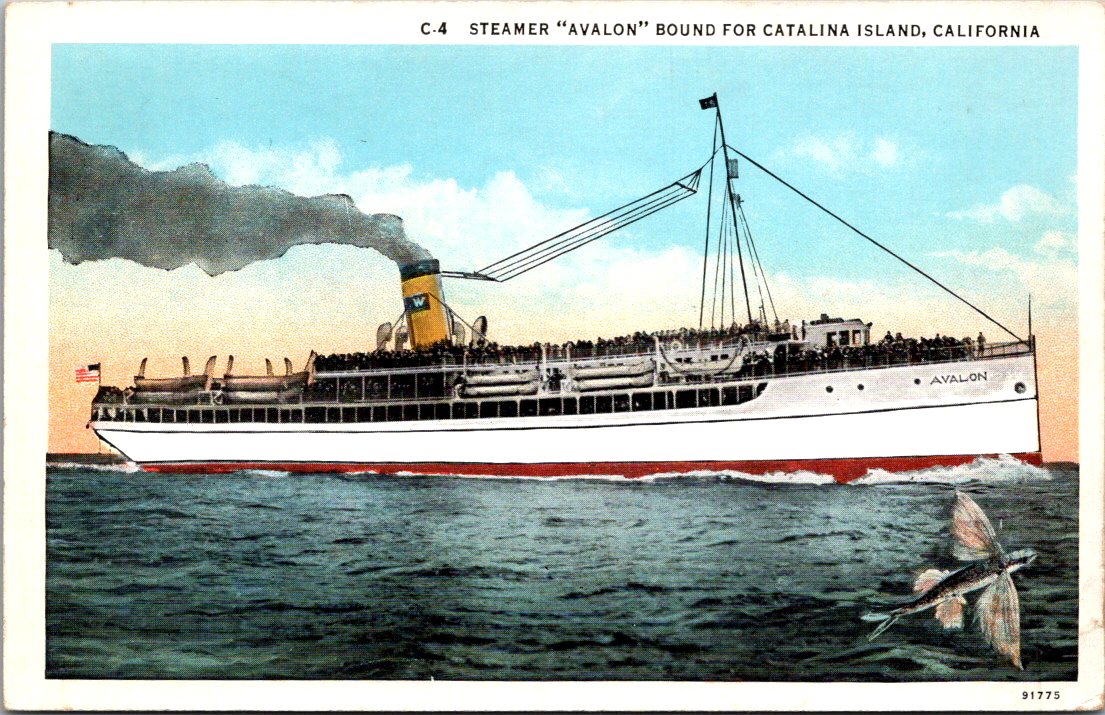
Tom stood on the deck of a fishing charter near Catalina, watching the captain clean yellowtail in the afternoon sun. He worked the knife along the spine with practiced efficiency, lifting the skin and scattering ribbons of bronze scales across the wet deck.
Tom was at sea three days, paid in full. His time between flights was long enough, he could have gone to Phoenix to check on the empty apartment. Or driven the two hours to Tucson to talk to Nina. Instead, he’d gone straight from the airport to the marina.
The ocean felt safer to Tom. He knew what he was dealing with—wind, current, the pull of the moon. On land, everything felt unmoored and awash in silence. The apartment with no one else there. Nina’s careful, measured heartache. The desperate life he’d abandoned in favor of flight schedules and hotel rooms.
The captain looked up. “You alright, man?”
“Fine.”
“You don’t look fine. You thinking about jumping?”
Tom laughed, the gallows humor helped. “Not far enough down.”
The captain went back to his work. Tom watched the horizon. His daughter was not far away. Working at the hospice. Taking care of people the way she’d taken care of her mother. While he was gone somewhere over the Pacific.
Tom didn’t make it to Jennie’s funeral. Delia was still sick and he had a flight schedule to keep. George hadn’t said much.
When Delia died two months later, George drove from Minnesota. Stayed ten days. Made coffee, answered the phone, helped with plans, and stood beside Tom at the service. Then, George drove back alone. Tom couldn’t make himself useful like that to anybody. Couldn’t even make himself stay.
A raven landed on the railing, tilted its head.
“Where’d you come from?” Tom asked.
The raven looked at Tom, croaked once, deep in its throat.
Suddenly the words came to him. He didn’t have a pen or a postcard handy, but finally he had something to say.
Flying solo is for the birds.
The raven lifted off, circled once, flew toward shore. Tom watched until it disappeared, then looked at his phone. He could get out of LA tonight, and rework his schedule from Phoenix next week. Enough time to get to Tucson and back, and to try.
The envelope arrived among the usual stack. Tom’s cramped handwriting unmistakable on the address. George carried it inside, set it on the kitchen table, made coffee before opening it.
Inside, a single sheet torn from a legal pad, Tom’s words filling margin to margin. George read it twice.
George— Sorry it’s been so long. Don’t know how to say what needs to get out.
Been working more flights than I should. Phoenix to anywhere. Hotel rooms are easier. Nina barely talks to me. Can’t blame her.
You drove all the way to Delia’s funeral. Made everything possible. I should’ve done the same for you and Jennie. Told myself it was work. We both know better. You’ve always been better at this life.
Tom was a restless kid — climbing trees, running off, coming home with scraped knees. George stayed close, watched birds, kept track of his brother.
After Jennie died, Tom just wasn’t around. George wanted to be angry but didn’t have the strength. Grief made him numb for awhile. Now, he was just glad to have his brother back, or at least a longer letter.
Mrs. Hanabusa sat by her window in the common room, as she often did. Hands folded in her lap. Face turned toward the light. Eyes resting gently on the flowering hibiscus outside.
Nina paused in the hallway, watching.
How did she keep such a calm reserve? After the camps, after losing everything, seeing your family degraded. How did she maintain that peace?
She would probably credit her mother, her grandmothers, and their extended friends and family. All gone, except her sister. How does she do it, still?
Mrs. Hanabusa turned her head slightly and smiled.
Nina smiled back, and walked on.
The story above is fiction, but the new Postcard People feature is real life! Meet Christine N. from Switzerland, who posts about her grandmother’s collection.
George’s gifts get a warm reception, while a note to Nina gives her a chill.
George’s daughter called on Tuesday evening. “The kids loved the postcards, Dad. Emma especially. She wants to start birding… with you.”
George felt a dial turn in his chest. “She does?”
“She’s been asking about your old field guide. The one you used to carry.”
After they hung up, George went right to the closet. Found the guide on a high shelf, spine cracked, pages marked with decades of pencil notes. He’d bought it in 1978. Carried it on weekend drives, on fishing trips, on the slow walks he took with each kid as they got adjusted.
He wiped dust from the cover. Flipped through. His handwriting tracked sightings—dates, locations, weather. A life measured in birds.
Emma would need binoculars, too. His old pair hung on a nail in the garage. He loved these trusty old binos. It would be hard to give them up. Maybe he should buy her a new pair? But George imagined seeing Emma out on the trail in front of him, patiently observing and tracking it all, just as Mai had. It was worth the heartache.
Lily needed art supplies—he remembered Jennie’s watercolor set, still good, stored in the craft closet. Paints and brushes. Clean paper. Save the easel and the satchel for next time.
Always books for Jack, but it was a hard choice. George searched his shelves. He found volumes he’d loved, but they were too intense for Jack right now. Shy and studious, he might like America, Land of Beauty and Splendor, a Reader’s Digest hardback with a handsome leather spine. Good chance he’d help Emma plan her birding trips with it.
By evening, the kitchen table was covered with brown paper and string. Three packages taking shape. The field guide and binoculars for Emma. The watercolor supplies for Lily. A stack of books for Jack.
George wrapped slowly, carefully. He wrote notes and tucked an old Christmas postcard in each one. He’d never been good at gifts. Always second-guessed himself. But these felt right. Things that had mattered to him, passed down. Things they’d actually use. He whispered to himself, “Old is still good.”
Christmas Eve morning, George loaded the packages into his truck. The drive to Wabasha took twenty minutes. The sky was gray, threatening snow.
Mai opened the door, flour on her hands. “Dad! Come in, it’s freezing.”
“Just wanted to drop these off.” George carried the packages inside, set them under the tree.
Emma appeared from the hallway. “Grandpa!”
Jack and Lily followed, voices overlapping. George let himself be pulled into the warm house, the noise, the aromas coming from the oven.
George didn’t look a thing like Santa—tall and thin, no beard, flannel shirt instead of red suit. But standing there with his grandchildren around him, he felt jolly. This was better than he’d imagined. Better than the quiet house and the empty days, anyway. Being a grandfather mattered more than anything now.
“Can we open them?” Lily asked.
“Christmas morning,” Mai said. “Dad, stay for coffee?”
George stayed for an hour. Drank coffee. Watched the kids. Drove home through the light snow feeling content, maybe even peaceful.
Nina pulled the stack of stuff from her mailbox. Bills. A grocery store circular, and two postcards.
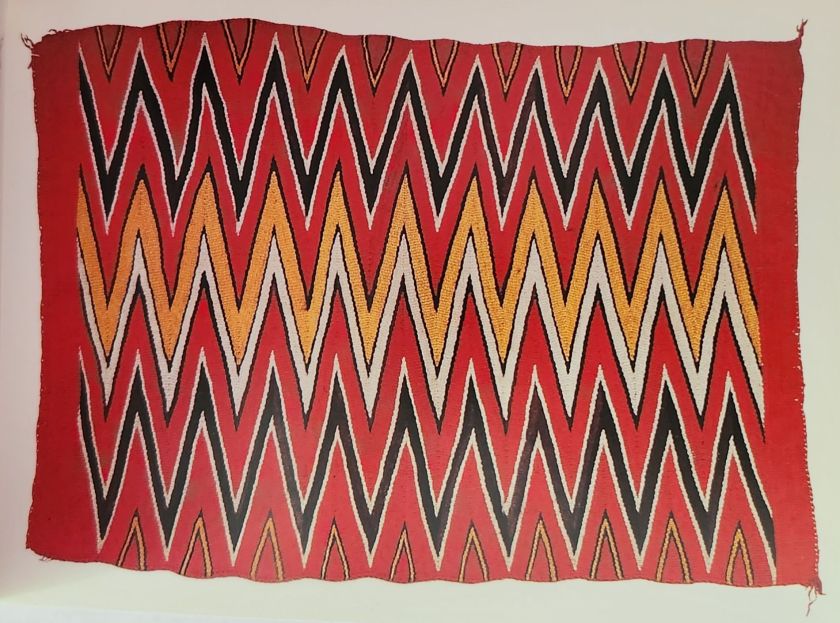
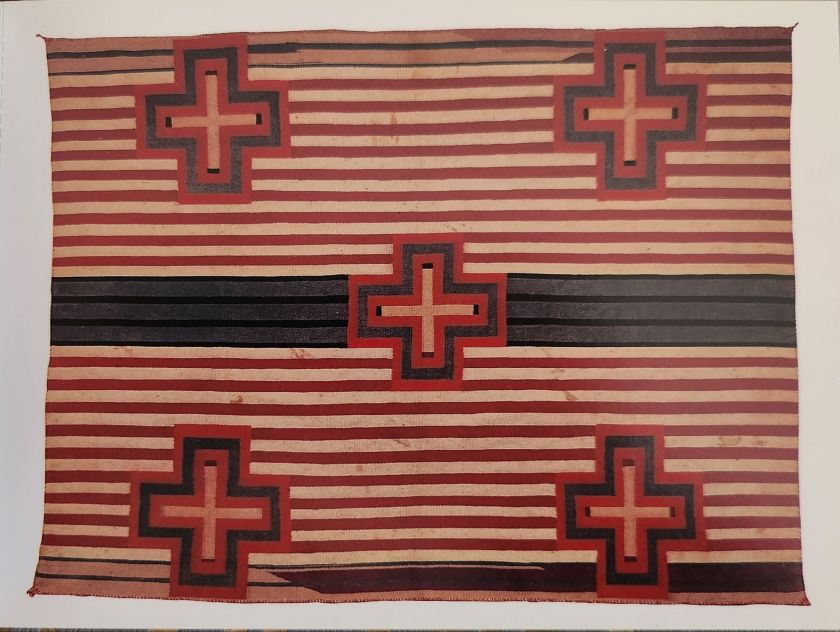
The first showed another Native textile—bold linear patterns in red, black, and cream with intense cross icons. Nora’s careful script on the back.
Hā lō. The words don’t come easily but people are kind. Cool and cloudy. I am floating in a haze between two languages and all the sights and sounds. —N
Nina flipped over the second card and took in a sharp breath. A generic Delta airplane photo. The handwriting slanted left, pressed hard into the faded card stock.
Layover. Thinking of you. -Dad
She hadn’t heard from her father in eight months. Not since he flew in for the funeral and left the next day.
Nina stood in the mailroom holding both cards. Nora’s textile and her father’s cardboard shrug. She whispered, “Merry Christmas, Dad,” and slipped them both into her bag.
Mrs. Hanabusa was by her window when Nina arrived for her shift. The older woman smiled. “You have mail.”
“How did you know?”
“The look you get.”
Nina pulled out Nora’s card. Showed her the textile pattern.
Mrs. Hanabusa took it carefully. Studied the bold lines, the sacred geometry. “Another one, but this is different, more dramatic.” She tilted it toward the light from outside and a mischievous grin washed across her calm visage. “My grandmother would have liked getting these back, too.”
Nina hesitated, then showed her the second card with the plane.
Mrs. Hanabusa looked at it, then at Nina, then waited.
“My father,” Nina said. “He’s a pilot. He sends almost the same card every time.”
Mrs. Hanabusa was quiet for another long moment. “My father came back from the camps different. Smaller and afraid. He couldn’t talk about what he’d lost. Some people need distance to be ok.” She paused. “But, that is not ok for you.”
“No,” Nina said. “It’s not.”
Nina looked at the card again. Thinking of you. Three words. A lifetime of absence compressed into a layover.
“I don’t know what to do with them,” she admitted.
“Keep it. Keep all of them, and figure out how to write back.”
Nina slipped both cards into her pocket. Nora’s textile and the latest of her father’s terminal attempts. Both efforts in their own ways, she had to agree.
Mrs. Hanabusa watched her. “These cards from your friend—they matter to me too, you know. Seeing which patterns she chooses next. What she wants you to know about her trip. That’s a kind of gift. Your friend is keeping her promise.”
“She said she’d send them all,” Nina said.
“Good,” Mrs. Hanabusa said. “You can show me each one.”
Time to Reconnect?
Though the story is fiction, a vintage postcard is still a great way to stay in touch. Browse our selection.
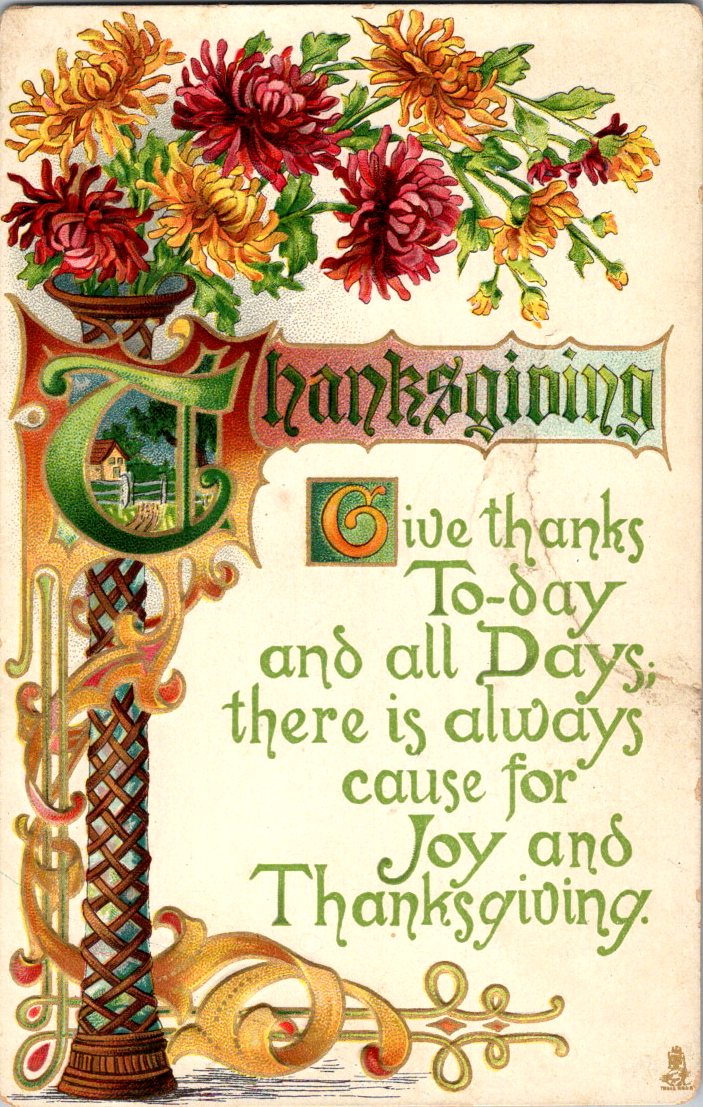
For a dip into distraction before the holiday, here’s a longer essay about Raphael Tuck & Sons, Mechanical Marvels, who were “Art Publishers to Her Majesty the Queen.” Today’s Thanksgiving selection by the same maker shows off their characteristic style and stamp.
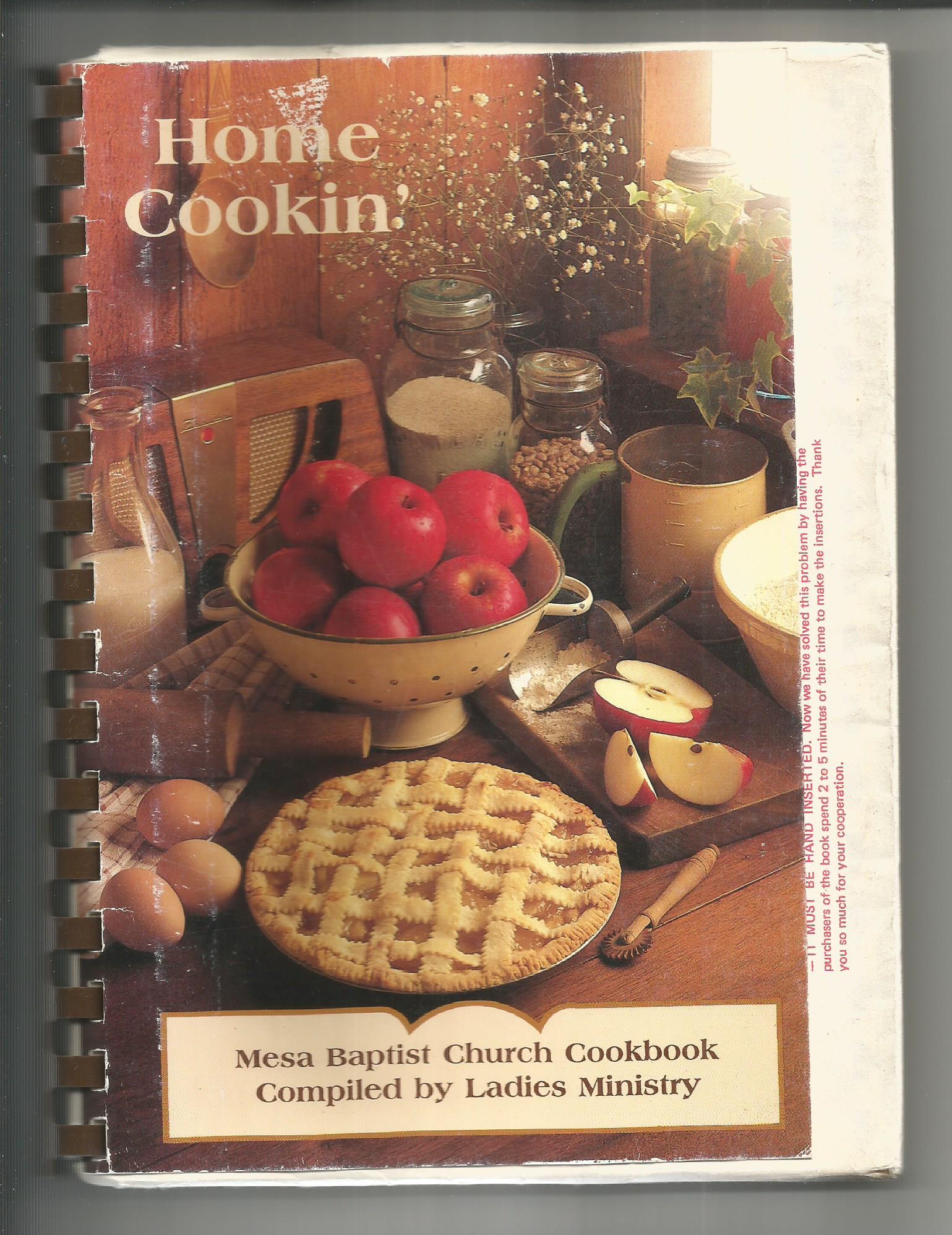
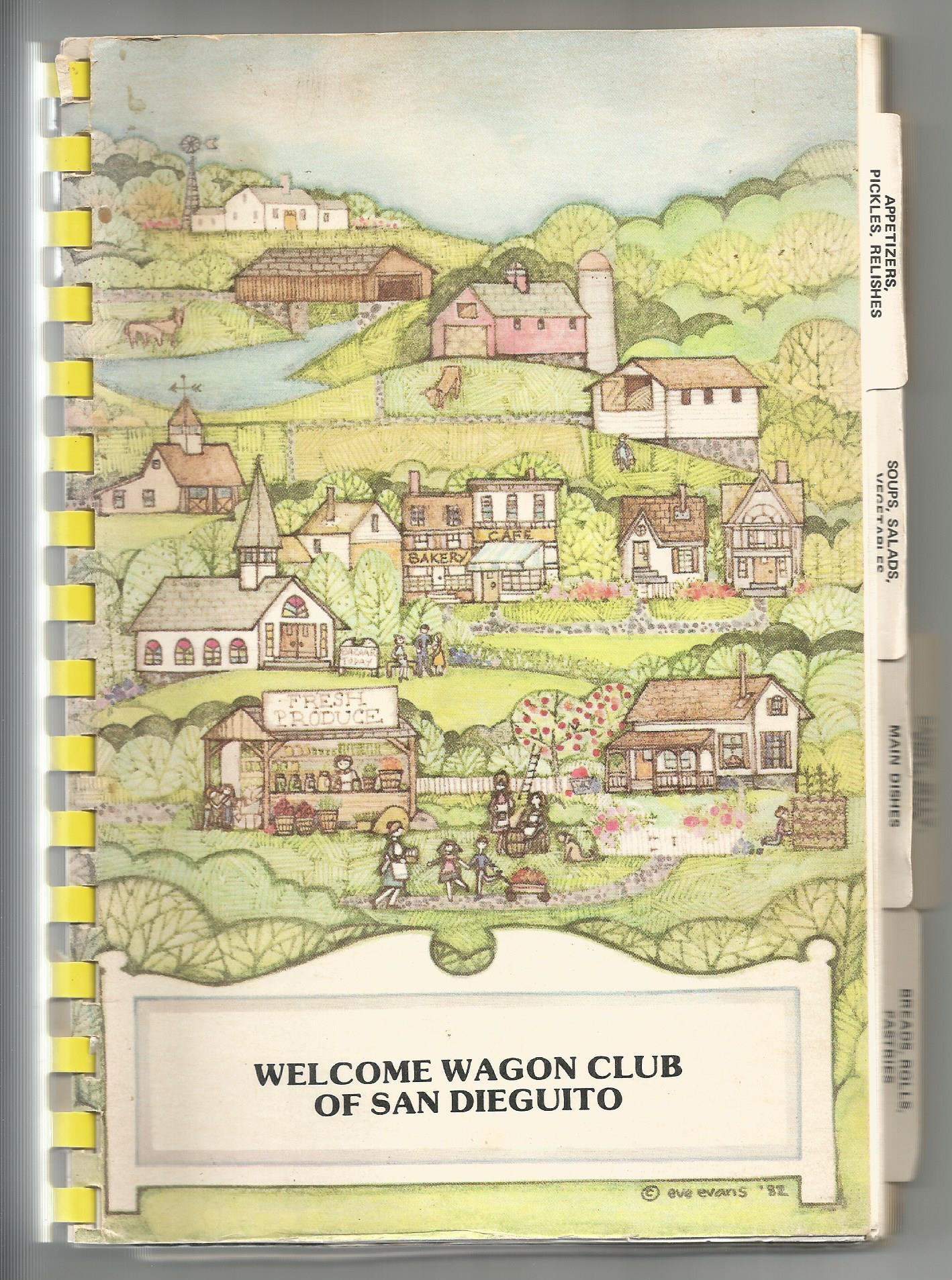
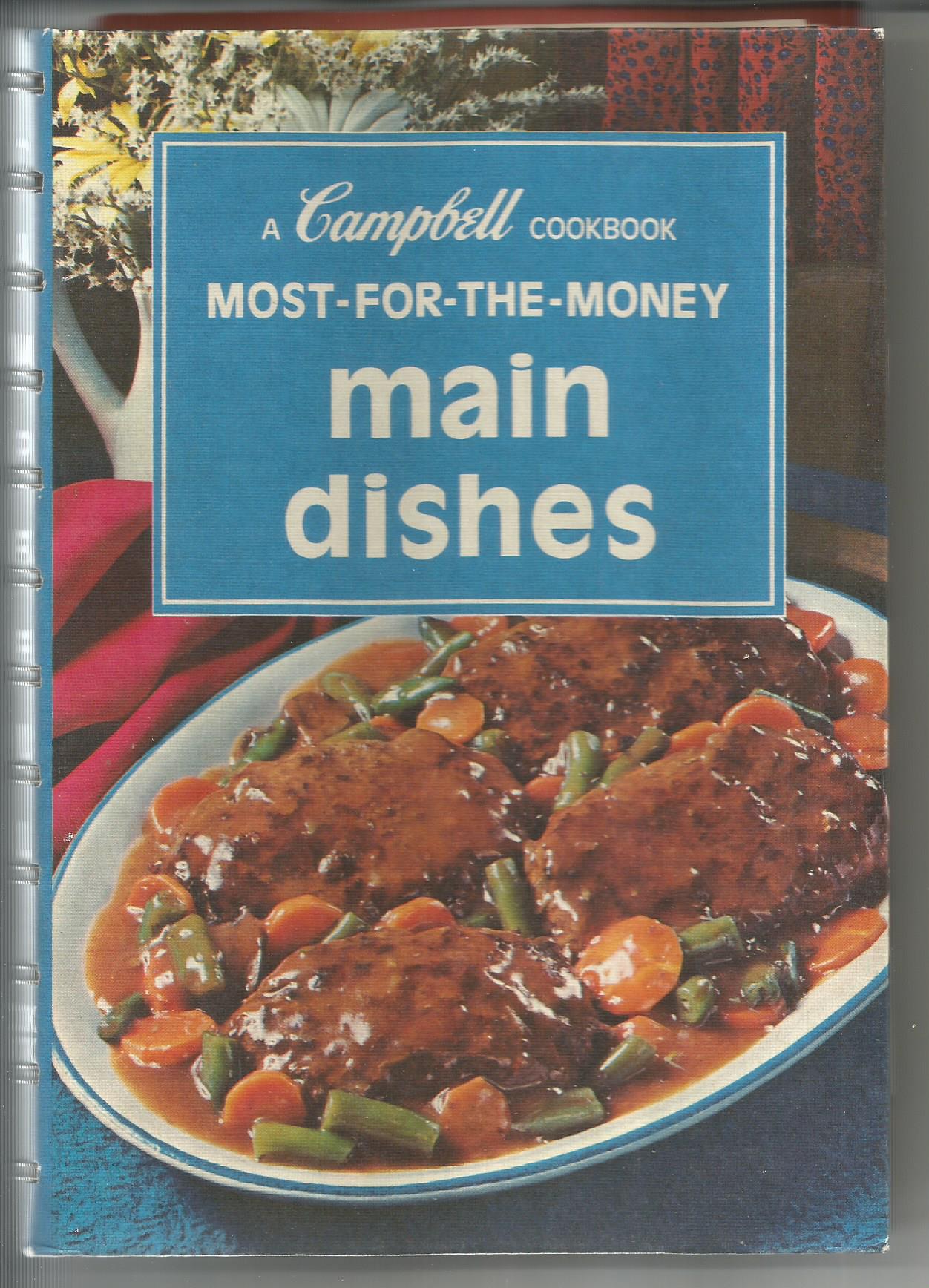
kitschy cookbooks
In time for the sumptuous season, these kitschy cookbooks remind us of this handy (and hilarious) pastime of sharing homecooked love and comfort.
Nice Gifts that are Kind to Your Budget
Add quirky fun to the gifting season with carefully curated vintage and resale finds. They are cost-conscious and climate-saving, too. Shop for vintage postcards, art card kits, and kitschy cookbooks at The Posted Past online shop.
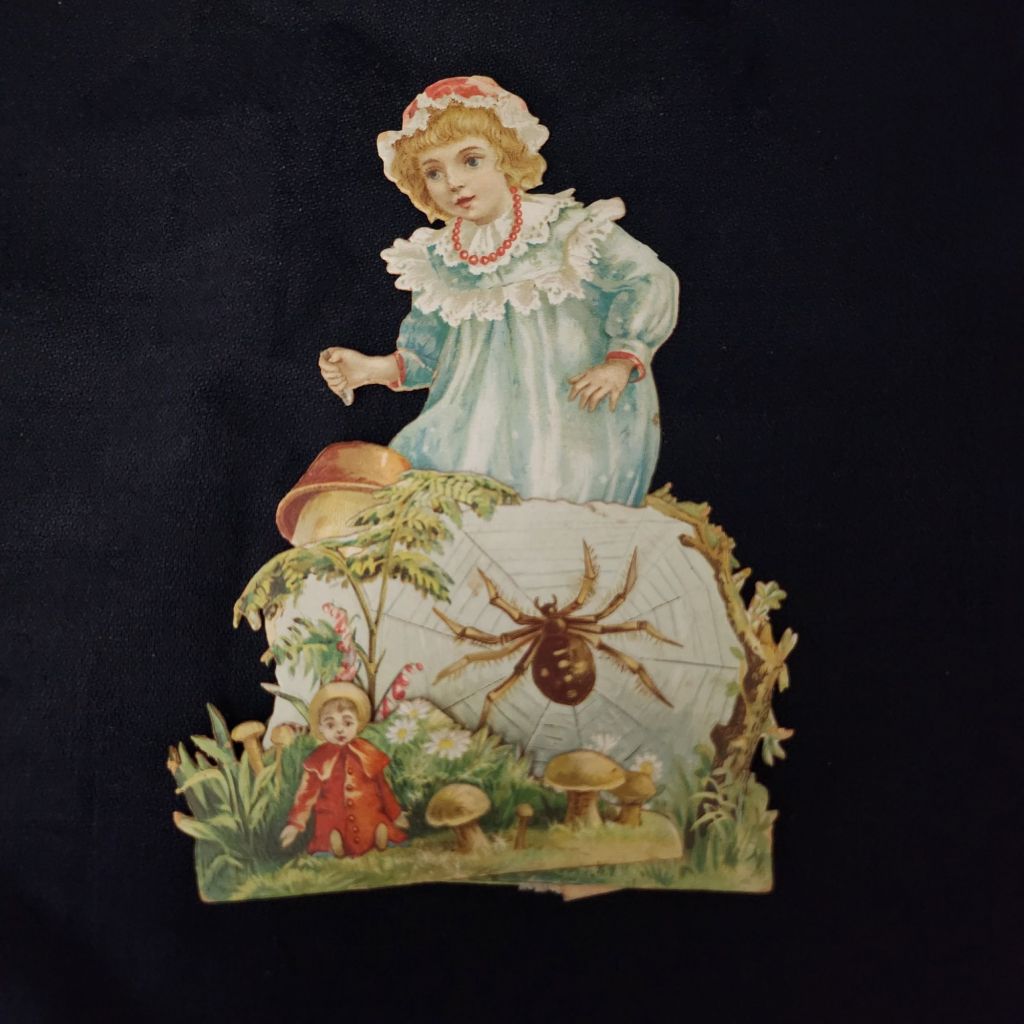
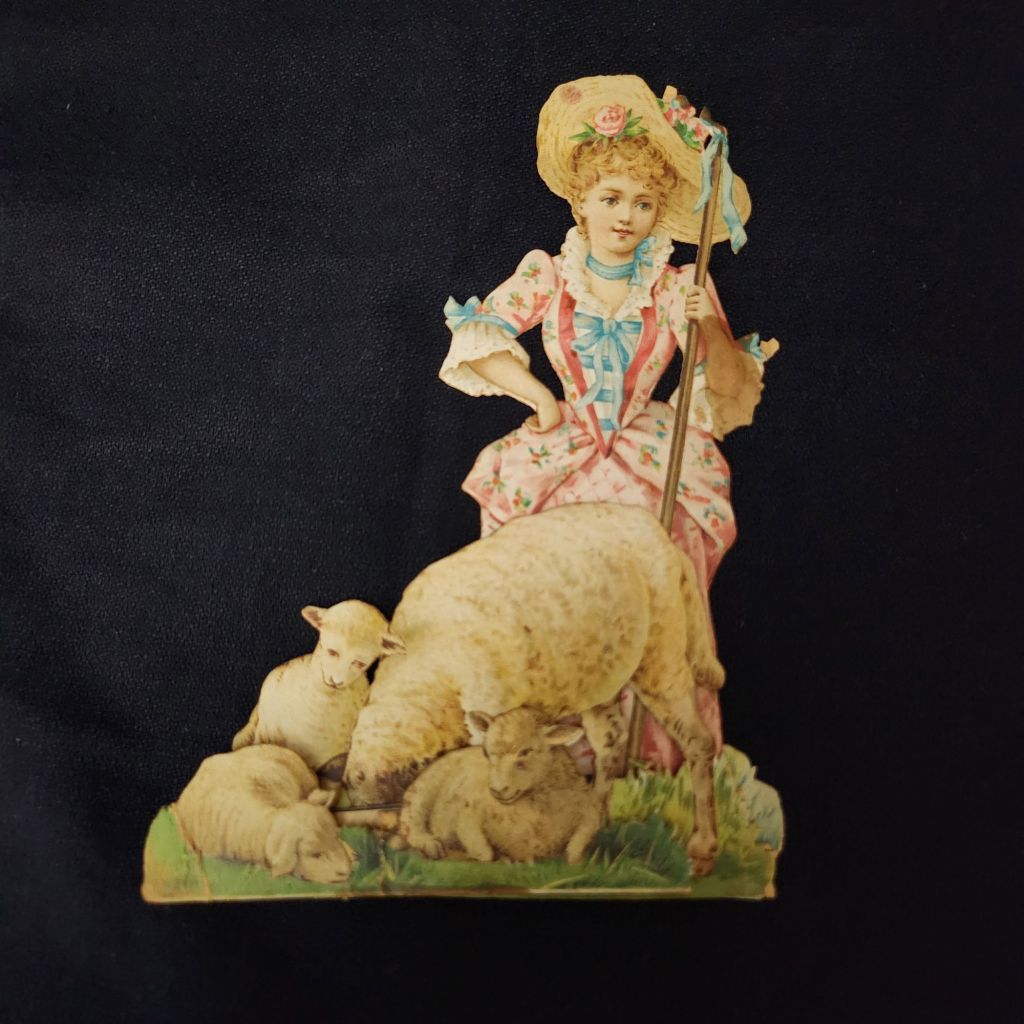
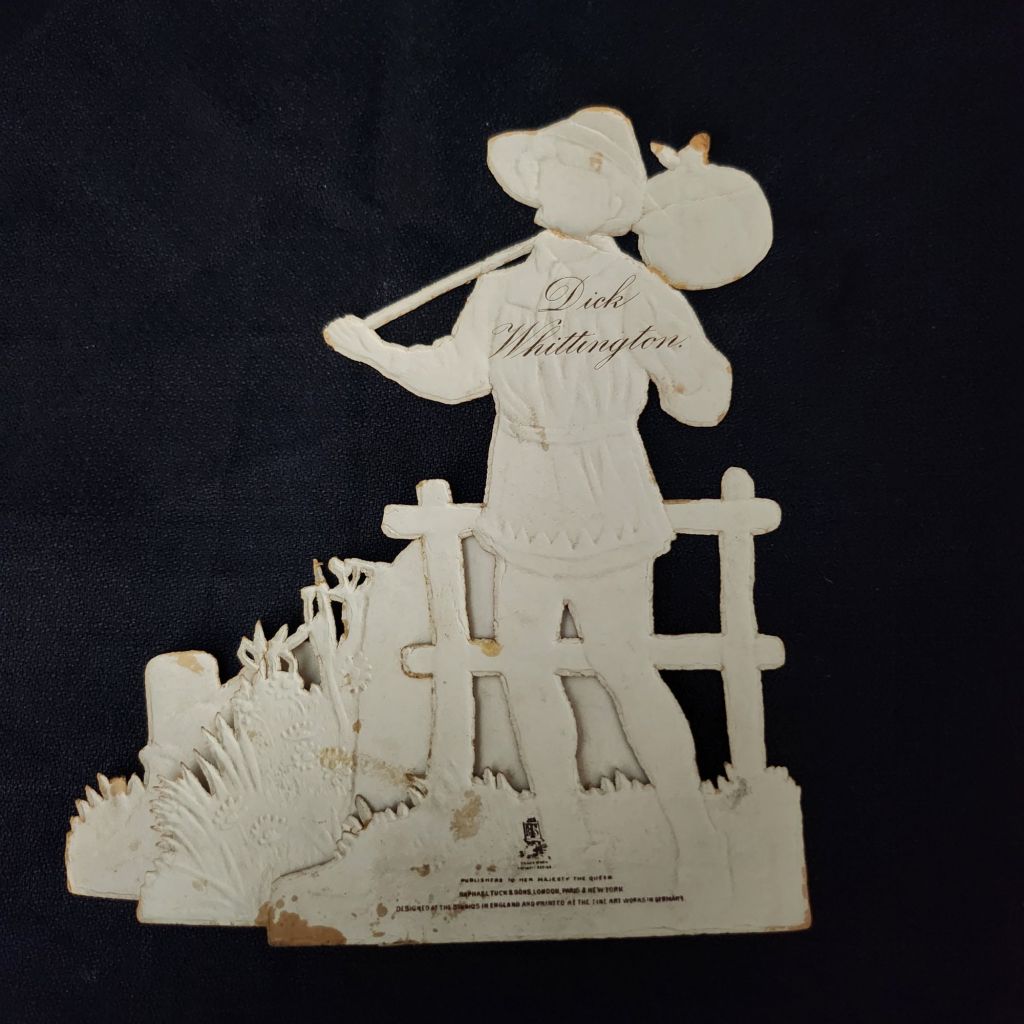
As the Harvest Moon wanes and the fall weather arrives, now is the time to cozy up with a few old nursery rhymes. These rare Raphael Tuck & Sons mechanical cards are an enchanting entrance to a magical season.
Published by Raphael Tuck & Sons of London, these elaborate die-cut pop-up cards feature beloved nursery rhymes and fairy tales including Little Bo Peep, Cinderella, Dick Whittington, and Three Little Kittens. Each piece showcases the exceptional craftsmanship and attention to detail that made Tuck one of the most prestigious names in Victorian publishing.
Vintage cards by raphael tuck & sons
Founded in the 1860s by German immigrant Raphael Tuck, the company quickly established itself as a leader in chromolithographic printing. By 1893, they had earned a Royal Warrant, becoming “Art Publishers to Her Majesty the Queen.” This royal endorsement reflected the superior quality of their work, which combined vibrant colors, intricate details, and innovative three-dimensional designs. These mechanical cards, likely produced between the 1880s and 1910s, represent the company at its creative peak.
In an era before mass media entertainment, these colorful, interactive pieces were technological marvels. The chromolithography process allowed for rich, multi-hued images that seemed almost magical to contemporary viewers. Their three-dimensional construction meant they weren’t merely viewed but displayed—transforming mantels into miniature theaters of beloved stories. Collecting and arranging these cards became a popular hobby. Many were preserved in elaborate scrapbooks, but relatively few have survived.
WWI widely disrupted the European paper and printing industries, and Raphael Tuck’s London facilities were destroyed during the WWII Blitz in 1940, losing 74 years of business records and thousands for illustrations and production files. Mid-century greeting card companies did continue to produce mechanical cards, but the more elaborate craft traditions largely faded in favor of modern design trends and less complicated manufacturing.
New technologies have revived the artform and inspired contemporary artists. Robert Sabuda elevated pop-up books and cards to fine art status with his extraordinary paper engineering. Lovepop creates elaborate 3D greeting cards for every occasion. The London company Roger la Borde produces wild and wonderful contemporary designs. Of course, independent artists worldwide create handcrafted die-cut cards that both honor and stretch well-beyond the Raphael Tuck legacy.
To Read More
The History of Raphael Tuck & Sons https://www.tuckdbpostcards.org/history Detailed company history from the TuckDB database, the premier online resource for Tuck collectors




















 The Posted Past