Rare Cards ~
Four Antique Swedish Postcards Sent to the Same Young Woman
In rural Dalarna, Sweden around 1903, a young woman named Susanna Pettersson receive four romantic postcards from three suitors in nearby towns. All the postcards arrived through the local mail to an address at Tjärnsvedens, Sunnansjö, in the wooded heart of Swedish folk country.
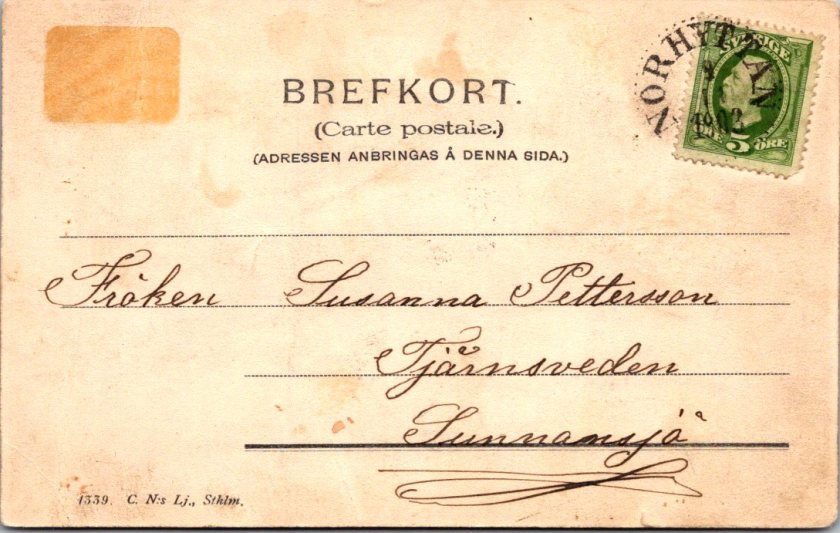
The honorific Fröken printed before her name on every card tells us she was unmarried. In early twentieth century Sweden, it was a title with genuine social weight that was relinquished upon marriage. For Susanna, the boundaries of daily life were drawn by family, church, and society. The careful correspondence of courtship may have provided a sense of choice.
In these years, postcards were at the absolute peak of a golden age. Dominated by the German printing industry and distributed across Europe and abroad, romance cards were a technically sophisticated and lucrative niche in a rapidly growing economy.
These exquisite cards were chosen deliberately by suitors to convey a range of emotion, laden with symbolic images and verses of serious sentiment. In our case, the hand-scripted messages are overt. To send such a postcard was a cautious and considered act, even a declaration. To receive four such cards suggests a woman who inspired intention.
In the early 1900s, Scandinavia was reckoning with questions of identity and sovereignty that touched daily life and daily culture, woven in with the cultural flowering of Larsson, Lagerlöf, Ibsen, Grieg, and Munch. Sweden itself was unsettled. The union with Norway, in place since 1814, was fracturing toward its peaceful but charged dissolution in 1905.
Borlänge, just down the road from Sunnansjö, was growing fast around iron and steel, drawing young men out of villages like Susanna’s into an industrializing economy. The authors of these cards may themselves have been young men who moved away to seek their futures, writing back to Susanna across a widening distance of place and era.
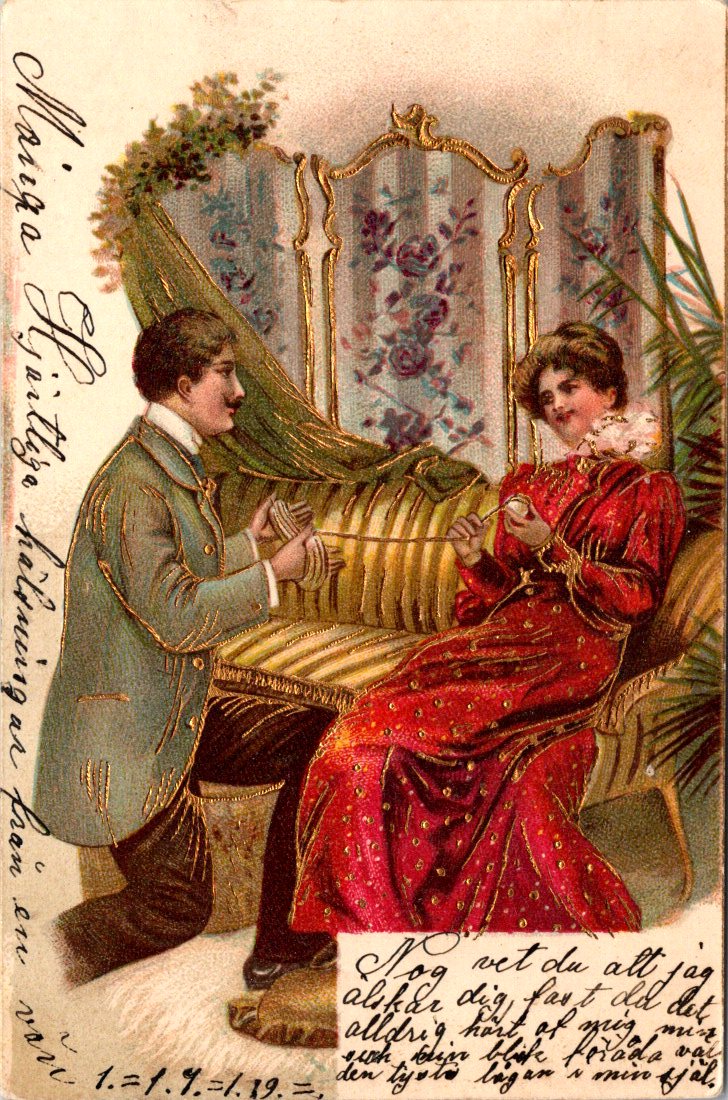
Card 1 ~ Suitor 1 from Norhyttan
Front: An elegantly dressed couple in a richly appointed interior — man in blue-grey jacket, woman in red and gold dress — seated before an ornate folding screen painted with roses. Tropical palm in background.
Många Hjärtliga helsning av han ere…
Many heartfelt greetings from him who is [yours]…
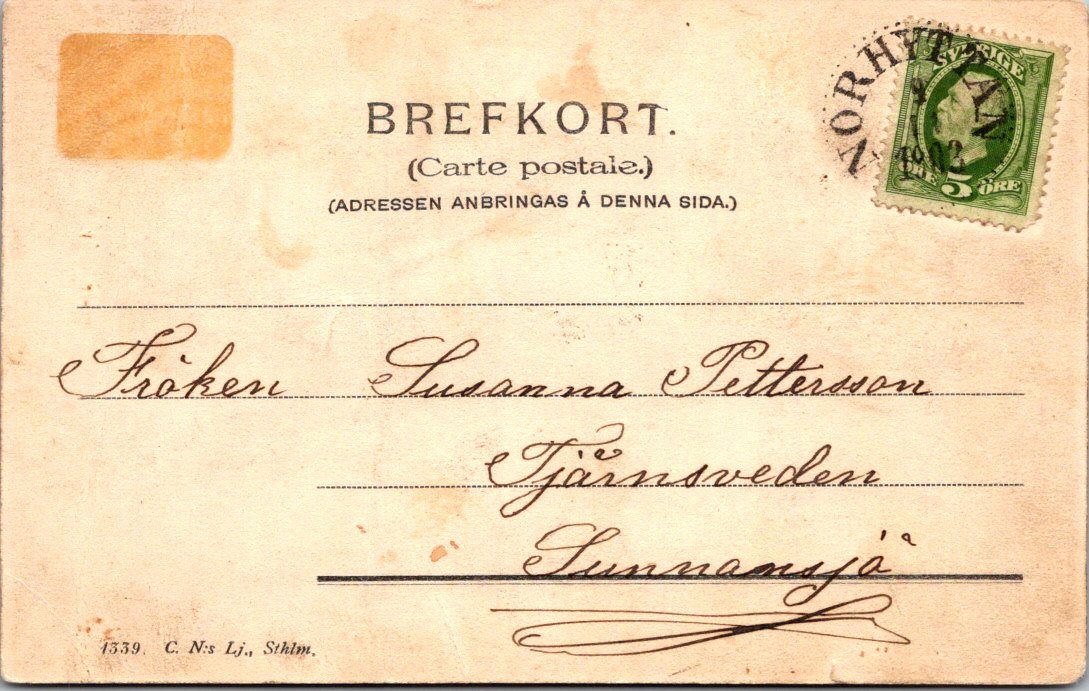
Back: Addressed to Fröken Sanna Persson, Tjärnsvedens, Sunnansjö. Note the affectionate diminutive Sanna rather than the formal Susanna used on other cards. Swedish 5 öre green stamp, Norhyttan postmark, circa 1902.
Correspondence: Lower right, heavily scripted in a practiced pen-and-ink hand. Left margin written vertically. Lower left coded notation: 1. = 1.9. = 1.19. =
Nog vet du att jag älskar dig, fast du det aldrig hört af mig, min och din blick föråda val den tysta lågan i min själ.
You surely know that I love you, even though you have never heard it from me. Mine and your glance betray the silent flame in my soul.
Production and Collector Notes: Premium chromolithograph with gold embossing, likely printed in Germany or Austria. Numbered series notation, Serie 193. Embossed romance cards of this quality with intact original Swedish correspondence are increasingly scarce. Of interest to collectors of Scandinavian ephemera, Edwardian romance, and social history researchers.
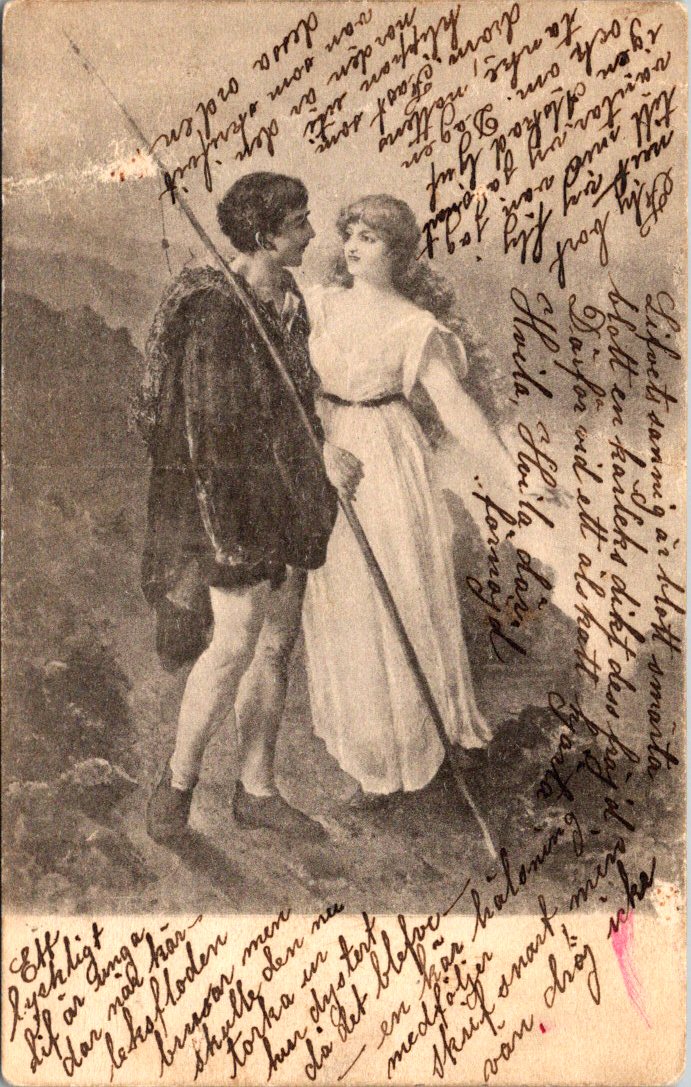
Card 2 ~ Suitor 1 from Norhyttan
Front: An archetypal couple stands on a rocky highland landscape with a misty and dramatic backdrop. A man in rough tunic carries a tall staff next to a woman in flowing white dress with loose hair.
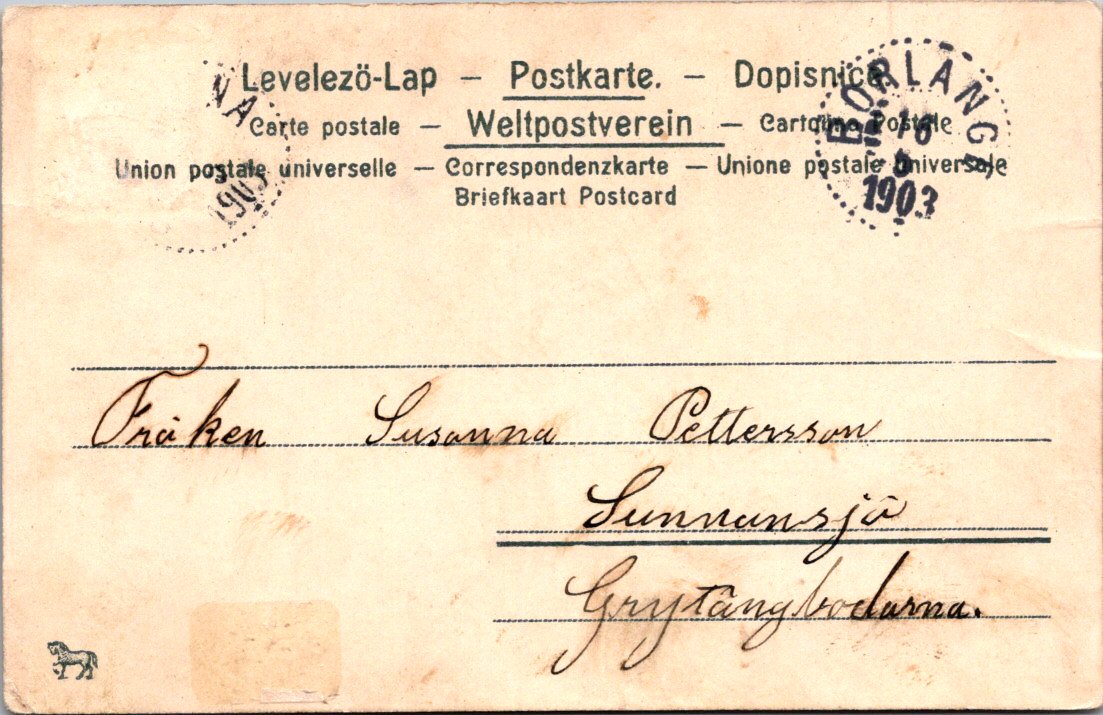
Back: Addressed to Fröken Susanna Pettersson, Tjärnsvedens, Sunnansjö. Swedish 5 öre stamp, Norhyttan postmark.
Correspondence: Densely written in heavy hand-scripted text running in multiple directions across the image.
Elfligt lyckligt är att änga — då ned har bäksfloden bringar men nu skralla den nu torka in text hur dyster då det blefo…
Blissfully happy it is to linger — when down the brook brings / but now how gloomy / when it became…
Production and collector notes: Sepia-toned romantic lithograph published in Stockholm by C. Ns Lj., Sthlm. Series 1339. Domestic Swedish production rather than imported German print, comparatively less common for this period and market. The heroic Nordic couple reflects romantic aesthetic prominent in Scandinavian visual culture of the early 1900s. Dense multi-directional handwriting across the image face is biographically significant. Of interest to collectors of Swedish ephemera, Scandinavian social history, and scholars of private correspondence.
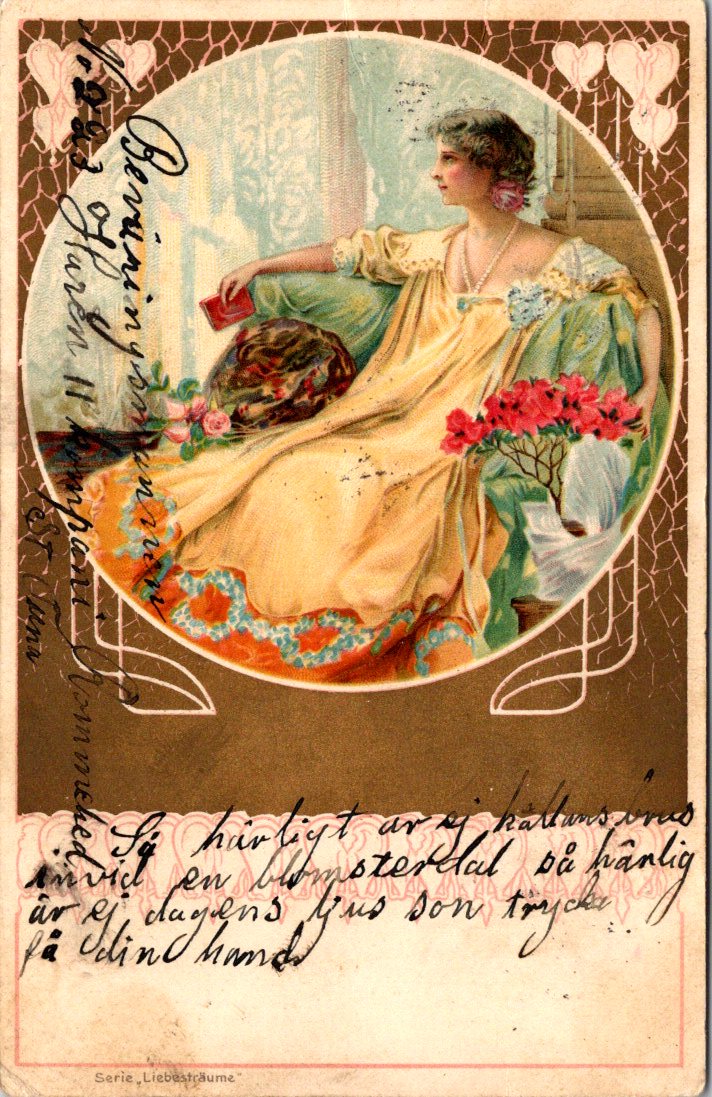
Card 3 ~ Suitor 2 from Borlänge
Front: A young woman in a golden-yellow gown reclines on a chaise surrounded by red azaleas and roses, holding a small red book or letter, gazing pensively to one side. Circular vignette set against a rich gold ground with pink Art Deco lattice decoration and heart motifs in each corner.
Back: Addressed to Fröken Susanna Pettersson, Sunnansjö, Gryftångbodarma. The address variation roughly translates to ‘summer farm buildings’ suggesting that Susanna was not at her main home but was staying at a seasonal outpost. Postmark, Borlänge, 1903. Small printer’s horse mark, bottom left.
Correspondence: Rounder and more casual hand-script. Left margin may be a name or family reference.
Så härligt är ej källans öras invid en blomstertal så härlig är ej dagens ljus son tryckt få din hand.
Not so lovely is the murmur of the spring, beside a flower-tale so lovely — not so bright is the light of day, as when pressed upon your hand.
Production and collector notes: Art Nouveau chromolithograph, Serie “Liebesträume” (Dreams of Love), produced by a quality German publisher and distributed internationally, reflecting Germany’s dominant role in the European postcard market of this era. Art Nouveau romance cards with intact Swedish correspondence and Borlänge postmark are notably scarce. Of interest to collectors of Art Nouveau ephemera, Scandinavian material culture, and historians of industrializing Sweden.
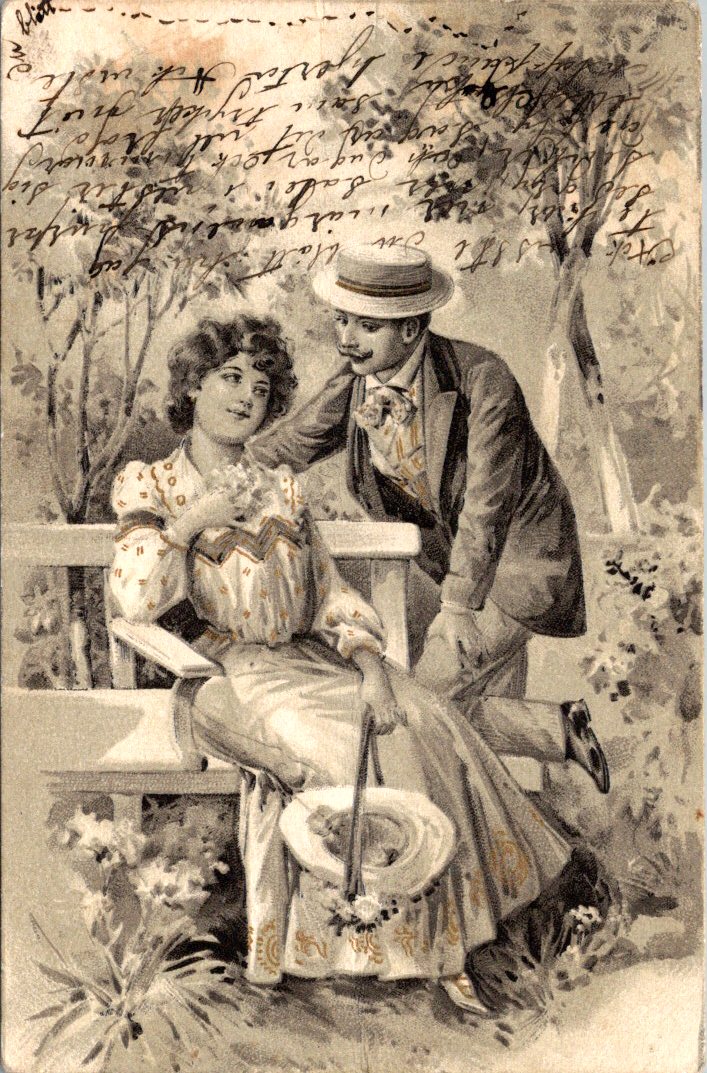
Card 4 ~ Suitor 3 from Stockholm
Front: A couple in a garden setting — woman in white and gold embroidered dress seated on a bench with flowers and parasol. Man in dark suit and straw boater hat leaning toward her attentively. Flowering trees surround them.
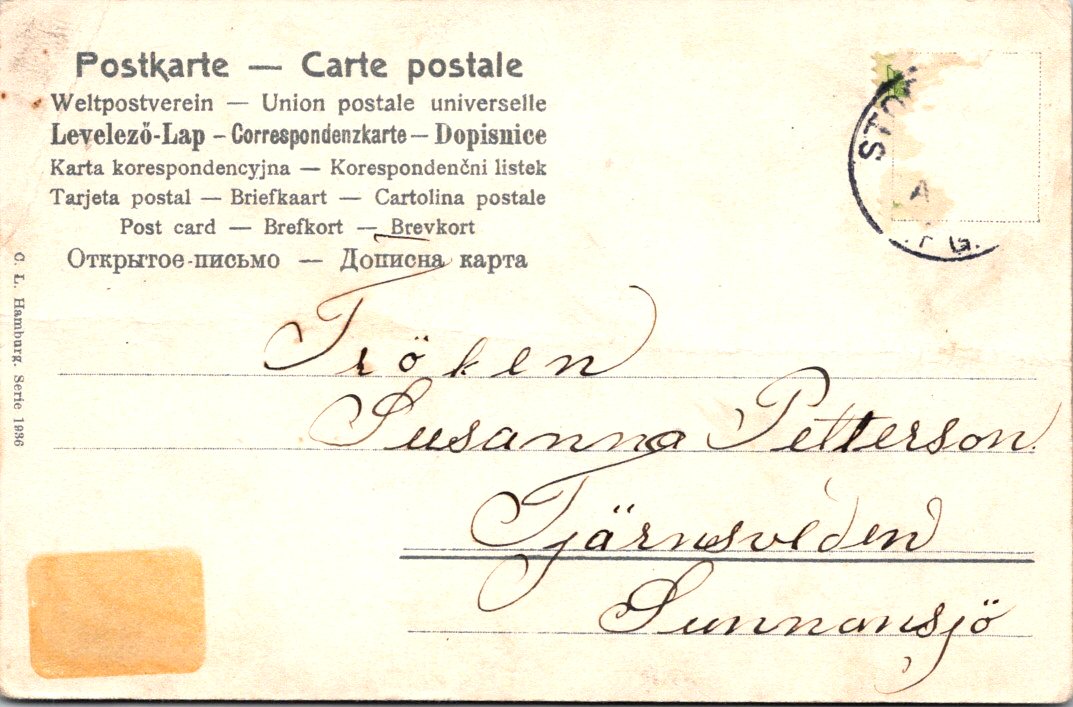
Back: Addressed to Fröken Susanna Petterson, Tjärnsvedens, Sunnansjö. Postmark origin reads Sto-, stamp damaged, full date not legible. Almost certainly Stockholm, circa 1903.
Correspondence: Written across the upper image in a compressed angular hand, distinct from both previous writers. Faded pen and ink, with partially legible fragments.
Bätt… polset… och mer… bättre…
Better… better… and more… better…
Production and collector notes: Sepia lithograph with gold highlights published by G. L. Hamburg. Serie 1896, a respected German publisher. Hamburg-published cards with intact Swedish correspondence and Stockholm postmarks from this period are collectible. Of interest to collectors of German-published romance cards and Edwardian Scandinavian ephemera.
Susanna Pettersson lived in a world that offered her limited formal choices. But in a small wooden house in Dalarna at the beginning of the last century, she could make her own quiet judgments. She could choose carefully.
Three suitors, three futures. Did she answer any of them? Whether she eventually became Fru or remained Fröken, we can’t discern from the evidence here. All we know is that she kept those four cards all those years.
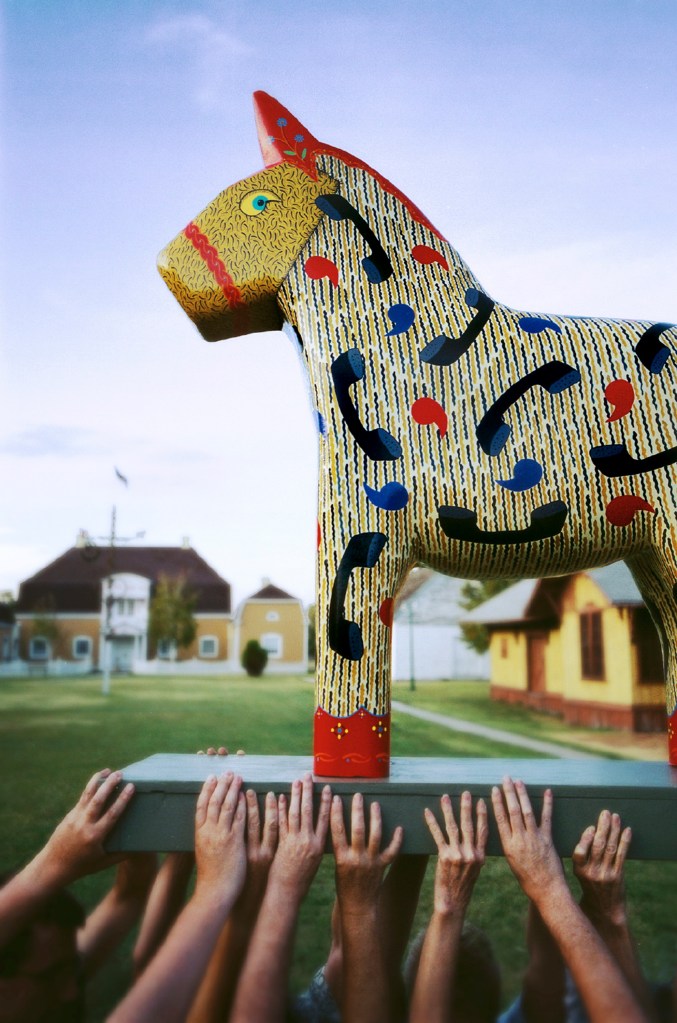
The postcards in this rare set were sent from the heart of Dalarna, Sweden — the same province that gave the world the iconic Dala horse, a brightly painted wooden folk toy whittled by loggers and miners during long Scandinavian winters. In 1869, Swedish immigrants from Dalarna carried that tradition across an ocean to the Kansas prairie, founding the town of Lindsborg — known today as Little Sweden USA, where you can Hunt for Wild Dalas!
 The Posted Past