Crazy Cat Postcards and a Case of Mistaken Identity

Mainzer Cats graced millions of postcards in their heyday. But the man whose name became synonymous with these charming, anthropomorphic animals was not their creator.

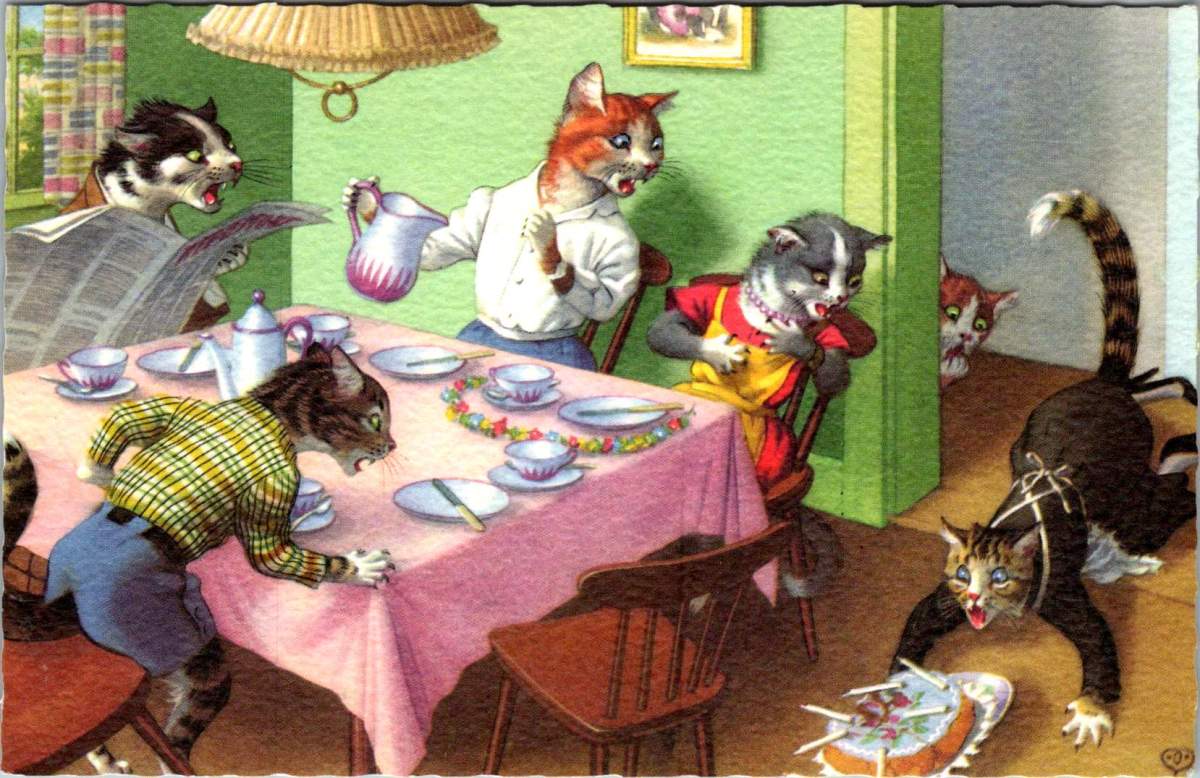
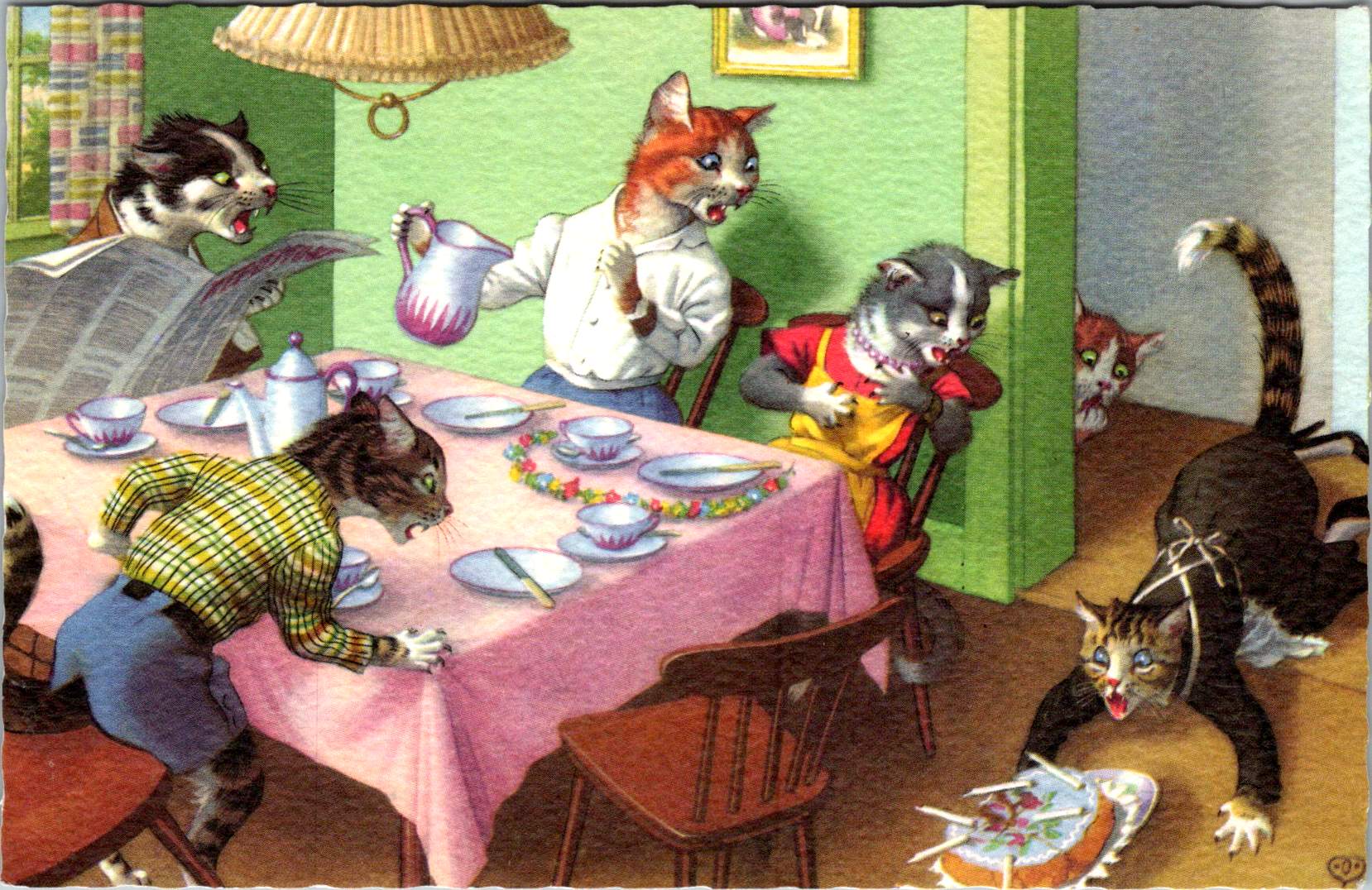
In the colorful world of mid-20th century postcards, a peculiar case of mistaken identity has long intrigued collectors and art enthusiasts. The charming, anthropomorphic cats that graced millions of postcards, known widely as “Mainzer Cats,” have a secret. Alfred Mainzer, the man whose name became synonymous with these whimsical felines, was not their creator. This tale of artistic attribution, commercial success, and enduring popularity offers a fascinating glimpse into the intersection of art, commerce, and our enduring love of cats.

Buy this Postcard!

Hartung-Mainzer Mystery

At the heart of this story are two men: Eugen Hartung, a Swiss artist born in 1897, and Alfred Mainzer, an American publisher. Hartung, the true artist behind the beloved cat illustrations, worked in relative obscurity, while Mainzer, through a twist of fate and business acumen, became the name associated with these popular images.

Eugen Hartung developed his artistic skills early in life, studying at the School of Applied Arts in Zürich. His background as a lithographer and graphic designer laid the foundation for his later work, which would prove ideal for reproduction on postcards and other printed materials. In the 1940s, perhaps inspired by the need for joy and whimsy in the aftermath of World War II, Hartung began painting his signature anthropomorphic animal scenes.

Hartung’s cats, engaged in human activities ranging from attending school to getting married, captured the imagination of viewers with their charm and humor. These illustrations, painted in delicate watercolors, featured cats with expressive faces and human-like postures, placed in everyday scenarios that resonated with people’s daily experiences.

Enter Alfred Mainzer, a businessman and publisher based in Long Island City, New York. Alfred Mainzer Inc. specialized in greeting cards and postcards. With a keen eye for marketable content, Mainzer imported the Belgium-printed postcards to distribute to the American market.

This business decision would lead to both the widespread popularity of the cat postcards and the confusion surrounding their creator. As the postcards gained fame in the United States, they became known as “Mainzer Cats” or “Alfred Mainzer postcards.” Over time, many people assumed Alfred Mainzer was the artist behind these charming illustrations.

The misattribution persisted for years, with Mainzer’s name becoming increasingly associated with the artwork. Meanwhile, Hartung, described by some sources as a quiet and modest individual, who was recognized in his native Switzerland, but not beyond.

This case of mistaken identity highlights the complex relationship between artists and publishers in the world of commercial art. While Mainzer’s business acumen brought Hartung’s work to a broader audience, it also inadvertently obscured the original artist’s identity. Today, collectors and art historians are working to properly attribute the artwork to Hartung while acknowledging Mainzer’s role in popularizing these images in the United States.

Enduring Appeal of Hartung’s Cats

The popularity of Hartung’s cat postcards, published by Mainzer, can be attributed to several factors. Their charm and humor, depicting cats in comical human situations, resonated with viewers. The illustrations were relatable, mirroring familiar human experiences through a feline lens. They also evoked a sense of nostalgia, particularly as they gained popularity in the 1950s and 1960s.

From a practical standpoint, postcards offered an affordable way for people to enjoy and share art. The wide variety of scenes depicted made the postcards highly collectible, with enthusiasts eager to acquire different designs. Moreover, the enduring popularity of cats as pets and subjects in art likely contributed to the appeal of Hartung’s work.

Cats in Art: A Rich History

While Hartung’s cats gained unique popularity through Mainzer’s postcards, the feline form has long been a subject of study for artists. Throughout history, artists have turned their attention to cats, each bringing their unique style and perspective to feline representation.

One of the most famous cat artists of the late 19th and early 20th centuries was Théophile Steinlen. This Swiss-French Art Nouveau painter became renowned for his cat illustrations, particularly his iconic “Chat Noir” (Black Cat) poster. Steinlen’s work, while more realistic and less anthropomorphic than Hartung’s, shared a focus on cats in daily life settings. Both artists imbued their feline subjects with personality and character, though Steinlen’s approach was less whimsical than Hartung’s.

Louis Wain, an English artist active in the same period, is another notable figure in the world of cat art. Wain’s early works bear some stylistic similarities to Hartung’s, featuring anthropomorphic cats engaged in human activities. However, Wain’s style evolved dramatically over his lifetime, influenced by his mental health. His later works became increasingly abstract and psychedelic, diverging significantly from the style of artists like Hartung. Fans will enjoy the 2021 movie starring Claire Foy and Benedict Cumberbatch, The Electrical Life of Louis Wain.

Léonard Tsuguharu Foujita, a Japanese-French painter of the early 20th century, was renowned for his drawings and paintings of cats. Foujita’s cats, often white with delicate, fine lines, showcased a different aesthetic from Hartung’s more colorful and active felines. Nonetheless, both artists shared a deep appreciation for the feline form and its expressive potential.

In the realm of fine art, artist Suzanne Valadon included cats in portraits and still life compositions. Valadon’s realistic depictions contrast with Hartung’s more stylized approach, yet both artists recognized the cat’s potential as a compelling subject.

The tradition of anthropomorphic animal art, of which Hartung’s work is a part, has roots that stretch back centuries. In Japan, for instance, Kuniyoshi Utagawa created many woodblock prints featuring cats in humorous or fantastical situations during the 19th century. While working in a very different medium and cultural context, Utagawa’s depictions of cats in unexpected scenarios share thematic similarities with Hartung’s work.

More recently, contemporary artists like Ai Weiwei have incorporated cats into their work, demonstrating the enduring appeal of felines as artistic subjects. Ai’s Cats and Dogs series of ceramic sculptures offers a modern take on feline representation, far removed from the whimsical postcards of Hartung yet part of the same long tradition of cats in art.

Legacy of Hartung and Mainzer

The story of Eugen Hartung and Alfred Mainzer illustrates the complex interplay between art and commerce. Hartung’s artistic talent and Mainzer’s business acumen combined to create a cultural phenomenon that has endured for decades.

Hartung’s legacy lies in his charming, whimsical artwork that continues to delight viewers today. His anthropomorphic cats, with their human-like expressions and activities, offer a unique blend of humor and familiarity. The enduring popularity of these images speaks to Hartung’s skill in capturing the essence of both feline and human nature in his illustrations.

Mainzer’s legacy, on the other hand, is one of successful commercialization and distribution. By recognizing the potential of Hartung’s work and bringing it to a wider audience, Mainzer played a crucial role in popularizing these images. The “Mainzer Cats” became a recognized brand, even if the attribution was misplaced.

Today, both Hartung and Mainzer are remembered in the world of postcard collecting and vintage art enthusiasts. Efforts to correctly attribute the artwork to Hartung have increased in recent years, bringing deserved recognition to the original artist. At the same time, the Mainzer name remains closely associated with these beloved postcards, a testament to the company’s role in their popularization.

Collecting Hartung/Mainzer Postcards

Despite the passage of time, Hartung’s cat postcards, often still referred to as Mainzer postcards, continue to captivate collectors. The market for these vintage pieces remains active, with enthusiasts ranging from dedicated deltiologists (postcard collectors) to cat lovers and nostalgia enthusiasts.
The appeal of these postcards extends beyond their original format. The enduring charm of Hartung’s designs has led to reproductions on various products, including calendars, notebooks, and home decor items. This expanded market has introduced Hartung’s whimsical cats to new generations of admirers.

Interestingly, some collectors and historians value these postcards not just for their artistic merit, but for their depiction of mid-20th century social norms and daily life, albeit in a whimsical, anthropomorphized form. This adds an educational dimension to their collectible status.

Cats in Art and Popular Culture

The enduring interest with cats that fueled the popularity of Hartung’s postcards is far from a thing of the past. In fact, felines have only grown in popularity as artistic subjects and cultural icons in the digital age.

Social media platforms have become showcases for cat-related art and imagery. Instagram accounts dedicated to cat art boast millions of followers, while viral cat videos and memes have become a staple of internet culture. This digital proliferation of cat content echoes the widespread appeal of Hartung’s postcards in a new medium.

Contemporary artists continue to find inspiration in felines. From traditional mediums like painting and sculpture to digital art and animation, cats remain a popular subject. Artists like Vanessa Stockard have gained recognition for their whimsical style that echoes some of the charm found in Hartung’s work. Stockard’s most famous work mimics the Old Masters while inserting her cat, Kevin, into traditional compositions.

The popularity of cats in art has also translated into commercial success in various industries. Cat-themed products, from clothing to home decor, are widely available and popular. This echoes the commercial success of Mainzer’s postcards, demonstrating the enduring marketability of feline-inspired art.

In the world of high art, cats continue to make appearances. Exhibitions dedicated to feline art have been held in major museums and galleries around the world. For instance, the Japan Society in New York hosted an exhibition titled “Life of Cats” in 2015, showcasing cats in Japanese art from the 1615 to 1868.

More than Mistaken Identity

The story of Eugen Hartung and Alfred Mainzer, and the beloved cat postcards they brought to the world, is more than just a tale of mistaken identity. It’s a narrative that touches on the nature of artistic creation, the power of commercial distribution, and the enduring appeal of a subject that has captivated humans for millennia.

Hartung’s artistic vision, brought to a wide audience through Mainzer’s business acumen, created a cultural phenomenon that continues to resonate today. The charming, anthropomorphic cats that populate these postcards speak to our enduring fascination with felines and our ability to see ourselves reflected in their actions and expressions.

As we unravel the mystery of the Hartung-Mainzer cats, we gain insight into the complex world of commercial art and the ways in which attribution can become confused over time. Yet, we also see how the power of the art itself can transcend issues of authorship, creating a legacy that endures for decades.

In our current era, where cat memes reign supreme and feline influencers command millions of followers, the popularity of Hartung’s cats seems almost prophetic. From fine art galleries to internet forums, our fascination with cats as artistic subjects continues unabated.

The Hartung-Mainzer story reminds us of the timeless appeal of art that captures the whimsy and charm of everyday life, whether through the lens of anthropomorphic cats or other creative interpretations. It stands as a testament to the power of art to connect with people across generations, and the enduring allure of our feline friends in the realm of human creativity.

Pick out a Hartung-Mainzer Postcard for yourself or a friend!

Precipice of Peace: Postcards from 1920 Antwerp Olympics

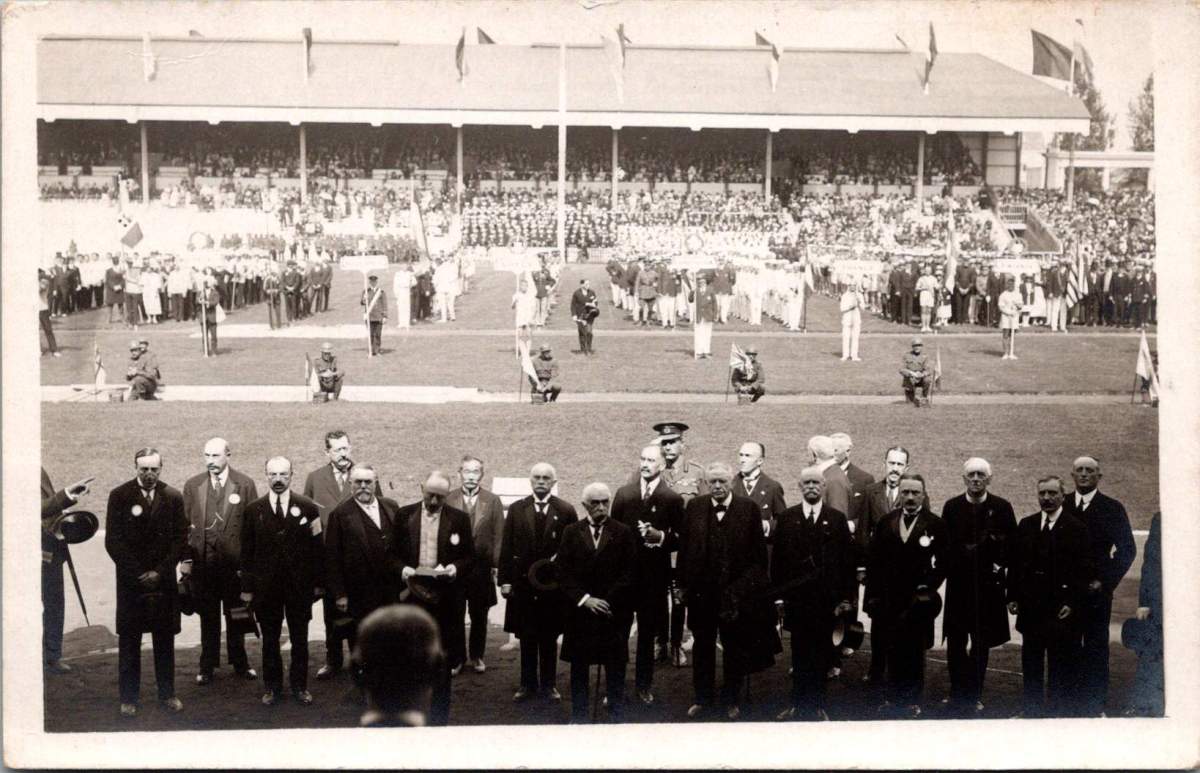
Sometimes a single image can capture the essence of an era. Such is the case with an extraordinary postcard, one of 18 rare images from the 1920 Antwerp Olympics. 

At first glance, it might seem like just another black-and-white snapshot of a bygone event. But look closer, and you’ll find yourself face to face with influential figures of the early 20th century. General John J. Pershing, commander of the American Expeditionary Forces during World War I, is captured in a crisp military salute. Baron Pierre de Coubertin, the father of the modern Olympic movement, instantly recognizable by his distinctive mustache.

This single frame tells a story far greater than the sum of its parts. Shot by an unknown photographer and made into a real photo postcard by Thomas Illingworth & Co., it shows a world emerging from the shadows of war and pandemic. 

A week earlier, US women won the vote and swimmer Ethelda Bleibtrey was about to bring home gold. The greats of the era – Duke Kahanamoku, Suzanne Lenglen, Paavo Nurmi, Frank Foss, and 72-year old Oscar Swahn – embodied the world’s tenuous progress through their excellence and effort in sport.

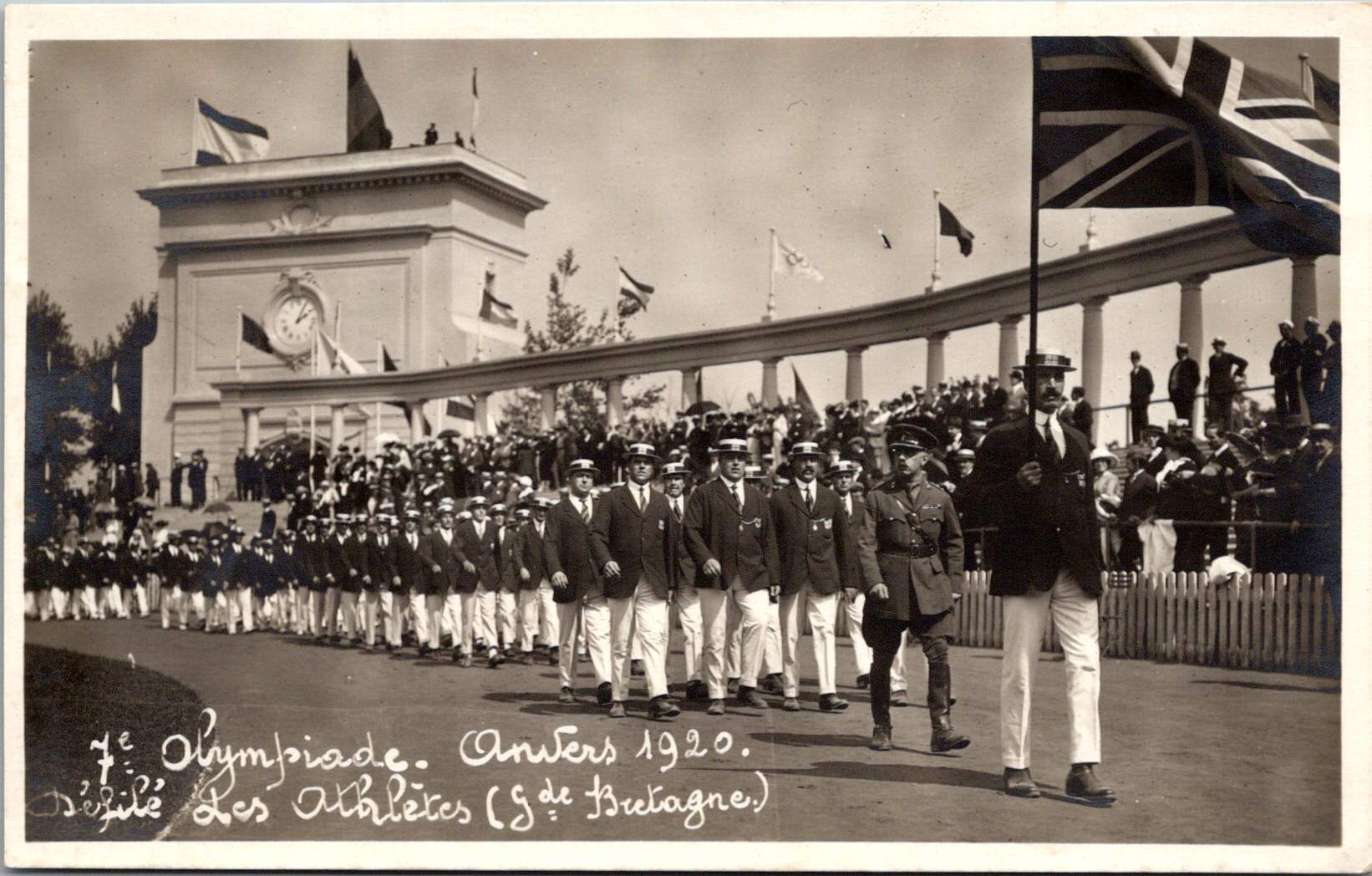
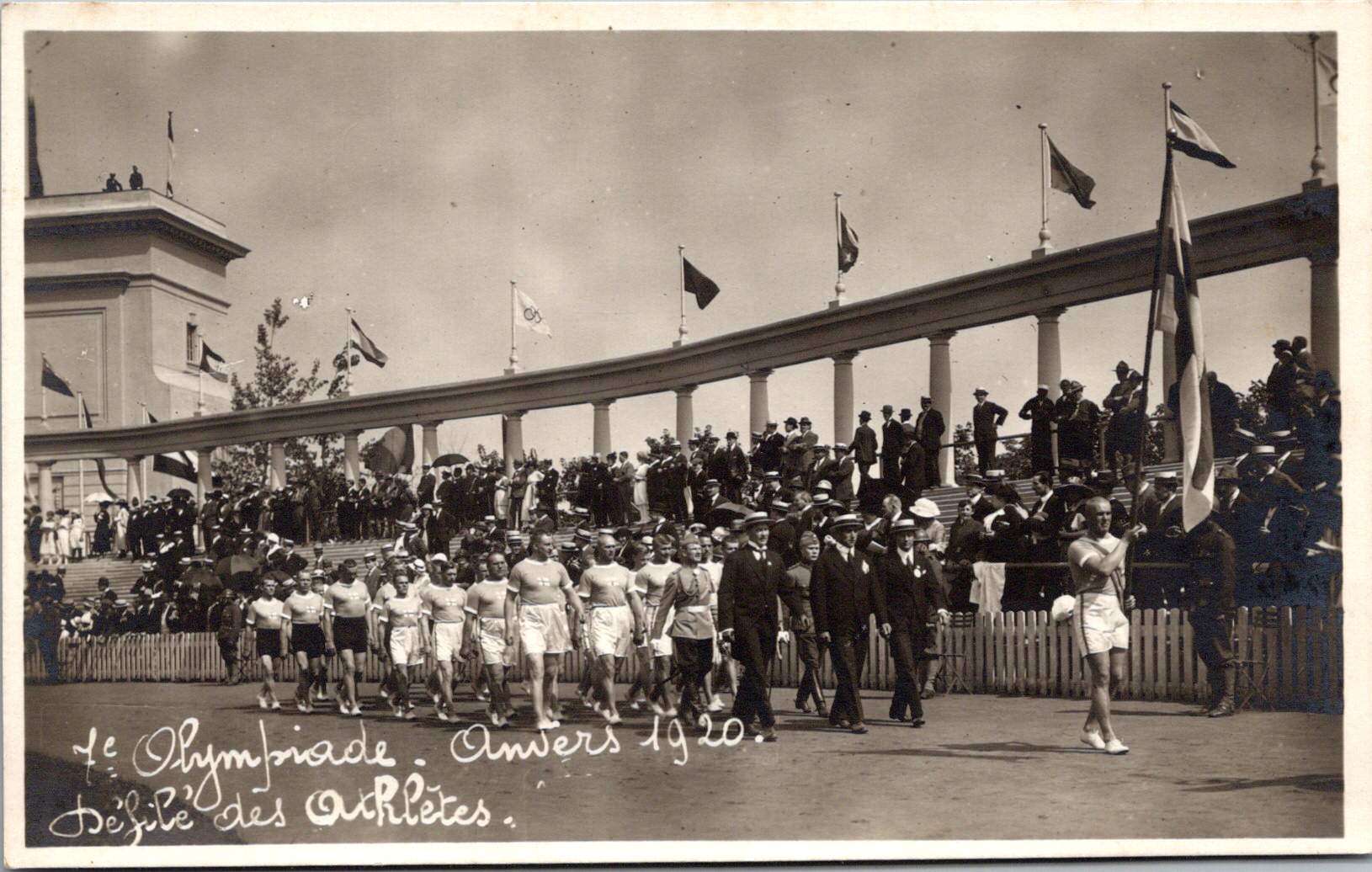
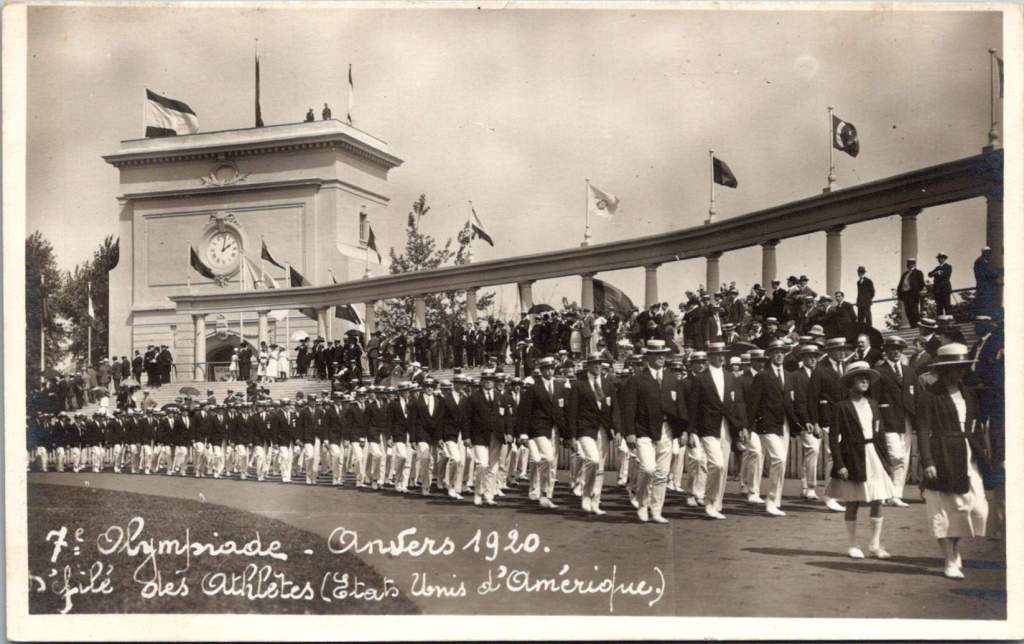
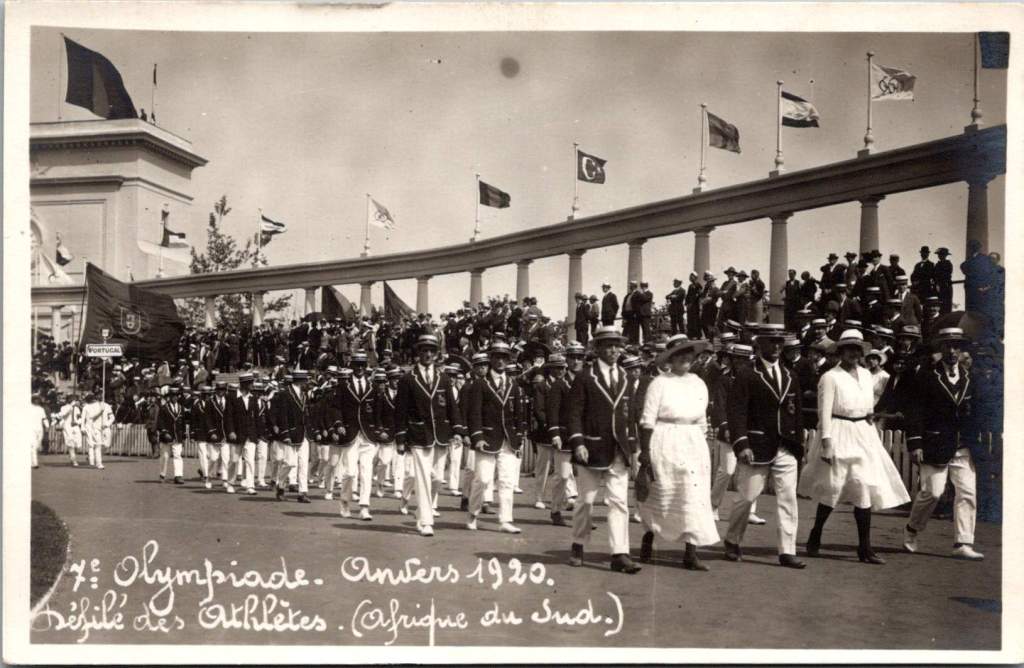
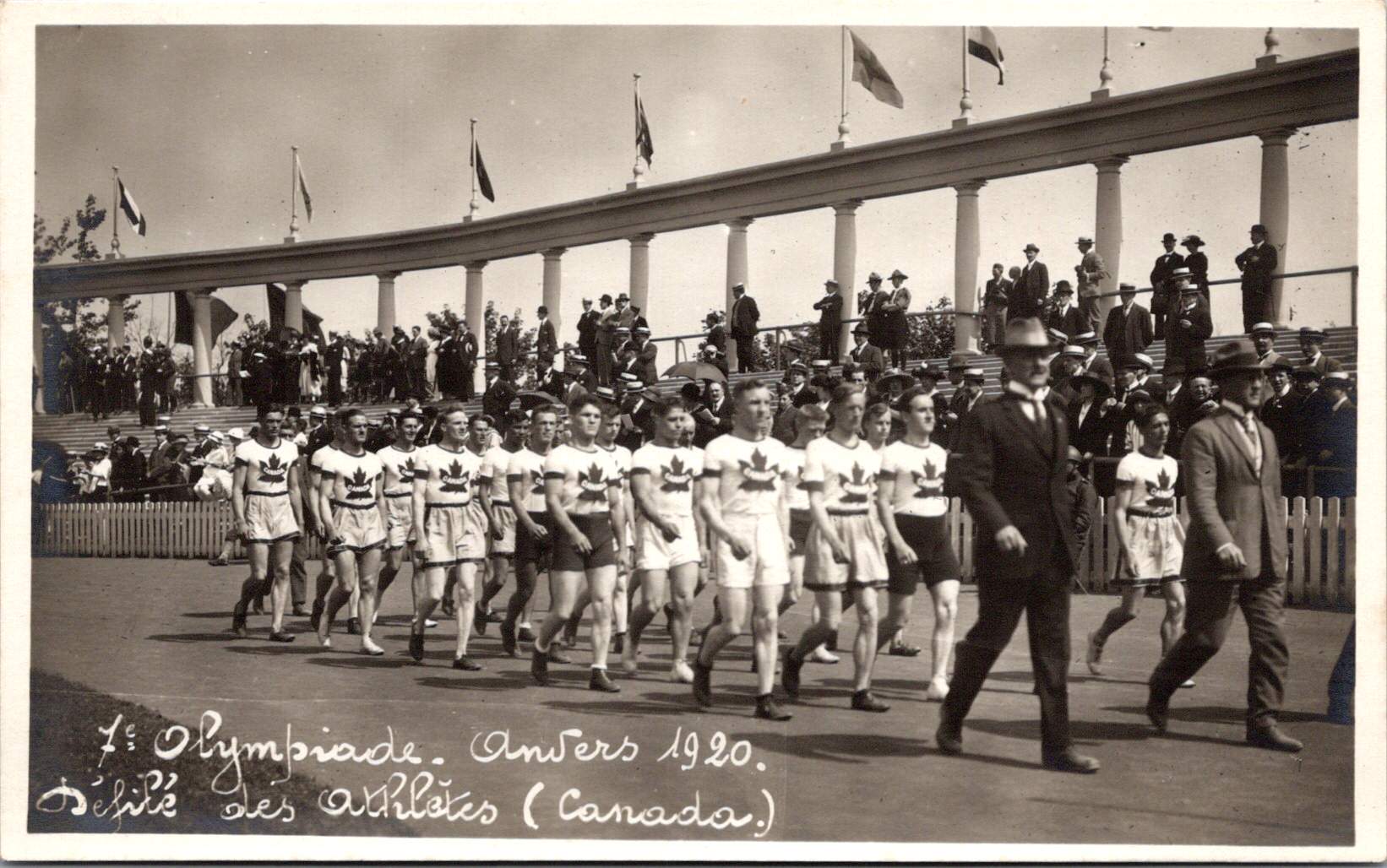
The accompanying 17 photos show the Parade of Athletes, including Australia, Belgium, Canada, Denmark, Egypt, France, Greece, Italy, Japan, Norway, South Africa, Spain, Sweden, Switzerland, and USA. Each delegation presented themselves to the Belgian King, sometimes with a wave or salute.

Window into 1920

Before we dive into the significance of the individuals captured in this image, let’s consider the medium itself. In 1920, the postcard was more than just a souvenir; it was a vital means of communication and a bearer of visual stories in a pre-digital age.

The postcards we’re examining used light-sensitive paper, a recently available technology in the marketplace. In this case, the Horse Shoe Brand from Thomas Illingworth & Co. – tells us exactly who produced the photographic prints directly from negatives. Each card, despite being a reproduction, was essentially a unique photograph, carrying subtle variations in exposure and tone that mass-printed cards could never match.

The quality of these postcards was remarkable for their time. The ability to clearly discern General Pershing’s salute and the details of de Coubertin’s mustache over a century later is a testament to the craftsmanship involved in their production. It’s also a stroke of luck for historians, providing us with invaluable visual evidence of this pivotal moment in Olympic history.

A General’s Salute: More Than a Gesture

The presence of General John J. Pershing at the 1920 Antwerp Olympics, captured mid-salute, is laden with symbolism. Just two years earlier, Pershing had been commanding millions of troops in the bloody fields of Europe. Now, here he was, saluting not to the drums of war, but to the peaceful competition of nations. The crowd was thrilled when Belgian soldiers released doves of peace to open the ceremonies.

Pershing’s salute was a powerful endorsement of the Olympic movement’s ideals, and a gesture of solidarity to the King of Belgium, who he is facing in the stands. It’s a military man’s acknowledgement that the battlefield is not the only place where nations can meet. The attendance of the two military commanders lent gravitas to the event, underlining the Games’ importance in post-war international relations.

Moreover, Pershing’s attendance highlighted the changing role of the United States on the world stage. The U.S. had emerged from World War I as a major global power, and Pershing’s presence at the Olympics signified America’s commitment to engaging with the international community not just through politics and economics, but through culture and sport as well.

Man Behind the Mustache: Pierre de Coubertin

Baron Pierre de Coubertin is easily identified in the front row by his long and gray mustache. The visionary behind the revival of the Olympic Games must have felt pride and vindication at this moment. For de Coubertin, whose Olympic ideal centered on promoting international understanding and peace through sport, the successful staging of the Antwerp Games was nothing short of a triumph.

The 1920 Antwerp Olympics were the first Games held after the cancellation of the 1916 Olympics due to World War I. The year prior, the Inter-Allied Games were hosted in France, mostly to keep WWI troops occupied in the sudden transition out of war. The fact that de Coubertin stands alongside Pershing, a military leader, in this peaceful setting, perfectly encapsulates the Olympic dream of turning swords into javelins, conflict into friendly competition.

De Coubertin’s presence also connects the ancient Olympic tradition with the modern era. Under his direction, the iconic Olympic rings and flag were introduced in 1920, along with other modernizations in sport, gear, and rules of the games. There were limitations, too, especially related to the post-war economy. Top athletes went unchallenged in some categories when other countries could not afford to compete. 

The choice of Antwerp as the host city was deeply significant. Belgium had suffered tremendously during World War I, with much of the country occupied and its people enduring great hardships. Hosting the Olympics was a statement of Belgium’s resilience and the international community’s support for its recovery. The stadium was more than just a sporting venue; it was a symbol of reconstruction and hope. Repurposed from the city’s hometown venue, it was transformed on short notice into the Olympisch Stadion.

The selection of Antwerp as host was not just a gesture of respect for the Olympic movement, but also an acknowledgment of Belgium’s sacrifices and its determination to rebuild. In the end, though, the city lost money on the Games due to low attendance.

Photo Paper to Digital Pixels: The Evolution of Olympic Memories

As we examine this postcard set today, we’re struck by how much has changed in the way we capture and share moments of global significance. The photographer who snapped this image must have thought carefully about each shot, knowing that film and processing were expensive and opportunities fleeting.

Today, a similar scene would be captured by thousands of smartphone cameras, instantly shared across the globe. The modern Olympic Games are documented in minute detail, with high-definition video capturing every bead of sweat and every emotional reaction.

Yet, there’s something special about this centenarian postcard. Its physical nature, the silver halide crystals that hold the image fast, give it a permanence that our digital memories often lack. It’s a tangible connection to a pivotal moment in history, one that we can hold and examine closely. It’s also remarkably detailed, given the age and technology at hand.

In our era of information overload, where countless images flood our screens daily, the rarity of this postcard becomes even more significant. While we don’t know exactly how many of these postcards were produced – estimates range from several hundred to a few thousand – we know that most have been lost to time.

Each surviving postcard is now a valuable historical artifact. They appear occasionally at auctions, eagerly sought after by collectors who understand their significance. But beyond their monetary value, these postcards are treasure troves of historical information.

The T.I.C. logo and the small ‘x’ between POST and CARD on the back, for instance, tell us not just who made the paper, but in what year. This level of detail allows historians to verify the authenticity of Olympic memorabilia and build a more detailed understanding of how the games were documented.

Finding Our Photographer

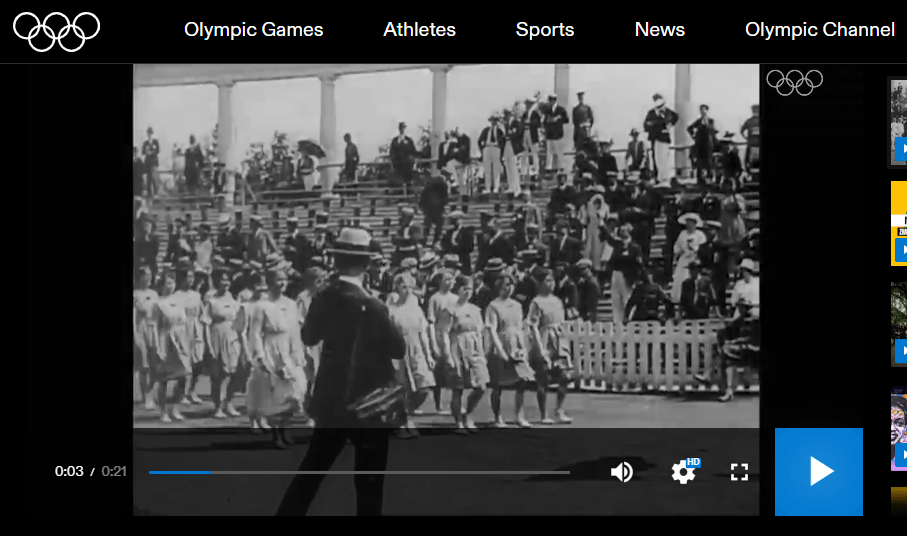
Who was the photographer? The mystery unraveled makes these rare images all the more interesting. Our research landed at the website for the official Olympic history, and a brief snippet of film from the 1920 opening ceremonies. In it we see a gaggle of photographers covering the proceedings. As the camera focuses, a sole figure breaks from the crowd and raises his camera for the perfect shot. The Denmark delegation is rounding the oval path and heading toward the risers. It’s the exact image we see in the postcard collection. Thrilling to have the photographic evidence, and travel through time to witness the moment!

Echoes Across Time

Seeing these images today, we can’t help but draw parallels between their time and ours. The world of 1920 was recovering from a pandemic and rebuilding after a major global conflict. The push for civil liberties was gaining strength in the U.S. and around the world. Today, we too are emerging from a global health crisis, facing international tensions, grappling with rapid technological change, and defending democracy.

The image of Pershing and de Coubertin, saluting the host country in an Olympic stadium, reminds us of the power of sport to bring people together. It shows us a world recovering after unimaginable hardship, finding unity in athletic achievement.

The Olympic Games continue to serve as a symbol of international cooperation and human achievement. As we look to the Olympics today, we might wonder: what form will our memories take? Will our digital images have the staying power of these centenarian postcards?

In an age where our memories are increasingly digital and ephemeral, these physical postcards serve as a poignant reminder of the value of tangible history. They urge us to consider how we document our own pivotal moments, and what legacy we will leave for future generations to discover. As we look to the future, may we carry forward the spirit of resilience, unity, and hope that these extraordinary images so powerfully illustrate.