
On a dark December day in 1943, someone in Chicago mailed an extraordinary postcard. At first glance, it appears to be a silver gelatin photograph of sheet music and a pair of scissors, artfully arranged and lit. But when held to the light, the card transforms – silhouetted orchestra members emerge from the shadows, and the scissors become a conductor’s upraised arms, creating a miniature theater of light and shadow. The message at the top reads MAY THE MUSIC BE JUST THE WAY YOU WANT IT ALL THROUGH ’44, signed playfully by Glen Shears – a silly pun referencing Glenn Miller, America’s most popular bandleader, and the scissors in the image.
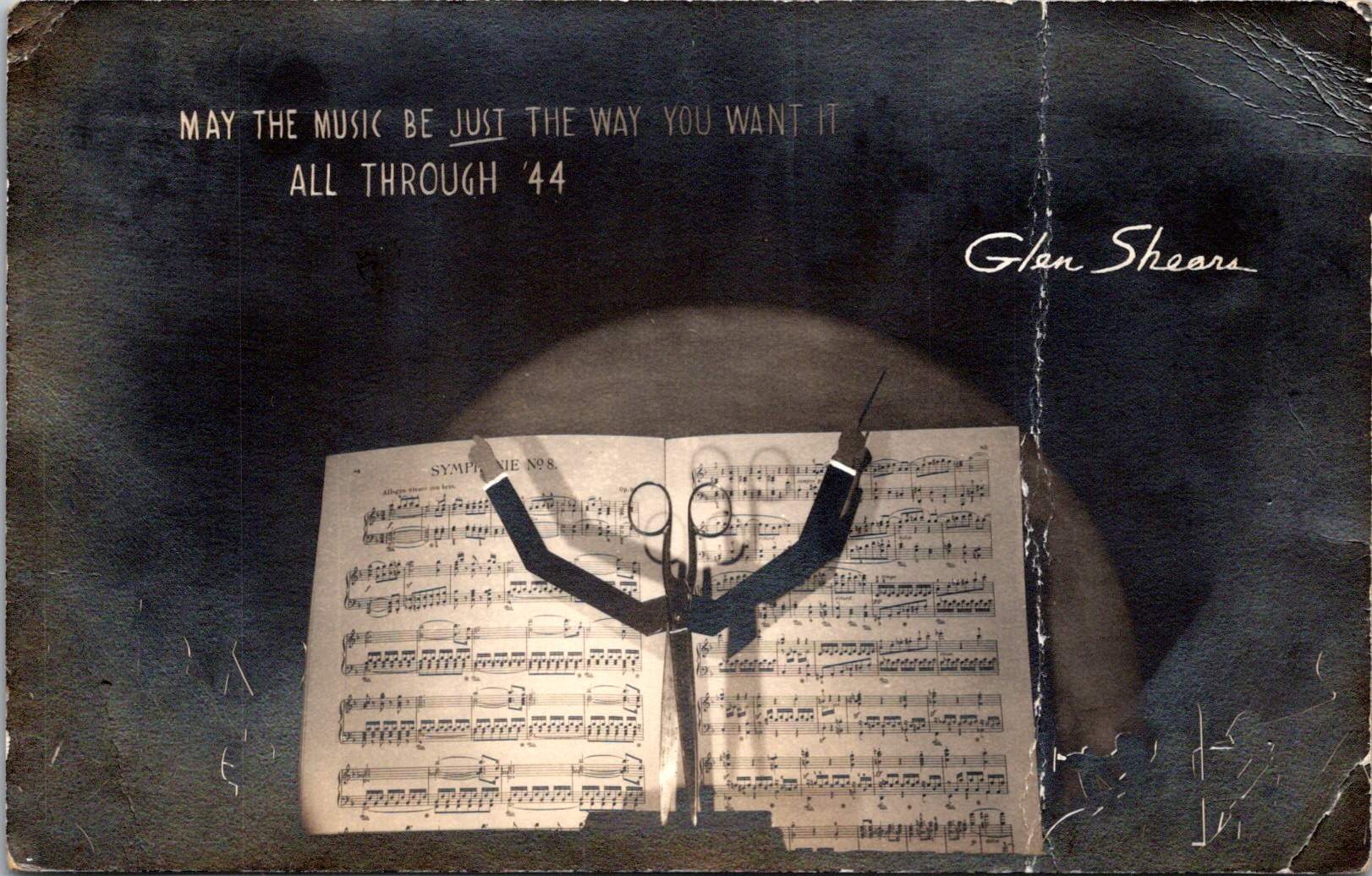
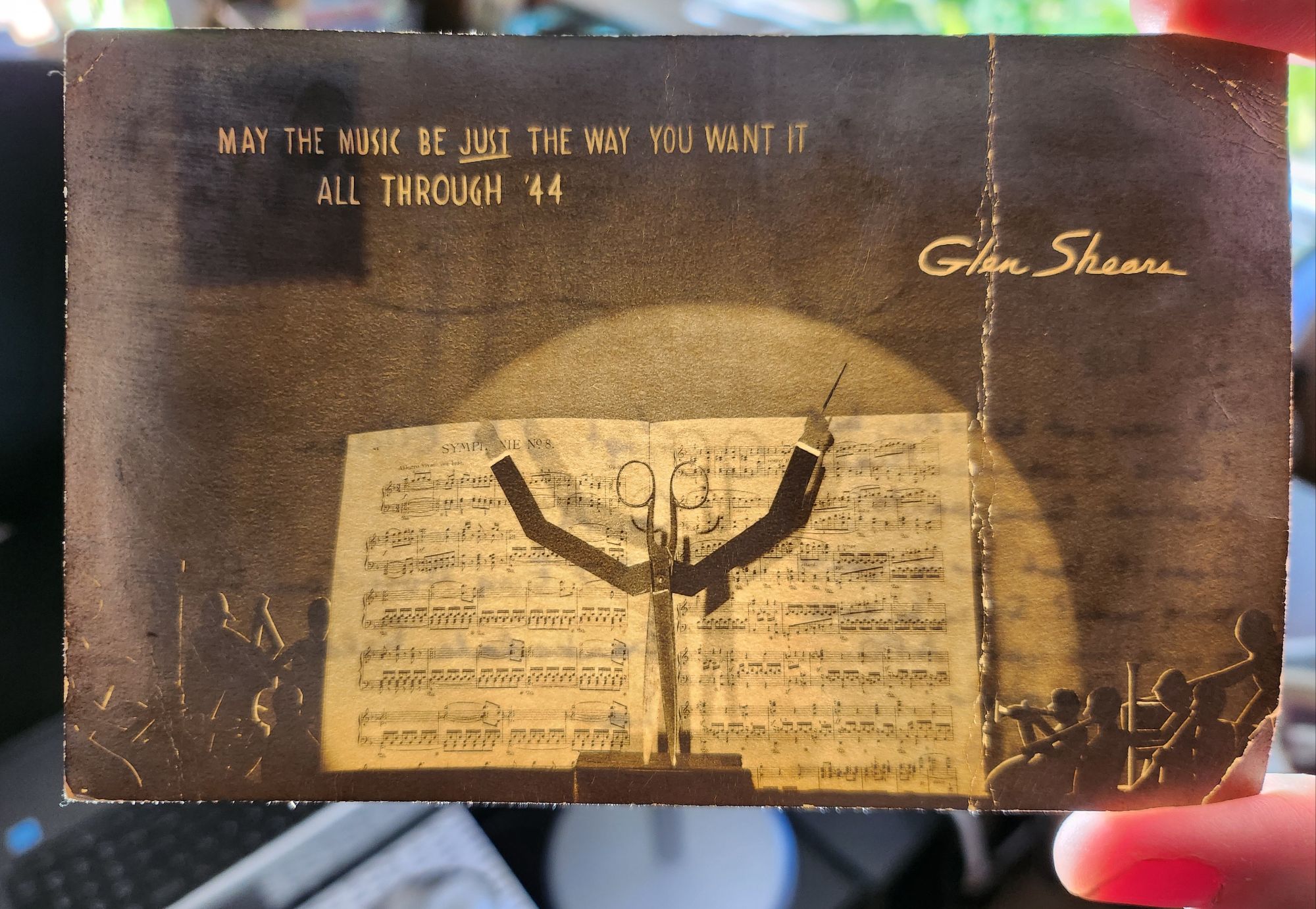

The technical sophistication of this artifact presents an intriguing mystery. Its foundation is a silver gelatin photographic print, created using the same process that Eastman Kodak had popularized with their 1903 postcard camera. But the card’s creator went further, adding to the photograph a second iridescent overlay to create the hidden orchestral scene – a remarkable innovation combining two distinct images. During wartime rationing, when the War Production Board strictly controlled access to photographic papers and printing supplies, the mere existence of such an experimental piece raises questions about its origins.


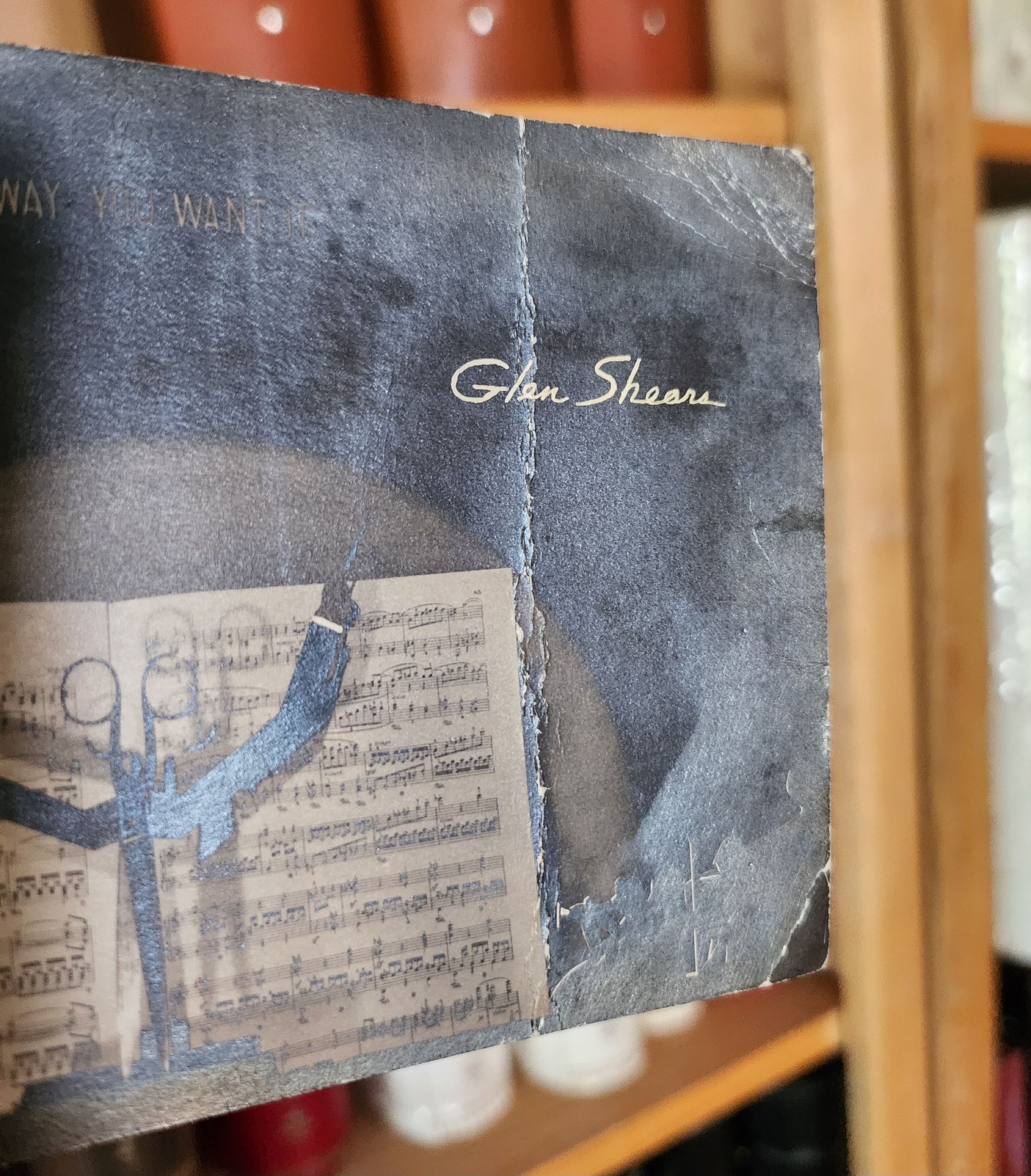
Two theories emerge: The card might be the work of an individual artist-photographer, one of the creative practitioners who had embraced Kodak’s democratization of the postcard medium. The careful composition, masterful lighting, and precise registration of the overlay suggest someone with both technical expertise and artistic vision.
Or, it could be an experimental piece from the American Colortype Company of Chicago (or one of a handful other production houses) known for innovative printing techniques and possessing both the technical capabilities and wartime authorization to access restricted materials.

But as we look closer, deeper historical resonances emerge. The card was postmarked December 15, 1943, and addressed to Staff Sergeant J.M. Ellison of the 937th Engineer Aviation Combat Battalion at Barksdale Field, Louisiana. The sender’s casual inquiry – “Does it look as if you’re going over?” – hints at the imminent deployment of Ellison’s specialized unit.
The 937th was part of the Army Air Forces’ engineering force tasked with rapidly constructing and maintaining combat airfields. These Aviation Engineer Battalions could build a 5,000-foot runway in as little as 15 days, creating the infrastructure that would support the Allied advance across Europe. Following D-Day, units like the 937th pushed forward with combat operations, often working under fire to establish the forward airfields necessary for tactical air support and troop transport.
The card’s musical theme and playful signature unknowingly connected to another Army Air Forces mission. By December 1943, Glenn Miller had transformed his career from civilian bandleader to Captain in the Army Air Forces, modernizing military music through his Training Command Orchestra. In June 1944, Miller brought his band to England, where they performed hundreds of concerts for Allied forces preparing for the invasion of Europe.
As Allied forces advanced across France in late 1944, Miller became determined to bring his music to the troops at forward bases. He began planning an ambitious series of concerts at the very airfields being constructed by the Aviation Engineers. The precise coordination required for these performances – ensuring runways were operational and facilities ready – meant that Miller’s musical mission and the work of units like the 937th were deeply intertwined.
Here the card’s hidden theater of light and shadow takes on new meaning. The sender could not have known that exactly one year after posting this cheerful greeting – on December 15, 1944 – Glenn Miller would board a small Norseman aircraft in England, bound for Paris to arrange performances at forward bases. His plane disappeared over the English Channel in poor weather, creating one of World War II’s enduring mysteries.
The card’s wish for music “all through ’44” became both prophecy and elegy. Somewhere in France, Sgt. Ellison and his fellow engineers might have been preparing the very airfields where Miller hoped to perform. The innovative combination of photography and theatrical lighting effect, created in Chicago a year earlier, had unknowingly captured the intersection of American technical ingenuity, cultural influence, and the human tragedies of war.

Today, this hold-to-light card stands as both artistic innovation and historical artifact. Whether created by an individual photographer or a commercial outfit, it demonstrates the creative adaptation of pre-war techniques to serve wartime needs for connection and morale. In its transformation from simple photo to magical light-show, it embodied the same spirit of innovation that characterized both Glenn Miller’s military music and the rapid-deployment airfield construction of the Aviation Engineers.
More than just a technological curiosity, the card captures a moment when American creativity – musical, photographic, and engineering – was being mobilized for war. The coincidence of the postmark date and Glenn Miller’s final flight reminds us how individual stories weave together to create the larger narrative of history, sometimes in ways that only become apparent when held up to the light.
Discover more from The Posted Past
Subscribe to get the latest posts sent to your email.

 The Posted Past