Road to Renewal

In the fading light of day, a solitary road cuts through a rugged landscape, winding its way towards a majestic mountain looming in the distance. This haunting black and white image, captured on a vintage real photo postcard, speaks volumes about the human spirit’s eternal quest for meaning, adventure, and self-discovery.

Unlike typical postcards that showcase famous landmarks or bustling cityscapes, this image offers a mystery. There are no identifying features, no tourist attractions, no clues as to its specific location. It’s a departure from the usual, instead inviting the viewer to project their own interpretations and desires onto the scene. This anonymity makes the unsent postcard all the more powerful, transforming it from a specific place into a universal symbol of journey and possibility.

The mountain silhouette ahead, is its conical shape a barrier or a beacon? The viewer decides. The road leading to this natural monument becomes a metaphor for life’s journey – full of twists and turns, all leading towards some distant, often unclear destination.

In a word, it’s wanderlust, that inexplicable urge to explore the unknown. In our modern world, where much of the globe has been mapped and catalogued, this image from the past reminds us that there are always frontiers to be explored – if not in the physical realm, then certainly within ourselves.

Traveling Companions

The open road has long been a symbol of freedom and possibility in literature, music, and popular culture. It represents escape from the mundane, a chance to shed the skin of our daily lives and reinvent ourselves. On the road, we are no longer defined by our jobs, our relationships, or our past mistakes. We become travelers, observers, seekers – each mile putting distance between who we were and who we might become.

In Robert Frost’s 1916 poem “The Road Not Taken,” the diverging paths in a yellow wood become a powerful metaphor for life choices and the allure of the less traveled route. Moving beyond familiar literary references like Kerouac, Steinbeck, and films like Easy Rider, we can find the open road in many stories across different eras.

Zora Neale Hurston’s 1937 novel Their Eyes Were Watching God uses the road as a symbol of Janie’s journey towards self-discovery and independence, as she travels through Florida in search of her own voice and identity.

Cheryl Strayed’s 2012 memoir Wild chronicles her solo hike along the Pacific Crest Trail, using the physical journey as a means to process grief and reclaim her life after personal tragedy.

Tracy Chapman’s 1988 song “Fast Car” portrays the open road as both an escape from poverty and a path to a better life, highlighting the complex relationship between freedom and responsibility. The recent popular cover proves our point about the enduring metaphor (and Chapman’s empathetic genius).

Chloé Zhao’s 2020 film “Nomadland” explores the lives of modern nomads traversing America’s highways, presenting the open road as both a refuge from economic hardship and a space for forming unconventional communities.

The open road represents more than just physical movement in these examples. It’s a space of possibility, where identities can be shed and remade, where the constraints of society fall away, and where one can confront the self in all its complexity. These works, created by diverse voices across different time periods, show the enduring power of the road as a symbol of freedom, self-discovery, and transformation.

Heading Inward

This photograph also hints at the solitude and introspection that often accompany such journeys. There are no people visible, no signs of civilization beyond the road itself. It’s a reminder that true exploration – whether of the world or of oneself – often requires a willingness to be alone with one’s thoughts, to embrace the silence and see what emerges from within.

In that silence, in the space between heartbeats, we find the opportunity to think differently. Away from the noise and distractions of our usual environments, our minds are free to wander new paths, to make connections we might never have seen before. The mountain and the road challenge us to question our assumptions, to look at problems from new angles, to dream bigger dreams.

There’s a healing quality to such landscapes. The vastness of nature has a way of putting our problems into perspective, of reminding us that we are part of something much larger than ourselves. In geological time, up against that ancient mountain, our individual worries can seem trivial. But this realization can be profoundly liberating, too. It puts us in sync with our time here on earth, and gives us permission to let go of the things that no longer serve us, to forgive ourselves and others, and to keep going.

The road in the image doesn’t reveal its final destination. It curves out of sight, leaving us to wonder what lies beyond. This uncertainty is both thrilling and terrifying – much like life itself. It’s an invitation to embrace the unknown, to find joy in the journey rather than fixating on the destination.

As we contemplate this scene, we might feel our hearts stirring with a mixture of emotions: longing, excitement, perhaps a touch of fear. The world is full of beauty and mystery, waiting to be discovered by those brave enough to venture beyond their comfort zones.

It challenges us to ask ourselves: What mountains do we need to climb? What roads are we yearning to explore? What parts of ourselves have we left unexplored, and what might we find if we dare to look?

Outbound Imagination

In the end, the power of this image lies in its ability to spark our imagination, to awaken the dormant adventurer within each of us. It reminds us that every day is an opportunity to begin anew, to set out on a journey of discovery – whether that journey takes us to distant lands or deeper into our own hearts and minds.

As the sun sets behind the mountain, casting long shadows across the landscape, we are left with room to wonder and wander. The road awaits, ready to carry us towards new horizons, new understandings, and perhaps, towards unexpected versions of ourselves.
Precipice of Peace: Postcards from 1920 Antwerp Olympics

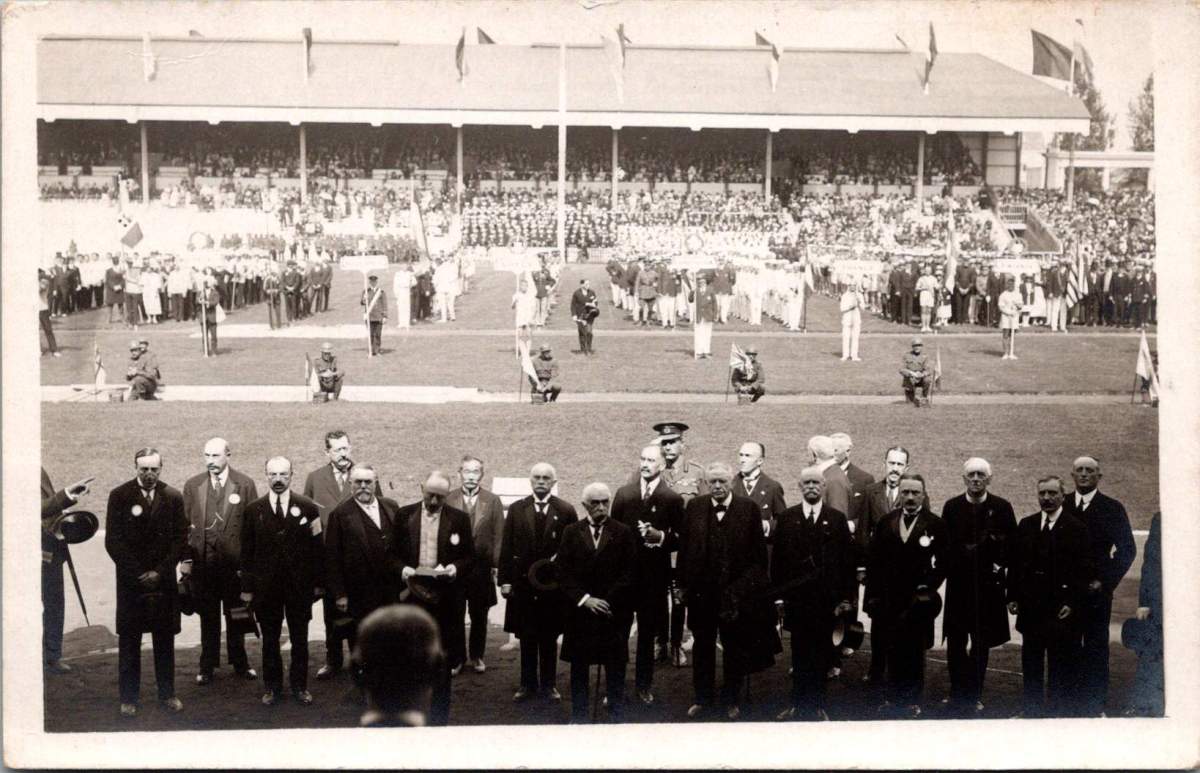
Sometimes a single image can capture the essence of an era. Such is the case with an extraordinary postcard, one of 18 rare images from the 1920 Antwerp Olympics. 

At first glance, it might seem like just another black-and-white snapshot of a bygone event. But look closer, and you’ll find yourself face to face with influential figures of the early 20th century. General John J. Pershing, commander of the American Expeditionary Forces during World War I, is captured in a crisp military salute. Baron Pierre de Coubertin, the father of the modern Olympic movement, instantly recognizable by his distinctive mustache.

This single frame tells a story far greater than the sum of its parts. Shot by an unknown photographer and made into a real photo postcard by Thomas Illingworth & Co., it shows a world emerging from the shadows of war and pandemic. 

A week earlier, US women won the vote and swimmer Ethelda Bleibtrey was about to bring home gold. The greats of the era – Duke Kahanamoku, Suzanne Lenglen, Paavo Nurmi, Frank Foss, and 72-year old Oscar Swahn – embodied the world’s tenuous progress through their excellence and effort in sport.

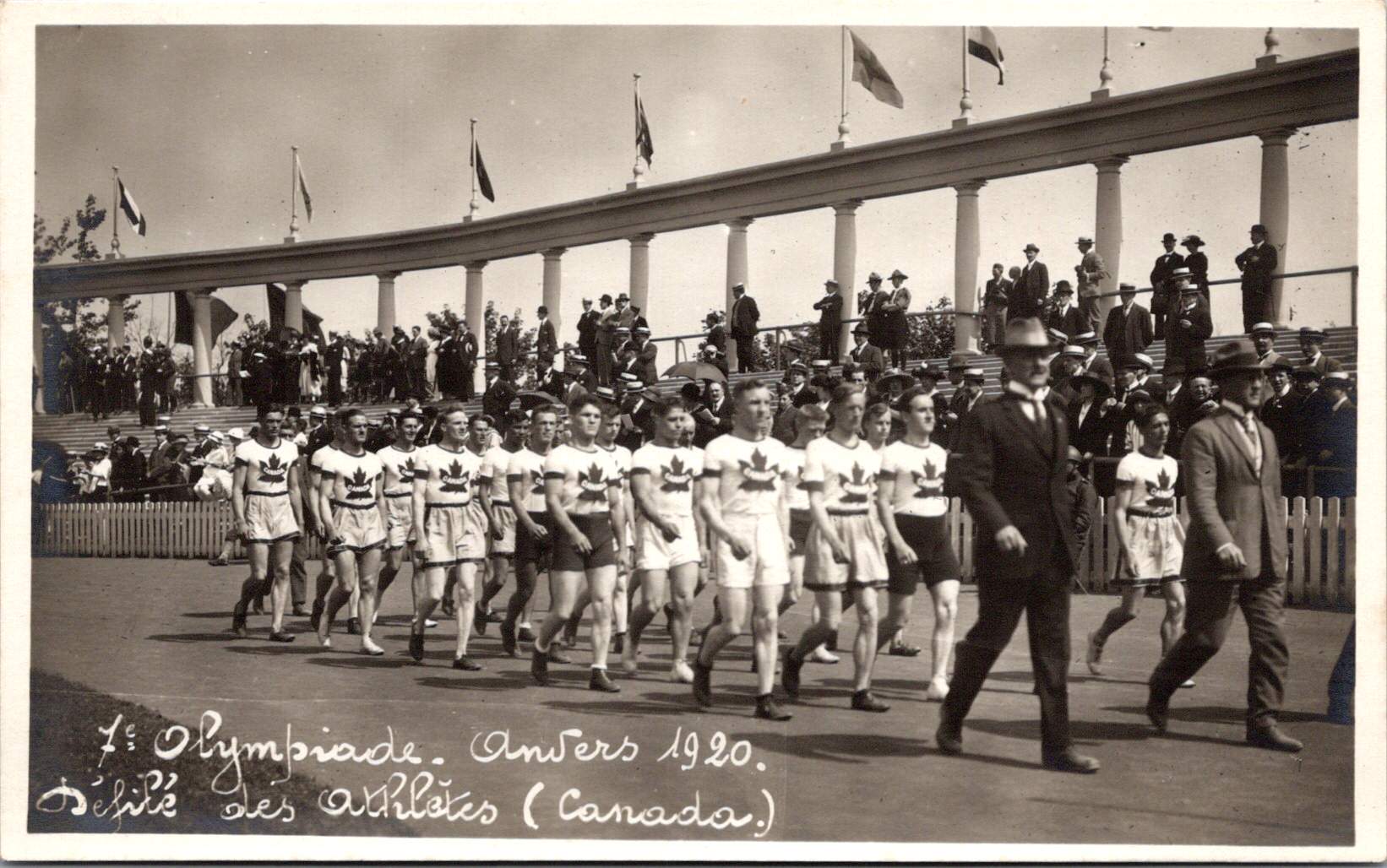
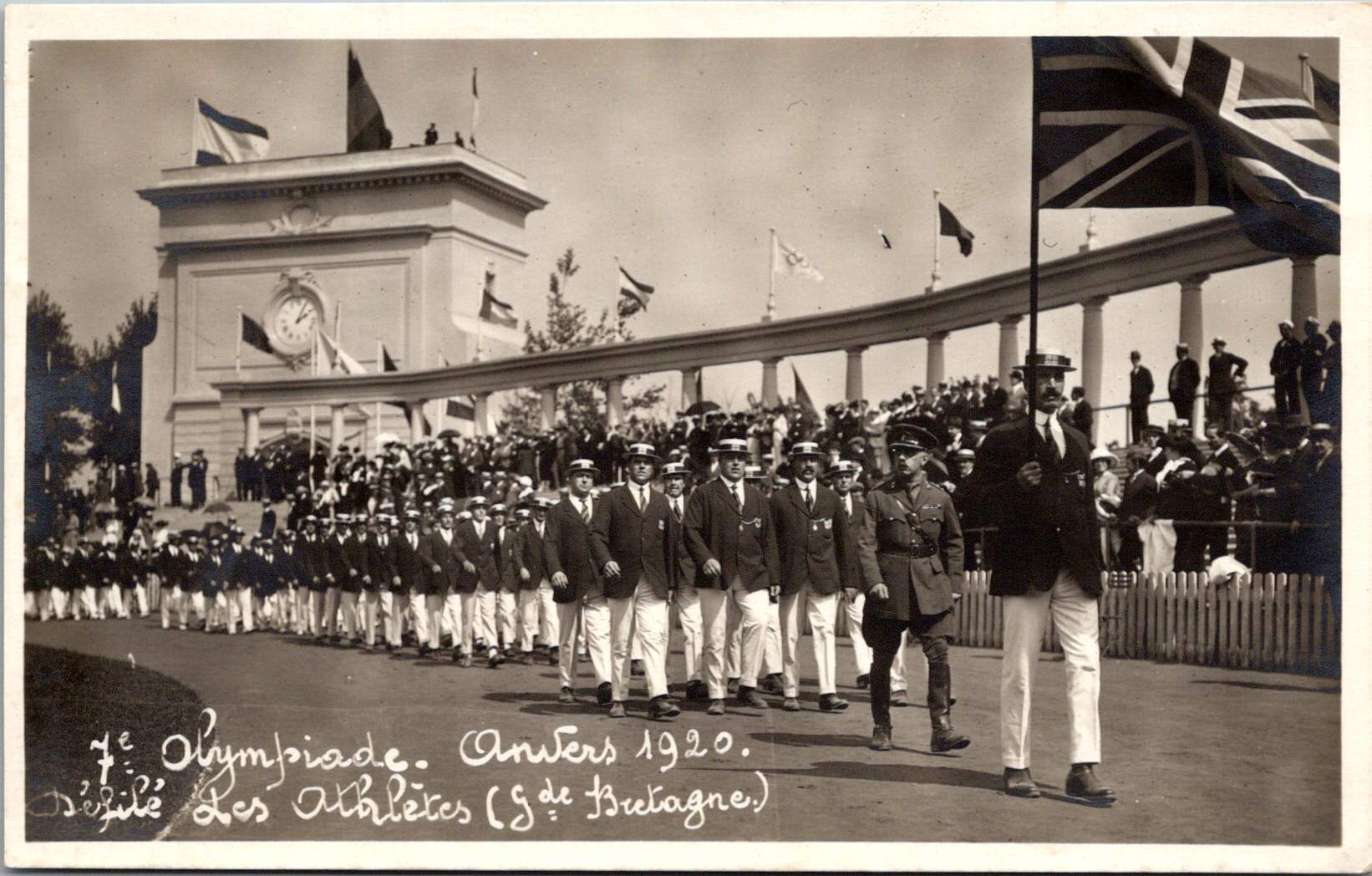
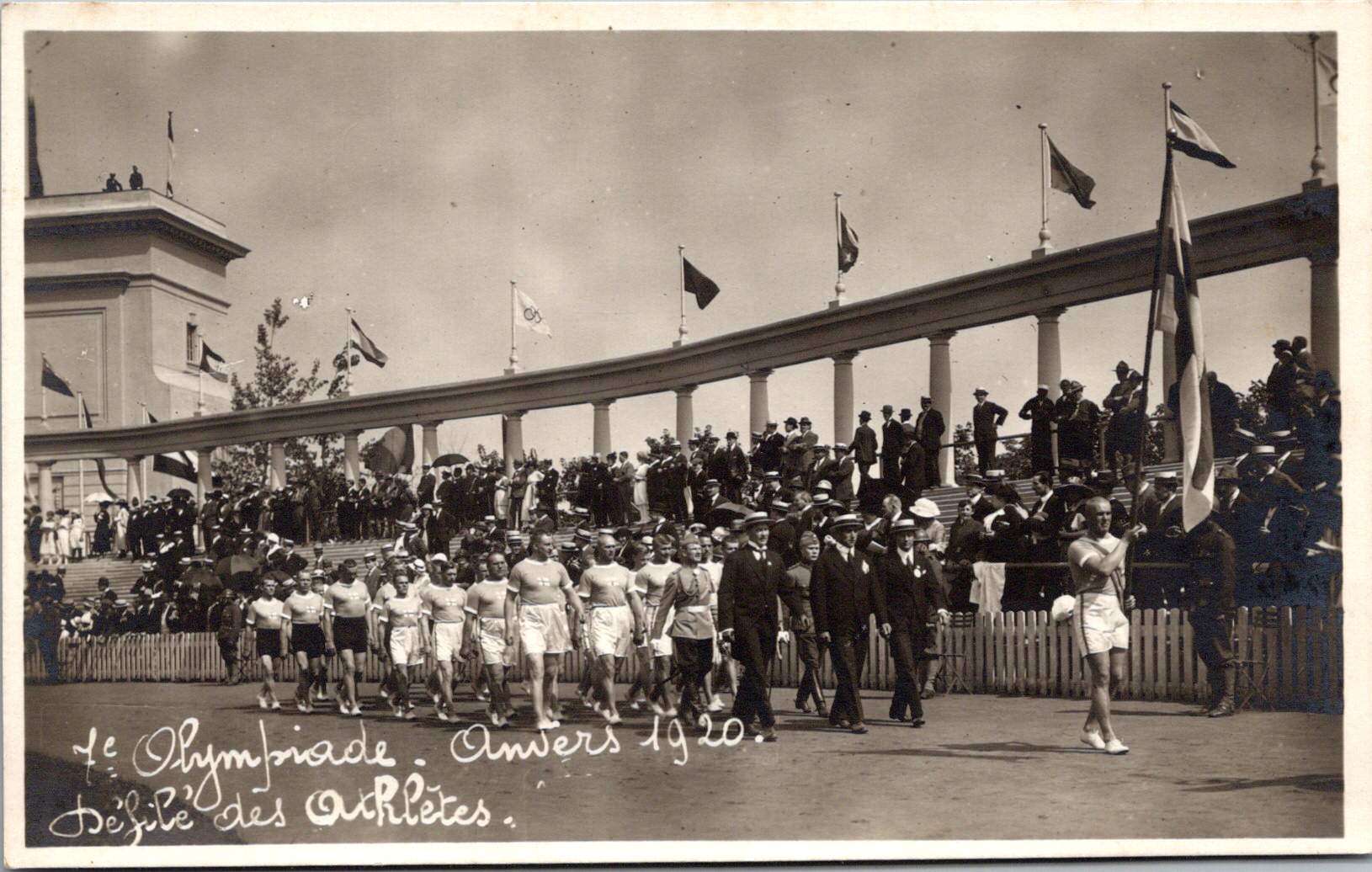
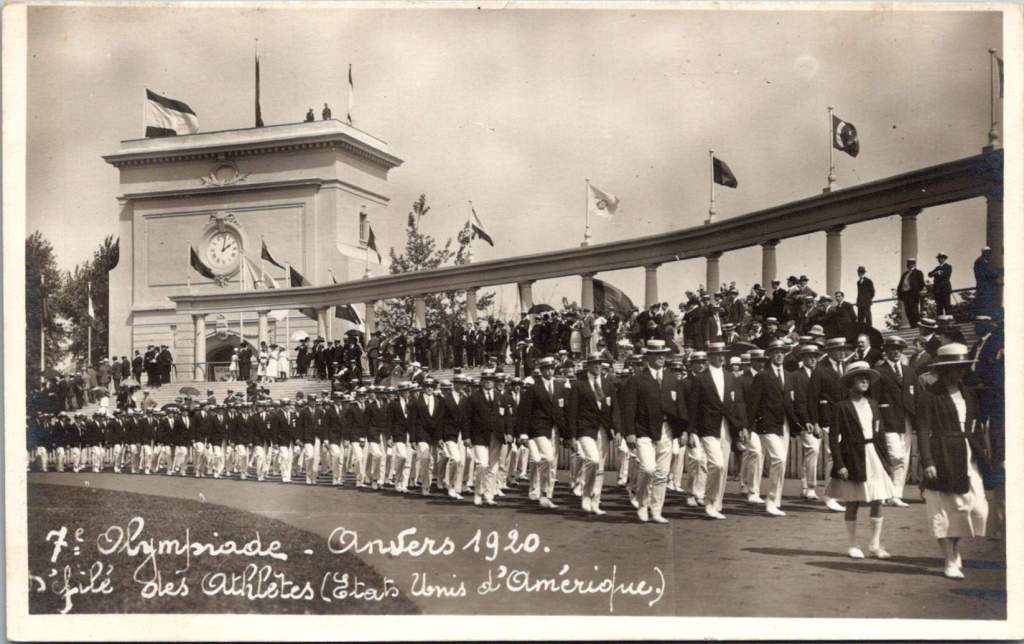
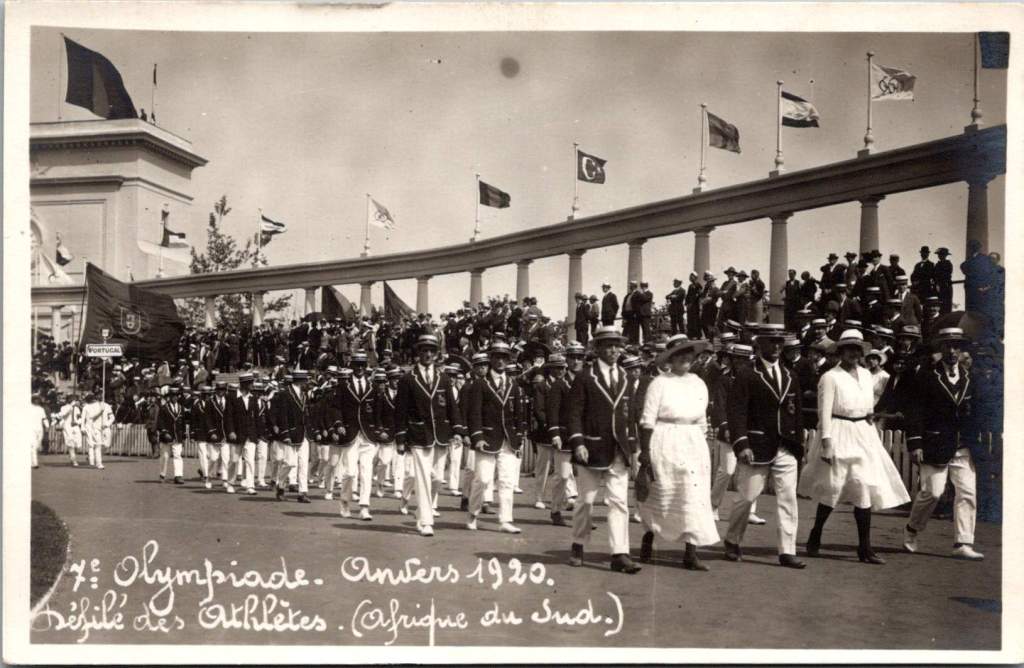
The accompanying 17 photos show the Parade of Athletes, including Australia, Belgium, Canada, Denmark, Egypt, France, Greece, Italy, Japan, Norway, South Africa, Spain, Sweden, Switzerland, and USA. Each delegation presented themselves to the Belgian King, sometimes with a wave or salute.

Window into 1920

Before we dive into the significance of the individuals captured in this image, let’s consider the medium itself. In 1920, the postcard was more than just a souvenir; it was a vital means of communication and a bearer of visual stories in a pre-digital age.

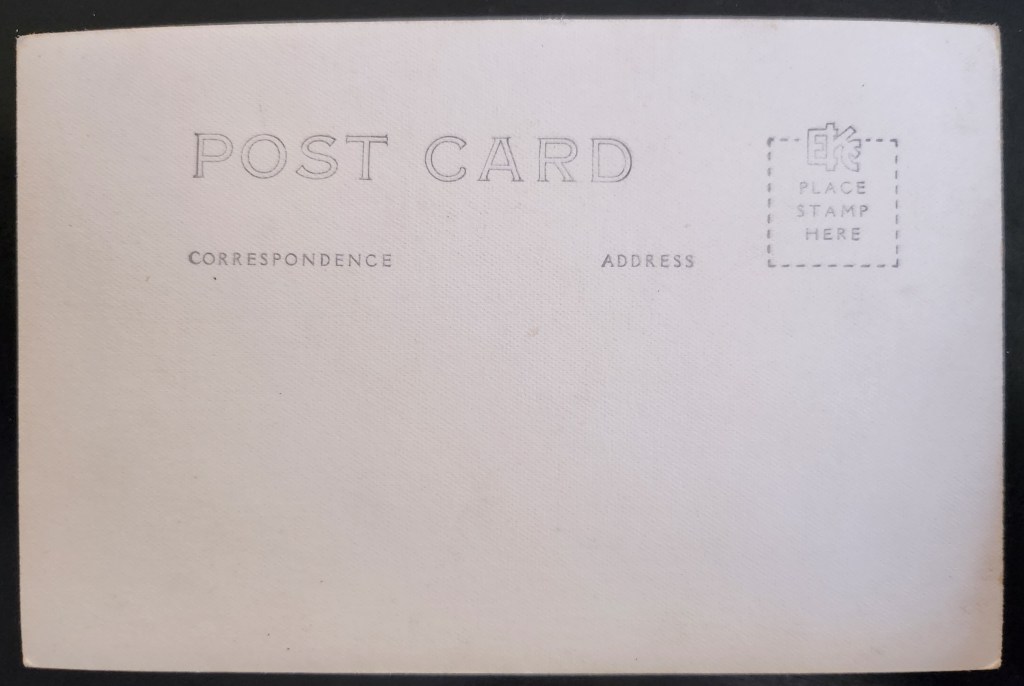
The postcards we’re examining used light-sensitive paper, a recently available technology in the marketplace. In this case, the Horse Shoe Brand from Thomas Illingworth & Co. – tells us exactly who produced the photographic prints directly from negatives. Each card, despite being a reproduction, was essentially a unique photograph, carrying subtle variations in exposure and tone that mass-printed cards could never match.

The quality of these postcards was remarkable for their time. The ability to clearly discern General Pershing’s salute and the details of de Coubertin’s mustache over a century later is a testament to the craftsmanship involved in their production. It’s also a stroke of luck for historians, providing us with invaluable visual evidence of this pivotal moment in Olympic history.

A General’s Salute: More Than a Gesture

The presence of General John J. Pershing at the 1920 Antwerp Olympics, captured mid-salute, is laden with symbolism. Just two years earlier, Pershing had been commanding millions of troops in the bloody fields of Europe. Now, here he was, saluting not to the drums of war, but to the peaceful competition of nations. The crowd was thrilled when Belgian soldiers released doves of peace to open the ceremonies.

Pershing’s salute was a powerful endorsement of the Olympic movement’s ideals, and a gesture of solidarity to the King of Belgium, who he is facing in the stands. It’s a military man’s acknowledgement that the battlefield is not the only place where nations can meet. The attendance of the two military commanders lent gravitas to the event, underlining the Games’ importance in post-war international relations.

Moreover, Pershing’s attendance highlighted the changing role of the United States on the world stage. The U.S. had emerged from World War I as a major global power, and Pershing’s presence at the Olympics signified America’s commitment to engaging with the international community not just through politics and economics, but through culture and sport as well.

Man Behind the Mustache: Pierre de Coubertin

Baron Pierre de Coubertin is easily identified in the front row by his long and gray mustache. The visionary behind the revival of the Olympic Games must have felt pride and vindication at this moment. For de Coubertin, whose Olympic ideal centered on promoting international understanding and peace through sport, the successful staging of the Antwerp Games was nothing short of a triumph.

The 1920 Antwerp Olympics were the first Games held after the cancellation of the 1916 Olympics due to World War I. The year prior, the Inter-Allied Games were hosted in France, mostly to keep WWI troops occupied in the sudden transition out of war. The fact that de Coubertin stands alongside Pershing, a military leader, in this peaceful setting, perfectly encapsulates the Olympic dream of turning swords into javelins, conflict into friendly competition.

De Coubertin’s presence also connects the ancient Olympic tradition with the modern era. Under his direction, the iconic Olympic rings and flag were introduced in 1920, along with other modernizations in sport, gear, and rules of the games. There were limitations, too, especially related to the post-war economy. Top athletes went unchallenged in some categories when other countries could not afford to compete. 

The choice of Antwerp as the host city was deeply significant. Belgium had suffered tremendously during World War I, with much of the country occupied and its people enduring great hardships. Hosting the Olympics was a statement of Belgium’s resilience and the international community’s support for its recovery. The stadium was more than just a sporting venue; it was a symbol of reconstruction and hope. Repurposed from the city’s hometown venue, it was transformed on short notice into the Olympisch Stadion.

The selection of Antwerp as host was not just a gesture of respect for the Olympic movement, but also an acknowledgment of Belgium’s sacrifices and its determination to rebuild. In the end, though, the city lost money on the Games due to low attendance.

Photo Paper to Digital Pixels: The Evolution of Olympic Memories

As we examine this postcard set today, we’re struck by how much has changed in the way we capture and share moments of global significance. The photographer who snapped this image must have thought carefully about each shot, knowing that film and processing were expensive and opportunities fleeting.

Today, a similar scene would be captured by thousands of smartphone cameras, instantly shared across the globe. The modern Olympic Games are documented in minute detail, with high-definition video capturing every bead of sweat and every emotional reaction.

Yet, there’s something special about this centenarian postcard. Its physical nature, the silver halide crystals that hold the image fast, give it a permanence that our digital memories often lack. It’s a tangible connection to a pivotal moment in history, one that we can hold and examine closely. It’s also remarkably detailed, given the age and technology at hand.

In our era of information overload, where countless images flood our screens daily, the rarity of this postcard becomes even more significant. While we don’t know exactly how many of these postcards were produced – estimates range from several hundred to a few thousand – we know that most have been lost to time.

Each surviving postcard is now a valuable historical artifact. They appear occasionally at auctions, eagerly sought after by collectors who understand their significance. But beyond their monetary value, these postcards are treasure troves of historical information.

The T.I.C. logo and the small ‘x’ between POST and CARD on the back, for instance, tell us not just who made the paper, but in what year. This level of detail allows historians to verify the authenticity of Olympic memorabilia and build a more detailed understanding of how the games were documented.

Finding Our Photographer

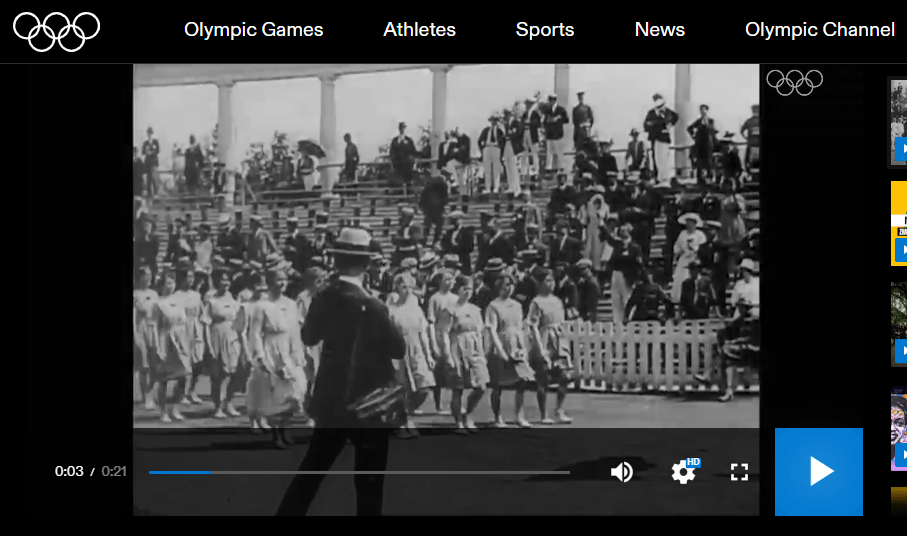
Who was the photographer? The mystery unraveled makes these rare images all the more interesting. Our research landed at the website for the official Olympic history, and a brief snippet of film from the 1920 opening ceremonies. In it we see a gaggle of photographers covering the proceedings. As the camera focuses, a sole figure breaks from the crowd and raises his camera for the perfect shot. The Denmark delegation is rounding the oval path and heading toward the risers. It’s the exact image we see in the postcard collection. Thrilling to have the photographic evidence, and travel through time to witness the moment!

Echoes Across Time

Seeing these images today, we can’t help but draw parallels between their time and ours. The world of 1920 was recovering from a pandemic and rebuilding after a major global conflict. The push for civil liberties was gaining strength in the U.S. and around the world. Today, we too are emerging from a global health crisis, facing international tensions, grappling with rapid technological change, and defending democracy.

The image of Pershing and de Coubertin, saluting the host country in an Olympic stadium, reminds us of the power of sport to bring people together. It shows us a world recovering after unimaginable hardship, finding unity in athletic achievement.

The Olympic Games continue to serve as a symbol of international cooperation and human achievement. As we look to the Olympics today, we might wonder: what form will our memories take? Will our digital images have the staying power of these centenarian postcards?

In an age where our memories are increasingly digital and ephemeral, these physical postcards serve as a poignant reminder of the value of tangible history. They urge us to consider how we document our own pivotal moments, and what legacy we will leave for future generations to discover. As we look to the future, may we carry forward the spirit of resilience, unity, and hope that these extraordinary images so powerfully illustrate.

Buffalos in Garden City, Kansas

These vintage real photo postcards, likely from the 1940s, offer a fascinating glimpse into an unexpected sight: a herd of buffalo grazing near Garden City, Kansas.

Roaming buffalos near Garden City were an early roadside attraction.

These vintage real photo postcards, likely from the 1940s, offer a fascinating glimpse into an unexpected sight: a herd of buffalo grazing near Garden City, Kansas. The images show several large, dark-coated bison scattered across a grassy field, their distinctive humped silhouettes unmistakable against the horizon. Look closely to see a car and a homestead in the distance.

At the time this photo was taken, such a scene would have been unusual. American bison, once numbering in the tens of millions across North America, had been hunted to near-extinction by the late 19th century. By the 1940s, conservation efforts were underway, but bison remained a rare sight, especially in settled areas of Kansas.

Garden City, located in the southwestern part of the state, was primarily agricultural. The presence of a bison herd would have been noteworthy, perhaps part of a concerted effort to showcase or protect these iconic animals.

The real photo postcard format was a popular form of communication in the 1940s era. Was this image meant to be a souvenir or attraction? For many Americans at the time, seeing buffalo outside of a zoo would have been a novel experience, evoking the romanticized notion of the Old West and the once-vast herds that roamed the Great Plains.

Or was it meant to document the changing American landscape? Perhaps this image speaks to early conservation efforts. Advocates, including Theodore Roosevelt, established the American Bison Society in 1905 to protect and restore bison populations. Wichita Mountains Wildlife Refuge, located in Oklahoma and established in 1908, was one of the first reserves to protect bison. In 1913, Wind Cave National Park received a small herd of bison, helping to establish another protected population.

By the time this image was made, conservation efforts had expanded. More national parks and refuges began maintaining bison herds. In 1935, the first intertribal bison cooperative formed, and Native American tribes started collaborating again on bison restoration efforts.

If only we knew more about the photographer, Wren. This enigmatic character could unlock the mystery of this image. What assignment sent them to the Kansas plains? We can only hope for future archival evidence to offer another clue.

Amid growing public interest over decades, the 2016 National Bison Legacy Act officially designated the American Bison as the national mammal of the United States. Since then, bison populations have rebounded with continued efforts to manage and expand herds on public, private, and tribal lands. The gradual but persistent efforts to bring bison back from sure extinction transformed them from a nearly lost species to a symbol of conservation success.

An enduring fascination with the American bison speaks to its lasting power as a part of our shared natural heritage. These images provide an interesting contrast between the wild, untamed nature of the buffalo and the settled agricultural landscape of 1940s Kansas.